To keep a conversation going, ask a follow-up question about something the other person just said, then share a little of your own so it moves back and forth. In three studies of live conversations, people who asked more questions, especially follow-up questions, were better liked by their partners, and responsiveness, a word researchers use for listening, understanding, validation and care, explained the effect [1].
If you want to know how to keep a conversation going, the best-supported answer is also the simplest. Ask a follow-up question, which is a question built on what the other person just said, and then offer something of your own so the conversation moves both ways. In three studies of live conversations, people who asked more questions, especially follow-up questions, were better liked by their partners. When people were told to ask more questions, their partners saw them as more responsive, a word researchers use for listening, understanding, validation and care [1].
This article stays on that one skill, the next move in the middle of a chat, because it is where most conversations quietly die. Openers and small talk, deep questions and listening each have their own research, and we cover those in separate articles.
What a follow-up question is
A follow-up question picks up a detail from the last thing the other person said and asks for more of it. If a friend says she spent the weekend at her cousin's wedding, "How was it?" is a fine question, but "Wait, you gave a toast? What did you say?" is a follow-up. The follow-up proves you were paying attention, because it could not have been asked without hearing the answer. The original authors describe follow-ups as questions that indicate responsiveness to a partner [2].
That matters because a follow-up question does two jobs at once. It gives the other person something easy to talk about, which keeps the conversation alive, and it tells them you care about the answer. A question that ignores what they just said does the first job and skips the second.
What the research found about asking questions
The main evidence comes from three studies. Two involved strangers getting to know each other in online chats, and one looked at face-to-face speed-dating conversations. Across all three, people who asked more questions, particularly follow-up questions, were better liked by their conversation partners [1].
The researchers also tested cause in the chat studies. When people were told to ask more questions, they were perceived as higher in responsiveness. They measured responsiveness two ways, with a survey scale and with a count of follow-up questions, and in both cases responsiveness explained why question-asking led to liking [1]. In plain words, people like you more when they feel heard, and follow-up questions are one visible way to show it.
The speed-dating data add a behavioral check. The team trained a program to detect follow-up questions in the transcripts and found that speed daters who asked more follow-ups were more likely to get a partner's agreement to a second date [1]. That is a real-world signal of liking, though it comes from one kind of setting, short romantic meetings, and one kind of sample.
We under-use the move, and a critique worth knowing
One of the most useful findings is a quiet one. The same paper reports that people do not anticipate that asking questions increases liking [1]. If you suspect you talk about yourself more than you mean to when you are nervous, this may be one reason. You may not realize that the question you did not ask would have helped.
In the interest of honesty, you should also know that part of the paper has been disputed. A published critique took issue with the analysis of the speed-dating study, and the original authors replied that the critique tested the wrong variables, made analytic choices that do not suit their dataset and misrepresented their findings. They restated that asking more questions, especially follow-ups, increases liking [2]. We did not find an independent replication in the sources we opened, so read the speed-dating result with some caution. As the reply describes it, the critique concerned the speed-dating study, so the two chat studies do not depend on it, and the broader idea that responsive partners are better liked fits the other findings below.
Curious how your friends would answer?
Free. Answer 10 quick questions about you, then send your link. Friends play in their browser, no app needed.
Start freeQuestions work better when the other person asks back
A string of questions can start to feel like an interview. A different study of initial interactions points to the fix. Its title states the finding: reciprocal self-disclosure, where both people take turns sharing about themselves, promotes liking in initial interactions [3]. We could not read the paper's full method, so treat it as a clue about balance and not a script.
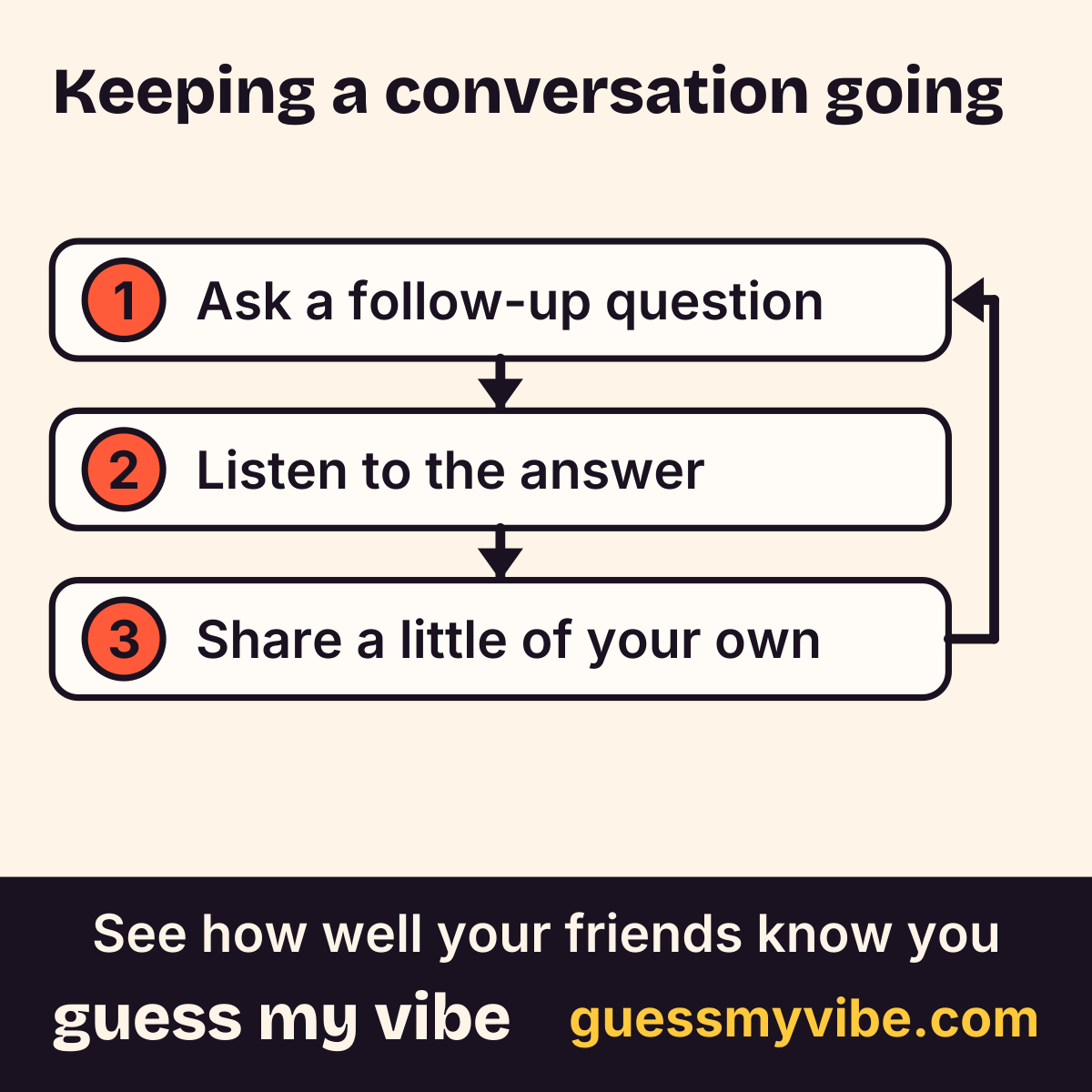
The practical version is easy to remember. Ask a follow-up, listen to the answer, then give a short answer of your own to the same question. "What did you say in the toast?" gets a story. Your "I'd have frozen, I always do" gives them something to react to, and now both of you are in it.
Cite this figure
Figure: "Keeping a conversation going." Guess My Vibe (guessmyvibe.com). https://guessmyvibe.com/learn/how-to-keep-a-conversation-going#figure-back-and-forth
The feeling of clicking is partly about timing
Another line of work asked two friends, or two strangers, to talk and then rate how connected they felt. For both groups, faster response times went with feeling more connected, and moments in a conversation that felt connected had faster response times than less connected moments. The effect came mainly from how quickly your partner responded to you, not from how quickly you responded to them [4].
The gaps involved were under about a quarter of a second, far too small to control on purpose, and the authors describe them as an honest signal of connection [4]. So this is not advice to answer fast or to fear silence. The useful takeaway is that some of what we call chemistry happens below conscious control, and a follow-up question helps in the way you can control: by showing you are tracking what was said.
What to do when the conversation stalls
The studies above do not test specific rescue lines, so the ideas below are practical reasoning built on their findings. Try the ones that fit you.
- Go back one step. Pick a detail from earlier that you did not ask about, the thing the other person mentioned and moved past. A skipped detail is an easy way back in.
- Ask for the story, not the fact. "What happened next?" and "How did you end up doing that?" invite a few sentences, while a yes-or-no question invites one word.
- Match what you ask with what you share. After two questions, offer something of your own so the exchange does not feel one-sided, in the spirit of the turn-taking study [3].
- Ask about the feeling when the facts run dry. "Did that annoy you or did you love it?" is a follow-up that shows you are tuned in to more than the plot.
- Let a pause be a pause. The timing effect above involves gaps far too small to control on purpose, so there is little to gain from fretting over a short silence [4].
After it ends, it probably went better than you think
Many people leave a conversation convinced they talked too much, asked too little or bored the other person. There is a research reason to doubt that verdict. In studies of strangers getting acquainted, first-year college students living in the same dorm and adults at a workshop, people systematically underestimated how much their partner liked them and enjoyed their company, regardless of how long the conversation lasted, and the gap was still measurable months later among the dorm residents [5]. Replaying the one awkward moment is the usual habit, and it is a poor guide.
That makes follow-up questions a double win. They help the other person feel heard, and the habit of asking gives you something concrete to do with your nerves besides rehearsing what to say next. If you want to see how well you read the people around you, Guess My Vibe has you and a friend each guess how the other would answer. The reveal is a fun way to find out which of your questions land.
Key takeaways
- People who asked more questions, particularly follow-up questions, were better liked by their conversation partners across three studies of live conversations [1].
- When people were told to ask more questions, their partners rated them as more responsive, meaning more attentive, understanding and caring, and responsiveness explained the extra liking [1].
- People did not anticipate that asking questions would make them better liked, so it may be easy to under-use the move [1].
- A published critique disputed the speed-dating analysis; the original authors replied that the critique was invalid and stand by the finding [2].
- A study of initial interactions reports that reciprocal self-disclosure, where both people take turns sharing, promotes liking [3].
- This isn't therapy, a diagnosis, or a substitute for professional care.
Questions people ask
How do you keep a conversation going when you run out of things to say?
Ask a follow-up question about something the other person already said, then share a small piece of your own. In three studies of live conversations, people who asked more questions, especially follow-ups, were better liked [1], and a study of initial interactions reports that reciprocal self-disclosure, where both people take turns, promotes liking [3].
What is a follow-up question?
It is a question that builds on what the other person just told you, such as asking what happened next or how they felt. Researchers describe follow-up questions as ones that indicate responsiveness to a partner [2].
Do people really like you more if you ask questions?
In three studies of live conversations, they did. People who asked more questions, particularly follow-ups, were better liked by their partners, and responsiveness explained the effect [1]. A published critique disputed the speed-dating analysis, and the original authors replied that it was invalid and stand by their findings [2].
Why do conversations feel awkward even when they go fine?
People tend to underestimate how much their partner liked them. In studies of strangers, dorm residents and workshop attendees, the underestimate showed up regardless of conversation length [5]. The awkward moment you remember is probably louder to you than to them.
Does reply speed matter in a conversation?
In lab conversations among friends and strangers, faster partner responses went with feeling more connected, but the gaps involved were under about a quarter of a second, below conscious control [4]. It is not a reason to rush your answers.
See how well your friends know you.
Free. Answer 10 quick questions about you, then send your link. Friends play in their browser, no app needed.
Start freeReferences
- [1] Huang, K., Yeomans, M., Brooks, A. W., Minson, J., & Gino, F. (2017). It doesn't hurt to ask: Question-asking increases liking. Journal of Personality and Social Psychology, 113(3), 430–452. PubMed: 28447835 (opens in a new tab)
- [2] Yeomans, M., Brooks, A. W., Huang, K., Minson, J., & Gino, F. (2019). It helps to ask: The cumulative benefits of asking follow-up questions. Journal of Personality and Social Psychology, 117(6), 1139-1144. PubMed: 31714109 (opens in a new tab)
- [3] Sprecher, S., Treger, S., Wondra, J. D., Hilaire, N., & Wallpe, K. (2013). Taking turns: Reciprocal self-disclosure promotes liking in initial interactions. Journal of Experimental Social Psychology, 49(5), 860-866. doi.org/10.1016/j.jesp.2013.03.017 (opens in a new tab)
- [4] Templeton, E. M., Chang, L. J., Reynolds, E. A., Cone LeBeaumont, M. D., & Wheatley, T. (2022). Fast response times signal social connection in conversation. Proceedings of the National Academy of Sciences, 119(4), e2116915119. PubMed: 35042815 (opens in a new tab)
- [5] Boothby, E. J., Cooney, G., Sandstrom, G. M., & Clark, M. S. (2018). The Liking Gap in Conversations: Do People Like Us More Than We Think?. Psychological Science, 29(11), 1742–1756. PubMed: 30183512 (opens in a new tab)
How we find and check these sources: how we write. Spotted an error? Report a correction.
Related
- How to Make Small Talk, According to Research
- Active Listening: What Research Says It Actually Does
- How to Have Deep Conversations, Backed by Research
- Building Rapport: The 3 Ingredients Researchers Found
- The Liking Gap: Why People Like You More Than You Think
- Get to Know You Questions That Make People Like You More
- Friend Who Only Talks About Themselves: What Research Says
Cite this article
- Title
- How to Keep a Conversation Going: Ask Follow-Ups
- Publisher
- Guess My Vibe
- Updated
- URL
- https://guessmyvibe.com/
learn/ how-to-keep-a-conversation-going
Copy this citation
Guess My Vibe. (2026, October 4). How to Keep a Conversation Going: Ask Follow-Ups. Guess My Vibe. https://guessmyvibe.com/
To point at one section, add that section's anchor (the # link on its heading) to the URL.