To have a deep conversation, go a little more personal than feels comfortable and ask real follow-up questions, because research finds people expect deep talk to be more awkward than it turns out to be. In a series of experiments, strangers found deep conversations less awkward and more connecting than they expected. People with more substantive conversations also report higher life satisfaction, but that link is correlational.
How to have deep conversations without it getting weird
If you want to know how to have deep conversations, the first thing the research offers is reassurance: the awkwardness you're bracing for is mostly in your head. Across a series of experiments, people who were assigned to talk with strangers found the conversations less awkward, and more connecting and enjoyable, than they had expected. The effect was strongest for deep topics: participants overestimated how awkward a deep conversation would feel compared with a shallow one [1]. So the practical advice is to go somewhat deeper than your instincts suggest, and to do it by showing real interest in the other person.
Why we stay shallow even when we want more
Most people say they want closer relationships, but plenty of conversations stay on the weather and weekend plans. The researchers behind that series of experiments proposed an explanation: people systematically underestimate how caring and interested others are in their personal revelations, and that mistaken expectation becomes a barrier to going deeper [1]. In the experiments, the gap was driven by exactly that. Participants expected their partners to care less about what they disclosed than the partners actually did.
Two other details are useful. Expectations were more accurate when people talked with close friends, family or partners, people whose care and interest was already known. And better-calibrated expectations were linked to choosing deeper topics, which suggests the fix is partly informational: knowing that others usually care more than you think makes it easier to ask the real question [1]. This is one reason deep conversation tends to feel easiest with people who have shown they're interested.
What counts as a deep conversation?
"Deep" is vague, so it helps to see how researchers pinned it down. In the well-being study described below, coders labeled each recorded snippet. Small talk was defined as an uninvolved conversation of a banal nature, where only trivial information is exchanged. A substantive conversation was defined as an involved conversation in which meaningful information is exchanged [2]. Note that the definition isn't about heavy topics or tears. It is about whether both people are actually involved and whether something meaningful passes between them.
That is a more relaxed bar than the phrase suggests. By that definition, a conversation about a project you're nervous about, a friend's decision, or why you chose your major could count, if both of you are really in it. That is our reading of the definition, not something the study tested. The practical point is that you don't have to jump straight to the biggest question you can think of.
What to actually do: three moves
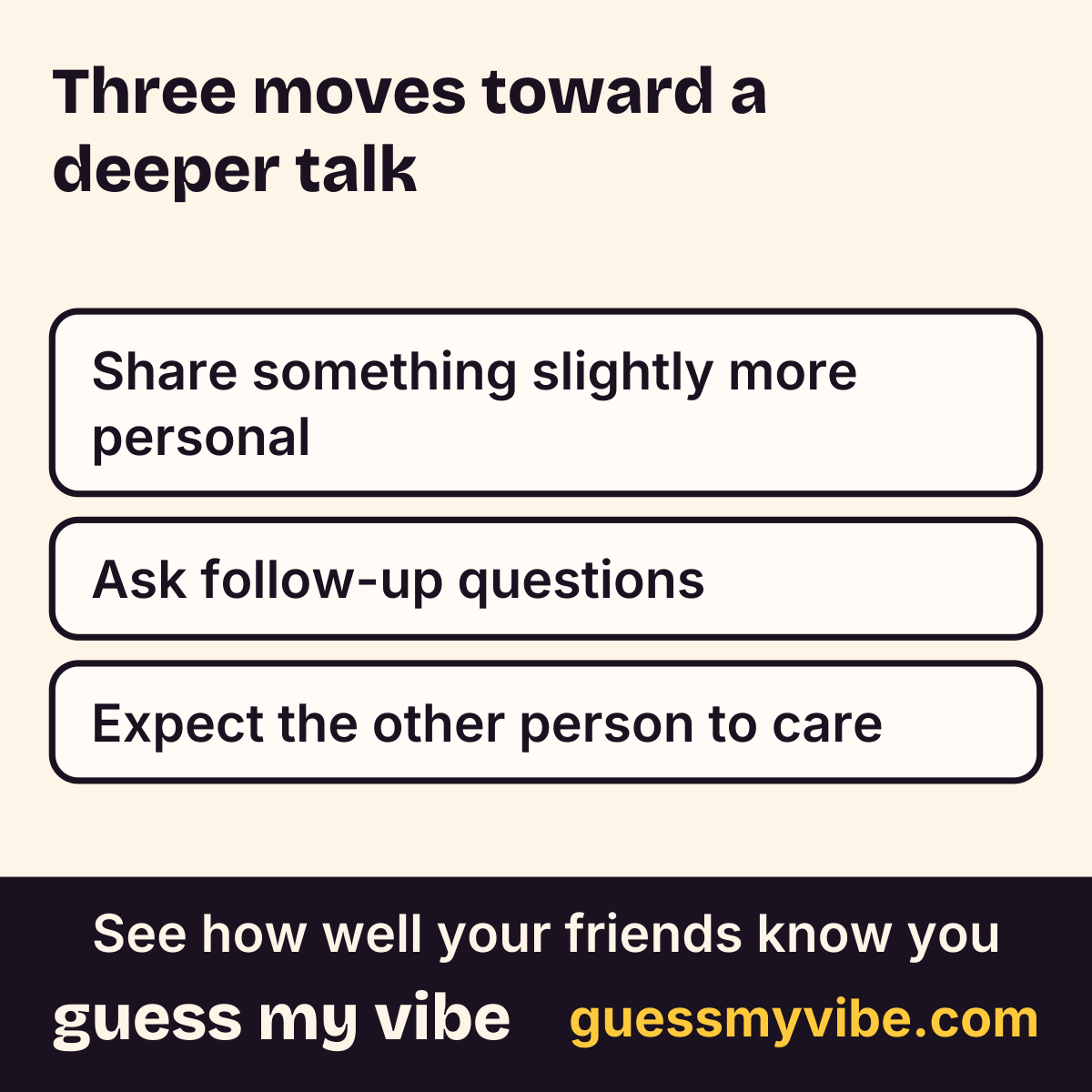
The studies don't give a formula, but they point to three moves that fit what was found.
- Share something slightly more personal than usual. A meta-analysis of the disclosure and liking literature found that people who disclose intimate information tend to be liked more than people who disclose less, and that people like others as a result of having disclosed to them [4].
- Ask follow-up questions instead of switching topics. In three studies of live conversations, people who asked more questions, particularly follow-up questions, were better liked by their partners [5].
- Expect the other person to care. The experiments suggest people systematically underestimate how interested a partner will be, so a small step deeper is less risky than it feels [1].
A note on the first move. The disclosure meta-analysis found these effects were moderated by things like the study setup, the type of disclosure and the gender of the person disclosing [4]. So "go deeper" doesn't mean "overshare." Going a notch more personal than small talk, and letting the other person match you, is the version the evidence supports.
Cite this figure
Figure: "Three moves toward a deeper talk." Guess My Vibe (guessmyvibe.com). https://guessmyvibe.com/learn/how-to-have-deep-conversations#figure-three-moves
Curious how your friends would answer?
Free. Answer 10 quick questions about you, then send your link. Friends play in their browser, no app needed.
Start freeIs deep conversation linked to being happier?
You'll often see the claim that deeper conversations make people happier. The source is a well-known 2010 study that did something unusual: instead of asking people how they talk, it recorded them. Seventy-nine undergraduates wore a small recorder for four days that captured 30 seconds of ambient sound every 12.5 minutes, and coders then labeled each snippet, including whether any conversation was small talk or substantive. Higher well-being went with fewer small-talk conversations and more substantive ones [2].
The size of the link was moderate, a correlation of about .28 for substantive conversations and about -.33 for small talk. Comparing the happiest and unhappiest participants, the happiest had roughly twice as many substantive conversations [2]. The authors themselves called the findings correlational and causally ambiguous: happy people might attract deeper conversations, or deep conversations might make people happier [2]. So the study can't tell you that having deeper talks will raise your happiness.
What replicated and what didn't
Here is the part the popular version leaves out. In 2018 a team that included the original lead author ran a replication, pooling the original sample with three more adult samples, for a total of 486 people. Moderate associations between life satisfaction and alone time, conversation time and substantive conversations held up. But the study found no reliable association between life satisfaction and small talk. The authors say plainly that failing to replicate the small-talk effect is important, given how much lay and scientific interest it had attracted [3].
So the fair summary is this. The link between substantive conversation and well-being looks reasonably solid. The claim that small talk is bad for you does not hold up. That matters, because it means you don't have to treat chatting about nothing as a failure. It is just not where the benefit seems to be. It is also still a correlation, so the "deeper talk makes you happier" version is a hypothesis the original authors raised, not something either study showed [2] [3].
When a deep conversation works best
Nothing in this research says every conversation should be deep. Small talk is often how a conversation warms up, and the pooled study did not find that it hurt well-being [3]. The practical read is to treat small talk as the on-ramp and let the conversation move deeper when the other person seems willing, instead of forcing it. Matching matters: the disclosure research suggests the effect depends on the setting and the kind of disclosure [4], and a conversation where only one person opens up can feel lopsided.
Limits of the evidence
A few cautions apply to everything above. The original recording study followed 79 undergraduates for four days [2], so it says little about, say, a 40-year-old with a young child. The pooled replication was larger and broader, but it still measures an association between conversation and life satisfaction, not a cause [3]. And the stranger experiments, as their abstract describes them, are about expectations and how conversations felt, not about long-term friendship outcomes [1]. None of this is a reason to doubt that deeper talk can feel good. It is a reason not to promise that it will fix a mood or save a friendship.
Find out what your friends would guess
One easy way into a deeper conversation with a friend is to see how well they already know you. In Guess My Vibe, a friend guesses how you'd answer questions about everyday social moments, and you compare their guesses to your real answers. The gaps and the surprises tend to be good conversation starters on their own.
Key takeaways
- Across a series of experiments, conversations between strangers felt less awkward, and created more connection and happiness, than the participants themselves expected [1].
- People overestimated how awkward deep conversations would be, and underestimated how much their partner cared about what they shared [1].
- More substantive conversations went with higher well-being in an observational study of 79 students, and a larger pooled replication confirmed that link; neither shows deep talk causes happiness [2] [3].
- The small-talk finding did not replicate: the pooled study found no reliable link between small talk and life satisfaction [3].
- This isn't therapy, a diagnosis, or a substitute for professional care; it's a plain-English summary of what conversation research does and doesn't show.
Questions people ask
How do you start a deep conversation?
Go slightly more personal than small talk and show interest with follow-up questions. In experiments, strangers found deep conversations less awkward than they expected [1], and people who asked follow-up questions were better liked [5].
Why are deep conversations so hard?
Partly because people expect them to be more awkward than they are and expect their partner to care less than the partner does [1].
Do deep conversations make you happier?
People with more substantive conversations report higher well-being, and a pooled replication of 486 people confirmed that link [3]. But it is correlational, so it doesn't show that deep conversations cause happiness [2].
Is small talk bad for you?
The original study linked less small talk to higher well-being, but a larger pooled replication found no reliable association between small talk and life satisfaction [3].
Can you have deep conversations with someone you just met?
Yes. The experiments were largely about strangers, and the conversations created more connection than the participants expected [1].
See how well your friends know you.
Free. Answer 10 quick questions about you, then send your link. Friends play in their browser, no app needed.
Start freeReferences
- [1] Kardas, M., Kumar, A., & Epley, N. (2022). Overly shallow? Miscalibrated expectations create a barrier to deeper conversation. Journal of Personality and Social Psychology, 122(3), 367–398. PubMed: 34591541 (opens in a new tab)
- [2] Mehl, M. R., Vazire, S., Holleran, S. E., & Clark, C. S. (2010). Eavesdropping on happiness: Well-being is related to having less small talk and more substantive conversations. Psychological Science, 21(4), 539-541. PubMed: 20424097 (opens in a new tab)
- [3] Milek, A., Butler, E. A., Tackman, A. M., Kaplan, D. M., Raison, C. L., Sbarra, D. A., Vazire, S., & Mehl, M. R. (2018). "Eavesdropping on happiness" revisited: A pooled, multisample replication of the association between life satisfaction and observed daily conversation quantity and quality. Psychological Science, 29(9), 1451-1462. PubMed: 29969949 (opens in a new tab)
- [4] Collins, N. L., & Miller, L. C. (1994). Self-disclosure and liking: A meta-analytic review. Psychological Bulletin, 116(3), 457-475. PubMed: 7809308 (opens in a new tab)
- [5] Huang, K., Yeomans, M., Brooks, A. W., Minson, J., & Gino, F. (2017). It doesn't hurt to ask: Question-asking increases liking. Journal of Personality and Social Psychology, 113(3), 430–452. PubMed: 28447835 (opens in a new tab)
How we find and check these sources: how we write. Spotted an error? Report a correction.
Related
- Deep Questions to Ask Friends, Grouped by Trait
- How to Make Small Talk, According to Research
- Get to Know You Questions That Make People Like You More
- Friend Question Games Backed by Real Closeness Research
- Active Listening: What Research Says It Actually Does
- Building Rapport: The 3 Ingredients Researchers Found
Cite this article
- Title
- How to Have Deep Conversations, Backed by Research
- Publisher
- Guess My Vibe
- Updated
- URL
- https://guessmyvibe.com/
learn/ how-to-have-deep-conversations
Copy this citation
Guess My Vibe. (2026, October 4). How to Have Deep Conversations, Backed by Research. Guess My Vibe. https://guessmyvibe.com/
To point at one section, add that section's anchor (the # link on its heading) to the URL.