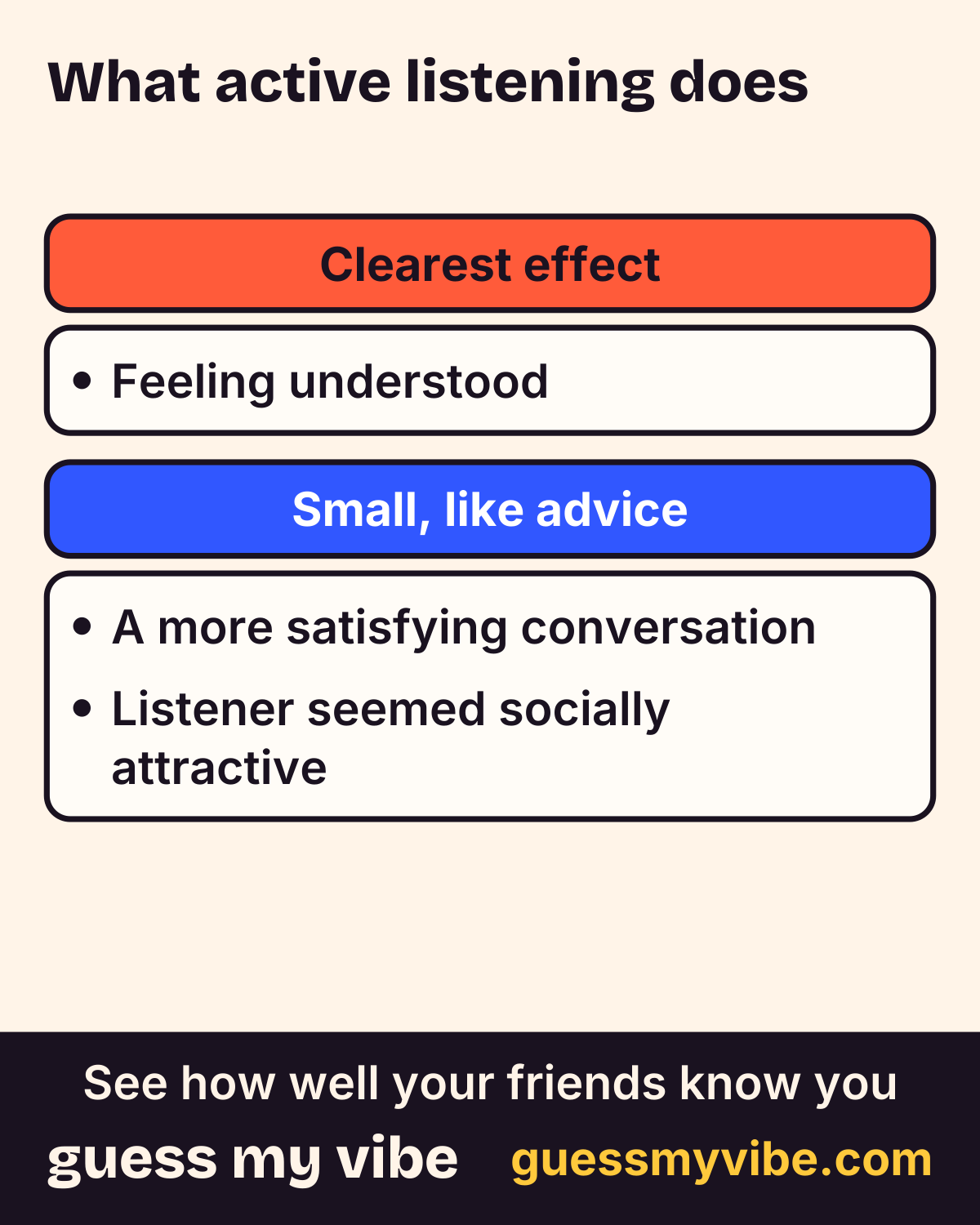
Active listening works best at one specific thing: making the speaker feel understood. In a lab study of 115 people talking with trained listeners, active listening made them feel more understood than advice or a bare acknowledgement did, but the gains in conversation satisfaction and liking were small and no bigger than advice produced. Separate experiments find that high-quality listening (attentive, empathic, nonjudgmental) can help speakers think more clearly about what they believe.
What active listening actually does (and doesn't)
Active listening gets sold as a communication superpower: nod, paraphrase, ask questions, and people open up, like you, and trust you. The research is more specific than that. The clearest thing active listening does is make the person talking feel understood. The other payoffs people attribute to it, a more enjoyable chat, more liking, a better relationship, show up in the studies as small or as no better than the alternatives. That's still worth knowing, because feeling understood is exactly what most people want from a listener. It just helps to know which claim the evidence actually backs.
The lab test: active listening vs advice vs a nod
One of the more direct tests put 115 participants into a getting-acquainted conversation with one of 10 confederates, people who worked with the researchers and had been trained to respond in one of three ways. Some used active listening messages. Some gave advice. Some offered only simple acknowledgements, the conversational equivalent of "mm-hmm" [1].
The headline finding is clean: people who got active listening responses felt more understood than people who got advice or simple acknowledgements [1]. The rest is where the popular version drifts. People who received either active listening or advice were more satisfied with the conversation, and rated the listener as more socially attractive, than people who received only acknowledgements. But the authors describe those effect sizes as small, and active listening did not beat advice on satisfaction or attractiveness [1].
In plain words: showing that you followed what someone said does the specific job of making them feel understood. Giving the person something back at all, whether reflection or advice, beat a flat acknowledgement. But "active listening makes people like you far more than advice would" is not what this study found. A few limits are worth keeping in mind too. The listeners were trained confederates, the talkers were strangers in an early conversation, and one study is one study. It doesn't tell you how this plays out between close friends over years.
Cite this figure
Figure: "What active listening does." Guess My Vibe (guessmyvibe.com). https://guessmyvibe.com/learn/active-listening#figure-listening-clear-vs-small
What high-quality listening does for the speaker
A separate line of research looks less at specific techniques and more at the overall quality of the listening. In this work, high-quality listening means a listener who is empathic, attentive and nonjudgmental. In five experiments, one of them preregistered, the researchers manipulated how a listener behaved in a variety of ways and then looked at what happened to the speaker. Speakers who talked with a high-quality listener felt less socially anxious and dug deeper into what they actually knew about the topic [2].
Two details matter here. First, the speakers' attitudes became clearer, meaning they were more certain about what they thought, but not more correct. Being heard well made people more sure of their own view; it did not make the view better. Second, the speakers' intentions to express their views went up, while their intentions to persuade other people did not [2]. A good listener, in this research, helps you say what you think. It doesn't turn you into a debater.
An earlier set of four lab experiments found a related pattern. Speakers who got high-quality listening had less social anxiety and became more aware of the contradictions in their own views, and they held less extreme attitudes. In one of the four experiments, the effects of listening on awareness of contradictions were stronger for people higher in social anxiety [3]. The authors' reading is that feeling safe from judgment lets people stop defending themselves and look at their own thinking more honestly. That is a theory about why it works, so treat it as the authors' interpretation, not a proven mechanism.
Curious how your friends would answer?
Free. Answer 10 quick questions about you, then send your link. Friends play in their browser, no app needed.
Start freeListening when you disagree
The hardest time to listen is when you disagree. A 2024 set of four experiments tested exactly that. The researchers note that during a disagreement, listeners often spend the time thinking about how to counterargue, which tends to fail to reduce polarization and might even backfire. They compared poor, moderate and high-quality listening, where high quality meant attention, understanding and positive intentions [4].
Speakers who got high-quality listening felt more socially comfortable and connected to the listener and reflected on their own views less defensively. Both perceived and actual polarization dropped, with actual polarization measured as less extreme attitudes [4]. The authors read this as a sign that genuine listening can help bridge divides. The studies manipulated listening in a video vignette and in live interactions, which is a good design for showing cause, but a lab disagreement is not the same as an argument with a friend who is hurt. Treat it as encouraging, not as a promise that listening will end a fight.
Where questions and responsiveness fit in
Listening is partly invisible. The other person can only judge it by what you do, which is why a related set of studies on conversations is useful. Across three studies of live conversations, people who asked more questions, especially follow-up questions, were better liked by their partners. When people were told to ask more questions, they were seen as more responsive, which the researchers describe as capturing listening, understanding, validation and care. Responsiveness explained the effect of asking questions on liking [5].
That gives a practical reading of active listening that doesn't depend on any script. A follow-up question is proof you were paying attention to the specific thing the person just said. It is hard to ask one without listening. The same research found that people don't expect question-asking to increase liking, so people may not ask as many questions as would help [5].
How to use this when someone is talking to you
None of these studies hands you a script, and it would be a mistake to turn them into one. They do point in a consistent direction.
- Aim at the right target. If your goal is for the person to feel understood, responses that show you followed what they said did that better than advice or a bare acknowledgement [1].
- Don't oversell it. The same study found only small differences in satisfaction and liking, and plain advice did about as well on those, so don't expect a technique to do the work of actually caring [1].
- Lean on being attentive, empathic and nonjudgmental. Those three are how the listening experiments defined high-quality listening, and they are what changed how speakers felt and thought [2].
- Ask the next question. A follow-up that builds on what was just said shows you were listening and was linked to being liked more [5].
- Hold back on pushing a view. In the listening studies, the benefit was the speaker getting clearer on their own thinking, not being talked into yours [2].
It also helps to remember that listening is a skill for the moment, not a personality type. Some people find it easier than others, but the studies above manipulated how a listener behaved. They didn't sort people into born listeners and everyone else.
What the research doesn't settle
Most of this evidence comes from lab conversations, often between people who had just met, with trained listeners or manipulated listening. That is great for showing cause and effect and weak for telling you what happens inside a ten-year friendship, where the listening has history. The abstracts also don't tell us how long the effects last, or whether they hold across cultures and different kinds of topics. Treat the findings as a reasonable guide to what helps in a conversation, not a guarantee about any one relationship.
See how well your friends really listen
A friend who has really listened to you can usually guess how you'd answer, even on things you've never said out loud. That is a decent informal test of listening: not whether they nodded, but whether they picked up who you are. Guess My Vibe turns it into a short game. A friend guesses your answers to everyday social questions, and you see how close they got to your own view.
Key takeaways
- Active listening made people feel more understood than advice or simple acknowledgements did, in a study of 115 people talking with trained listeners [1].
- The same study found only small differences in how satisfying the conversation was and how socially attractive the listener seemed, and active listening did not beat plain advice on either [1].
- In five experiments, speakers talking to a high-quality listener felt less socially anxious and ended up with clearer views, not more correct ones [2].
- Listening quality seems to matter for the speaker's own thinking: in four experiments it made people more aware of contradictions in their own views [3].
- This isn't therapy, a diagnosis, or a substitute for professional care; it's a plain-English summary of what conversation research does and doesn't show about listening.
Questions people ask
What is active listening?
It's a way of responding that shows the speaker you followed what they said, rather than just waiting for your turn or jumping in with advice. In one lab study, active listening responses made people feel more understood than advice or simple acknowledgements did [1].
Does active listening actually work?
It works for making people feel understood. The same study found only small gains in how satisfying the conversation felt and how socially attractive the listener seemed, and active listening did not beat advice on those two [1].
How do I become a better listener?
The research points to being attentive, empathic and nonjudgmental, the qualities used to define high-quality listening in experiments where speakers ended up less anxious and clearer about their views [2]. Asking follow-up questions is a concrete way to show you were paying attention [5].
Is giving advice a bad way to listen?
Not necessarily. In the lab study, advice and active listening both led to more conversation satisfaction than a bare acknowledgement, and active listening did not beat advice on that measure. Advice just didn't make people feel as understood [1].
Does listening help in an argument?
In four experiments, high-quality listening during a disagreement made speakers feel more comfortable and reflect less defensively, and reduced how extreme their attitudes were [4]. Those were lab disagreements, so it isn't a guarantee for a real fight.
See how well your friends know you.
Free. Answer 10 quick questions about you, then send your link. Friends play in their browser, no app needed.
Start freeReferences
- [1] Weger, H., Castle Bell, G., Minei, E. M., & Robinson, M. C. (2014). The relative effectiveness of active listening in initial interactions. International Journal of Listening, 28(1), 13-31. doi.org/10.1080/10904018.2013.813234 (opens in a new tab)
- [2] Itzchakov, G., DeMarree, K. G., Kluger, A. N., & Turjeman-Levi, Y. (2018). The listener sets the tone: High-quality listening increases attitude clarity and behavior-intention consequences. Personality and Social Psychology Bulletin, 44(5), 762-778. PubMed: 29347879 (opens in a new tab)
- [3] Itzchakov, G., Kluger, A. N., & Castro, D. R. (2017). I am aware of my inconsistencies but can tolerate them: The effect of high quality listening on speakers' attitude ambivalence. Personality and Social Psychology Bulletin, 43(1), 105-120. PubMed: 27856728 (opens in a new tab)
- [4] Itzchakov, G., Weinstein, N., Leary, M., Saluk, D., & Amar, M. (2024). Listening to understand: The role of high-quality listening on speakers' attitude depolarization during disagreements. Journal of Personality and Social Psychology, 126(2), 213-239. PubMed: 37917499 (opens in a new tab)
- [5] Huang, K., Yeomans, M., Brooks, A. W., Minson, J., & Gino, F. (2017). It doesn't hurt to ask: Question-asking increases liking. Journal of Personality and Social Psychology, 113(3), 430–452. PubMed: 28447835 (opens in a new tab)
How we find and check these sources: how we write. Spotted an error? Report a correction.
Related
- How to Make Small Talk, According to Research
- Communication Styles and Personality: The Real Research
- Get to Know You Questions That Make People Like You More
- How to Get Honest Feedback From Friends
- Building Rapport: The 3 Ingredients Researchers Found
- How to Have Deep Conversations, Backed by Research
- Communication in Relationships: What the Research Shows
- How to Keep a Conversation Going: Ask Follow-Ups
- Trauma Dumping on Friends: What Co-Rumination Research Says
- Friend Who Only Talks About Themselves: What Research Says
- How to Respond to a Friend's Good News (Research-Backed)
Cite this article
- Title
- Active Listening: What Research Says It Actually Does
- Publisher
- Guess My Vibe
- Updated
- URL
- https://guessmyvibe.com/
learn/ active-listening
Copy this citation
Guess My Vibe. (2026, October 4). Active Listening: What Research Says It Actually Does. Guess My Vibe. https://guessmyvibe.com/
To point at one section, add that section's anchor (the # link on its heading) to the URL.