Communication in relationships isn't one skill with one right technique. A review of conflict research found that blunt, direct disagreement helps in some situations and harms in others, and so does warm, validating communication, depending on how serious the problem is and how secure the partners feel [1]. What recurs across the studies below is less about the script and more about whether your partner feels heard.
Communication in relationships: why no single technique wins
Search for advice on communication in relationships and you'll find confident rules: always use "I" statements, never go to bed angry, never criticize. The research is less tidy. A review of conflict communication in intimate relationships argues that answering the question means asking whether communication expresses opposition or cooperation and is direct or indirect, through what mechanisms it affects the relationship, and in what context, such as how serious the problem is [1]. So the honest answer to "what's the best way to communicate?" is that it depends, and the research can tell you what it depends on.
This article covers what that research found, where couples' day-to-day talk fits in, and what the studies can and can't tell you. It isn't advice for any specific relationship.
When direct talk helps, and when warmth helps
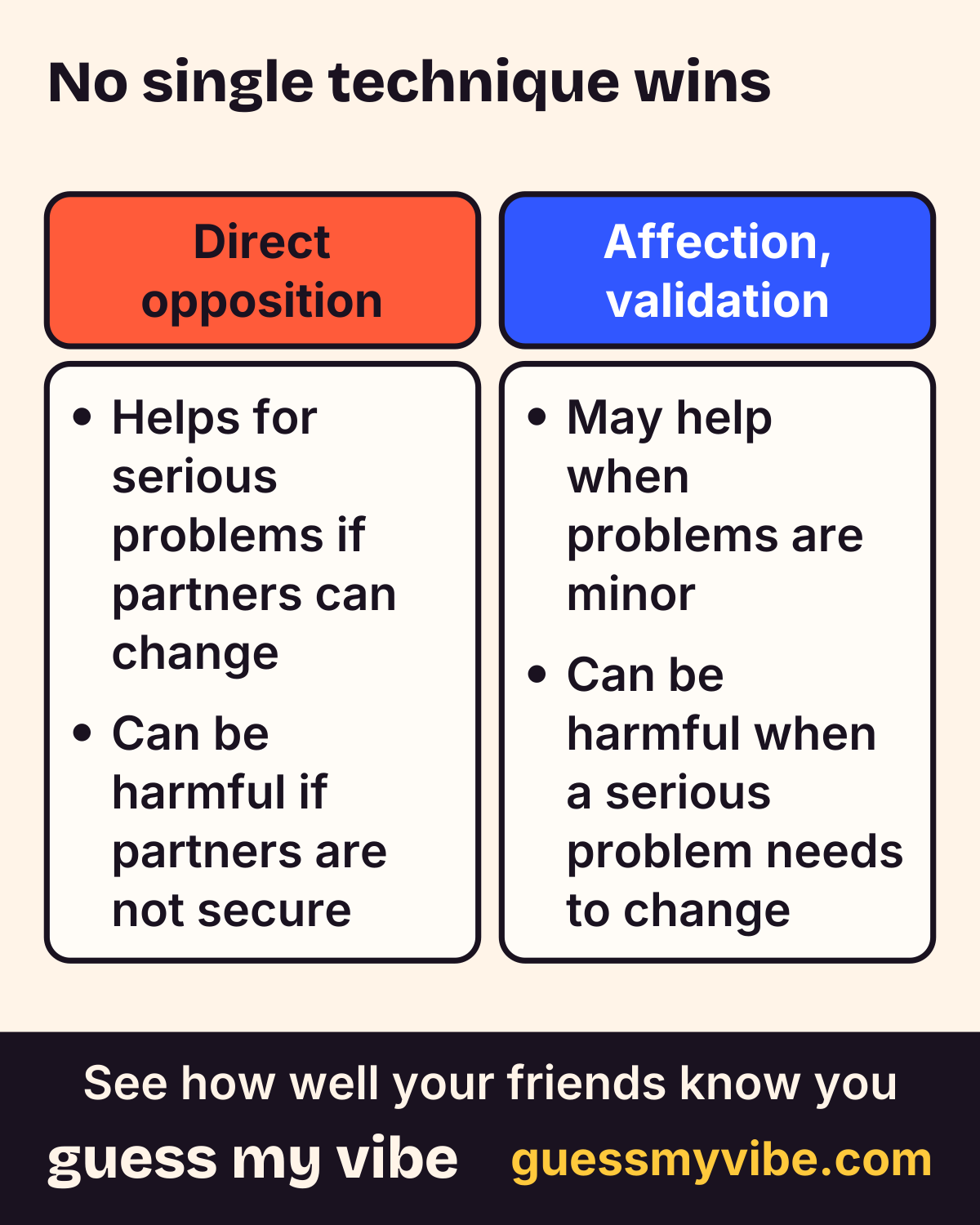
The review makes two findings that run against common advice. Direct opposition, meaning saying plainly that something is wrong and needs to change, was beneficial when serious problems needed addressing and the partner was able to change. But it could be harmful when partners were not confident or secure enough to be responsive [1]. In other words, blunt honesty tends to work when the listener can take it in and act on it, and backfire when they can't.
The reverse was true of the cooperative style. Communication involving affection and validation could be harmful when a serious problem needed to change. But it may be beneficial when problems are minor, can't be changed, or involve partners whose defensiveness would otherwise shut down problem-solving [1]. This is a review article, not a single experiment, so treat it as the authors' reading of recent studies, but it explains why so much single-rule advice sounds right and then fails: each rule fits some situations and not others.
A practical way to hold this: before choosing how to say something, it helps to ask how serious it is and whether the other person can do anything about it. That framing is ours, built on the review's logic, not a tested technique. But it's a more useful question than "what's the right script?"
Cite this figure
Figure: "No single technique wins." Guess My Vibe (guessmyvibe.com). https://guessmyvibe.com/learn/communication-in-relationships#figure-direct-vs-warm
Everyday talk: feeling heard
Most communication isn't conflict. It's the ordinary back-and-forth of a day. In two diary studies, people logged their social interactions right after they happened for one or two weeks, reporting how much they disclosed, how much the other person disclosed, how responsive the other person seemed, and how intimate the interaction felt. The pattern supported intimacy as a combination of your own disclosure and the other person's disclosure, with perceived responsiveness acting as a partial explanation of the link. In the second study, sharing an emotion tracked intimacy better than sharing facts and information [2].
These were everyday interactions, not just romantic couples, so it's a general finding about closeness in conversation. It fits what many people feel intuitively: "I felt relieved" lands differently than "here's what happened," and a partner who engages with it matters more than one who nods and waits for their turn.
The same idea shows up with good news. In four studies, telling someone about a positive event was linked to higher daily positive emotion and well-being beyond the event itself, and the benefits were larger when the other person was perceived to respond actively and constructively rather than passively or destructively. In two studies of close relationships, partners who typically responded enthusiastically to good news were associated with higher relationship well-being, including intimacy and daily marital satisfaction [4]. Communication, in this light, isn't only about handling disagreements. Whether your partner meets your good news with real interest is part of it too.
Curious how your friends would answer?
Free. Answer 10 quick questions about you, then send your link. Friends play in their browser, no app needed.
Start freeWhat long-term couple studies found
A long-term study followed couples for 14 years and measured how they interacted in two kinds of conversations at the start: a discussion of a conflict, and a talk about the events of the day after the partners had been apart. Different things forecast divorce early and later. Negative affect during conflict forecast divorcing early in the marriage, but not later. By contrast, a lack of positive affect, in both the everyday talk and the conflict discussion, forecast divorcing later, but not early [3].
That's a useful result because it separates two things people tend to blur together: the harsh moments, and the absence of warm ones. It suggests that how couples talk on an ordinary evening may matter alongside how they fight. The paper also reports a model combining marital satisfaction, thoughts of ending the marriage, and affective behavior in both conversations that forecast divorce with 93% accuracy [3]. A caution that applies to any figure like that: a model built on one sample's data tends to look better there than it would on new couples, and it describes groups of couples, not any one relationship. A pattern in a study is not a forecast about you.
A second study followed 60 newlywed couples for four years. Partners completed measures at the start, were observed in a marital interaction, and reported their satisfaction every six months. How the partners behaved during the interaction forecast how satisfaction changed over time but wasn't associated with where satisfaction started [5]. With only 60 couples, it's a small study, but the direction fits the other work: the way partners talk to each other is linked to where satisfaction heads.
What the biggest study says about conflict and appreciation
Across 43 longitudinal datasets from 29 labs, the top relationship-specific predictors of relationship quality included perceived-partner commitment, appreciation, perceived-partner satisfaction, and conflict [6]. Two of those, appreciation and conflict, are things that show up in how partners talk to each other. The same project found that change in relationship quality over the course of a study was largely unpredictable from any combination of self-report measures [6]. So even large pooled data points to factors like appreciation and conflict going with relationship quality, but not to any single habit determining the outcome.
A note on popular communication lists
You may have seen a popular framework of four communication habits, usually called the "four horsemen,". It's a framework, not a finding we've tested here: none of the studies cited in this article examine it, so we're not going to claim anything about it. The research above points toward something more modest and more flexible: context matters, responsiveness matters, and a few kinds of everyday warmth and conflict behavior track how relationships go.
What to take from this
- Match the approach to the problem. Direct honesty suits a serious, fixable issue with a partner who feels secure. Validation suits minor or unchangeable ones [1].
- Respond to the feeling, not just the facts. Emotional disclosure tracked intimacy more than factual disclosure did in one diary study [2].
- Don't save your attention for the bad news. Responding with interest to good news goes with relationship well-being [4].
- Notice the ordinary conversations. In one long-term study, a lack of positive affect in everyday talk was one of the signs linked to later divorce [3].
Guess My Vibe is built on a related idea. Feeling understood comes partly from whether the people around you have an accurate picture of you. Playing it with a partner or a friend is a light way to find out where their picture of you matches yours, and a good prompt for the kind of conversation the research is about.
Key takeaways
- A review of conflict research found that direct opposition is beneficial when serious problems need addressing and partners are able to change, but can be harmful when partners are not secure enough to be responsive [1].
- That same review found that affectionate, validating communication can be harmful when serious problems need to change, but may help when problems are minor, can't be changed, or involve defensive partners [1].
- In diary studies of everyday social interactions, felt intimacy tracked with your own disclosure plus the other person's disclosure, and how responsive the other person seemed helped explain the link [2].
- In a long-term study of couples, negative affect during conflict forecast earlier divorce, while a lack of positive affect in everyday and conflict talks forecast later divorce [3].
- This isn't therapy, a diagnosis, or a substitute for professional care.
Questions people ask
What is the best way to communicate in a relationship?
There isn't one, according to a review of conflict research. Direct opposition helps when serious problems need addressing and partners can change; warm, validating communication helps when problems are minor or unchangeable [1].
How you fight or how you talk day to day: which matters more?
Both showed up in one long-term study. Negative affect during conflict forecast early divorce, and a lack of positive affect in everyday and conflict conversations forecast later divorce [3].
Does sharing feelings help more than sharing facts?
In one diary study of everyday interactions, disclosing an emotion was a stronger predictor of felt intimacy than disclosing facts [2].
Does it matter how my partner reacts to good news?
Yes, in two studies of close relationships, partners who typically responded to good news enthusiastically were associated with higher relationship well-being [4].
Are the four horsemen of communication proven?
This article doesn't evaluate them. It's a popular framework, and none of the studies cited here test it, so we don't make claims about it.
See how well your friends know you.
Free. Answer 10 quick questions about you, then send your link. Friends play in their browser, no app needed.
Start freeReferences
- [1] Overall, N. C., & McNulty, J. K. (2017). What type of communication during conflict is beneficial for intimate relationships?. Current Opinion in Psychology, 13, 1-5. PubMed: 28025652 (opens in a new tab)
- [2] Laurenceau, J. P., Barrett, L. F., & Pietromonaco, P. R. (1998). Intimacy as an interpersonal process: the importance of self-disclosure, partner disclosure, and perceived partner responsiveness in interpersonal exchanges. Journal of Personality and Social Psychology, 74(5), 1238-1251. PubMed: 9599440 (opens in a new tab)
- [3] Gottman, J. M., & Levenson, R. W. (2000). The timing of divorce: Predicting when a couple will divorce over a 14-year period. Journal of Marriage and Family, 62(3), 737-745. doi.org/10.1111/j.1741-3737.2000.00737.x (opens in a new tab)
- [4] Gable, S. L., Reis, H. T., Impett, E. A., & Asher, E. R. (2004). What do you do when things go right? The intrapersonal and interpersonal benefits of sharing positive events. Journal of Personality and Social Psychology, 87(2), 228–245. PubMed: 15301629 (opens in a new tab)
- [5] Karney, B. R., & Bradbury, T. N. (1997). Neuroticism, marital interaction, and the trajectory of marital satisfaction. Journal of Personality and Social Psychology, 72(5), 1075-1092. PubMed: 9150586 (opens in a new tab)
- [6] Joel, S., Eastwick, P. W., Allison, C. J., Arriaga, X. B., Baker, Z. G., et al. (2020). Machine learning uncovers the most robust self-report predictors of relationship quality across 43 longitudinal couples studies. Proceedings of the National Academy of Sciences, 117(32), 19061-19071. PubMed: 32719123 (opens in a new tab)
How we find and check these sources: how we write. Spotted an error? Report a correction.
Related
Cite this article
- Title
- Communication in Relationships: What the Research Shows
- Publisher
- Guess My Vibe
- Updated
- URL
- https://guessmyvibe.com/
learn/ communication-in-relationships
Copy this citation
Guess My Vibe. (2026, October 4). Communication in Relationships: What the Research Shows. Guess My Vibe. https://guessmyvibe.com/
To point at one section, add that section's anchor (the # link on its heading) to the URL.