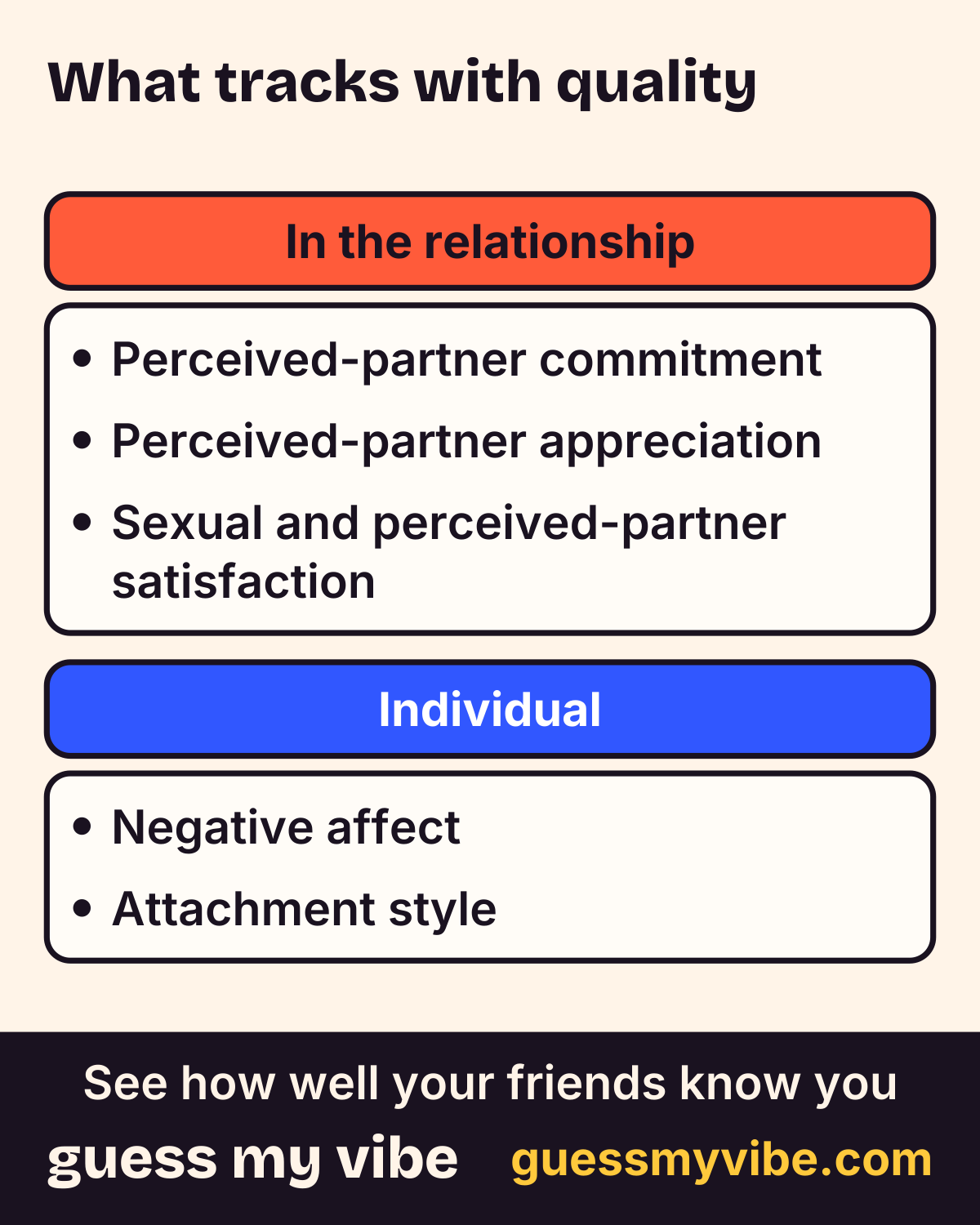
A large-scale project pooling 43 long-term couples studies with machine learning found that how people see their own relationship explained more about relationship quality than either partner's individual traits did. The strongest predictors were how committed and appreciative each person perceived their partner to be, sexual and perceived-partner satisfaction, and how much conflict the couple had; life satisfaction, mood and attachment style mattered too, but less [1].
What makes relationships last: it's not mostly personality
What makes relationships last is one of those questions everyone has a theory about: find the right personality match, share enough interests, avoid someone "too different." The large, careful attempt to actually answer it with data found something less tidy and more useful: how long and how well a relationship goes mostly comes down to how committed and appreciated each partner feels in it, not what personality either one brought to the table.
The biggest study yet: 43 datasets, one machine-learning model
A team of 85 researchers across 29 labs pooled 43 separate longitudinal couples studies and ran machine learning (specifically, random forests) across the combined data to find out which self-report measures actually go with relationship quality, and how strongly. The strongest relationship-specific predictors were perceived-partner commitment, appreciation, sexual and perceived-partner satisfaction, along with how much conflict the couple reported. The strongest individual-difference predictors, by contrast, were life satisfaction, negative affect, depression, and attachment style, and those explained meaningfully less of the variation in relationship quality than the relationship-specific measures did [1]. In plain terms: how you feel about your actual relationship beats who you are as a person, as a predictor of how that relationship is going.
One more detail from the same study is worth sitting with. Reports about your own relationship-specific experience were two to four times stronger predictors of relationship quality than your partner's reports about those same things were. And once a person's own relationship-specific perceptions were accounted for, neither their broader personality traits nor their partner's separate reports added much more predictive power on top [1]. The clearest signal about how a relationship is doing comes from how you, specifically, experience it day to day, not from a personality test either of you could take alone.
Cite this figure
Figure: "What tracks with quality." Guess My Vibe (guessmyvibe.com). https://guessmyvibe.com/learn/what-makes-relationships-last#figure-what-predicts-quality
What even this study couldn't tell us
It's worth being honest about the limits here too, because the study was. Relationship-specific variables explained up to 45% of the variation in relationship quality at the start of a study, and individual differences added up to 21% on their own. But forecasting change, whether a relationship's quality would rise or fall over the course of a study, from any combination of these same self-report measures, was largely unsuccessful [1]. Snapshotting how a relationship is doing right now is something researchers can do reasonably well. Forecasting which direction it's headed is still mostly beyond what self-report data alone can tell you, no matter how much of it you pool together.
Curious how your friends would answer?
Free. Answer 10 quick questions about you, then send your link. Friends play in their browser, no app needed.
Start freeDecades earlier, the field already suspected this
This isn't a brand new idea; it's a large-scale confirmation of something relationship researchers had already been circling for decades. A classic review examined 115 longitudinal studies, representing more than 45,000 marriages, looking at how relationship quality and stability actually change over time. After weighing the competing theories against each other, the review outlined a model meant to integrate their strengths and account for how marriages change over time, rather than resting on any single, stable trait either partner brought in on day one [2]. Put the two studies together, 25 years apart, and the message holds up: the search for one fixed personal quality that reliably points to a lasting relationship keeps coming up short, while how two specific people actually handle their life together keeps coming up as the better answer.
What 'appreciation' and 'commitment' actually look like, day to day
"Perceived-partner appreciation" and "commitment" can sound abstract, so it helps to connect them to smaller, well-studied, everyday behaviors that plausibly feed them. One is how a partner reacts to your good news: a set of studies on "capitalization" found that sharing a positive event went with higher daily well-being on its own, and more so when the listener responds actively and enthusiastically; in close relationships specifically, a partner's habit of responding enthusiastically to good news went with higher relationship well-being overall [3]. Another is ordinary responsiveness in everyday conversation: diary studies found that feeling intimate in an interaction went with a combination of disclosing something real, your partner disclosing something real back, and feeling like they actually engaged with what you said [4]. Neither of those is a personality trait. Both are repeatable behaviors, which is exactly why they're more within a couple's control than "are we compatible" ever was.
Why this matters more than finding the 'right type'
The practical upshot of all this research is almost the opposite of most relationship advice. A lot of popular advice is built around finding the right person: the right personality, the right values on paper, the right compatibility score. The research above keeps pointing somewhere else: toward what two specific people actually do with each other, day after day, once they're together. Commitment and appreciation aren't traits either person carries into a relationship fully formed. They may well be built and rebuilt through ordinary moments, noticing good news, disclosing something real, showing up the same way on an easy day and a hard one [1] [3] [4]. That's a less romantic story than "we were just meant to be," and also a more useful one, because unlike a personality match, it's something a couple can actually work on directly.
It's also worth saying plainly what this research doesn't claim. None of it says a relationship with real incompatibilities will fix itself through enough appreciation and good communication, or that a struggling relationship is simply a communication problem waiting to be solved. What it does say is narrower and better supported: when researchers measure what tracks with relationship quality across 43 datasets, relationship-specific measures explain more than fixed individual traits do, though the traits still matter some [1].
Guess My Vibe isn't built for romantic partners specifically, it's a friend-to-friend game, but the underlying lesson generalizes past any one kind of relationship: feeling genuinely known by someone, and actually noticing when you've guessed wrong about them, matters more than how similar two personalities are on paper. The game checks exactly that gap for friendships: you each answer the same questions, your friend guesses your answers, and you see where their read on you actually held up.
Key takeaways
- Across 43 long-term couples studies and 29 research labs, perceived-partner commitment and appreciation were the strongest predictors of relationship quality, ahead of either partner's personality traits [1].
- Individual-difference traits (life satisfaction, negative mood, attachment style) were real predictors of relationship quality too, but meaningfully weaker ones than how a person felt about their actual relationship [1].
- Even this large study couldn't tell whether a relationship's quality would improve or decline over time from any combination of self-report measures. Where a relationship is headed stayed genuinely hard to call [1].
- A classic review of 115 longitudinal studies of marriage, covering over 45,000 marriages, ended by outlining a model of how marriages change over time rather than pointing to a single fixed trait either partner brought into it [2].
- This isn't therapy, a diagnosis, or a substitute for professional care.
Questions people ask
What are the strongest predictors of whether a relationship will last?
According to a large-scale project pooling 43 long-term couples datasets, the strongest predictors were perceived-partner commitment, appreciation, satisfaction, and how much conflict a couple had, with individual traits mattering less [1].
Does personality matter for a lasting relationship?
Some, but less than relationship-specific factors. Individual-difference traits like life satisfaction, negative mood, and attachment style were real predictors of relationship quality too, but meaningfully weaker ones than how committed and appreciated someone felt in their actual relationship [1].
Can researchers tell if a relationship will get better or worse over time?
Not reliably, even with a large, pooled dataset and machine learning. The same study that found strong predictors of current relationship quality also found that forecasting change in quality over time, from any combination of self-report measures, was largely unsuccessful [1].
Is it more important how I see my relationship or how my partner sees it?
Your own view. A large study found a person's own relationship-specific reports were two to four times stronger predictors of their relationship quality than their partner's reports about the same things were [1].
What's one concrete thing that helps relationships last?
Responding well when your partner shares good news. Research on 'capitalization' found a partner's enthusiastic, engaged response to good news went with better relationship well-being than a flat or distracted one did [3].
See how well your friends know you.
Free. Answer 10 quick questions about you, then send your link. Friends play in their browser, no app needed.
Start freeReferences
- [1] Joel, S., Eastwick, P. W., Allison, C. J., Arriaga, X. B., Baker, Z. G., et al. (2020). Machine learning uncovers the most robust self-report predictors of relationship quality across 43 longitudinal couples studies. Proceedings of the National Academy of Sciences, 117(32), 19061-19071. PubMed: 32719123 (opens in a new tab)
- [2] Karney, B. R., & Bradbury, T. N. (1995). The longitudinal course of marital quality and stability: A review of theory, method, and research. Psychological Bulletin, 118(1), 3-34. PubMed: 7644604 (opens in a new tab)
- [3] Gable, S. L., Reis, H. T., Impett, E. A., & Asher, E. R. (2004). What do you do when things go right? The intrapersonal and interpersonal benefits of sharing positive events. Journal of Personality and Social Psychology, 87(2), 228–245. PubMed: 15301629 (opens in a new tab)
- [4] Laurenceau, J. P., Barrett, L. F., & Pietromonaco, P. R. (1998). Intimacy as an interpersonal process: the importance of self-disclosure, partner disclosure, and perceived partner responsiveness in interpersonal exchanges. Journal of Personality and Social Psychology, 74(5), 1238-1251. PubMed: 9599440 (opens in a new tab)
How we find and check these sources: how we write. Spotted an error? Report a correction.
Related
- Questions to Ask Your Partner That Build Real Closeness
- Friendship Compatibility: What Actually Makes It Work
- Do Opposites Attract? What the Research Actually Says
- Friendship Psychology: What the Research Actually Says
- Communication in Relationships: What the Research Shows
- Couple Compatibility Test: What It Can and Can't Tell You
- Love Languages: What the Research Actually Shows
Cite this article
- Title
- What Makes Relationships Last? The Biggest Study Yet
- Publisher
- Guess My Vibe
- Updated
- URL
- https://guessmyvibe.com/
learn/ what-makes-relationships-last
Copy this citation
Guess My Vibe. (2026, October 3). What Makes Relationships Last? The Biggest Study Yet. Guess My Vibe. https://guessmyvibe.com/
To point at one section, add that section's anchor (the # link on its heading) to the URL.