The best questions to ask your partner aren't trivia, they're ones that invite a real answer and get a real reaction back. A classic lab procedure of escalating, increasingly personal questions built more closeness between two participants than small talk did, over about 45 minutes [1], and the questions below follow that same idea: start light, get more personal, and actually listen when they answer.
Questions to ask your partner: start here
Good questions to ask your partner share one trait: they ask for something specific and a little real, not a yes-or-no fact. Work through these in order, from light to more personal, and actually answer each other instead of rushing to the next one.
- What's a small thing from today you haven't mentioned yet?
- What's something you believed as a kid that you now think is funny?
- What's a skill you wish you'd learned, and why that one?
- When do you feel most like yourself?
- What's a decision you made that turned out better than you expected?
- Who outside this relationship has shaped how you see the world?
- What's something I do that you've never told me you noticed?
- What's a fear you don't talk about much?
- What does a genuinely good week look like for you right now?
- What's something you're proud of that nobody really asked about?
- What's a moment you felt completely understood by someone?
- What do you actually need from me on a hard day: advice, distraction, or just company?
That ordering isn't random. The classic lab version of this idea put two strangers together and had them work through 36 questions, arranged in three sets that escalate from light ("given the choice of anyone in the world, whom would you want as a dinner guest?") to deeply personal ("when did you last cry in front of another person?"), finishing with a short relationship-building task. Compared to a control group who just made small talk for the same amount of time, the group working through the escalating questions reported more closeness afterward [1]. The exact 36 questions aren't the point. The structure, starting easy and earning your way to more personal ground, is what the research actually tested, and it produced more closeness than small talk did. A question like "what's a fear you don't talk about much?" lands very differently as the first thing you ask than as the twelfth, once some easier disclosure has already happened on both sides.
Why asking isn't enough on its own
A question is only half the exchange. Two diary studies had people report on their real conversations over one or two weeks, logging how much they disclosed, how much their partner disclosed back, how responsive their partner seemed, and how intimate the interaction actually felt. The pattern held strongly across both studies: self-disclosure and partner disclosure together went with felt intimacy, and how responsive the partner seemed, whether they actually engaged with what was said, helped explain why disclosure built intimacy in the first place. One more detail, from the second study: disclosing an emotion mattered more for intimacy than disclosing a plain fact [2]. Translated into practice: asking a good question gets you nowhere if you don't actually listen to the answer, and "I felt relieved when that happened" does more for closeness than "here's what happened." A question that only asks for a fact ("what happened at work today?") invites a fact back. A question that asks how something felt ("what's a decision you made that turned out better than you expected?") invites the kind of emotional disclosure this research found matters most.
Curious how your friends would answer?
Free. Answer 10 quick questions about you, then send your link. Friends play in their browser, no app needed.
Start freeOpening up builds liking, independent of anything else
A classic meta-analytic review of the disclosure-liking link found three separate, mutually reinforcing effects: people who disclose more intimately are liked more, people disclose more to people they already like, and people come to like someone more as a direct result of having opened up to them [3]. That third effect is the useful, slightly counterintuitive one: the act of disclosing itself, not just being disclosed to, builds liking. A good list of questions works in both directions at once, since each person in the exchange is both the one asking and the one answering.
Don't skip the good-news questions
Deep questions tend to drift toward fears, pasts, and hard moments, which is worth balancing against a separate, well-studied finding: how a partner responds to good news matters for the relationship too. A set of four studies on "capitalization," the act of telling someone your good news, found that sharing a positive event was linked to higher daily well-being beyond the event itself, and more so when the listener responded actively and enthusiastically rather than passively. In close relationships specifically, a partner's habit of responding enthusiastically to good news went with higher relationship well-being, including intimacy and satisfaction [4]. A question like "what's something you're proud of that nobody really asked about?" isn't just nice. It's asking for exactly the kind of moment this research says is worth responding to well, and it only pays off if the response matches the moment: genuine interest and follow-up questions, not a quick nod before moving on.
How to actually use a list like this
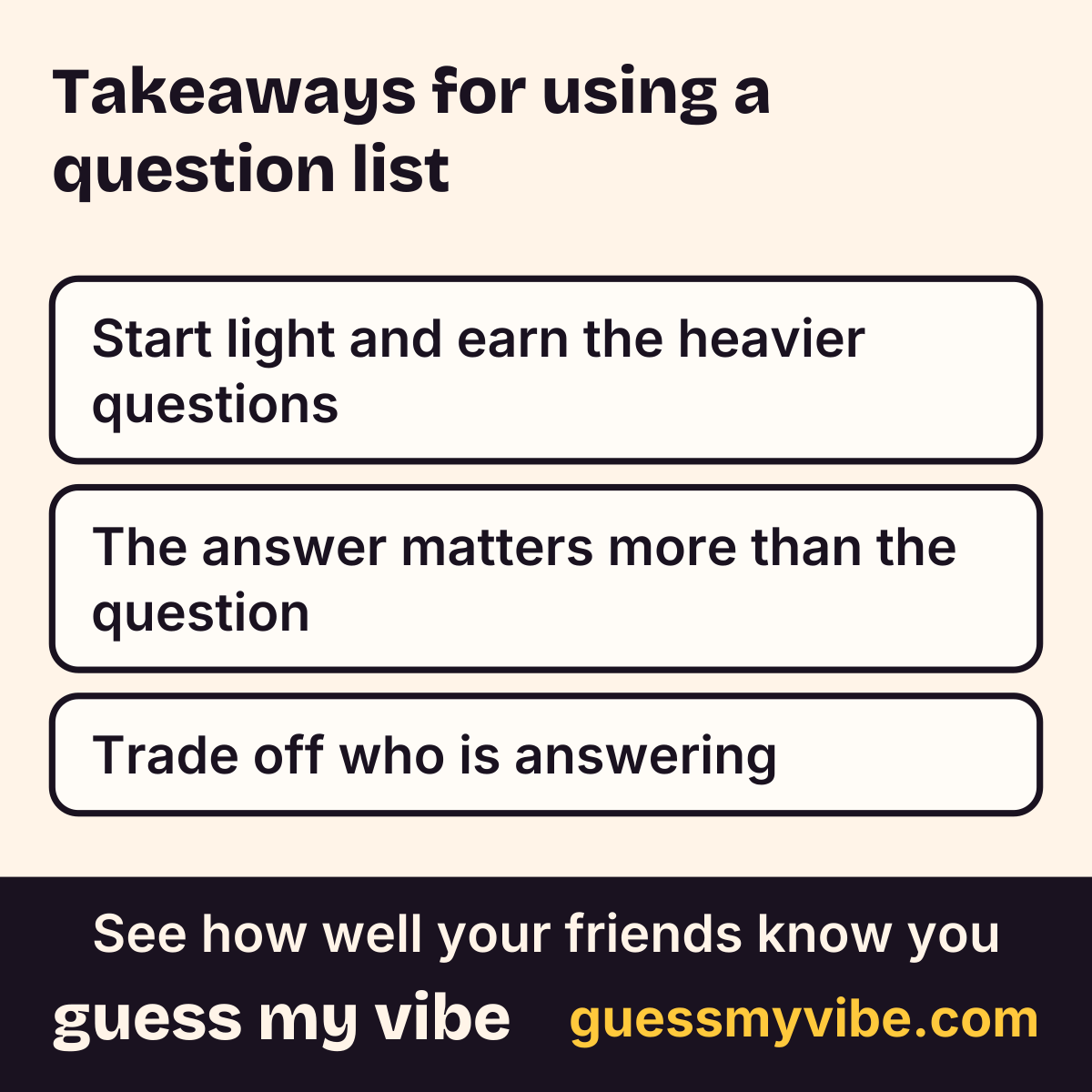
Three practical takeaways fall straight out of the research above. First, order matters: start light and earn your way to the heavier questions, the way the escalating-questions procedure did, rather than opening with the hardest one in the room [1]. Second, the answer matters more than the question: a flat, half-listening response undercuts even a great question, while a genuinely engaged one builds intimacy even on a fairly ordinary topic [2]. Third, this isn't a one-sided interview. Research on disclosure and liking finds that people come to like someone more as a result of having opened up to them, so trade off who's answering rather than one partner always asking and the other always answering [3].
Cite this figure
Figure: "Takeaways for using a question list." Guess My Vibe (guessmyvibe.com). https://guessmyvibe.com/learn/questions-to-ask-your-partner#figure-how-to-use-the-list
A good question list isn't a one-time event
The diary studies behind the intimacy-process findings above weren't measuring one big conversation. They were measuring ordinary interactions, logged over one or two weeks, which means the disclosure-responsiveness pattern they found builds up through lots of small exchanges, not a single deep night of questions [2]. The practical version of that: answers change. "What does a genuinely good week look like for you right now?" asked again in six months isn't a repeat, it's a different question, because the honest answer has probably moved. Treating a list like this as something you revisit occasionally, rather than a box to check once, fits the actual mechanism the research describes better than a single marathon session does.
None of this is specific to romantic partners, either. The same mix, real disclosure, a partner who actually responds, and genuine two-way exchange, is exactly what research on close friendships finds too. Guess My Vibe is built around a related but different question: not what you'd say if asked, but whether a friend can actually guess how you'd answer. Played alongside a list like this one, it's a way of checking how much a friend has picked up on you beyond what gets said out loud in any one conversation.
Key takeaways
- A lab procedure built from escalating, increasingly personal questions produced more closeness between participants than comparable small talk did, over about 45 minutes in a first study [1].
- Intimacy isn't just about what you ask. In daily-life diary studies, it tracked with a combination of disclosing something real yourself, your partner disclosing something real back, and feeling like they actually responded to what you said [2].
- People who disclose more intimately tend to be liked more, and people also come to like someone more as a result of having opened up to them [3].
- How your partner responds to your good news matters too, not just how they handle the bad. In close relationships, a partner who typically responds to good news enthusiastically went with higher relationship well-being [4].
- This isn't therapy, a diagnosis, or a substitute for professional care.
Questions people ask
What are good deep questions to ask your partner?
Ones that ask for something specific and a little personal, not a fact they could answer in one word. The list above starts light and moves toward more personal ground, the same structure a classic closeness-building study used successfully between strangers [1].
Do questions actually make couples feel closer?
Yes, when combined with a real answer and a real reaction to it. A lab study found escalating, increasingly personal questions produced significantly more closeness than small talk in under an hour [1], and diary research found intimacy depends on disclosure plus feeling like your partner actually responded [2].
Is it the question or the answer that matters more for closeness?
The answer, and specifically how responsive it feels. Diary studies found perceived partner responsiveness helped explain why disclosure built intimacy in daily interactions, beyond just the fact that disclosure happened [2].
Should I ask about good things or hard things?
Both. Deep, harder questions build real intimacy [2], but a separate line of research found how someone responds to your good news also goes with relationship well-being, not just how they handle hard moments [4].
Does opening up actually make someone like you more?
Yes, on its own. A meta-analytic review found disclosing more intimately goes with being liked more, and the act of disclosing to someone goes with liking them more too [3].
See how well your friends know you.
Free. Answer 10 quick questions about you, then send your link. Friends play in their browser, no app needed.
Start freeReferences
- [1] Aron, A., Melinat, E., Aron, E. N., Vallone, R. D., & Bator, R. J. (1997). The experimental generation of interpersonal closeness: A procedure and some preliminary findings. Personality and Social Psychology Bulletin, 23(4), 363–377. doi.org/10.1177/0146167297234003 (opens in a new tab)
- [2] Laurenceau, J. P., Barrett, L. F., & Pietromonaco, P. R. (1998). Intimacy as an interpersonal process: the importance of self-disclosure, partner disclosure, and perceived partner responsiveness in interpersonal exchanges. Journal of Personality and Social Psychology, 74(5), 1238-1251. PubMed: 9599440 (opens in a new tab)
- [3] Collins, N. L., & Miller, L. C. (1994). Self-disclosure and liking: A meta-analytic review. Psychological Bulletin, 116(3), 457-475. PubMed: 7809308 (opens in a new tab)
- [4] Gable, S. L., Reis, H. T., Impett, E. A., & Asher, E. R. (2004). What do you do when things go right? The intrapersonal and interpersonal benefits of sharing positive events. Journal of Personality and Social Psychology, 87(2), 228–245. PubMed: 15301629 (opens in a new tab)
How we find and check these sources: how we write. Spotted an error? Report a correction.
Related
- What Makes Relationships Last? The Biggest Study Yet
- How Well Do You Know Me Questions to Ask Friends
- Self-Awareness: What the Research Says It Actually Takes
- First Date Questions: 25 to Ask (and Why Follow-Ups Win)
- Newlywed Game Questions (and How Well You Know Them)
- How Well Do You Know Your Partner? 100+ Questions
Cite this article
- Title
- Questions to Ask Your Partner That Build Real Closeness
- Publisher
- Guess My Vibe
- Updated
- URL
- https://guessmyvibe.com/
learn/ questions-to-ask-your-partner
Copy this citation
Guess My Vibe. (2026, October 3). Questions to Ask Your Partner That Build Real Closeness. Guess My Vibe. https://guessmyvibe.com/
To point at one section, add that section's anchor (the # link on its heading) to the URL.