Newlywed game questions work best when each partner writes down an answer about themselves and the other guesses it: favorites, habits, how they'd react to something. The science suggests the game is worth playing for one reason: a longer or more involved relationship tended to make dating partners and roommates more confident in their impressions without consistently making them more accurate [1]. The score tells you something you can't get from feeling sure.
Newlywed game questions: 20 to play with
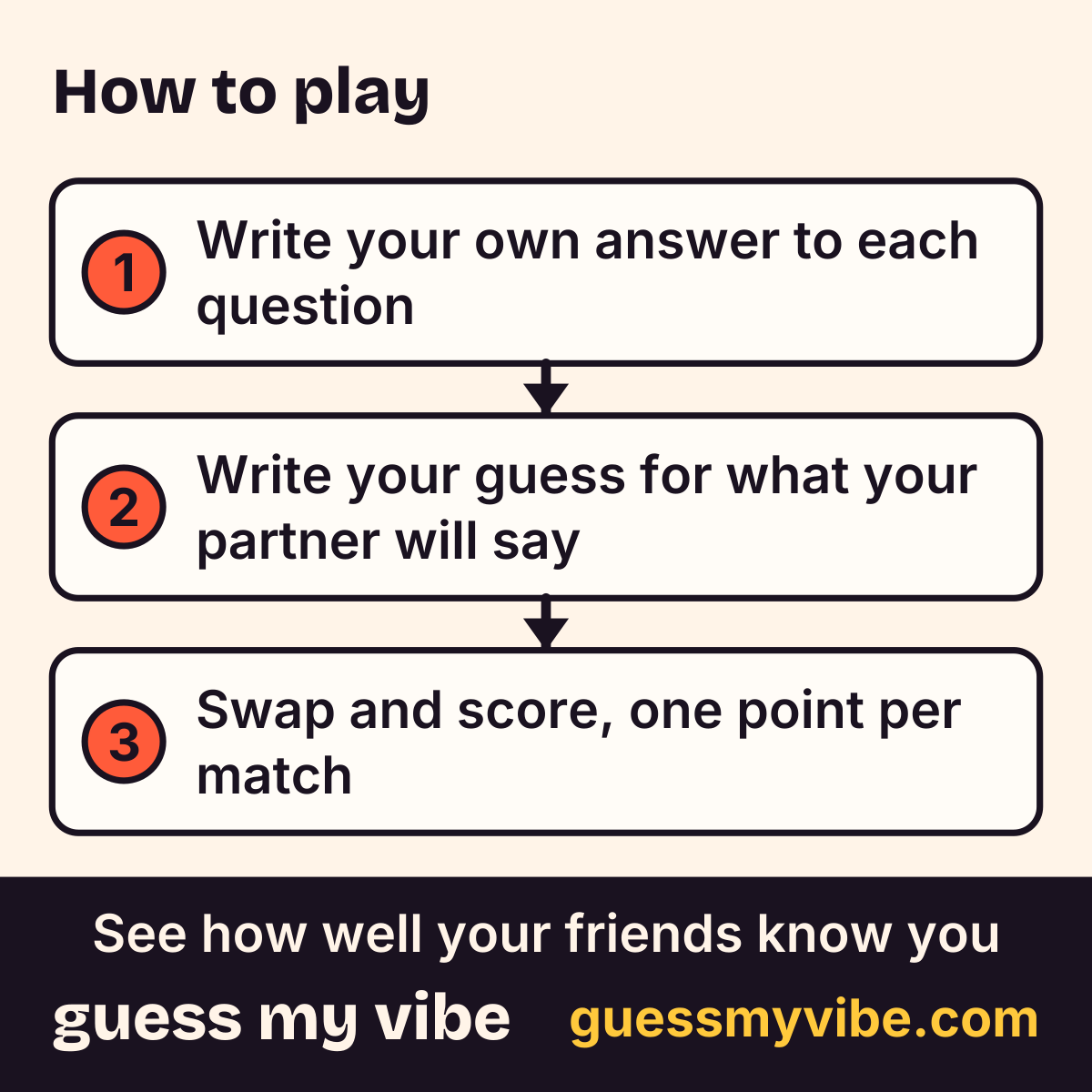
The classic newlywed game questions come from a TV game show format: partners answer questions about each other separately, then reveal their answers and see who really knew. You don't need to be newly married, or even married. Any two people who've spent time together can play. Here's how: write your own answer to each question on paper, write your guess for what your partner will say, then swap and score. One point per match. The questions below are deliberately about habits, preferences and reactions, not just trivia, because those are the things partners are most likely to be sure about and wrong about.
Round 1: everyday habits
- What's the first thing your partner does after getting home?
- Which household chore would your partner pick last?
- What would your partner order if they could only pick one comfort food for a month?
- How many alarms does your partner set on a workday morning?
- What's the app your partner opens most on their phone?
- What would your partner say is their most annoying habit?
Round 2: reactions and preferences
- If plans were canceled last minute, would your partner feel relieved or disappointed?
- After a bad day, does your partner want to talk it through or be left alone first?
- Would your partner rather plan a trip down to the hour or decide when they get there?
- What compliment would land best with your partner right now?
- If your partner had a free weekend to spend alone, what would they actually do?
- What would your partner say is the best decision they've made in the past year?
- How does your partner react to a surprise: love it, or want a heads-up?
Round 3: bigger picture
- What is your partner proudest of that they rarely mention?
- What would your partner say they're most looking forward to this year?
- Which of their friends would your partner call first with good news?
- What does your partner worry about most when no one's asking?
- What would your partner say is the best thing about how the two of you handle disagreements?
- What would your partner say they most want you to understand about them?
- Which trait would your partner say they're most like their family in?
Don't treat the score as a verdict on the relationship. The most valuable part of the game is the "wait, really?" moment when an answer surprises you. That's the part the research below says matters.
Cite this figure
Figure: "How to play." Guess My Vibe (guessmyvibe.com). https://guessmyvibe.com/learn/newlywed-game-questions#figure-how-to-play
Feeling sure isn't the same as being right
Researchers asked a basic question: as relationships get longer and closer, do people really get more accurate about each other, or just more confident? They studied dating partners (comparing people at different relationship lengths at one point in time) and followed college roommates over time. The confidence and the accuracy of people's impressions were often dissociated, meaning they didn't move together. Relationship length and degree of involvement tended to raise confidence, but neither consistently raised accuracy about things like a partner's history and activity preferences [1].
A third study in the same paper found that relationship length and involvement increased the richness of people's impressions, and that richer impressions fostered confidence [1]. So the picture of your partner in your head fills in with detail as time passes, and that detail feels like knowledge. The authors raise the possibility that confidence may sometimes contribute to relationship quality even when it is unrelated to accuracy [1]. That's a useful reminder that a missed answer on a quiz isn't a failure. It does mean that "I know them so well" is a feeling worth testing now and then.
That's the real reason the newlywed game is more than a party trick. A wrong guess you were sure about is a small, harmless piece of data that confidence alone would never have given you.
Curious how your friends would answer?
Free. Answer 10 quick questions about you, then send your link. Friends play in their browser, no app needed.
Start freeHow well do couples know each other?
A different line of research measures how well people read what someone else is thinking. In one study, a team used a video-review procedure in which people tried to read the thoughts of 50 dating couples. The perceivers ranged from the partners themselves to friends of the partners to strangers. Accuracy was higher the better the perceiver knew the person, and it differed with each perceiver's individual ability. The study also found female perceivers were more accurate than male perceivers. In couples and friends, higher accuracy went with higher satisfaction, closeness and more prior disclosure about the problems discussed, but only under certain conditions involving sex and how long the relationship had lasted [2]. In plain terms: knowing someone helps, but how well it works depends on who is doing the reading and on the relationship, and the link between accuracy and happiness wasn't a simple one.
A more recent study followed 292 recently cohabiting couple members, who were about 25 on average, for 10 days. They gave up to 50 personality-state reports over those days, using their own and their partner's reports. Among the Big Five traits, the most robust pattern, using self-reports and partner reports together, showed up for conscientiousness and neuroticism. Partners were not more accurate among the more satisfied people. But they were more accurate when the two were alone together as a couple than when they were around other people [3].
That second finding is a nice excuse to play the game without an audience. How well you read each other seems to depend, at least a bit, on whether you're paying attention to each other in the first place, rather than on how in love you feel.
Why some of your guesses will miss
Part of the reason some answers are easy and others hard is that traits differ in how visible they are. In a study of 165 people who were rated by four friends and up to four strangers each, the self was the best judge of neuroticism-related traits, friends were the best judges of intellect-related traits, and people from every perspective were about equally good at judging extraversion-related traits [4]. That study wasn't about couples, so it can't tell us how partners compare. But it fits a plausible reading of why quiz questions about "what do they worry about" are so much harder than ones about "what do they order." Inner states are low in visibility, and a partner can only guess at them unless they've been told.
Our own suggestion, not a research finding, is that the game works better with questions about reactions and priorities than with trivia like middle names and anniversary dates. Trivia is easy to memorize, so a good score mostly shows who paid attention to a list. Questions about what someone would feel or do ask about the person, and they're also the ones where the "wait, really?" moments tend to show up.
How to get something useful out of the game
- Ask "why" after a miss. The answer to a wrong guess is usually more interesting than the right one.
- Skip the scoreboard if it starts to feel like a contest.
- Play it again in a few months. Answers change, which is part of the point.
- Add your own questions. Any question where you were sure and wrong is a good one.
Guess My Vibe is built around the same idea from a different direction: instead of a partner guessing your answers, friends guess how you'd answer personality questions, and you see where their picture of you lines up with yours. It's a fun way to run the same experiment with the people who aren't your partner. As with the newlywed game, it's for curiosity, not a verdict.
Key takeaways
- In a study of dating partners and one of college roommates, relationship length and involvement tended to raise people's confidence in their impressions of the other person but did not consistently raise their accuracy [1].
- In a study with 50 dating couples, friends and strangers, accuracy at reading someone's thoughts rose with how well the judge knew the person [2].
- In a preregistered 10-day study of 292 recently cohabiting couple members, partners' accuracy was not higher among more satisfied people, but it was higher when the two were alone together as a couple than when they were with other people [3].
- People are not equally good judges of every trait: in one study the self was the best judge of neuroticism-related traits, while ratings from friends, strangers and the self were about equally good for extraversion-related traits [4].
- This isn't therapy, a diagnosis, or a substitute for professional care.
Questions people ask
What are good newlywed game questions?
Ones about habits, reactions and priorities rather than pure trivia, such as how your partner reacts to a canceled plan, what they'd do with a free weekend, or what they're most looking forward to. The list above has 20.
Do couples really know each other well?
Sometimes less than they think. In studies of dating partners and roommates, longer and closer relationships tended to raise confidence in impressions without consistently raising accuracy [1]. In a study that included 50 dating couples, accuracy at reading someone's thoughts rose with how well the judge knew the person [2].
Does knowing your partner better mean a happier relationship?
The research is mixed. In one study of dating couples and their friends, higher accuracy went with higher satisfaction and closeness only under certain conditions involving sex and relationship length [2]. In a study of recently cohabiting couples, accuracy was not higher among more satisfied people [3].
Can you play the newlywed game if you're not married?
Yes. The format works for dating partners, long-term partners or even close friends. Each person writes their own answer and a guess for the other, then you compare.
See how well your friends know you.
Free. Answer 10 quick questions about you, then send your link. Friends play in their browser, no app needed.
Start freeReferences
- [1] Swann, W. B., Jr., & Gill, M. J. (1997). Confidence and accuracy in person perception: Do we know what we think we know about our relationship partners?. Journal of Personality and Social Psychology, 73(4), 747-757. PubMed: 9325592 (opens in a new tab)
- [2] Thomas, G., & Fletcher, G. J. O. (2003). Mind-reading accuracy in intimate relationships: Assessing the roles of the relationship, the target, and the judge. Journal of Personality and Social Psychology, 85(6), 1079-1094. PubMed: 14674815 (opens in a new tab)
- [3] Bühler, J. L., Scheling, L., & Wrzus, C. (2025). Knowing yourself and your partner: Accuracy of personality judgment in recently cohabiting couples. Journal of Personality and Social Psychology, 129(6), 1218-1239. PubMed: 41021509 (opens in a new tab)
- [4] Vazire, S. (2010). Who knows what about a person? The self-other knowledge asymmetry (SOKA) model. Journal of Personality and Social Psychology, 98(2), 281–300. PubMed: 20085401 (opens in a new tab)
How we find and check these sources: how we write. Spotted an error? Report a correction.
Related
Cite this article
- Title
- Newlywed Game Questions (and How Well You Know Them)
- Publisher
- Guess My Vibe
- Updated
- URL
- https://guessmyvibe.com/
learn/ newlywed-game-questions
Copy this citation
Guess My Vibe. (2026, October 4). Newlywed Game Questions (and How Well You Know Them). Guess My Vibe. https://guessmyvibe.com/
To point at one section, add that section's anchor (the # link on its heading) to the URL.