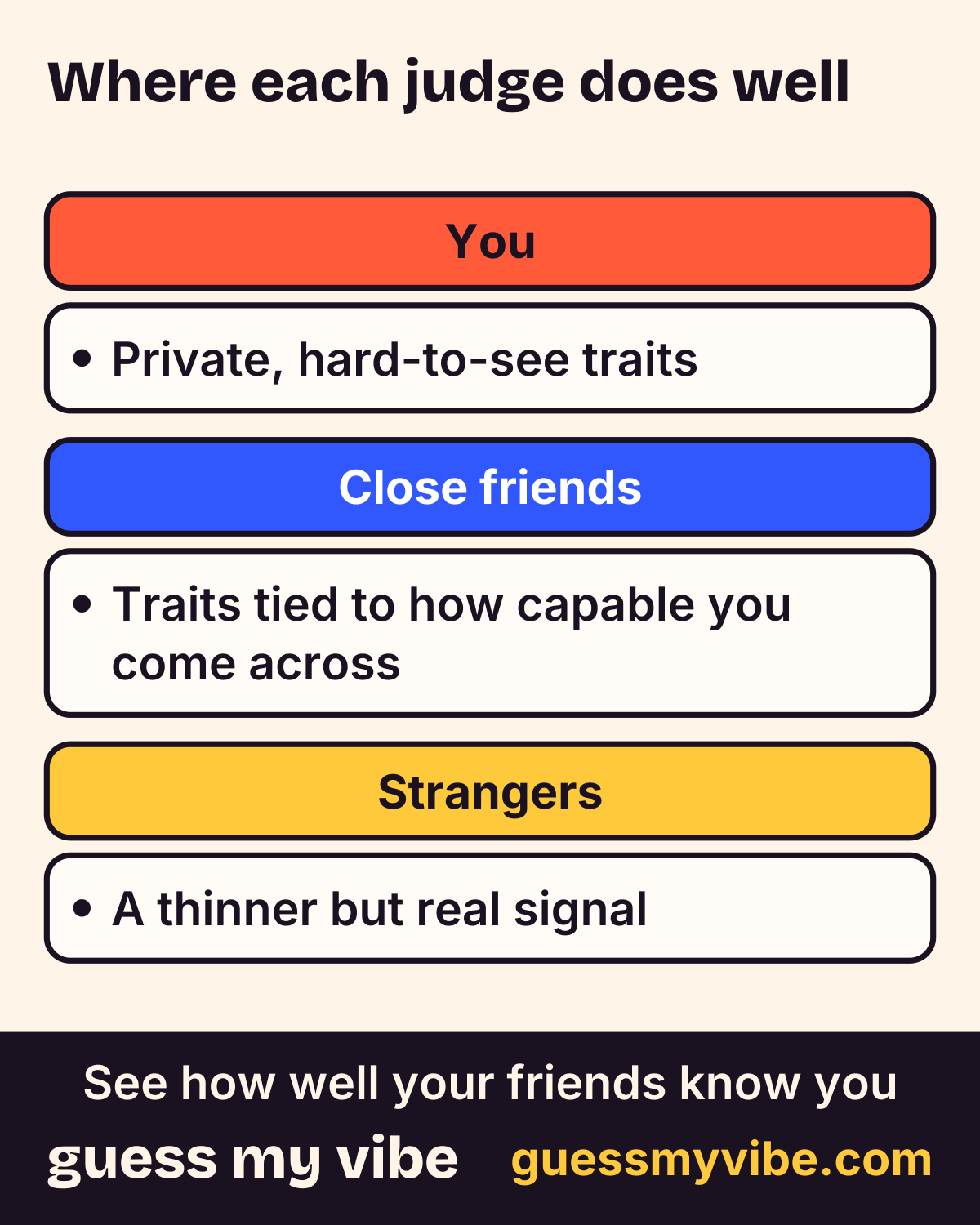
There's no single answer to who knows you best, because the title changes depending on the trait. You're the most reliable judge of your own private, hard-to-observe traits, like how anxious you get; a close friend tends to edge you out on traits tied to how smart or capable you come across, while on visible traits like sociability everyone is about equally good [1]; and even a total stranger's first impression carries real, above-chance information, just a thinner slice of it than someone who's actually spent time around you [2].
Want to take it for real? Find out who knows you best with the best friend test
"Who knows you best" sounds like a question with one answer: your best friend, your mom, your partner, or you. Personality research treats it differently. It studies specific rater types, self, close friend, family, stranger, and asks which one is the better judge of which specific trait, because the honest answer keeps changing depending on what's being judged.
The rater types researchers actually compare
Studies in this field usually sort judges into a handful of categories: the self (you, rating your own personality), close acquaintances (friends, family, partners, people with real history with you), and strangers (people judging you from a brief interaction, a photo, or a short video clip, with no prior history at all). Some studies also separate "a single close acquaintance" from "multiple acquaintances averaged together," since that distinction turns out to matter on its own. None of these categories is simply right or wrong across the board. Each one is a different vantage point onto a different, real slice of you.
You: the best judge of what nobody else can see
A study that rated 165 people using close friends, strangers, and the people themselves, then checked those ratings against actual lab behavior, found a clean, consistent pattern: you are the best judge of your own low-observability traits, the ones that happen mostly inside your head and rarely surface as visible behavior, like how easily your mood is thrown off by stress [1]. Nobody else gets to watch your internal monologue. On traits like this, your self-rating isn't a biased guess to be corrected by an outsider; it's the most direct evidence anyone has access to.
Close friends and family: the best judges of your visible patterns
The same study found the opposite pattern for high-evaluativeness traits, the ones tied to how smart or capable someone comes across. There, friends (especially a few of them averaged together) outperformed the people being judged [1]. A separate meta-analysis of 44,178 people confirms why acquaintances carry real, independent value: other-ratings weren't just a weaker copy of self-ratings, they had their own link to real outcomes, like job performance and achievement, on their own, beyond what the person's own self-report captured [3]. The same meta-analysis found that closeness to the rater matters most specifically for traits that are hard to see from the outside; for traits that are easy to see, closeness adds much less, because the behavior itself is visible to anyone paying attention.
Strangers: a thinner, but still real, signal
It's tempting to write off a stranger's first impression entirely, and the research says that's an overcorrection. A classic study comparing close acquaintances to total strangers (who'd only watched one brief videotaped interaction) found that close acquaintances agreed with each other, and with the target's own self-view, far more than strangers agreed with each other [2]. But strangers' ratings still agreed with one another more than random chance alone would produce, and the traits that were easiest for friends to judge were also the easiest for strangers to judge on a first look. A stranger isn't reading nothing. They're reading the same general signal a close friend reads, just a much thinner, noisier version of it.
Curious how your friends would answer?
Free. Answer 10 quick questions about you, then send your link. Friends play in their browser, no app needed.
Start freeOne judge, or several averaged together?
A separate study of roughly 140 undergraduates put a sharper number on how much averaging multiple judges actually buys you. A single close acquaintance's personality judgment slightly out-performed the person's own self-judgment at matching real videotaped behavior. Two acquaintances' combined judgment significantly beat self-judgment, a clearer margin than the slight edge one acquaintance had [4]. The lesson generalizes past this one study: a single rater, of any type, carries noise alongside their real signal. Averaging across a few honest raters, even just two, cancels out some of that individual noise in a way no single rater, however close to you, can do alone.
So who actually knows you best?
Put the research together and the real answer is a short table, not a single name. For your private, low-visibility feelings (stress, self-doubt, what you're actually thinking in an awkward moment), you're the most reliable source. For traits tied to how capable, creative or sociable you come across, a close friend, especially a couple of them combined, tends to edge you out. For a quick first read on something visible, a stranger isn't useless, just working with a much smaller sample of you than anyone who's known you for years. And a family member sits closer to the "close acquaintance" category than to the "stranger" category on most of these traits, with the same strengths and the same blind spots as a close friend, shaped by whatever specific behaviors a family member happens to actually witness.
Cite this figure
Figure: "Where each judge does well." Guess My Vibe (guessmyvibe.com). https://guessmyvibe.com/learn/who-knows-you-best#figure-who-sees-what
Where a romantic partner fits in
A romantic partner usually behaves like a close acquaintance in this research, with one extra wrinkle: they often see you in situations nobody else does, including friends you've had for years, like how you handle stress at 1am or what you're like on the worst day of a bad week. That extra access can make a partner a particularly strong judge of traits that mostly surface in private, low-guard moments. It doesn't automatically make them a better judge of everything. A partner who's never seen you in a large group of old friends may genuinely know less about your Social battery in that specific setting than a close friend who's watched you work a room for a decade. The pattern holds: what a rater knows well tracks what they've actually had the chance to observe, not just how close the relationship label sounds.
Test this with the people in your own life
This is a testable question, not just a trivia fact, and Guess My Vibe is built around testing it directly. A friend guesses your answers to the same Big Five personality questions you answer about yourself, and you see both scores side by side. Run it with a few different people in your life, a longtime friend, a sibling, someone newer, and you'll likely see the exact pattern the research above describes: different raters landing closer on different traits, nobody perfect across the board, and more than one of them genuinely right about a different part of you.
Key takeaways
- Who knows you best depends on the trait, not just on closeness. You hold the edge on private feelings and worry; friends hold the edge on traits tied to how smart or capable you come across, and on visible traits like sociability nobody has a clear edge [1].
- A meta-analysis of 263 samples and 44,178 people found closeness to the rater matters most for traits that are hard to observe from the outside, less for traits that are visible to almost anyone [3].
- Close acquaintances agree with each other, and with your own self-view, far more than strangers do, but strangers' first impressions still beat chance [2].
- Two acquaintances' combined judgment significantly beat self-judgment at matching real recorded behavior, while a single acquaintance's judgment beat it only slightly [4].
- This isn't therapy, a diagnosis, or a substitute for professional care; it's a plain-English summary of what personality research says about different judges' accuracy.
Questions people ask
Who knows you best: yourself, a friend, or family?
It depends on the trait. You're the best judge of private, low-visibility traits like stress and self-doubt; close friends tend to be better judges of traits tied to how smart or capable you come across, and everyone is about equally good on visible traits like sociability [1].
Can a stranger really know anything real about my personality?
Yes, a limited amount. Strangers' first-impression ratings agree with each other more than chance alone would produce, though far less than close acquaintances agree with each other [2].
Does a family member know me the same way a close friend does?
Research on other-ratings draws on family, friends and even strangers, and finds that real closeness to the person boosts accuracy most for traits that are hard to see from the outside [3].
Is one friend's opinion of me reliable?
Somewhat, but in one study two acquaintances' combined judgment beat self-judgment by a clearer margin than a single acquaintance's did, which fits the idea that each individual rater carries their own noise alongside real signal [4].
Why do I know some things about myself better than my friends do?
Because some traits, like how anxious you get under pressure, happen mostly inside your own head. Nobody else has access to that information directly, so your self-report is the most direct evidence available for those traits [1].
How can I actually test who knows me best?
Have a few different people in your life (a close friend, a family member, someone newer) guess the same set of questions about you that you answer yourself, then compare. That's the same self-other comparison the research above runs, just with people you actually know.
See how well your friends know you.
Free. Answer 10 quick questions about you, then send your link. Friends play in their browser, no app needed.
Start freeReferences
- [1] Vazire, S. (2010). Who knows what about a person? The self-other knowledge asymmetry (SOKA) model. Journal of Personality and Social Psychology, 98(2), 281–300. PubMed: 20085401 (opens in a new tab)
- [2] Funder, D. C., & Colvin, C. R. (1988). Friends and strangers: Acquaintanceship, agreement, and the accuracy of personality judgment. Journal of Personality and Social Psychology, 55(1), 149–158. PubMed: 3418488 (opens in a new tab)
- [3] Connelly, B. S., & Ones, D. S. (2010). An other perspective on personality: Meta-analytic integration of observers' accuracy and predictive validity. Psychological Bulletin, 136(6), 1092–1122. PubMed: 21038940 (opens in a new tab)
- [4] Kolar, D. W., Funder, D. C., & Colvin, C. R. (1996). Comparing the accuracy of personality judgements by the self and knowledgeable others. Journal of Personality, 64(2), 311–337. PubMed: 8656321 (opens in a new tab)
How we find and check these sources: how we write. Spotted an error? Report a correction.
Related
Want to try it with your own friends? Make a friendship quiz and see who knows you best
Cite this article
- Title
- Who Knows You Best: Comparing the Different Judges
- Publisher
- Guess My Vibe
- Updated
- URL
- https://guessmyvibe.com/
learn/ who-knows-you-best
Copy this citation
Guess My Vibe. (2026, October 3). Who Knows You Best: Comparing the Different Judges. Guess My Vibe. https://guessmyvibe.com/
To point at one section, add that section's anchor (the # link on its heading) to the URL.