In one well-known 2015 study, yes, by one specific measure: a computer model built from people's Facebook Likes read their self-reported personality more accurately than their own Facebook friends did, using a large sample of 86,220 people [1]. But that study measured a statistical model trained on digital-footprint data, not a chatbot having a conversation with you, and no published research yet compares a conversational AI to a close friend directly.
Does AI know you better than your friends? There's an actual study behind this question, not just internet speculation, and it found something genuinely striking: a computer model beat real friends at reading personality, using nothing but Facebook Likes. But the honest answer needs the study's own fine print, because "AI" in that 2015 paper and "AI" in a 2026 search bar usually mean two different things.
The study behind the headline
The paper is "Computer-based personality judgments are more accurate than those made by humans," published in the Proceedings of the National Academy of Sciences in 2015. Researchers had 86,220 volunteers complete a 100-item personality questionnaire about themselves, then compared two separate reads of that same personality: one made by a computer model trained only on each person's Facebook Likes (the pages, bands, shows and brands they'd clicked "like" on), and one made by the person's actual Facebook friends filling out a personality questionnaire about them [1].
The computer model won, by a real margin. Its reads correlated with people's self-reported personality at r=.56; the friends' reads correlated at r=.49. The computer model also agreed with itself more: separate computer judgments of the same person matched each other more closely than separate human judges matched each other, meaning the model was more consistent, not just luckier on average. And on a handful of real-world outcomes, like substance use, political attitudes and physical health, the computer model's reads lined up with those outcomes better than the friends' reads did, and for some outcomes even better than the person's own self-rating [1].
What "AI" actually meant in this study
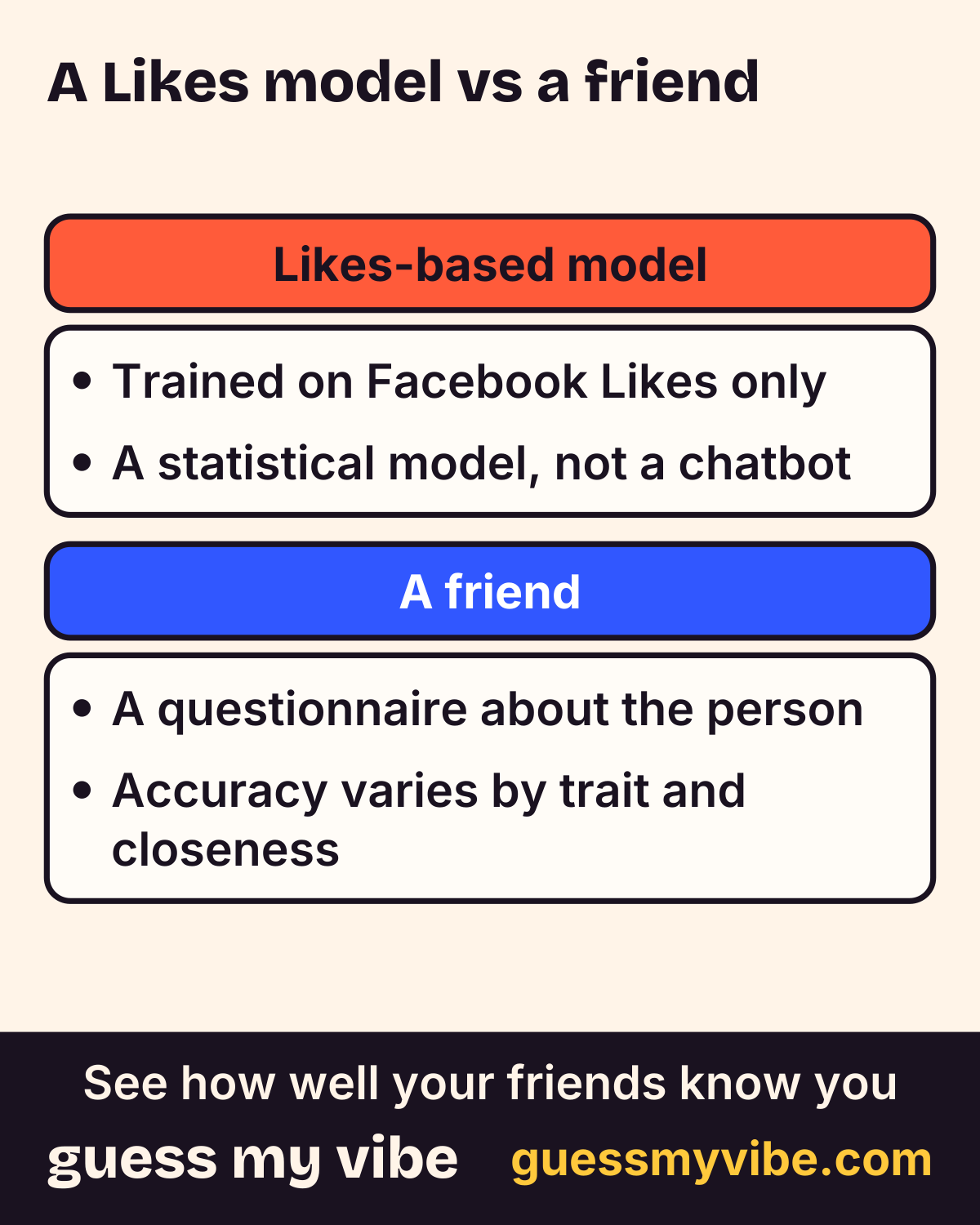
This is the part worth being precise about. The "computer" in this 2015 study wasn't a chatbot you could talk to. It was a statistical model, essentially a regression-style algorithm, trained to find patterns between thousands of specific Facebook Likes and the personality scores of the people who'd clicked them (liking a certain band, a certain brand, a certain page turns out to correlate, in aggregate across huge samples, with specific personality traits). It never had a conversation with anyone. It never asked a follow-up question. It read a list of clicks and output a number. That's a meaningfully different kind of "knowing someone" than what a modern conversational AI does when you type to it, and a different kind again from what a friend does by watching you live your life for years.
Why a Likes-based model could beat a friend at all
It helps to understand why friend accuracy has a ceiling in the first place. Research on other-ratings finds that a judge's accuracy depends on how visible the trait is and on how often and how closely the judge has interacted with the person [2]. That ceiling is not low, though: in a four-day check against real, unobtrusively recorded daily behavior, close others were as accurate as the self at judging what people actually did [3]. A friend's picture of you is built from a limited, specific slice of your life: the parts of you they happen to be around for. A Likes-based model, by contrast, draws on thousands of small, consistent data points, the exact kind of broad, repeated behavior that's hard for any one human observer to track and remember accurately across years. It's not reading you more deeply. It's aggregating a wider, more consistent set of shallow signals than any single friend has the bandwidth to track in their own head.
Cite this figure
Figure: "A Likes model vs a friend." Guess My Vibe (guessmyvibe.com). https://guessmyvibe.com/learn/does-ai-know-you-better-than-friends#figure-model-vs-friend
Curious how your friends would answer?
Free. Answer 10 quick questions about you, then send your link. Friends play in their browser, no app needed.
Start freeWhat the 2015 study doesn't tell you
A few real limits are worth naming plainly, the same way this study's own authors would. The sample was Facebook users willing to install a personality-quiz app in the early-2010s social media era, a specific population, not a random cross-section of everyone alive today. The comparison measured friends filling out a questionnaire about someone, not friends drawing on years of lived, in-person observation the way a close friend you grew up with actually knows you. And "Likes" as a behavioral signal has changed enormously since 2015; plenty of people barely like public pages anymore. None of that erases the finding, but it means "a computer model beat friends in 2015, using Facebook Likes, in that specific sample" is the accurate claim, not a blanket "AI knows you better than anyone."
What about asking a chatbot directly?
This is the question most people typing "does AI know you better than your friends" are actually asking in 2026, and the honest answer is that there's no published research to point to yet. Nobody has run the 2015 study's design (a large sample, a real comparison group of close friends, a hard outcome to check the reads against) using a modern conversational AI reading a chat history instead of a Likes dataset. What the other-rating research does say is that accuracy improves with how often someone interacts with a person, and rises most when that contact is genuinely close [2]. A friend who's watched you handle a hundred small moments has a kind of data a few months of text messages to a chatbot simply doesn't contain yet, whatever a future study on this specific comparison eventually finds.
Where friends still have a real edge
It's also worth remembering that "a friend" isn't one fixed accuracy level to beat. Research comparing close acquaintances to total strangers found acquaintances agreed with each other, and with a person's own self-view, far more than strangers did after a single brief interaction [4]. A model trained on digital footprints sits somewhere in between those two in terms of what it's actually observing: broader than one brief interaction, but without the lived, two-way relationship a real friendship has. None of the three, stranger, model, or friend, has access to everything. Each is working from a different, partial window into a person.
A comparison you can actually run yourself
Since nobody's run the chatbot-versus-friend study yet, the useful move today isn't waiting for an AI to settle the question. It's checking how a real friend's read on you actually compares to your own. Guess My Vibe has a friend answer the same Big Five personality questions you answer about yourself, then scores how close their guess landed, the same self-other comparison researchers have been running for decades, just turned into something you and one specific person can actually see.
Key takeaways
- A 2015 study of 86,220 people found a computer model using only Facebook Likes read personality more accurately (r=.56) than the person's own Facebook friends did (r=.49) [1].
- The same study found computer judgments agreed with each other more than separate human judges did, and lined up with real outcomes like political attitudes and physical health better than the friend ratings did [1].
- "AI" here meant a statistical model trained on Likes data, not a chatbot talking to you [1]. We found no published study that directly compares a conversational AI's read on someone to a close friend's.
- Friend accuracy itself varies a lot by trait and by how much real behavior a friend has actually observed, which is the bar any AI comparison has to clear [2].
- This isn't therapy, a diagnosis, or a substitute for professional care; it's a plain-English summary of what the research actually found.
Questions people ask
Does AI know you better than your friends do?
In one 2015 study, a computer model using Facebook Likes read personality more accurately than friends did (r=.56 vs. r=.49), but that measured a statistical model, not a chatbot, and on a specific 2010s-era dataset [1].
How did the computer model in the study actually work?
It was trained to find statistical patterns between thousands of specific Facebook Likes and people's self-reported personality scores across a huge sample, then used those patterns to read a new person's personality from their own Likes [1].
Is this the same as asking ChatGPT or a chatbot to guess your personality?
No. The 2015 study used a Likes-based statistical model, not a conversational AI [1]. We found no published research that directly compares a chatbot's read on someone to a close friend's.
Why would a computer beat a friend at guessing personality?
A computer model can draw on a large pool of consistent small data points at once [1]; a friend's accuracy depends on how often and how closely they interact with you [2].
Are friends ever more accurate than a computer model?
The 2015 study found the opposite on average, but friend accuracy is highly trait-dependent, and close acquaintances clearly outperform strangers who saw only a single brief interaction [4].
Can I test this with my own friends instead of waiting for an AI study?
Yes. The same kind of self-other comparison researchers use (a friend guessing your answers to real personality questions, scored against your own) is exactly what Guess My Vibe runs for the five Big Five traits.
See how well your friends know you.
Free. Answer 10 quick questions about you, then send your link. Friends play in their browser, no app needed.
Start freeReferences
- [1] Youyou, W., Kosinski, M., & Stillwell, D. (2015). Computer-based personality judgments are more accurate than those made by humans. Proceedings of the National Academy of Sciences, 112(4), 1036–1040. PubMed: 25583507 (opens in a new tab)
- [2] Connelly, B. S., & Ones, D. S. (2010). An other perspective on personality: Meta-analytic integration of observers' accuracy and predictive validity. Psychological Bulletin, 136(6), 1092–1122. PubMed: 21038940 (opens in a new tab)
- [3] Vazire, S., & Mehl, M. R. (2008). Knowing me, knowing you: The accuracy and unique predictive validity of self-ratings and other-ratings of daily behavior. Journal of Personality and Social Psychology, 95(5), 1202–1216. PubMed: 18954202 (opens in a new tab)
- [4] Funder, D. C., & Colvin, C. R. (1988). Friends and strangers: Acquaintanceship, agreement, and the accuracy of personality judgment. Journal of Personality and Social Psychology, 55(1), 149–158. PubMed: 3418488 (opens in a new tab)
How we find and check these sources: how we write. Spotted an error? Report a correction.
Related
Want to try it with your own friends? Make a friendship quiz and see who knows you best
Cite this article
- Title
- Does AI Know You Better Than Your Friends?
- Publisher
- Guess My Vibe
- Updated
- URL
- https://guessmyvibe.com/
learn/ does-ai-know-you-better-than-friends
Copy this citation
Guess My Vibe. (2026, October 3). Does AI Know You Better Than Your Friends?. Guess My Vibe. https://guessmyvibe.com/
To point at one section, add that section's anchor (the # link on its heading) to the URL.