A bff test is a quiz where your best friend guesses how you'd actually act, not trivia like your favorite color. Take the free, 12-question version below and score it together in a few minutes, then see the honest research on how well a close friend's guesses really hold up [1].
Want to take it for real? Take the real best friend test
What is a BFF test, really?
A bff test is any quiz built to find out whether your best friend actually knows you, not just how long you've been friends. Search "bff test" and most of what comes back is trivia: your favorite color, your go-to order, which character you'd be. That's fun for about two minutes, but it tests memory, not whether your friend understands how you work.
A better bff test asks about behavior: what you'd actually do in a specific moment, not a fact you could learn once and never update. That's the version below. It takes about five minutes, and it leans on the same idea researchers use when they study how well people really know each other: look at what someone does, not just what they say about themselves [1].
Take the real BFF test: 12 questions, scored together
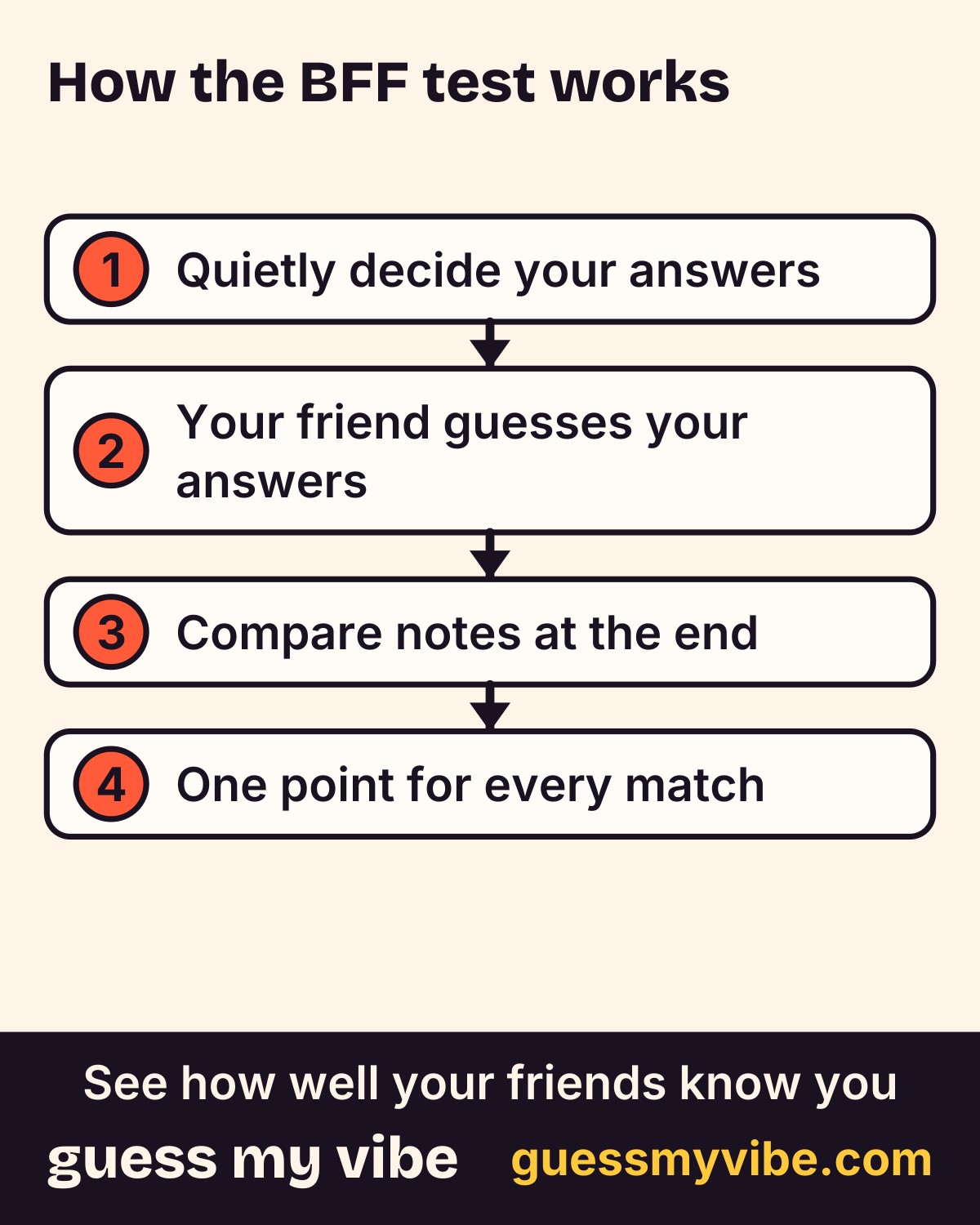
One of you is the subject. Go through all 12 lines below and quietly decide, just for yourself, which side you land on. Don't say your answers out loud yet. Then your friend goes through the same 12 lines and guesses your answer to each one. Compare notes at the end. One point for every match, out of 12.
- A free Saturday with zero plans: you're already texting the group chat, or you're thrilled nobody needs you.
- Your desk, backpack, or car: everything has its own spot, or it's organized chaos only you can explain.
- A friend cancels plans an hour before: you shrug it off by dinner, or you're still turning it over at midnight.
- A new restaurant just opened nearby: you've already looked at the menu, or you'll wait for someone else to pick.
- Someone cuts you off in traffic: you say something out loud, or you let it go in about ten seconds.
- A group project with no leader yet: you start assigning tasks, or you wait to see what's actually needed first.
- A stranger at a party starts venting to you: you're genuinely into it, or you're looking for the snack table.
- Your phone is at 1%: you've got a charger on you, or you're about to be offline for a while.
- A friend asks what you think of their rough new haircut: you find a kind, true thing to say, or you just say you love it.
- A weekend trip, nothing booked yet: you've already made a spreadsheet, or you'll figure it out when you get there.
- You disagree with a friend in front of other people: you say so right there, or you bring it up later, one-on-one.
- A sad movie: you're fine within the hour, or it's with you for the rest of the week.
Add up the matches.
- 10-12: She's watched this pattern enough times to call it. That's a real, earned score.
- 7-9: Solid. She has the obvious parts down and misses a few of the quieter ones.
- 4-6: About what a close friend usually gets on everyday behavior like this: somewhere between a coin flip and a sure thing [1].
- 0-3: Either a rough night for guessing, or there's more to catch up on than you thought.
Cite this figure
Figure: "How the BFF test works." Guess My Vibe (guessmyvibe.com). https://guessmyvibe.com/learn/bff-test#figure-how-the-test-works
Curious how your friends would answer?
Free. Answer 10 quick questions about you, then send your link. Friends play in their browser, no app needed.
Start freeBe honest: most BFF tests stop at trivia
A 12-question list scored by hand is a fun start, not the full picture. You lose things a real test would catch: whether a 7 out of 12 means the same thing for two different friends, whether one question did all the work, whether you were both just reading each other's faces instead of actually guessing. Guess My Vibe runs the same basic idea as a full game: your friend guesses your answers to real personality questions, you see where your views line up and where they split, and the score comes from questions drawn from decades of published personality research, not a list one person wrote in ten minutes.
The real research: how well can a close friend know you?
One study had people rate their own and a close friend's everyday behavior (how much they talk on the phone, argue, watch TV, spend time with others), then checked those ratings against what people actually did, logged by an audio recorder worn for four days. A single friend's guess matched reality at about r = .23 across 20 behaviors. Your own self-guess did about as well: r = .26, and three friends' guesses averaged together also landed at r = .26 [1]. In plain words, that's a real relationship, clearly better than chance, but nowhere near a sure thing. Nobody in that study, including the subjects themselves, got close to calling their own daily habits exactly right.
A much larger meta-analysis, pulling together 263 samples and over 44,000 people, found that some traits are simply easier for a friend to call than others. Correcting for measurement error, a single other person's rating lined up best with self-ratings for how outgoing someone is (a correlation of about .51) and least for Agreeableness, the warmth and cooperativeness trait (about .39), with the other three traits in between [2]. Closeness mattered most for the traits that are hardest to see: family and close friends pulled well ahead of co-workers and strangers at reading how emotionally steady someone is, and the gap between close and distant raters was smallest for how outgoing someone is [2].
A separate study of 165 people rated by both friends and strangers found a similar split by trait, not just by how close the rater was. People were the best judges of their own stress-prone, easily-rattled side. Friends, not the people themselves, were the better judges of how sharp, curious, or intellectually engaged someone comes across. And everyone, self included, read extraversion about equally well [3]. The quiet, inward traits stay closest to home; the ones that show up in a room get read by anyone in it.
Time together helps too, but maybe not the way you'd expect. A study that followed new acquaintances over several weeks found that as people spent more time together, they got better at spotting what made that specific person different from the average person, rather than leaning on a generic stereotype of "what people are usually like." Oddly, the raw accuracy on any one trait didn't necessarily climb much. What improved with time was precision about the individual in front of them, not just a bigger overall score [4].
Do best friends actually have similar personalities?
This is where the evidence gets mixed, so here's the honest version. A study that followed new college friendships for a year found that actually sharing a similar personality had no real link to how close a new friendship became. What did matter was believing you were similar (whether or not you actually were) and other people's sense that you two were alike. In other words, feeling like you're alike can build a friendship even when the underlying personalities don't match up much at all [5].
A later, much larger study found real personality similarity between friends after all, but only once it measured personality through actual behavior (what people did and shared) instead of the usual self-report questionnaire. Across more than 46,000 friend relationships, friends turned out to be meaningfully alike, with correlations roughly between .12 and .31 depending on the trait: a real but modest overlap, not a match. The researchers' explanation is that self-report surveys hide this similarity because people tend to rate themselves against whoever they happen to be comparing themselves to at the time [6]. So the honest answer is: a little, probably, once you measure it the right way, but nowhere near as much as "best friends are basically the same person" would suggest.
Key takeaways
- A real bff test asks how you'd behave in a specific moment, not a fact a friend could just memorize once.
- The 12-question version below takes about five minutes to play and score together, no app required.
- Even your closest friend's guess about your everyday behavior lines up with reality only moderately well, about as well as your own self-guess does [1].
- Friends read some traits far better than others: your outgoing side is the easiest of the five traits to call, and Agreeableness, your warmth toward people, the hardest [2].
- This isn't therapy, a diagnosis, or a substitute for professional care.
Questions people ask
Is a BFF test actually accurate?
Somewhat, and that's a genuinely good result. Research on close friends guessing everyday behavior finds a real but moderate match, not a perfect one, and your own self-guess isn't meaningfully better [1]. A high score on the test above means your friend read you well; it doesn't mean either of you is flawless.
What's the difference between a BFF test, a friendship test, and a best friend quiz?
Mostly branding. All three ask the same basic question: does this friend actually know you? Some lean on trivia (favorite color, inside jokes); the one on this page, and Guess My Vibe itself, lean on behavior instead, which is harder to fake and tells you more.
Can we take this bestie quiz over text instead of in person?
Yes. Write your own answers somewhere your friend can't see (notes app, a message to yourself), then send the 12 lines one at a time and have them guess before you reveal each answer. It works fine long-distance.
How is Guess My Vibe different from a regular best friend quiz?
It uses real personality questions instead of a 12-line list one person wrote, scores everything automatically instead of by hand, and shows you trait by trait where your friend's view of you matches your own and where it splits. The quiz on this page is a free, honest preview of the same idea.
Do best friends really have similar personalities?
A little, once it's measured carefully, but less than people assume. One study found that feeling similar to a new friend mattered more to the friendship than actually being similar [5]; a larger, behavior-based study later found a real but modest personality overlap between friends [6]. Either way, it's not a requirement for a close friendship.
See how well your friends know you.
Free. Answer 10 quick questions about you, then send your link. Friends play in their browser, no app needed.
Start freeReferences
- [1] Vazire, S., & Mehl, M. R. (2008). Knowing me, knowing you: The accuracy and unique predictive validity of self-ratings and other-ratings of daily behavior. Journal of Personality and Social Psychology, 95(5), 1202–1216. PubMed: 18954202 (opens in a new tab)
- [2] Connelly, B. S., & Ones, D. S. (2010). An other perspective on personality: Meta-analytic integration of observers' accuracy and predictive validity. Psychological Bulletin, 136(6), 1092–1122. PubMed: 21038940 (opens in a new tab)
- [3] Vazire, S. (2010). Who knows what about a person? The self-other knowledge asymmetry (SOKA) model. Journal of Personality and Social Psychology, 98(2), 281–300. PubMed: 20085401 (opens in a new tab)
- [4] Biesanz, J. C., West, S. G., & Millevoi, A. (2007). What do you learn about someone over time? The relationship between length of acquaintance and consensus and self-other agreement in judgments of personality. Journal of Personality and Social Psychology, 92(1), 119–135. PubMed: 17201547 (opens in a new tab)
- [5] Selfhout, M., Denissen, J., Branje, S., & Meeus, W. (2009). In the eye of the beholder: Perceived, actual, and peer-rated similarity in personality, communication, and friendship intensity during the acquaintanceship process. Journal of Personality and Social Psychology, 96(6), 1152–1165. PubMed: 19469593 (opens in a new tab)
- [6] Youyou, W., Schwartz, H. A., Stillwell, D., & Kosinski, M. (2017). Birds of a feather do flock together: Behavior-based personality-assessment method reveals personality similarity among couples and friends. Psychological Science, 28(3), 276–284. PubMed: 28059682 (opens in a new tab)
How we find and check these sources: how we write. Spotted an error? Report a correction.
Related
- How Well Do You Know Me Questions to Ask Friends
- Introvert vs Extrovert: What the Research Actually Shows
- Self-Perception vs. How Others See You
- Friendship Compatibility: What Actually Makes It Work
- Do Opposites Attract? What the Research Actually Says
- Sibling Relationships: Closeness, Conflict and Personality
- Friendship Psychology: What the Research Actually Says
- Does AI Know You Better Than Your Friends?
- BuddyMeter Alternative: A Friendship Quiz With Science
- Best Friend Quiz App: Five Kinds, and How to Choose
Want to try it with your own friends? Make a friendship quiz and see who knows you best
Cite this article
- Title
- BFF Test: A Real One to Take With Your Best Friend
- Publisher
- Guess My Vibe
- Updated
- URL
- https://guessmyvibe.com/
learn/ bff-test
Copy this citation
Guess My Vibe. (2026, October 2). BFF Test: A Real One to Take With Your Best Friend. Guess My Vibe. https://guessmyvibe.com/
To point at one section, add that section's anchor (the # link on its heading) to the URL.