Sibling relationships run on three independent dimensions, warmth, conflict, and rivalry, not one simple scale from good to bad, so you can be close to a sibling and still fight constantly [1]. Siblings usually turn out less alike in personality than people assume, and a sibling who's known you your whole life can still be a sharp, honest judge of who you actually are.
What actually makes sibling relationships close, or tense
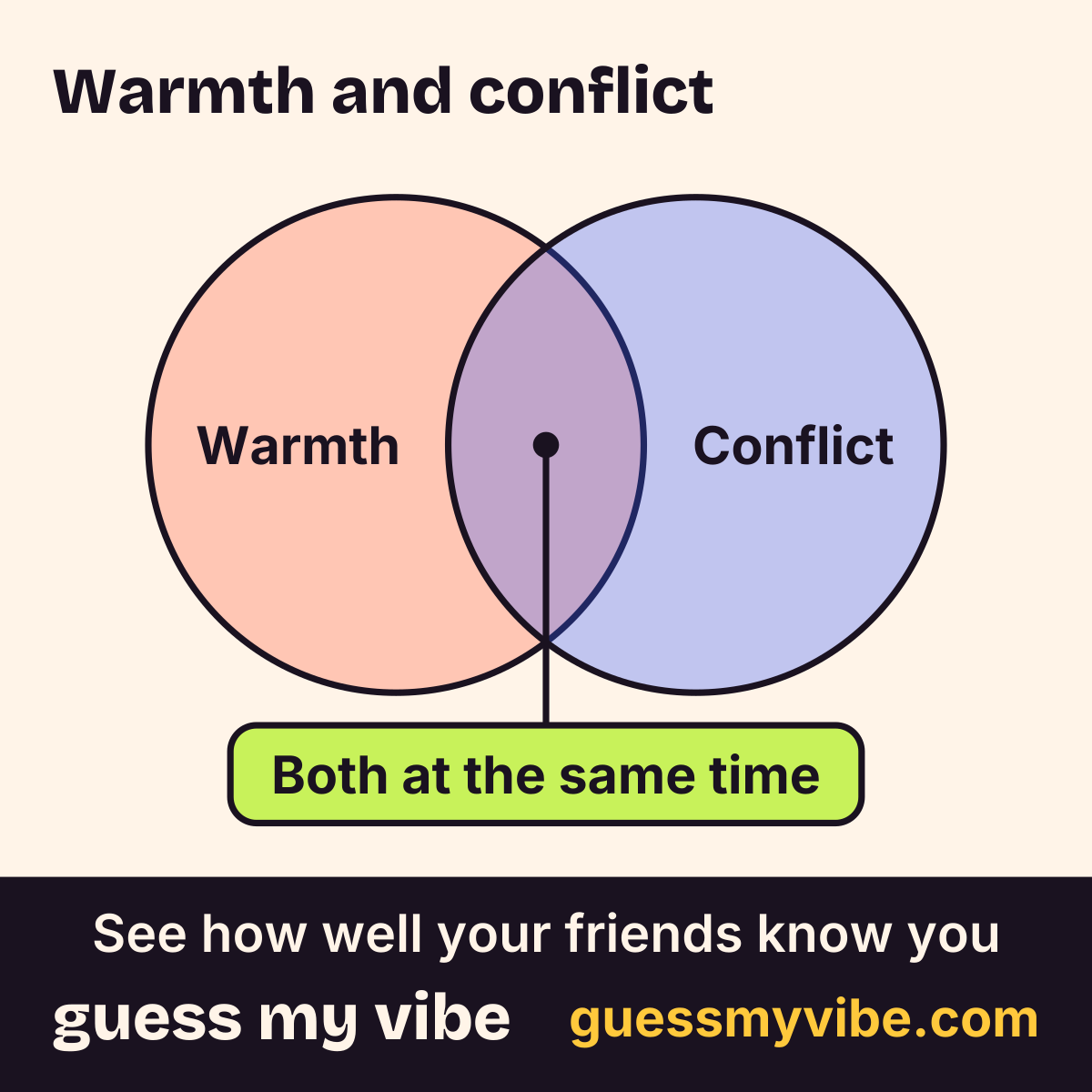
Ask someone to describe their relationship with a sibling and you'll usually get a single word: close, distant, complicated. Research on actual sibling relationships says that single word is hiding something more useful. One study built a questionnaire specifically to measure adult sibling bonds and found they break down into three separate, independent dimensions: warmth, conflict, and rivalry [1]. Independent is the key word. Two siblings can score high on warmth and high on conflict at the same time, which matches how a lot of real sibling relationships actually feel: genuinely close, and also the person who can get under your skin faster than anyone else alive. The same study found these dimensions connected to family structure, how much contact siblings kept up as adults, and siblings' own mental health, which is a fair description of how much a sibling relationship can carry.
Cite this figure
Figure: "Warmth and conflict." Guess My Vibe (guessmyvibe.com). https://guessmyvibe.com/learn/sibling-relationships#figure-warmth-and-conflict-coexist
How the sibling bond changes growing up
Sibling closeness isn't fixed from childhood. A study following 288 families through adolescence used growth-curve modeling to track how attachment to mothers, fathers, and siblings shifted over time, and found the pattern wasn't the same for everyone [3]. Boys' attachment to their mothers changed in one pattern while their attachment to their fathers steadily declined; girls showed close to the opposite split. Sibling attachment quality shifted too, and it depended partly on whether the two siblings were two brothers, two sisters, or a brother and sister. The practical takeaway: if a sibling relationship feels like it's going through a rough patch, or a good one, during the teenage years specifically, that's a completely normal, well-documented stretch of change, not a sign the relationship is broken or set for life.
Does sibling conflict actually matter long-term?
It's tempting to write off sibling fighting as background noise every family has. A meta-analysis pulling together 34 studies and more than 12,000 children and adolescents looked specifically at how sibling relationship quality connected to emotional and behavior problems growing up [4]. More warmth and less conflict between siblings were both linked to fewer of these problems, and sibling conflict was the stronger factor of the two, meaning how much siblings fought mattered more than how little warmth they showed. The link was also stronger between two brothers, in siblings closer in age, and in younger kids rather than teenagers. None of this means sibling conflict causes trouble on its own. Families with more conflict everywhere will naturally show more conflict between siblings too. But it's a real, replicated pattern, not just something parents say to get kids to stop fighting in the back seat.
How sibling dynamics tend to shift later in life
Sibling relationships aren't static once everyone's grown and out of the house, either. Contact often drops for a stretch in early adulthood, when careers, partners, and new cities pull attention elsewhere, which can feel like drifting apart even when the underlying warmth hasn't actually changed. The same three-dimension structure, warmth, conflict, and rivalry, is how the research that established it describes sibling bonds in young adulthood, and that study specifically linked individual differences in warmth, conflict, and rivalry to how much contact siblings kept up and to siblings' own mental health [1]. The study didn't track people into midlife or old age, so it's an open question how far the same three-part structure holds later on, but nothing about it suggests the dynamic freezes in place either. None of that means every distant sibling relationship is secretly fine underneath, or that every close one stays close without any effort. It means the dynamic keeps moving, the same way any long relationship does, rather than locking into whatever shape it had during childhood.
Curious how your friends would answer?
Free. Answer 10 quick questions about you, then send your link. Friends play in their browser, no app needed.
Start freeSibling rivalry: the part that isn't just conflict
Rivalry is the third, often overlooked dimension in the same research that identified warmth and conflict, and it isn't simply a rebrand of fighting [1]. Conflict is about friction, disagreements, getting on each other's nerves. Rivalry is about comparison: who got more attention growing up, whose achievements counted for more, who's "winning" at some unspoken scoreboard that usually started in childhood and sometimes never fully retires. Two siblings can have very little day-to-day conflict and still carry real rivalry underneath it, which is part of why "we never fight" and "we're not competitive with each other" aren't actually the same claim. Because the study found these three dimensions independent of each other, a sibling relationship with low conflict and high rivalry, or high warmth and high rivalry, is a perfectly ordinary, well-documented combination, not a contradiction.
Do siblings actually have similar personalities?
Here's the part that surprises people: growing up in the same house, with the same parents, doesn't make siblings alike in personality nearly as much as it seems like it should. The clearest evidence for this comes from adoption research. Adopted siblings share a family environment, the same house, the same rules, the same holidays, but not genes, so comparing them isolates exactly how much the shared family itself shapes personality. Across most psychological traits, those correlations land close to zero [2]. The researchers behind this line of work call the real driver the nonshared environment: the different friends, teachers, experiences, and even a slightly different version of the same parents that each child in a family ends up with. It's the same explanation that debunks most birth-order claims (read more in our guide to birth order), and it holds here too: two siblings raised "the same way" were never actually having identical experiences, even living under one roof.
This surprises people partly because shared genes do pull siblings somewhat toward each other, just less than shared upbringing gets credit for. Full siblings share about half their genetic material on average, which is part of why two siblings can look alike and still turn out to have noticeably different temperaments: half-shared genes leave plenty of room for difference, and the environment each child experiences separately does the rest of the work. The practical version of this for any one family: a sibling who seems like your opposite in almost every way isn't evidence that something unusual happened in your house. It's closer to the statistically expected outcome.
Can a sibling guess your personality better than a friend can?
None of this means siblings don't know each other. A sibling relationship built on real warmth, even one with plenty of conflict mixed in, usually comes with decades of direct observation: every awkward phase, every bad haircut, every version of you before you learned to manage how you come across to new people. Research on how well close others judge personality consistently finds that closeness and time spent together both help accuracy, especially for the traits that are hardest to observe from the outside, like how easily someone gets stressed [5]. A sibling has both of those going for them in a way almost nobody else in your life does, including most friends.
A friend usually only meets the version of you that's already a little curated for new people. A sibling met you before you knew how to do that. That's a genuinely different vantage point, not a better or worse one, and it's exactly why comparing the two is more interesting than picking a winner in advance. Whether your sibling actually beats your best friend at guessing your real answers is a fun, open question with no guaranteed outcome either way, and it's exactly what Guess My Vibe is built to test: have a sibling answer the same real personality questions a friend would, and see whose guesses land closer to who you actually are.
Key takeaways
- Adult sibling relationships break down into three separate dimensions, warmth, conflict, and rivalry, so closeness and friction can both be true of the same relationship at once [1].
- Siblings sharing a house and parents doesn't make them alike. Adopted siblings, who share family environment but not genes, show personality correlations near zero, evidence that most of what shapes personality happens separately to each child, not together as a family [2].
- Attachment to siblings changes through adolescence, and a study of 288 families found the pattern depended on both siblings' genders and whether the two were brothers, sisters, or a brother and sister [3].
- A meta-analysis of over 12,000 children and teens found sibling warmth and low conflict were both linked to fewer emotional and behavior problems growing up, with conflict the stronger factor of the two [4].
- This isn't therapy, a diagnosis, or a substitute for professional care.
Questions people ask
What makes sibling relationships close as adults?
Research on adult sibling bonds finds three separate dimensions at play, warmth, conflict, and rivalry, so a relationship can be both close and prone to friction at the same time. Individual differences in warmth, conflict, and rivalry were linked to how much contact siblings kept up and to siblings' own mental health [1].
Why do siblings have such different personalities if they grew up in the same house?
Because sharing a house and parents isn't the same as sharing experiences. Adopted siblings, who share family environment but not genes, show personality correlations near zero, which means most of what shapes personality happens separately to each child, not through what the family shares [2].
Does fighting with a sibling growing up cause problems later?
A meta-analysis of over 12,000 children and teens found more sibling conflict was linked to more emotional and behavior problems, and less sibling warmth was too, with conflict the stronger factor. That's a correlation across many families, not a guarantee for any two siblings [4].
Do siblings get closer or more distant during the teenage years?
It varies, and it shifts. A study tracking 288 families through adolescence found attachment to siblings changed over time in patterns that depended on both the siblings' own genders and whether the two were brothers, sisters, or a brother and sister [3].
Does a sibling know me better than my best friend does?
Possibly, especially for traits that are hard to see from the outside, since closeness and years of direct observation both improve how well someone reads your personality. The honest way to find out is to have both guess the same questions about you and compare [5].
See how well your friends know you.
Free. Answer 10 quick questions about you, then send your link. Friends play in their browser, no app needed.
Start freeReferences
- [1] Stocker, C. M., Lanthier, R. P., & Furman, W. (1997). Sibling relationships in early adulthood. Journal of Family Psychology, 11(2), 210–221. doi.org/10.1037/0893-3200.11.2.210 (opens in a new tab)
- [2] Plomin, R., & Daniels, D. (2011). Why are children in the same family so different from one another?. International Journal of Epidemiology, 40(3), 563–582. PubMed: 21807642 (opens in a new tab)
- [3] Buist, K. L., Deković, M., Meeus, W., & van Aken, M. A. G. (2002). Developmental Patterns in Adolescent Attachment to Mother, Father and Sibling. Journal of Youth and Adolescence, 31(3), 167–176. doi.org/10.1023/A:1015074701280 (opens in a new tab)
- [4] Buist, K. L., Deković, M., & Prinzie, P. (2013). Sibling relationship quality and psychopathology of children and adolescents: A meta-analysis. Clinical Psychology Review, 33(1), 97–106. PubMed: 23159327 (opens in a new tab)
- [5] Connelly, B. S., & Ones, D. S. (2010). An other perspective on personality: Meta-analytic integration of observers' accuracy and predictive validity. Psychological Bulletin, 136(6), 1092–1122. PubMed: 21038940 (opens in a new tab)
How we find and check these sources: how we write. Spotted an error? Report a correction.
Related
Cite this article
- Title
- Sibling Relationships: Closeness, Conflict and Personality
- Publisher
- Guess My Vibe
- Updated
- URL
- https://guessmyvibe.com/
learn/ sibling-relationships
Copy this citation
Guess My Vibe. (2026, October 3). Sibling Relationships: Closeness, Conflict and Personality. Guess My Vibe. https://guessmyvibe.com/
To point at one section, add that section's anchor (the # link on its heading) to the URL.