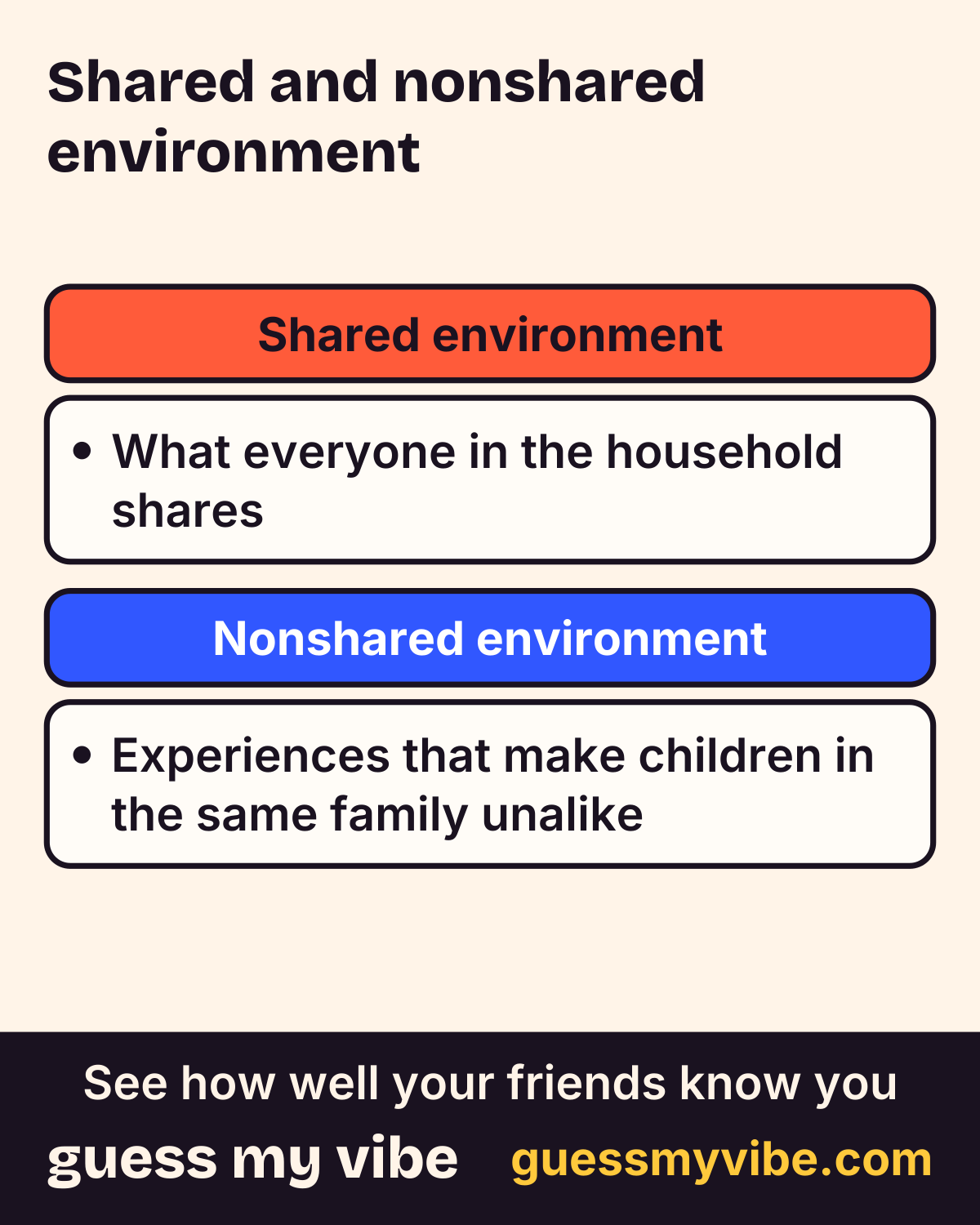
Siblings are so different largely because of what researchers call nonshared environment: experiences that make children in the same family unalike, not the ones the family shares [1]. The twist is that the specific nonshared factors researchers have measured, do not account for a substantial portion of those differences [2].
Why are siblings so different? The standard answer from behavioral genetics is that growing up in the same house doesn't mean growing up in the same environment. Experiences that are unique to each child, which researchers call nonshared environment, account for more of the environmental variation in personality than what the family shares. But there's a second half to the story that rarely gets told: when scientists went looking for those unique experiences, they found that the obvious candidates explain only a small share of the differences. So the honest answer is partly "we know the category, and we haven't pinned down the causes."
This article covers where the idea came from, what the biggest reviews found, and what it does and doesn't mean for your own family. It goes deeper on the research question than our guides to sibling relationships and to birth order, which cover the day-to-day relationship and the birth-order myth respectively.
The puzzle: same house, different people
A natural assumption is that parenting and home life shape children, which should make siblings alike. Behavioral geneticists tested this by comparing different kinds of relatives, and one result stood out: when genetic similarity is controlled, siblings often appear no more alike than individuals selected at random from the population [2].
The clearest test uses adopted children. Two unrelated children raised in the same family share the family environment but not genes, so their similarity directly measures how much the shared environment matters. For most psychological characteristics, correlations for such adoptive siblings hover near zero [1]. In other words, being raised in the same home by the same parents doesn't make unrelated children noticeably alike on most psychological characteristics.
The 1987 argument: nonshared environment
In a seminal 1987 article, Plomin and Daniels pulled this evidence together. Their central claim was that environmental differences between children in the same family, which they called nonshared environment, are the major source of environmental variance for personality, psychopathology and cognitive abilities. The research, they wrote, converges on a surprising conclusion: environmental influences make two children in the same family as different from each other as two children chosen at random from the population [1]. The same text was reprinted in 2011 in the International Journal of Epidemiology with commentaries [5].
The authors also noted that cognitive ability, long thought to be an exception, appeared to follow the same pattern after adolescence: the environmental variance affecting IQ was also of the nonshared kind [1]. The article's point wasn't that families don't matter. It was that the environmental influences that show up in the data are the ones that differ between children in a family, not the ones everyone in the household shares.
What "nonshared environment" actually means
The term sounds like a cause, but it started as a statistical category. Researchers split the differences between people into pieces: those linked to genes, those linked to what family members share, and a remainder linked to everything that differs between family members. The nonshared part is that third piece. Turkheimer and Waldron's review separated two ideas that are easy to blur: nonshared environment as a component of variance in a model, and the actual environmental events that cause differences, with a further distinction between the effective environment (what actually affects a child) and the objective one (what an observer would see) [2].
That's a key point for understanding sibling differences. When people say "nonshared environment explains it," they're naming a category large enough to hold many things, and not identifying a specific cause. Naming the category tells you that the shared family home isn't the main driver. It doesn't tell you which unique experiences are.
Cite this figure
Figure: "Shared and nonshared environment." Guess My Vibe (guessmyvibe.com). https://guessmyvibe.com/learn/why-are-siblings-so-different#figure-shared-vs-nonshared
Curious how your friends would answer?
Free. Answer 10 quick questions about you, then send your link. Friends play in their browser, no app needed.
Start freeThe twist: the things we can measure explain little
If nonshared environment is the big driver, the next step is to find the specific experiences behind it: different friends, different teachers, different treatment by parents, different life events. Researchers have measured many such things. Turkheimer and Waldron's quantitative review pulled those studies together and reached a notable conclusion: measured nonshared environmental variables do not account for a substantial portion of the nonshared variability that the biometric studies posit [2].
In plain words, the experiences that scientists measured, and that feel like obvious explanations, don't add up to the amount of difference that the biometric studies attribute to nonshared environment. The authors suggest other explanations for the large nonshared component, and their abstract doesn't specify which [2]. The review is from 2000, and we haven't checked whether later work has closed the gap. Treat this as a documented limit of what had been measured at that point, not a final verdict.
Where genes fit in
Full siblings aren't genetic copies of each other, so some of the differences between them are genetic. A meta-analysis of virtually all published twin studies of complex traits, covering 17,804 traits from 2,748 publications and about 14.6 million partly dependent sets of twins, found that average reported heritability across all traits was 49%. For a majority (69%) of traits, twin resemblance was consistent with a simple model in which it comes solely from additive genetic variation, and the data were inconsistent with substantial influences from shared environment [3].
Two cautions. This analysis covers human traits of every kind, not personality alone, so it's a broad backdrop and not a figure for any one trait. And heritability is a population statistic: it describes how much of the variation between people in a sample is linked to genetic differences, not how much of any individual's personality is "genetic." Still, the pattern fits the story above: shared family environment seems to explain little of why siblings resemble each other, which leaves genes and nonshared factors to account for the rest.
Birth order isn't the missing explanation
A tempting shortcut is to say siblings differ because of birth order: the responsible firstborn, the rebellious middle child, the charming baby. The best recent evidence doesn't support it for personality. Using three national panels from the United States (n = 5,240), Great Britain (n = 4,489) and Germany (n = 10,457), and comparing siblings both within and between families, researchers found no birth-order effects on extraversion, emotional stability, agreeableness, conscientiousness or imagination. They did find a small decline of about a tenth of a standard deviation in self-reported intellect with later birth position [4]. Our birth order guide covers this in more detail.
This matters here because birth order is a measured nonshared factor, and one of the most intuitive. It's consistent with the Turkheimer and Waldron conclusion that the experiences people can name and measure don't account for much of the difference between siblings.
What this means for your own family
- Differences between siblings are normal. Environmental influences make two children in the same family about as different as children picked at random from the population [1]. So a difference between siblings isn't, by itself, evidence that anyone's parenting failed or that one sibling is the odd one out.
- There's rarely one explanation. Even researchers can't name the specific experiences that drive most of the difference [2]. Be skeptical of a neat story that one cause explains why you and your sibling are different.
- "You were raised the same" isn't a fair expectation. Growing up in the same home doesn't mean growing up in the same environment, and the twin data were inconsistent with substantial shared-environment influence across traits [3].
- Your sibling's view of you is one view among several. Self-views and other people's views of us don't always match, as our guide to how others see you explains, so a sibling's picture of you and your own can legitimately differ.
These are findings about averages across many families, not claims about yours. They can't tell you why you and a particular sibling differ, only that differences are what the research would lead you to expect.
See how well your sibling knows you
If siblings are so different, how well do they actually know each other? Guess My Vibe is a free game where a friend guesses how you'd answer questions about yourself, and a sibling can play too. It's a light way to see where you and a sibling see things the same way, and where you don't, with plenty to laugh about when you compare answers.
Key takeaways
- Behavioral genetics found that environmental differences between children in the same family, not the shared family environment, are the major source of environmental variance in personality, and adopted siblings reared together show correlations near zero for most psychological traits [1].
- A quantitative review found that measured nonshared environmental variables do not account for a substantial portion of the nonshared variability that biometric studies posit, so the category has been named more clearly than its causes [2].
- Across 2,748 publications of twin studies, average heritability was 49%, and the data were inconsistent with substantial shared-environment influence, which fits siblings differing even in the same home [3].
- Birth order, the favorite explanation, showed no effect on extraversion, emotional stability, agreeableness, conscientiousness or imagination in three large national panels [4].
- This isn't therapy, a diagnosis, or a substitute for professional care.
Questions people ask
Why are siblings so different in personality?
The leading explanation is nonshared environment: experiences that differ between children in the same family, which behavioral genetics research found to be the major source of environmental variance in personality [1]. Genes also differ between siblings, and the specific causes of the nonshared part remain largely unidentified [2].
Do siblings raised in the same house have the same environment?
Not in the sense that matters for most psychological characteristics. Adopted children reared in the same family, who share environment but not heredity, show correlations near zero for most psychological characteristics [1].
Is birth order why siblings are different?
Not for personality. Three large national panels found no birth-order effects on the Big Five traits, only a small decline in self-reported intellect among later-born siblings [4].
How much of personality is genetic?
Across all human traits studied in twins, average heritability was 49%, but that figure covers traits of every kind and describes variation in populations, not any one person [3].
Do different friends and parenting explain sibling differences?
Only to a small extent in the research reviewed. A quantitative review found measured nonshared environmental variables don't account for a substantial portion of the nonshared variability posited by biometric studies [2].
See how well your friends know you.
Free. Answer 10 quick questions about you, then send your link. Friends play in their browser, no app needed.
Start freeReferences
- [1] Plomin, R., & Daniels, D. (1987). Why are children in the same family so different from one another?. Behavioral and Brain Sciences, 10(1), 1-16. doi.org/10.1017/S0140525X00055941 (opens in a new tab)
- [2] Turkheimer, E., & Waldron, M. (2000). Nonshared environment: A theoretical, methodological, and quantitative review. Psychological Bulletin, 126(1), 78-108. PubMed: 10668351 (opens in a new tab)
- [3] Polderman, T. J. C., Benyamin, B., de Leeuw, C. A., Sullivan, P. F., van Bochoven, A., Visscher, P. M., & Posthuma, D. (2015). Meta-analysis of the heritability of human traits based on fifty years of twin studies. Nature Genetics, 47(7), 702-709. PubMed: 25985137 (opens in a new tab)
- [4] Rohrer, J. M., Egloff, B., & Schmukle, S. C. (2015). Examining the effects of birth order on personality. Proceedings of the National Academy of Sciences, 112(46), 14224–14229. PubMed: 26483461 (opens in a new tab)
- [5] Plomin, R., & Daniels, D. (2011). Why are children in the same family so different from one another?. International Journal of Epidemiology, 40(3), 563–582. PubMed: 21807642 (opens in a new tab)
How we find and check these sources: how we write. Spotted an error? Report a correction.
Related
- Sibling Relationships: Closeness, Conflict and Personality
- Birth Order and Personality: What the Evidence Shows
- Self-Knowledge: Why You Know Some Traits Better Than Others
- Self-Perception vs. How Others See You
- Do Twins Have the Same Personality? What Studies Show
- Is Personality Genetic? About 40%, Says the Research
- Sibling Rivalry in Adulthood: What Research Says
Cite this article
- Title
- Why Are Siblings So Different? What Twin Studies Show
- Publisher
- Guess My Vibe
- Updated
- URL
- https://guessmyvibe.com/
learn/ why-are-siblings-so-different
Copy this citation
Guess My Vibe. (2026, October 4). Why Are Siblings So Different? What Twin Studies Show. Guess My Vibe. https://guessmyvibe.com/
To point at one section, add that section's anchor (the # link on its heading) to the URL.