No, twins don't have the same personality, but identical twins are more alike than fraternal twins are. In one study that gave a personality questionnaire to reared-together and reared-apart twins, models that left out genes fit none of the 14 personality scales, and heritability estimates ranged from .39 to .58 [1]. That leaves a lot of room for differences, even between people who share the same genes.
Do twins have the same personality? Identical twins tend to resemble each other more than fraternal twins do, and in some striking studies they resemble each other even when raised apart. But "more alike" isn't "the same." The research that makes twins so interesting to scientists also shows how much room is left for differences. In an adult twin study, heritabilities across 14 personality scales ranged from .39 to .58 [1], which means a large share of the differences between people was not explained by genes.
This article explains how twin studies work, what they have found about personality, why identical twins still differ, and where the method runs out of road. For the headline heritability figure and how to read it, see our guide to whether personality is genetic. For why siblings in general turn out so different, see our guide to that question.
How twin studies work
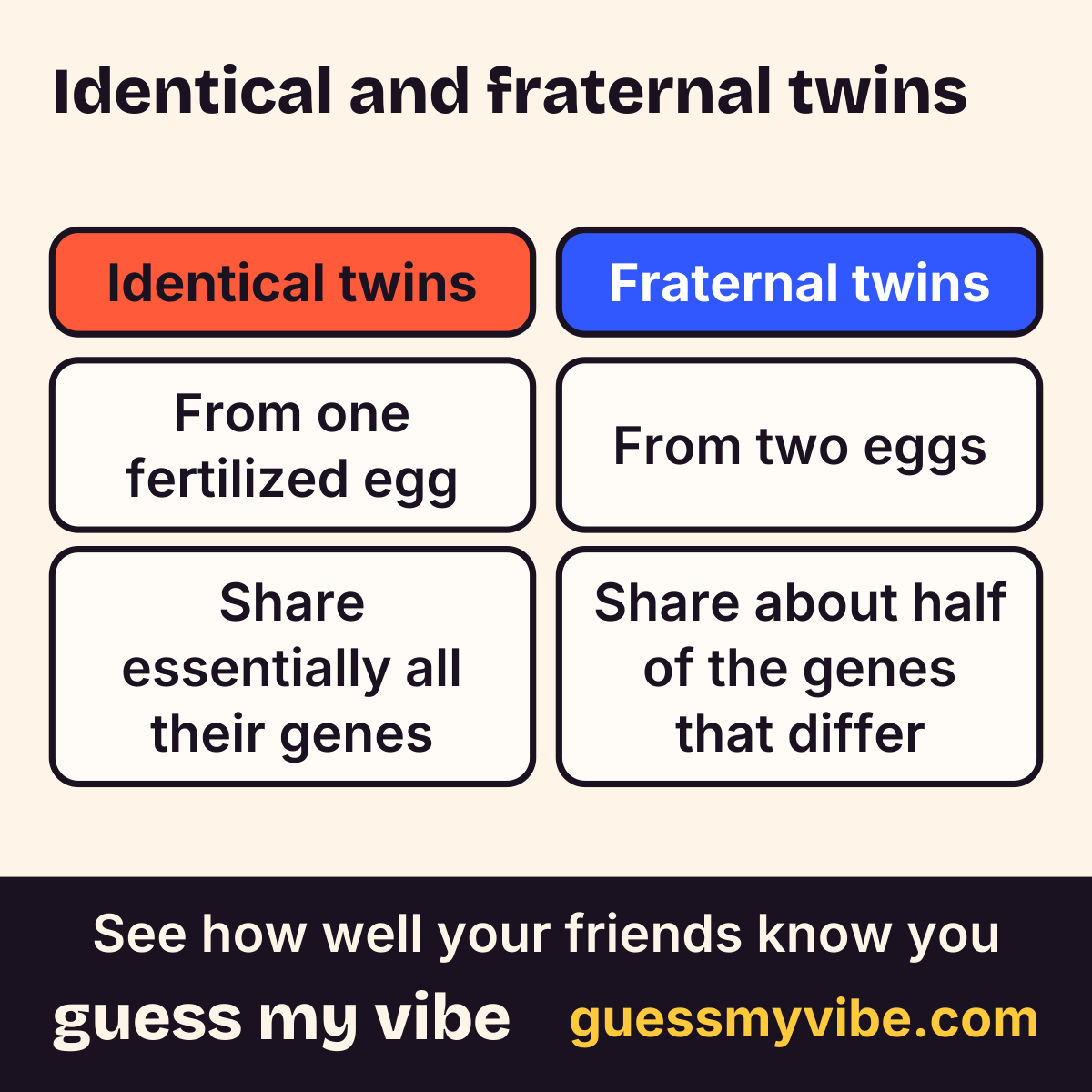
Identical (monozygotic) twins develop from one fertilized egg and share essentially all their genes. Fraternal (dizygotic) twins develop from two eggs and, like ordinary siblings, share about half of the genes that differ between people. Both types of twins are usually raised in the same home at the same time. So if identical twins turn out more alike on a trait than fraternal twins do, genes are one plausible reason. Researchers turn that comparison into a statistical estimate called heritability. This basic logic is textbook behavior genetics rather than a finding from any single paper cited here.
A second design adds twins who were adopted away and raised in different homes. If identical twins who never lived together still turn out similar, shared upbringing becomes a less likely explanation. Researchers often combine the designs in one study, comparing identical and fraternal twins, reared together and reared apart, to separate genetic influence from the family environment the twins share. The best-known version of this design is the Minnesota Study of Twins Reared Apart.
Cite this figure
Figure: "Identical and fraternal twins." Guess My Vibe (guessmyvibe.com). https://guessmyvibe.com/learn/twins-personality#figure-identical-vs-fraternal
What twins reared apart show
The Minnesota Study of Twins Reared Apart examined more than 100 sets of twins or triplets who had been separated in infancy, giving each a week of psychological and physiological assessment. On multiple measures of personality and temperament, occupational and leisure-time interests, and social attitudes, identical twins reared apart were about as similar as identical twins reared together [2]. That is hard to explain by shared upbringing alone.
Another study of personality used a 14-scale questionnaire with 217 identical and 114 fraternal reared-together adult twin sets, and 44 identical and 27 fraternal reared-apart sets. Models that left out genes did not fit any of the scales. Heritabilities estimated by the best-fitting model ranged from .39 to .58, and the contribution of a common family environment was small and negligible for all but 2 of the 14 measures [1]. The authors note this is consistent with earlier reports but contrary to widely held beliefs. They also found evidence of nonadditive genetic effects for 3 of the measures, meaning some genetic influences may combine in ways that are more than a simple sum.
A Big Five study shows a similar pattern. In a twin study with 123 identical and 127 fraternal twin sets, genetic influence was estimated at 41% for neuroticism, 53% for extraversion, 61% for openness, 41% for agreeableness and 44% for conscientiousness. Shared environmental influences accounted for a negligible proportion of the variance in most scales [5]. These are single-study estimates, and the exact numbers vary from study to study.
Curious how your friends would answer?
Free. Answer 10 quick questions about you, then send your link. Friends play in their browser, no app needed.
Start freeWhy identical twins still differ
Heritability near .40 to .50 isn't the same as sameness. Across studies, a meta-analysis found an average personality heritability of .40, which is about 40% of the differences between people, with the rest attributed to environment [3]. For twin studies the average was .47, so in a typical twin study something over half of the variation in personality was not tied to genes. And that figure describes differences between people in a group, not how much of one twin's personality is "genetic".
What does the remaining difference come from? In the twin study of the Big Five, nonshared environmental influences, meaning experiences that differ between family members, accounted for the majority of the environmental variance in all scales [5]. One review concluded that nonshared environment is the major source of environmental variance for personality [6]. One small prospective study followed 26 identical twin sets from birth and found that more stressors in childhood and early adolescence went along with bigger personality differences within a set at age 29, in agreeableness, openness and conscientiousness [7]. That sample is tiny, and the authors themselves frame it as a lead for larger studies, so treat it as a suggestion rather than a finding.
There are also reasons that have nothing to do with life events. Personality questionnaires contain measurement error, which in these models typically gets counted as environment. So some of what looks like a difference between identical twins is just noise in how each twin answered on a given day. That's our own caution about how the models work, not a number from a particular paper.
The limits of twin studies
Twin studies are one of the most useful tools for separating nature and nurture, but they are not a perfect instrument. A broad review covering the genetic and environmental influences on human psychological differences discusses the main criticisms of twin and adoption designs, and it still concludes that virtually all individual psychological differences, when reliably measured, are moderately to substantially heritable [4]. In our reading, that means the debate is about how precise the estimates are, not whether genes play a role at all.
A few limits are worth keeping in mind. The design assumes that identical and fraternal twins are treated similarly enough that extra similarity in identical twins is genetic, and that assumption is one of the standard targets of criticism. The estimates also depend on the design: the meta-analysis found twin studies averaged .47 while family and adoption studies averaged .22 [3]. And the included studies used self-reported personality, so the numbers describe how people rate themselves. A twin's friends might describe them differently. Finally, results from twins may not generalize perfectly to everyone, since twins and their circumstances aren't identical to those of other people. These are general cautions of ours, not conclusions drawn by one particular paper.
What twins can teach the rest of us
The most useful lesson is a modest one. Genes shape the tendencies people are born with, but they don't write a personality in advance. Even for people who share their entire genome, the research shows meaningful differences. If you are a twin, or have twin friends, that probably matches your experience: two people can seem very alike at first and then very different once you know them well.
It also shows why asking someone else about you can be revealing. Even people who know you well can see you differently from how you see yourself. That's the idea behind Guess My Vibe: friends answer as they think you would, and you see where they match you and where they miss. If you have a twin or a sibling, it's a fun way to see how similar your read of each other really is, instead of assuming you know.
Key takeaways
- In a study of twins who were separated in infancy, identical twins reared apart were about as similar on several personality and temperament measures as identical twins reared together [2].
- In an adult twin study using a 14-scale personality questionnaire, models with no genetic influence did not fit any of the scales, and heritabilities ranged from .39 to .58 [1].
- Heritability estimates are well below 100%, so genes are not the whole story. A meta-analysis found an average of .47 in twin studies and .22 in family and adoption studies [3].
- Twin and adoption designs have criticisms that a broad review sets out, so estimates are best read as approximate [4].
- This isn't therapy, a diagnosis, or a substitute for professional care.
Questions people ask
Do identical twins have the same personality?
No. They are more alike than fraternal twins, but heritabilities in twin studies are well below 100%. One study found estimates from .39 to .58 across 14 personality scales [1].
Are twins raised apart still similar in personality?
In the Minnesota Study of Twins Reared Apart, identical twins reared apart were about as similar on multiple measures of personality and temperament as identical twins reared together [2].
Why do identical twins have different personalities?
Largely because of environmental influences, and especially experiences that differ between them. In a Big Five twin study, nonshared environmental influences accounted for the majority of the environmental variance in all scales [5]. Measurement error also plays a part in these models.
Do fraternal twins share personality traits?
Somewhat, as ordinary siblings do. Fraternal twins share about half of the genes that vary between people, so twin studies expect them to be less alike than identical twins. Heritability estimates in the personality literature come from twin, family and adoption designs, and the average from twin studies was .47 [3].
See how well your friends know you.
Free. Answer 10 quick questions about you, then send your link. Friends play in their browser, no app needed.
Start freeReferences
- [1] Tellegen, A., Lykken, D. T., Bouchard, T. J., Jr., Wilcox, K. J., Segal, N. L., & Rich, S. (1988). Personality similarity in twins reared apart and together. Journal of Personality and Social Psychology, 54(6), 1031-1039. PubMed: 3397862 (opens in a new tab)
- [2] Bouchard, T. J., Jr., Lykken, D. T., McGue, M., Segal, N. L., & Tellegen, A. (1990). Sources of human psychological differences: the Minnesota Study of Twins Reared Apart. Science, 250(4978), 223-228. PubMed: 2218526 (opens in a new tab)
- [3] Vukasović, T., & Bratko, D. (2015). Heritability of personality: A meta-analysis of behavior genetic studies. Psychological Bulletin, 141(4), 769-785. PubMed: 25961374 (opens in a new tab)
- [4] Bouchard, T. J., Jr., & McGue, M. (2003). Genetic and environmental influences on human psychological differences. Journal of Neurobiology, 54(1), 4-45. PubMed: 12486697 (opens in a new tab)
- [5] Jang, K. L., Livesley, W. J., & Vernon, P. A. (1996). Heritability of the big five personality dimensions and their facets: a twin study. Journal of Personality, 64(3), 577-591. PubMed: 8776880 (opens in a new tab)
- [6] Plomin, R., & Daniels, D. (2011). Why are children in the same family so different from one another?. International Journal of Epidemiology, 40(3), 563–582. PubMed: 21807642 (opens in a new tab)
- [7] Torgersen, A. M., & Janson, H. (2002). Why do identical twins differ in personality: shared environment reconsidered. Twin Research, 5(1), 44-52. PubMed: 11893281 (opens in a new tab)
How we find and check these sources: how we write. Spotted an error? Report a correction.
Related
Cite this article
- Title
- Do Twins Have the Same Personality? What Studies Show
- Publisher
- Guess My Vibe
- Updated
- URL
- https://guessmyvibe.com/
learn/ twins-personality
Copy this citation
Guess My Vibe. (2026, October 4). Do Twins Have the Same Personality? What Studies Show. Guess My Vibe. https://guessmyvibe.com/
To point at one section, add that section's anchor (the # link on its heading) to the URL.