Partly. A meta-analysis of studies covering more than 100,000 people found an average heritability of personality of about .40, meaning genetic differences account for roughly 40% of the differences between people in a sample, with the other 60% coming from environment [1]. That is a statement about groups of people, not a claim that 40% of your own personality is written in your DNA.
Is personality genetic? The best summary we have says partly, and by a moderate amount. When researchers pooled behavior genetic studies of personality, the average heritability came out at about .40: roughly 40% of the differences between people in those samples traced to genetic differences, and roughly 60% to environmental influences [1]. That sounds like a clean split of your personality into two buckets. It isn't, and the gap between what the number says and what people hear is the interesting part of this topic.
This article covers what meta-analyses of personality heritability found, how to read the word "heritability" correctly, what the "environment" half actually contains, and what the research does not tell you about your own personality. If you want the twin-study method in detail, see our guide to whether twins have the same personality, and for why siblings turn out different, see our guide to that question.
What the main personality meta-analysis found
Vukasović and Bratko (2015) gathered behavior genetic studies of personality: twin, family and adoption designs, all using self-reported personality measures. After applying their inclusion rules, the final sample was 62 independent effect sizes representing more than 100,000 participants of both genders and all ages [1]. The average effect size was .40. The authors summarize that as 40% of individual differences in personality being due to genetic influences and 60% to environmental ones, and the conclusion did not change after they corrected for possible publication bias, the tendency of positive findings to get published more often than null ones [1].
Two further details matter for reading that number. First, gender and the choice of personality model were not significant moderators of the heritability estimate. Second, study design was a significant moderator: twin studies averaged .47, while family and adoption studies averaged .22 [1]. That is a big enough gap to remind you that "40%" is a central estimate across methods, not a measurement of a fixed biological quantity. The authors describe the moderator test by design as the first of its kind in personality research, and they discuss limitations in the paper.
Individual twin studies show similar territory, with variation across traits. In one twin study of 123 identical and 127 fraternal twin sets, using a Big Five questionnaire, the estimated genetic influence was 41% for neuroticism, 53% for extraversion, 61% for openness, 41% for agreeableness and 44% for conscientiousness [3]. Another, using a different personality questionnaire with reared-together and reared-apart adult twins, put heritabilities between .39 and .58 across 14 scales [4]. These are single studies, with their own measurement choices and sampling error, so treat the individual trait numbers as rough illustrations rather than fixed values for each trait.
How personality compares with other human traits
It helps to know that personality isn't unusual. A meta-analysis of twin studies covering 17,804 traits from 2,748 publications, representing about 14.6 million partly dependent twin sets, found an average reported heritability of 49% across all traits, not personality in particular [2]. For 69% of the traits, twin resemblance was consistent with additive genetic variation alone, and the data were inconsistent with substantial shared-environment or non-additive genetic influence [2].
A broad review of the field reached a similar overall conclusion about psychology: there is strong evidence that virtually all individual psychological differences, when reliably measured, are moderately to substantially heritable [5]. That review also covers the main criticisms of twin and adoption designs, which we come back to below. So when you read that personality is about 40% heritable, the fair framing is that this is in the normal range for human traits that vary from person to person, not a special fact that sets personality apart.
Heritability is a population statistic, not a percent of you
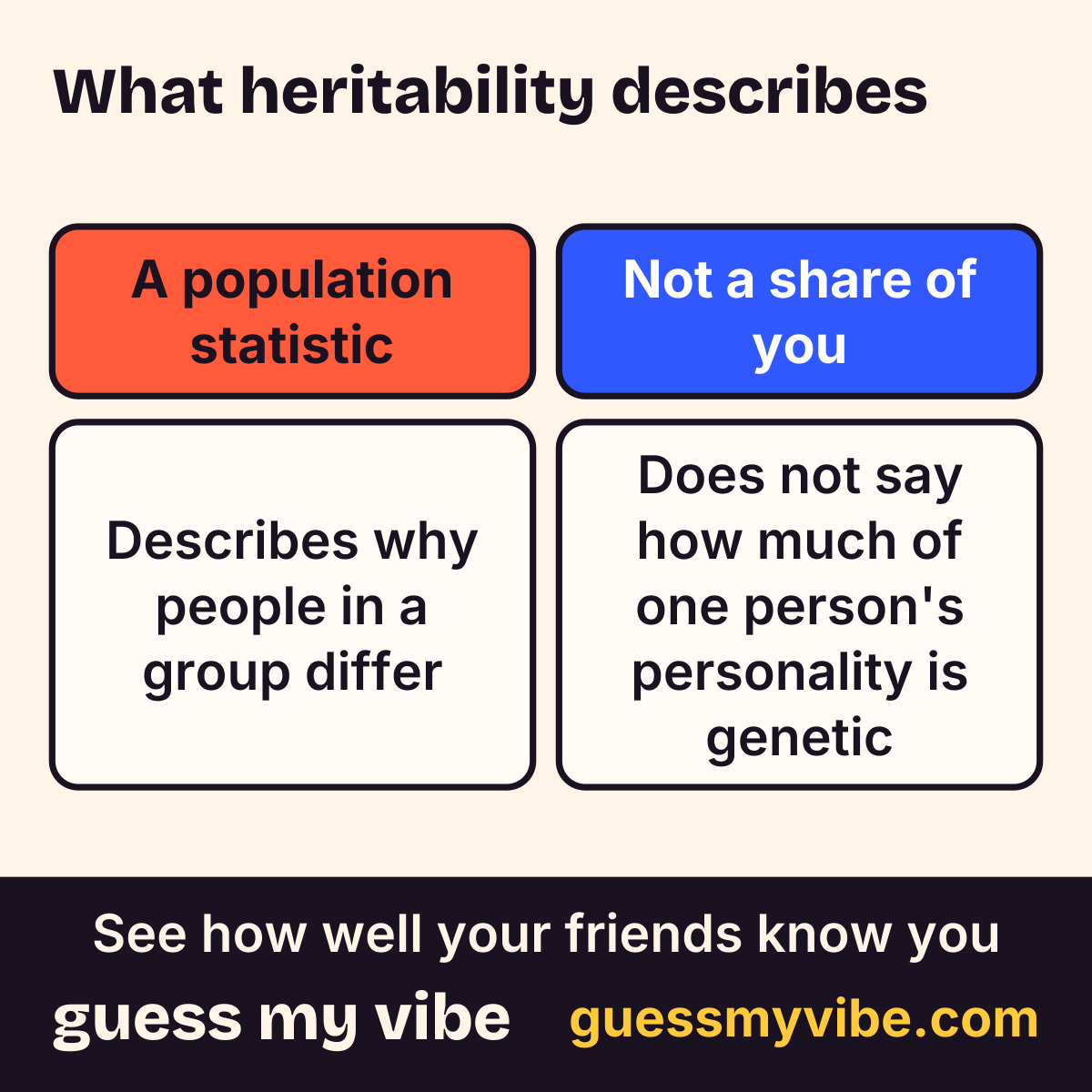
Here is the most common misreading. "Personality is 40% heritable" does not mean that 40% of your personality comes from your genes and 60% from your upbringing. Heritability is calculated across a group of people. It answers one question: of the differences we see between people in this sample, how much line up with genetic differences between them? It says nothing about how any one person's traits were built, and it can't be split into a part that belongs to you.
A rough analogy: ask how much of the variation in the area of a rectangle comes from its width versus its height. In a set of rectangles that differ mostly in width, the answer is mostly width. In a set that differ mostly in height, the answer flips. Neither answer tells you what share of one particular rectangle's area is "width", because area needs both. Personality works in a similar way in the sense that a trait develops from genes and experience together, so a single person's personality has no meaningful 40/60 split. This analogy is ours, not from the papers cited here.
Two practical consequences follow, and both come from how the statistic is built rather than from any one study. Heritability can change if the population or its environments change, because it depends on how much people vary in each. And a heritable trait is not an unchangeable one. The statistic describes differences between people at a time; it doesn't say what would happen if someone's circumstances changed.
Cite this figure
Figure: "What heritability describes." Guess My Vibe (guessmyvibe.com). https://guessmyvibe.com/learn/is-personality-genetic#figure-population-statistic
Curious how your friends would answer?
Free. Answer 10 quick questions about you, then send your link. Friends play in their browser, no app needed.
Start freeWhat is in the other 60%?
The "environment" share is everything that isn't genes, and in these models that typically also soaks up measurement noise, such as a bad day when someone filled out a questionnaire. It's less obvious than people expect which environment matters. In twin data, the part of environment that siblings share, such as the same house and the same parents, usually comes out small for personality. In the twin study above, shared environmental influences accounted for a negligible proportion of the variance in most scales, and nonshared environmental influences accounted for the majority of the environmental variance in all scales [3]. In the reared-together and reared-apart twin study, the common family-environment contribution was small and negligible for all but 2 of the 14 personality measures [4].
The "nonshared" label means environmental influences that differ from one child to another in the same family. One review concluded that this nonshared environment is the major source of environmental variance for personality, psychopathology and cognitive abilities [6]. That doesn't mean parents don't matter. It means that, for personality differences between people, the ways siblings are treated and the experiences they have separately seem to do more of the work than the shared home. Our guide to why siblings are so different goes deeper on why pinning down those specific nonshared causes has turned out to be hard.
Does the genetic share change as you get older?
Personality becomes more stable from childhood into adulthood, and a natural guess is that genes crystallize over time. A meta-analysis of 24 longitudinal behavior genetic studies, covering 21,057 sibling sets from infancy to old age, found something a bit different. The contribution of genetic effects to personality stability was moderate and relatively constant with age, in part because the heritability of personality showed small-to-moderate decreases over child development. By contrast, the contribution of environmental effects to stability rose from near zero in early childhood to moderate in adulthood, and the authors conclude that the life-span rise in stability results predominantly from environmental mechanisms [7].
In plain words: as people age, their personalities settle down, and that settling seems to come more from stable life circumstances and experiences than from genes taking over. This is one reason "it's genetic" is a poor summary of a lifetime of personality development. We would still treat the specific age curves with caution, since they pool studies that vary in design and age range.
Limits of the evidence
Three limits are worth keeping in mind. First, the evidence leans heavily on twin studies, and the meta-analysis found they gave higher estimates than family and adoption designs (.47 versus .22), so the choice of method moves the answer [1]. Second, the included studies relied on self-reported personality, so the numbers describe how people rate themselves, which isn't the same as how friends or family see them. Third, a heritability estimate doesn't identify which genes are involved or how they work. One research team called it a plausible hypothesis that genetic differences affect psychological differences largely indirectly, by influencing the effective environment of the developing child [8]. That idea is a hypothesis, not a settled mechanism.
What this means for you
If your personality seems to run in your family, genes may be part of why, though shared habits and shared stories play a role too. If it differs sharply from your siblings' or parents', that fits the research too, since heritability is moderate, not total, and the experiences that differ between people count for a lot. Either way, your personality isn't a fixed percentage of anything. It is a set of tendencies that other people can see and describe, and often see differently from how you see yourself.
That's the idea behind Guess My Vibe. The research can tell you what is true of people in general, but it can't tell you how your friends read you in particular. Your friends see you in the places where your personality actually shows up, so how well they can guess your answers is a fun, direct way to find out how visible your tendencies are to the people who know you.
Key takeaways
- A meta-analysis of 62 independent effect sizes covering more than 100,000 participants put the average heritability of personality at .40, and the figure held after correcting for publication bias [1].
- Study design mattered: twin studies gave an average estimate of .47, while family and adoption studies gave .22, so "40%" is a central estimate, not a fixed constant [1].
- Heritability describes why people in a population differ from each other. It does not say how much of any one person's personality comes from genes, and it can differ across groups and settings.
- Across twin studies of all kinds of human traits (not only personality), the average heritability was 49%, so personality sits in a similar range to many other traits [2].
- Heritable does not mean fixed. Environment accounts for a large share of the differences, and in twin data the part of environment that makes siblings alike tends to be small [3].
- This isn't therapy, a diagnosis, or a substitute for professional care.
Questions people ask
Is personality genetic or learned?
Both contribute. A meta-analysis of more than 100,000 people found an average heritability of about .40, so genetic differences account for a substantial but not majority share of the differences between people, and environment accounts for the rest [1].
Is personality 40% genetic?
The average heritability across studies was .40, but that is a population statistic. It describes why people in a sample differ from each other, not what percent of your own personality comes from genes. Twin studies gave a higher average (.47) than family and adoption studies (.22) [1].
How heritable is personality compared with other traits?
In the normal range. Across twin studies of 17,804 human traits, the average reported heritability was 49% [2]. That figure covers all kinds of traits, not just personality.
Do parents or genes shape personality more?
In twin studies the shared family environment usually explains little of the differences in personality between people, while genes and experiences that differ between family members explain more [3]. That describes differences between people, and it doesn't mean parenting is unimportant in other ways.
Can your personality change if it is partly genetic?
Yes. Heritability describes differences between people, not whether a trait can shift. A meta-analysis found that the rise in personality stability from childhood to adulthood results predominantly from environmental mechanisms rather than genetic ones [7].
See how well your friends know you.
Free. Answer 10 quick questions about you, then send your link. Friends play in their browser, no app needed.
Start freeReferences
- [1] Vukasović, T., & Bratko, D. (2015). Heritability of personality: A meta-analysis of behavior genetic studies. Psychological Bulletin, 141(4), 769-785. PubMed: 25961374 (opens in a new tab)
- [2] Polderman, T. J. C., Benyamin, B., de Leeuw, C. A., Sullivan, P. F., van Bochoven, A., Visscher, P. M., & Posthuma, D. (2015). Meta-analysis of the heritability of human traits based on fifty years of twin studies. Nature Genetics, 47(7), 702-709. PubMed: 25985137 (opens in a new tab)
- [3] Jang, K. L., Livesley, W. J., & Vernon, P. A. (1996). Heritability of the big five personality dimensions and their facets: a twin study. Journal of Personality, 64(3), 577-591. PubMed: 8776880 (opens in a new tab)
- [4] Tellegen, A., Lykken, D. T., Bouchard, T. J., Jr., Wilcox, K. J., Segal, N. L., & Rich, S. (1988). Personality similarity in twins reared apart and together. Journal of Personality and Social Psychology, 54(6), 1031-1039. PubMed: 3397862 (opens in a new tab)
- [5] Bouchard, T. J., Jr., & McGue, M. (2003). Genetic and environmental influences on human psychological differences. Journal of Neurobiology, 54(1), 4-45. PubMed: 12486697 (opens in a new tab)
- [6] Plomin, R., & Daniels, D. (2011). Why are children in the same family so different from one another?. International Journal of Epidemiology, 40(3), 563–582. PubMed: 21807642 (opens in a new tab)
- [7] Briley, D. A., & Tucker-Drob, E. M. (2014). Genetic and environmental continuity in personality development: a meta-analysis. Psychological Bulletin, 140(5), 1303-1331. PubMed: 24956122 (opens in a new tab)
- [8] Bouchard, T. J., Jr., Lykken, D. T., McGue, M., Segal, N. L., & Tellegen, A. (1990). Sources of human psychological differences: the Minnesota Study of Twins Reared Apart. Science, 250(4978), 223-228. PubMed: 2218526 (opens in a new tab)
How we find and check these sources: how we write. Spotted an error? Report a correction.
Related
- Do Twins Have the Same Personality? What Studies Show
- Why Are Siblings So Different? What Twin Studies Show
- Birth Order and Personality: What the Evidence Shows
- Sibling Relationships: Closeness, Conflict and Personality
- Big Five Personality Traits: A Plain-Words Guide
- Can Your Personality Change? What the Evidence Shows
Cite this article
- Title
- Is Personality Genetic? About 40%, Says the Research
- Publisher
- Guess My Vibe
- Updated
- URL
- https://guessmyvibe.com/
learn/ is-personality-genetic
Copy this citation
Guess My Vibe. (2026, October 4). Is Personality Genetic? About 40%, Says the Research. Guess My Vibe. https://guessmyvibe.com/
To point at one section, add that section's anchor (the # link on its heading) to the URL.