The Big Five personality traits are openness, conscientiousness, extraversion, agreeableness, and neuroticism. Each is a sliding scale, not a type, and most people land in the middle of most of them. The five-factor structure was clearly replicated in most of 50 cultures in one large study and was recognizable in all of them [1]. This guide explains each trait in plain words, and what research shows about how they change, where they come from, and who can see them.
What are the Big Five personality traits?
The Big Five is the personality model researchers use most. It describes a person on five broad scales: openness, conscientiousness, extraversion, agreeableness, and neuroticism. You will also see it called OCEAN, from the first letters, or the five-factor model. It is not a quiz that hands you a type. Each trait is a continuous scale from low to high, and the five are largely separate: where you land on one does not settle where you land on the others.
The model is popular for a practical reason. When researchers run statistical analyses on large sets of questionnaire answers, five broad groupings keep showing up. A very large study had college students in 50 cultures rate people they knew well, and the five-factor structure was clearly replicated in most cultures and recognizable in all [1]. That does not prove the model is the only way to describe people, only that it is a robust one.
The five traits in plain words
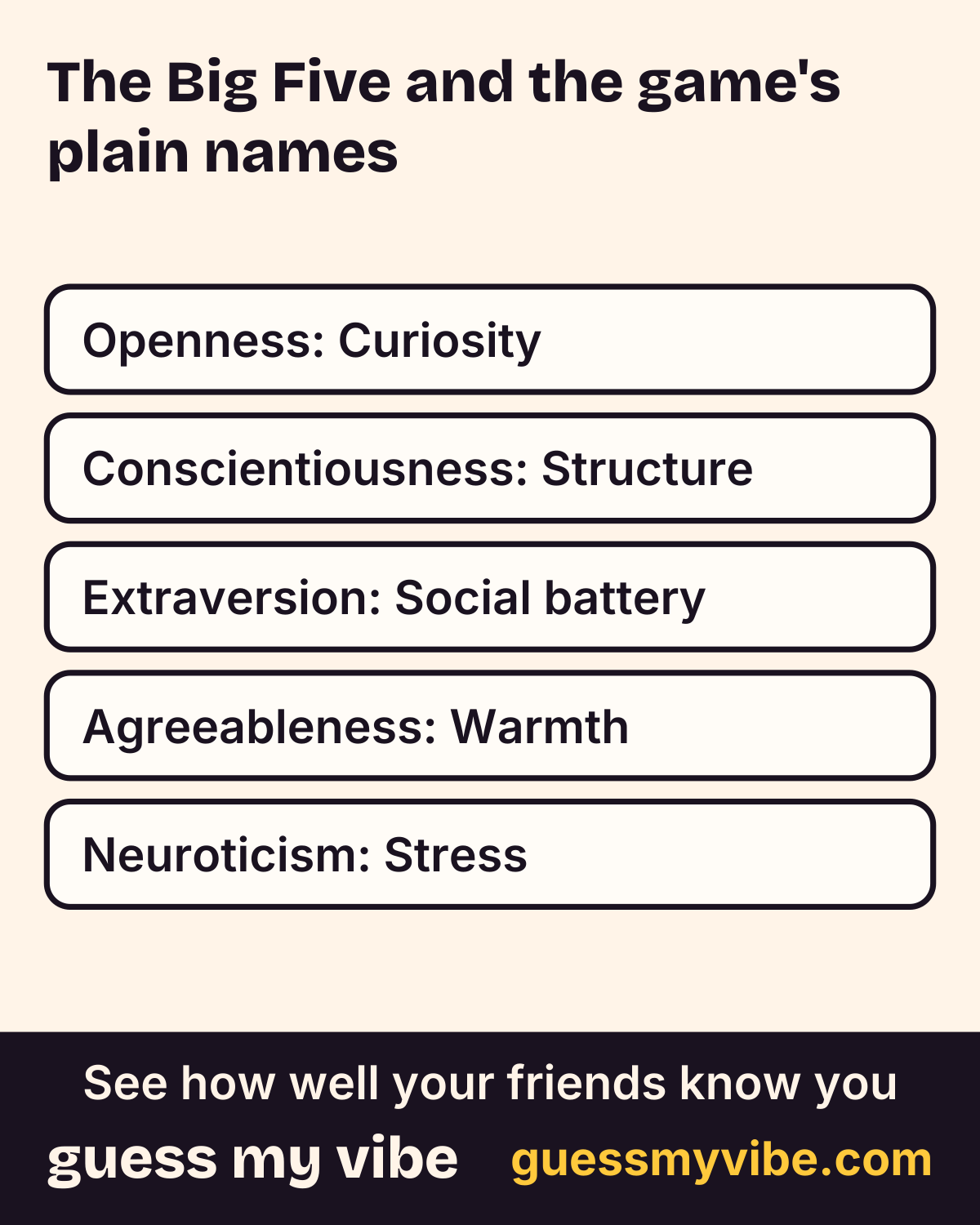
- Openness (Curiosity in the game): how curious and imaginative someone is, and how much they enjoy new ideas and experiences.
- Conscientiousness (Structure): how organized, dependable, and goal-focused someone is.
- Extraversion (Social battery): how outgoing, energetic, and socially bold someone tends to be. Our article on extraversion goes deeper.
- Agreeableness (Warmth): how cooperative, trusting, and considerate someone is toward other people.
- Neuroticism (Stress): how strongly and often someone responds to stress with negative emotion. Our article on the meaning of neuroticism goes deeper. Its calm opposite is emotional stability.
A high score on any of these is not better or worse, only different, and the traits describe tendencies, not rules. Someone high on conscientiousness can still leave a mess on a bad week. Someone low on agreeableness can still be a loyal friend. The game uses plain names because words like "agreeableness" and "neuroticism" sound judgmental in everyday English.
Cite this figure
Figure: "The Big Five and the game's plain names." Guess My Vibe (guessmyvibe.com). https://guessmyvibe.com/learn/big-five-personality-traits#figure-five-traits-plain-names
Scales, not types
The most common misreading of the Big Five is to turn it into five boxes, like "I'm an extravert" or "I'm a neurotic." Scores pile up in the middle of each scale, and the ends are thinly populated. More importantly, behavior moves around a person's average. In experience-sampling studies, where people described their behavior several times a day for two to three weeks, within-person variability was high and the typical individual regularly showed nearly all levels of all the traits, yet each person's average was almost perfectly stable [2].
That is why a single day, party, or text thread is a poor guide to someone's traits. The traits describe the average, not any single moment.
Curious how your friends would answer?
Free. Answer 10 quick questions about you, then send your link. Friends play in their browser, no app needed.
Start freeEach trait has smaller parts
Researchers also look at smaller parts within each trait. One factor analysis of 75 facet scales in a community sample of 481 people found that every Big Five domain splits into two distinct but correlated aspects, sitting between the broad trait and its narrow facets [6]. That helps explain why two people with the same score on a trait can seem different: they may differ in which part of it they carry.
Do the Big Five change over time?
They shift gradually. A meta-analysis of 92 longitudinal samples found that people increase in social dominance (a part of extraversion), conscientiousness, and emotional stability, especially in young adulthood, roughly ages 20 to 40. Social vitality and openness rose in adolescence and fell in old age, and agreeableness changed only in old age [3]. A very large cross-sectional web sample of 1,267,218 people aged 10 to 65 pointed the same broad way for adults: trends overwhelmingly toward greater maturity and adjustment, with late childhood and adolescence a key period of change [7].
Those are group averages. The second study compares different people at different ages, not the same people over time, so it can't show how any one person changes. The practical reading is that the traits are fairly stable and still move, and that a score from today is not a life sentence.
Where do the Big Five come from?
A twin study of 123 sets of identical twins and 127 sets of fraternal twins estimated broad genetic influence on neuroticism, extraversion, openness, agreeableness, and conscientiousness at 41, 53, 61, 41, and 44 percent. Shared family environment accounted for a negligible proportion of the variance in most scales, and non-shared environment accounted for most of the environmental influence [4]. In plain words, genes matter a good deal, but not completely, and the experiences that differ between family members shape the rest. These are estimates from one sample.
Do the Big Five matter for real life?
A review of prospective longitudinal studies compared personality traits with socioeconomic status and cognitive ability for three outcomes, mortality, divorce, and occupational attainment. The size of the personality effects was indistinguishable from the effects of the other two [8]. That is a review of observational work, so it does not show that a trait causes an outcome. It does show that personality is not too small to matter, which is the point the review makes against the older view that traits have only tiny effects.
Who can see which trait?
Not every trait is equally visible. In a study of 165 people rated by themselves, four friends, and strangers, then checked against behavioral tests, the self was the best judge of neuroticism-related traits, friends were the best judges of intellect-related traits, and people of all perspectives were equally good at judging extraversion-related traits [5]. A meta-analysis of 44,178 people across 263 samples found that closeness helped most for traits low in visibility, such as emotional stability, and only minimally for highly evaluative traits such as agreeableness [9].
What the Big Five is not
It is not a diagnosis and not a full portrait. It says nothing about values, talents, or history, and a short online quiz is a rough snapshot. It also does not tell you who to be friends with. It is a research summary of tendencies, and it works best as a conversation starter, especially with people who see you from the outside.
See the five traits through your friends' eyes
Guess My Vibe is built on these five traits. A friend guesses your answers to everyday questions about each one, and the game scores how close they land. Because friends see some traits better than others, the pattern of hits and misses is the interesting part. It is a game, not a Big Five test.
Key takeaways
- The five traits are openness, conscientiousness, extraversion, agreeableness, and neuroticism (OCEAN). In the game they are called Curiosity, Structure, Social battery, Warmth, and Stress.
- They are scales, not types. In experience-sampling studies, the typical person showed nearly all levels of every Big Five trait in everyday behavior, while their average stayed stable [2].
- The five-factor structure was clearly replicated in most of 50 cultures and recognizable in all [1].
- Traits shift with age: across 92 longitudinal samples, people on average rose in conscientiousness and emotional stability, especially between about 20 and 40 [3].
- Twin-study estimates of genetic influence ranged from 41 to 61 percent across the five [4].
- Friends read some traits better than others. The self was the best judge of neuroticism-related traits, friends of intellect-related ones, and everyone about equal on extraversion-related ones [5].
- This isn't therapy, a diagnosis, or a substitute for professional care.
Questions people ask
What are the Big Five personality traits?
Openness, conscientiousness, extraversion, agreeableness, and neuroticism, often remembered as OCEAN. Each is a continuous scale from low to high.
Is the Big Five the same as OCEAN?
Yes. OCEAN is a memory aid built from the first letters of the five traits. "Five-factor model" is another name for the same framework.
Are the Big Five types?
No. They are scales. In experience-sampling studies, the typical person showed nearly all levels of every trait in everyday behavior, while each person's average was stable [2].
Does the Big Five work across cultures?
The five-factor structure was clearly replicated in most of 50 cultures in one large study and was recognizable in all, with a few exceptions [1].
Can your Big Five traits change?
Gradually. On average, people rose in conscientiousness and emotional stability, especially between about ages 20 and 40 [3].
Can I take a Big Five test here?
No. Guess My Vibe isn't a test and doesn't diagnose or label anyone. It lets a friend guess your answers on the five traits and scores how close they land.
See how well your friends know you.
Free. Answer 10 quick questions about you, then send your link. Friends play in their browser, no app needed.
Start freeReferences
- [1] McCrae, R. R., & Terracciano, A. (2005). Universal features of personality traits from the observer's perspective: Data from 50 cultures. Journal of Personality and Social Psychology, 88(3), 547–561. PubMed: 15740445 (opens in a new tab)
- [2] Fleeson, W. (2001). Toward a structure- and process-integrated view of personality: Traits as density distributions of states. Journal of Personality and Social Psychology, 80(6), 1011–1027. PubMed: 11414368 (opens in a new tab)
- [3] Roberts, B. W., Walton, K. E., & Viechtbauer, W. (2006). Patterns of mean-level change in personality traits across the life course: A meta-analysis of longitudinal studies. Psychological Bulletin, 132(1), 1–25. PubMed: 16435954 (opens in a new tab)
- [4] Jang, K. L., Livesley, W. J., & Vernon, P. A. (1996). Heritability of the big five personality dimensions and their facets: a twin study. Journal of Personality, 64(3), 577-591. PubMed: 8776880 (opens in a new tab)
- [5] Vazire, S. (2010). Who knows what about a person? The self-other knowledge asymmetry (SOKA) model. Journal of Personality and Social Psychology, 98(2), 281–300. PubMed: 20085401 (opens in a new tab)
- [6] DeYoung, C. G., Quilty, L. C., & Peterson, J. B. (2007). Between facets and domains: 10 aspects of the Big Five. Journal of Personality and Social Psychology, 93(5), 880–896. PubMed: 17983306 (opens in a new tab)
- [7] Soto, C. J., John, O. P., Gosling, S. D., & Potter, J. (2011). Age differences in personality traits from 10 to 65: Big Five domains and facets in a large cross-sectional sample. Journal of Personality and Social Psychology, 100(2), 330–348. PubMed: 21171787 (opens in a new tab)
- [8] Roberts, B. W., Kuncel, N. R., Shiner, R., Caspi, A., & Goldberg, L. R. (2007). The power of personality: The comparative validity of personality traits, socioeconomic status, and cognitive ability for predicting important life outcomes. Perspectives on Psychological Science, 2(4), 313–345. PubMed: 26151971 (opens in a new tab)
- [9] Connelly, B. S., & Ones, D. S. (2010). An other perspective on personality: Meta-analytic integration of observers' accuracy and predictive validity. Psychological Bulletin, 136(6), 1092–1122. PubMed: 21038940 (opens in a new tab)
How we find and check these sources: how we write. Spotted an error? Report a correction.
Related
- Extraversion: What the Trait Is and What It Isn't
- Neuroticism Meaning: What the Trait Actually Is
- Agreeableness: The Trait Closeness Barely Helps Friends Read
- Emotional Stability: What It Means and Why It Helps Friends
- Conscientiousness in Relationships: What the Research Says
- What Makes an Open-Minded Person? Openness in Friendships
- Personality and Relationships: What the Research Shows
- Is Personality Genetic? About 40%, Says the Research
- Conscientiousness Meaning: What the Trait Is and Isn't
- Openness to Experience: Meaning, Facets and Creativity
- Is MBTI Accurate? MBTI vs the Big Five, Fairly
- Are Personality Tests Accurate? What the Evidence Shows
- Can Your Personality Change? What the Evidence Shows
- 16Personalities vs the Big Five: How They Differ
Cite this article
- Title
- Big Five Personality Traits: A Plain-Words Guide
- Publisher
- Guess My Vibe
- Updated
- URL
- https://guessmyvibe.com/
learn/ big-five-personality-traits
Copy this citation
Guess My Vibe. (2026, October 6). Big Five Personality Traits: A Plain-Words Guide. Guess My Vibe. https://guessmyvibe.com/
To point at one section, add that section's anchor (the # link on its heading) to the URL.