Extraversion is one of the Big Five personality traits: a continuous scale that runs from reserved and quiet to outgoing and energetic. It is not a type and it is not the same as being loud. Researchers still debate what holds the trait together. One research team found that only parts of extraversion tied to reward sensitivity formed its core, and suggested sociability may be a by-product of that [1].
What is extraversion?
Extraversion is the Big Five trait that describes how outgoing, energetic, and socially bold a person tends to be. It is measured on one continuous scale from low (quiet, reserved) to high (talkative, active, assertive), and most people land somewhere in the middle. The scale describes tendencies across many situations. It does not say that a high scorer is always the life of the party or that a low scorer is shy or unhappy. Our separate article on introvert vs extrovert compares the two ends. This page is about the trait itself: what it is made of and what researchers still argue about.
Researchers use the spelling "extraversion" for the trait, and "extrovert" in everyday talk, but the two describe the same scale. A plain-language name for the same idea in the game is Social battery.
What the trait is made of
Extraversion is not one thing. A meta-analysis of 92 longitudinal samples treated social dominance and social vitality as two facets of extraversion, and found they follow different paths over a life [2]. Social dominance, roughly taking the lead and speaking up, rose especially in young adulthood. Social vitality, roughly energy and liveliness around people, rose in adolescence and then fell in old age. A separate factor analysis of 75 facet scales in a community sample of 481 people found that every Big Five domain breaks into two distinct but correlated aspects, which sit between the broad trait and its narrow facets [3].
This is why two people can both be called extraverted and look quite different. One may be an assertive organizer and another a warm, high-energy friend who rarely takes charge. Our article on the outgoing personality walks through that difference in detail.
What is the core of extraversion? Sociability or reward?
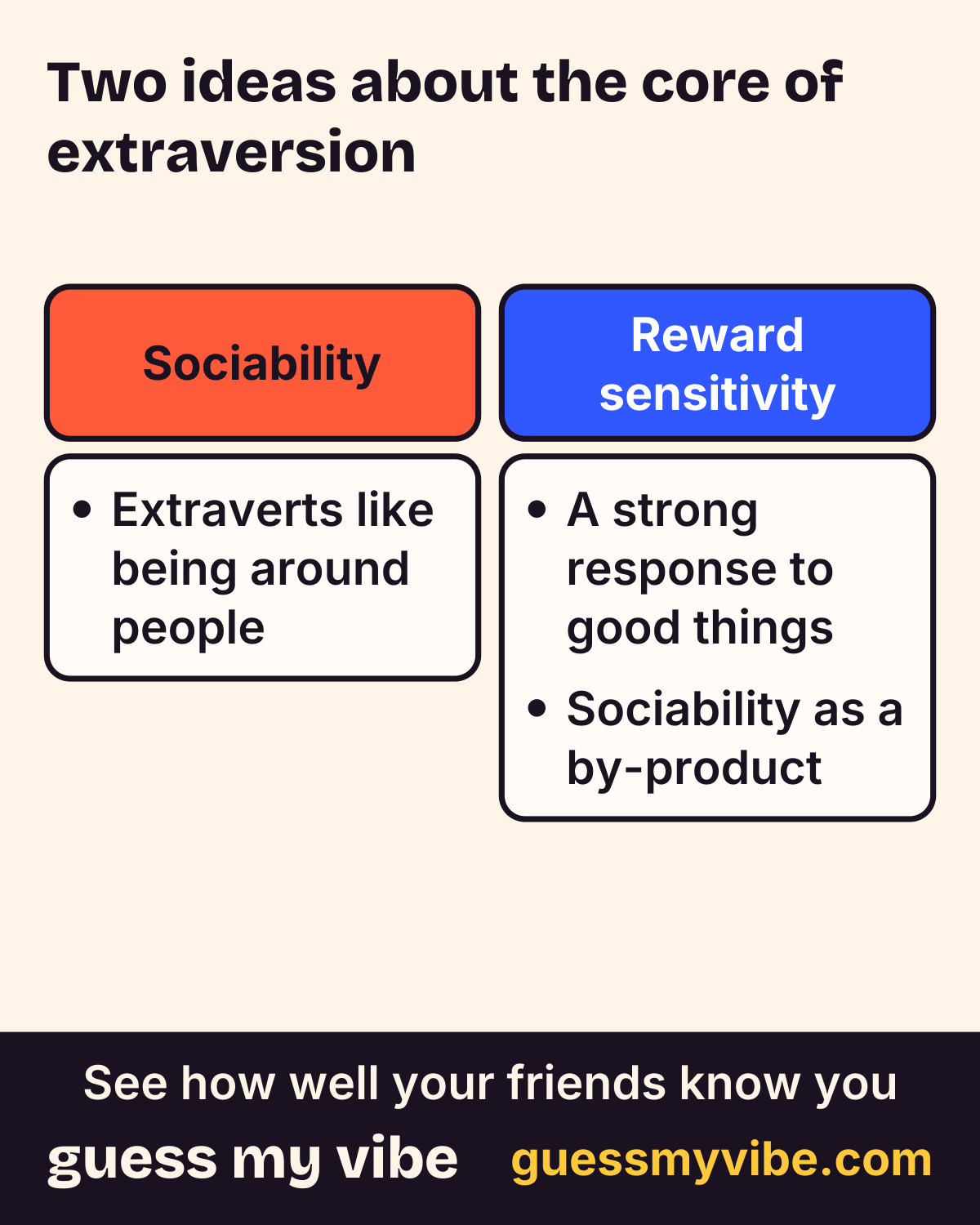
The obvious answer is sociability: extraverts like being around people. One research team tested a different idea, that the parts of extraversion are linked by reward sensitivity, a tendency to respond strongly to good things. In four studies, including participants from 39 nations, only the facets that reflected reward sensitivity loaded on a higher-order extraversion factor, and that factor correlated strongly with pleasant affect. The authors suggest that extraverts' sociability may be a by-product of reward sensitivity rather than the core of the trait [1].
Read that as one serious position in a live debate, not a settled answer. It is a good reminder that "extraversion" is a statistical summary of things that tend to go together, and researchers keep refining what the glue is.
Cite this figure
Figure: "Two ideas about the core of extraversion." Guess My Vibe (guessmyvibe.com). https://guessmyvibe.com/learn/extraversion#figure-two-ways-to-see-the-core
Why extraversion goes with feeling good
Extraversion and pleasant feelings are linked, and how strongly depends partly on how you measure feelings. Across six studies, different extraversion and affect scales mostly gave moderate to strong correlations, and in-the-moment measures such as diary and moment reports gave lower and more consistent correlations than global, retrospective ones [4]. So the link is real, but it is not a law, and the size depends on method.
Why does the link exist? One study looked at the social side. In a first study of 225 people, social well-being, and specifically a sense of making an impact on one's social world, accounted for the link between trait extraversion and positive affect. In a second study of 81 people, perceived contribution to two brief discussion tasks accounted for up to 70 percent of the effect of acting extraverted on positive mood [5]. That is two modest studies, so it is a lead and not the whole story.
A different line of work shows that acting extraverted matters, not just being extraverted. In a diary study, every participant was happier when acting extraverted than when acting introverted, and the pattern replicated in an experiment [7]. That is why one quiet person's loud night out can feel good. It is also why the trait is better read as a tendency than as a fixed mode.
There is a cost question too, and the answer is more reassuring than people expect. In two studies that randomly assigned people to act introverted or extraverted, acting extraverted raised positive mood without raising negative mood, even for people who were introverted by disposition. The one cost found, worse performance on a concentration test, showed up only for naturally extraverted people told to act introverted [8]. These are short experiments in a lab, so they say nothing about a year of draining social calendars. They do suggest that stepping outside your usual style is not automatically costly.
Curious how your friends would answer?
Free. Answer 10 quick questions about you, then send your link. Friends play in their browser, no app needed.
Start freeWhat extraversion does not tell you
Because the word is everywhere, it picks up meanings the research does not give it. Extraversion is a scale about outgoing energy and social boldness. It is not a measure of kindness, which belongs to a different Big Five trait, and it says nothing direct about confidence, skill, or intelligence. A low score is not the same as shyness, a topic our article on shy vs introvert covers, and a high score does not make someone a better friend. Someone can be quiet and warm, or loud and careless, because the traits are separate scales.
It also helps to know how the scale is usually measured. Most questionnaires ask a person to rate statements about talking, energy, and assertiveness, then average across them. The result is a summary of how someone describes their typical self, which is exactly why a single memorable night out, good or bad, should not move your sense of where you sit.
Where does extraversion come from?
A twin study of 123 sets of identical twins and 127 sets of fraternal twins estimated broad genetic influence on extraversion at 53 percent, and found that non-shared environment made up the majority of the environmental influence [9]. In plain words, genes shape it a fair amount, and the experiences that differ between family members shape the rest. One twin study is an estimate from one sample, not a precise recipe, and nothing in it says your level is fixed.
Does extraversion change?
Moment to moment, a lot. In experience-sampling studies, the typical person showed nearly all levels of every Big Five trait in everyday behavior over two to three weeks, while people's averages were almost perfectly stable [10]. Across a life, the parts of the trait move differently, as above [2]. So a quiet week does not make you an introvert, and a wild one does not make you an extrovert. The scale describes the average.
Can other people see your extraversion?
Quite well. In a study with 165 people rated by themselves, four friends, and strangers, then checked against behavioral tests, people of all perspectives were equally good at judging extraversion-related traits, unlike neuroticism, where the self had the edge, and intellect, where friends did [6]. Extraversion shows in visible behavior, so a friend's read on it is a decent check on your own.
Check your Social battery against a friend's read
Because extraversion shows in visible behavior, a friend can be a good judge of it. Guess My Vibe has a friend guess your answers on how you recharge, who texts first, and who stays late, then scores how close they land. It is a fun comparison of your view and theirs, not a measure of the trait.
Key takeaways
- Extraversion is one sliding scale in the Big Five, not two types. Social dominance and social vitality are two separate parts of it [2], and every Big Five trait splits into two correlated aspects [3].
- Researchers disagree about its core. In four studies including participants from 39 nations, only parts of extraversion tied to reward sensitivity formed the core factor, and sociability may be a by-product [1].
- Extraversion and pleasant feelings go together: across six studies, scales gave moderate to strong correlations [4].
- Part of that link may run through how acting outgoing feels: perceived social contribution accounted for up to 70 percent of the effect of acting extraverted on positive feelings in one experiment [5].
- Extraversion shows from the outside: people of all perspectives were about equally good at judging it in one study [6].
- This isn't therapy, a diagnosis, or a substitute for professional care.
Questions people ask
What does extraversion mean?
It is the Big Five trait describing how outgoing, energetic, and socially bold a person tends to be, measured on one continuous scale from low to high. Most people sit in the middle.
Is extraversion the same as being an extrovert?
Yes, they name the same scale. "Extraversion" is the research spelling for the trait, and "extrovert" is the everyday word for someone high on it.
Is extraversion the same as being social?
Not exactly. One research team found that only the parts of extraversion tied to reward sensitivity formed its core, and suggested sociability may be a by-product [1]. That is one position in an ongoing debate.
Are extraverts happier?
Extraversion and pleasant feelings go together, with moderate to strong correlations in six studies, though the size depends on how mood is measured [4]. That is a correlation, and the studies don't show that extraversion makes anyone happy.
Is extraversion genetic?
Partly. One twin study estimated broad genetic influence on extraversion at 53 percent, with non-shared environment accounting for most of the environmental influence [9].
Can a friend tell how extraverted I am?
Yes, about as well as you can. In one study, self, friends, and strangers were equally good at judging extraversion-related traits [6].
See how well your friends know you.
Free. Answer 10 quick questions about you, then send your link. Friends play in their browser, no app needed.
Start freeReferences
- [1] Lucas, R. E., Diener, E., Grob, A., Suh, E. M., & Shao, L. (2000). Cross-cultural evidence for the fundamental features of extraversion. Journal of Personality and Social Psychology, 79(3), 452–468. PubMed: 10981846 (opens in a new tab)
- [2] Roberts, B. W., Walton, K. E., & Viechtbauer, W. (2006). Patterns of mean-level change in personality traits across the life course: A meta-analysis of longitudinal studies. Psychological Bulletin, 132(1), 1–25. PubMed: 16435954 (opens in a new tab)
- [3] DeYoung, C. G., Quilty, L. C., & Peterson, J. B. (2007). Between facets and domains: 10 aspects of the Big Five. Journal of Personality and Social Psychology, 93(5), 880–896. PubMed: 17983306 (opens in a new tab)
- [4] Lucas, R. E., & Fujita, F. (2000). Factors influencing the relation between extraversion and pleasant affect. Journal of Personality and Social Psychology, 79(6), 1039–1056. PubMed: 11138753 (opens in a new tab)
- [5] Smillie, L. D., Wilt, J., Kabbani, R., Garratt, C., & Revelle, W. (2015). Quality of social experience explains the relation between extraversion and positive affect. Emotion, 15(3), 339–349. PubMed: 25603131 (opens in a new tab)
- [6] Vazire, S. (2010). Who knows what about a person? The self-other knowledge asymmetry (SOKA) model. Journal of Personality and Social Psychology, 98(2), 281–300. PubMed: 20085401 (opens in a new tab)
- [7] Fleeson, W., Malanos, A. B., & Achille, N. M. (2002). An intraindividual process approach to the relationship between extraversion and positive affect: Is acting extraverted as "good" as being extraverted?. Journal of Personality and Social Psychology, 83(6), 1409–1422. PubMed: 12500821 (opens in a new tab)
- [8] Zelenski, J. M., Santoro, M. S., & Whelan, D. C. (2012). Would introverts be better off if they acted more like extraverts? Exploring emotional and cognitive consequences of counterdispositional behavior. Emotion, 12(2), 290–303. PubMed: 21859197 (opens in a new tab)
- [9] Jang, K. L., Livesley, W. J., & Vernon, P. A. (1996). Heritability of the big five personality dimensions and their facets: a twin study. Journal of Personality, 64(3), 577-591. PubMed: 8776880 (opens in a new tab)
- [10] Fleeson, W. (2001). Toward a structure- and process-integrated view of personality: Traits as density distributions of states. Journal of Personality and Social Psychology, 80(6), 1011–1027. PubMed: 11414368 (opens in a new tab)
How we find and check these sources: how we write. Spotted an error? Report a correction.
Related
- Introvert vs Extrovert: What the Research Actually Shows
- Outgoing Personality: What It Actually Means
- Ambivert: What the Science Actually Says
- Omnivert vs Ambivert: What the Research Says
- Social Battery: The Science of Why Socializing Drains You
- Reserved Personality: Why Quiet Isn't the Same as Cold
- Shy vs Introvert: Why They Get Confused
Cite this article
- Title
- Extraversion: What the Trait Is and What It Isn't
- Publisher
- Guess My Vibe
- Updated
- URL
- https://guessmyvibe.com/
learn/ extraversion
Copy this citation
Guess My Vibe. (2026, October 6). Extraversion: What the Trait Is and What It Isn't. Guess My Vibe. https://guessmyvibe.com/
To point at one section, add that section's anchor (the # link on its heading) to the URL.