Shy vs introvert is a real distinction, not just wording. Shyness is tension and self-consciousness around other people; introversion is a lower appetite for social stimulation in the first place. A classic study found the two are only moderately related, so you can be shy and still want company, or introverted and perfectly at ease in a crowd you simply don't crave [1].
Shy vs introvert: the real difference
"Shy" and "introverted" get used as if they're the same word, but personality research treats them as two different things. Shyness is about feeling tense, self-conscious, or worried around other people, especially people you don't know well. Introversion is about how much social stimulation you want in the first place, regardless of how comfortable you feel once you're in it. A classic paper built and validated separate scales for shyness and sociability (wanting to be around people) and found the two were only moderately related to each other, not two names for one thing [1]. That moderate relationship is the whole answer to "shy vs introvert": they overlap sometimes, but knowing one doesn't tell you much about the other.
Why some people are shy but not introverted, or introverted but not shy
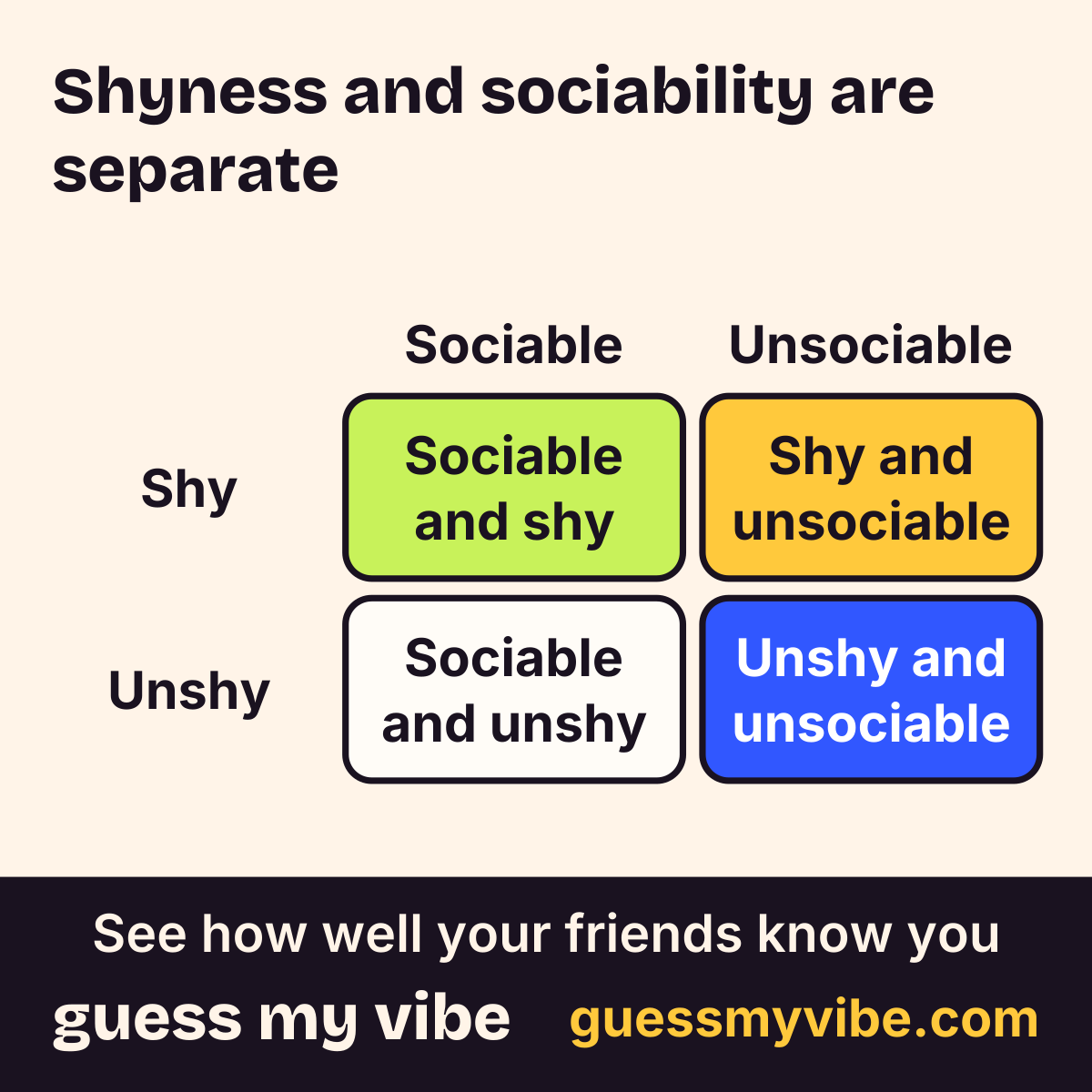
Because shyness and sociability are separate scales, not opposite ends of the same one, four combinations are all possible, not just the two the stereotype assumes. Someone can be sociable and shy: they genuinely want to be at the party, invited, included, and still feel a knot in their stomach walking in. Someone can be unshy and unsociable: completely at ease talking to a stranger if it comes up, with zero interest in seeking that out. Someone can be both sociable and unshy (the stereotype "extrovert") or both shy and unsociable (the stereotype "introvert"). Because the two scales are only moderately correlated, all four combinations are possible, not just the two the stereotype assumes [1]. If you've ever met someone who seems to want a crowded room but looks miserable once they're in it, that's the sociable-and-shy combination in action, and it's exactly why "shy vs introvert" as a question needs two answers, not one.
Cite this figure
Figure: "Shyness and sociability are separate." Guess My Vibe (guessmyvibe.com). https://guessmyvibe.com/learn/shy-vs-introvert#figure-shy-sociable-grid
What shyness actually is, in plain terms
Shyness, in the research sense, is the discomfort, self-consciousness, and sometimes physical tension that shows up specifically around other people, especially in new or evaluative situations: meeting someone for the first time, speaking in a group, being watched. It's not a formal diagnosis, and most people who'd call themselves shy aren't describing anything clinical, just a familiar, uncomfortable feeling that shows up in certain moments. That matters here: this article is about shyness as an ordinary personality trait and a common feeling, not about social anxiety as a condition. If worry around people is severe enough to consistently get in the way of things you want to do, that's a conversation for a professional, not a personality quiz.
What shyness is not, based on the same research, is a synonym for "not wanting to be around people." Wanting company and feeling nervous about getting it are two different signals, and a person can send both at once. That's a useful reframe if you've ever been told you're "just introverted" when what you actually feel is nervous, not uninterested.
What introversion actually is, in plain terms
Introversion is the low end of extraversion, one of the five traits researchers use to describe personality (the Big Five). It's about appetite, not fear: how much stimulation, company, and excitement feels good to you, not how anxious you feel once you're in it. Extraversion itself isn't one single behavior either. A widely used public-domain personality inventory, built from a development sample of more than 21,000 people, breaks it into six smaller facets: Friendliness, Gregariousness, Assertiveness, Activity Level, Excitement-Seeking, and Cheerfulness [4]. Notice what's missing from that list: nothing about anxiety, self-consciousness, or fear of judgment. Those live in a different part of personality altogether. An introverted person, by this definition, simply doesn't crave a packed calendar; whether they feel nervous about the plans they do make is a separate question entirely.
Curious how your friends would answer?
Free. Answer 10 quick questions about you, then send your link. Friends play in their browser, no app needed.
Start freeWhy a friend can usually tell if you're introverted, but not if you're shy
Here's a genuinely useful piece of research for telling these two apart in real life: they're not equally visible from the outside. A meta-analysis covering 263 samples and more than 44,000 people found that, across raters from family to strangers, extraversion showed the highest agreement between self- and other-ratings of the five traits, a corrected correlation of about .51 [3]. A separate study of 165 people, comparing self-ratings, friend-ratings and stranger-ratings against real recorded behavior, found a similar pattern: for outward, sociable traits, other people are about as accurate as you are about yourself [2]. Introversion, in other words, tends to show on the outside: a quiet person in a loud room is fairly easy to spot.
Shyness is a different kind of trait: internal, often masked on purpose (plenty of shy people have learned to look composed while feeling anything but), and tied more to private discomfort than to visible behavior. The same research above found that traits like this, ones that happen mostly inside a person's head, are exactly the ones where the person themselves tends to have the real edge over any outside observer [2]. That's a plausible, if not separately tested, reason your closest friend might correctly call you "not that into crowds" while being genuinely surprised to learn you've felt nervous at every single one of them.
Why "overcoming shyness" and "becoming an extrovert" are different goals
Because shyness and introversion are separate traits, the useful move for each one is different too, and mixing them up leads to bad advice. Trying to become more extraverted when the real friction is shyness, pushing yourself into more plans, saying yes more often, won't touch the anxious feeling itself, and can just mean more frequent exposure to a feeling you haven't actually changed. On the other hand, treating ordinary introversion (a real preference for less stimulation) as something to "fix" with exposure misreads a comfortable, stable preference as if it were a fear to overcome. The more useful question isn't "how do I stop being introverted" or even "how do I stop being shy," but "is what's actually in my way a lack of interest, or a knot of nerves?" Those call for different responses: building genuine comfort and familiarity (smaller groups first, people you already know, repeat exposure to the same low-stakes situation) tends to ease the nervous-tension side; nothing needs fixing on the low-stimulation-preference side at all, since it isn't a problem to begin with.
What a quick online quiz can and can't tell you
A short online quiz asking "am I shy or introverted" usually just reshuffles a handful of questions about crowds, small talk, and energy into one score, which can't actually separate the two dimensions the research above treats as distinct. A more useful self-check borrows the real distinction: notice whether your hesitation in a given moment is about not wanting to be there (introversion) or about feeling nervous once you are there (shyness). Most people find it's a mix that shifts by situation, not a fixed label, which is closer to how the research actually describes it.
How a friend sees this differently than you do
Since extraversion-type behavior is visible and shyness-type feeling often isn't, a friend guessing "introvert or extrovert" about you is answering a question the research says they're actually well-equipped to answer [2]. A friend guessing whether you feel shy in a given moment is answering a much harder question, one the research suggests you have a real edge on answering about yourself [2]. That gap, between what's visible and what's felt, is exactly what Guess My Vibe turns into a game: a friend guesses your answers to real personality questions, and the gap between their guess and your honest answer is often most interesting on exactly the traits, like this one, that don't show on the outside the way people assume they do.
Key takeaways
- Shyness is discomfort or worry around people; introversion is a lower drive to seek out social stimulation. Research separating the two traits found them only moderately related [1].
- You can be shy and sociable at once (wanting company but nervous getting there), or introverted and unshy (comfortable around people, just not drawn to a crowd) [1].
- Extraversion, the trait behind "introvert," is the trait where other people's ratings agree most with a person's own. Shyness is a quieter, more internal experience that is probably harder for anyone outside your own head to see directly (these studies didn't measure shyness itself) [2] [3].
- Shyness isn't one of the six specific facets researchers use to describe extraversion [4], which is a clue the two ideas sit in different places.
- This isn't therapy, a diagnosis, or a substitute for professional care.
Questions people ask
What's the actual difference between shy and introverted?
Shyness is discomfort or self-consciousness around other people. Introversion is a lower appetite for social stimulation in general. Research building separate scales for the two found them only moderately related, so they're genuinely different traits, not two words for the same thing [1].
Can you be shy but not introverted?
Yes. Someone can want to be around people, even crave an invitation, and still feel nervous once they're there. That sociable-and-shy combination is one of several the research found, not a contradiction [1].
Can you be introverted but not shy?
Also yes. Someone can feel completely comfortable in a conversation or a room full of people and simply not want much of it. That's low extraversion without the self-consciousness that defines shyness [1].
Is shyness something you can overcome?
Shyness is ordinary discomfort around people, not a diagnosis, and for most people it eases with familiarity and smaller, lower-stakes situations rather than needing a "fix." This isn't medical advice; if nervousness around people is severe enough to regularly get in the way of things you want to do, that's worth bringing to a professional rather than a personality article.
Why does a friend know I'm introverted but not that I'm shy?
Introversion tends to show in visible behavior, which friends read about as accurately as people read it in themselves [2]. Shyness is a more internal, often-masked feeling, and research on self-other agreement finds people have a real edge over outside observers on traits like that [2].
See how well your friends know you.
Free. Answer 10 quick questions about you, then send your link. Friends play in their browser, no app needed.
Start freeReferences
- [1] Cheek, J. M., & Buss, A. H. (1981). Shyness and sociability. Journal of Personality and Social Psychology, 41(2), 330–339. doi.org/10.1037/0022-3514.41.2.330 (opens in a new tab)
- [2] Vazire, S. (2010). Who knows what about a person? The self-other knowledge asymmetry (SOKA) model. Journal of Personality and Social Psychology, 98(2), 281–300. PubMed: 20085401 (opens in a new tab)
- [3] Connelly, B. S., & Ones, D. S. (2010). An other perspective on personality: Meta-analytic integration of observers' accuracy and predictive validity. Psychological Bulletin, 136(6), 1092–1122. PubMed: 21038940 (opens in a new tab)
- [4] Johnson, J. A. (2014). Measuring thirty facets of the Five Factor Model with a 120-item public domain inventory: Development of the IPIP-NEO-120. Journal of Research in Personality, 51, 78–89. doi.org/10.1016/j.jrp.2014.05.003 (opens in a new tab)
How we find and check these sources: how we write. Spotted an error? Report a correction.
Related
Cite this article
- Title
- Shy vs Introvert: Why They Get Confused
- Publisher
- Guess My Vibe
- Updated
- URL
- https://guessmyvibe.com/
learn/ shy-vs-introvert
Copy this citation
Guess My Vibe. (2026, October 3). Shy vs Introvert: Why They Get Confused. Guess My Vibe. https://guessmyvibe.com/
To point at one section, add that section's anchor (the # link on its heading) to the URL.