An outgoing personality is the everyday name for scoring high on extraversion, one of the Big Five personality traits. It isn't a single switch: researchers break extraversion into six separate facets (friendliness, gregariousness, assertiveness, activity level, excitement-seeking and cheerfulness), so two "outgoing" people can look quite different depending on which facets are actually high for them [1]. It's also the trait where other people's ratings agree most with your own [2].
Outgoing personality: what the word actually means
"Outgoing personality" is the plain-English name for scoring high on extraversion, one of the five traits researchers use to describe personality (the Big Five). It's not a yes-or-no label. Extraversion runs on a continuous scale from low to high, and "outgoing" is just what people call the high end of it, the same way "introverted" or "reserved" describes the low end. The research spelling is "extraversion" (with an a); "outgoing" and "extroverted" are the everyday words for the same underlying trait.
An outgoing personality is six facets, not one switch
The most useful thing to know about "outgoing" is that it isn't a single behavior. A public-domain personality inventory built from a development sample of more than 21,000 people breaks extraversion into six smaller facets: Friendliness (warmth toward people you meet), Gregariousness (enjoying crowds and company), Assertiveness (taking the lead, speaking up), Activity Level (preferring a full, busy schedule), Excitement-Seeking (chasing novelty and stimulation), and Cheerfulness (experiencing frequent positive emotion) [1]. Someone can be high on all six, which is the stereotype most people picture when they hear "outgoing personality." But plenty of genuinely outgoing people are high on some of these and not others.
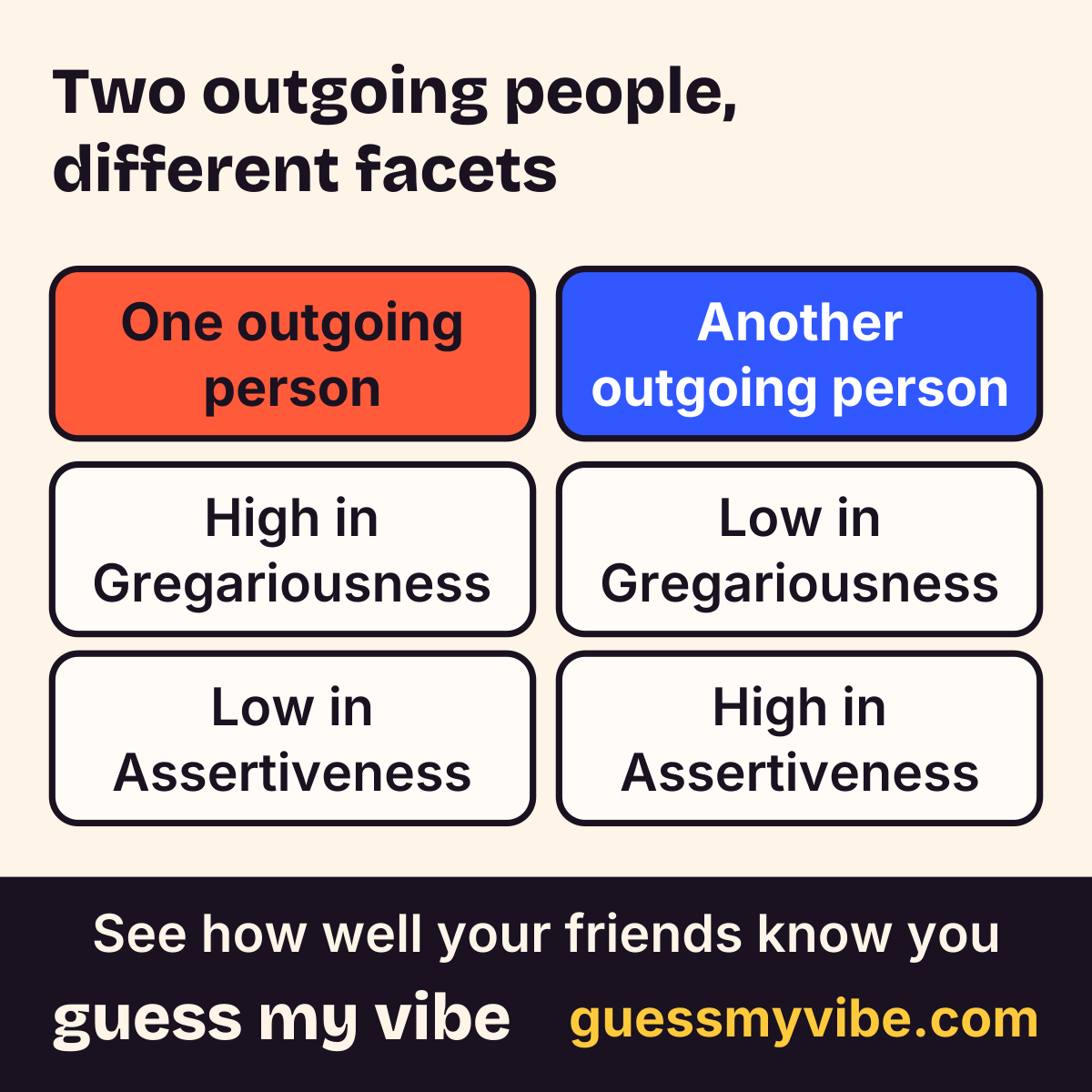
A concrete example: one person might be high in Gregariousness (thrilled by a packed party) but low in Assertiveness (has no interest in running the conversation or being the center of attention once there). Another might be the reverse: low in Gregariousness (would rather skip the party) but high in Assertiveness (perfectly comfortable taking charge in the small group they do end up in). Both would reasonably be called "outgoing" by people around them in different settings, and both would likely call themselves something different if you only asked about one facet. "Talkative" and "loud" , two words people often reach for to describe an outgoing personality, aren't facets on this list at all; they're surface behaviors that usually come from a mix of Gregariousness, Assertiveness and Cheerfulness rather than any one trait on its own.
Cite this figure
Figure: "Two outgoing people, different facets." Guess My Vibe (guessmyvibe.com). https://guessmyvibe.com/learn/outgoing-personality#figure-two-outgoing-people
Why "outgoing" isn't the same as "happy" or "confident"
Because Cheerfulness and Assertiveness are both folded into extraversion, it's easy to assume an outgoing personality automatically comes with high mood and high confidence. That's a real tendency, not a guarantee: extraversion is reliably linked to pleasant mood, with moderate to strong correlations across several studies and a meta-analysis [4]. But a facet breakdown means someone can be high in Gregariousness and Activity Level (always making plans, always around people) while being only moderate in Cheerfulness or Assertiveness specifically. "Outgoing" describes a pattern of social behavior, not a guaranteed emotional state underneath it, which is part of why two outgoing people can have very different inner experiences of the same busy week.
Curious how your friends would answer?
Free. Answer 10 quick questions about you, then send your link. Friends play in their browser, no app needed.
Start freeHow visible is an outgoing personality, really?
Here's where an outgoing personality stands out from the rest of the Big Five: it's unusually easy for other people to see. A meta-analysis covering 263 independent samples and more than 44,000 people compared self-ratings on each Big Five trait against ratings from family, friends, and others who know the person, and found a corrected agreement with a single other rater of about .51 for extraversion, the highest of the five traits (agreeableness was the lowest, at about .39) [2]. A correlation around .5 is a real, moderate match, not a perfect copy of your own self-view and not a coin flip either. In plain terms: the people around you are genuinely decent judges of how outgoing you are, even if they don't get every detail right.
A separate study pushed this further by checking ratings against actual recorded behavior, not just against self-reports. Researchers compared self-ratings, close friends' ratings, and even strangers' ratings of 165 people's extraversion-related behavior against real behavior recorded in the lab, and found all three groups, self, friend, and stranger, were about equally accurate [3]. That's a genuinely unusual result: for most personality traits, closeness to a person buys you real accuracy a stranger doesn't have. For how outgoing someone comes across, a stranger rating you does about as well as a friend does.
Is a "loud person" the same as an outgoing personality?
Not quite, and the gap between the two is a good example of how loosely everyday words map onto the six facets above. Volume and energy in the moment can come from Activity Level or Excitement-Seeking, both real extraversion facets, but they can also come from something that has nothing to do with extraversion at all: excitement about a specific topic, a reaction to a loud environment, or simply a loud voice, which is a physical trait, not a personality one. Meanwhile, someone can be high in Friendliness and Gregariousness, genuinely warm, genuinely drawn to company, and still speak quietly. "Loud" describes a behavior anyone might notice first; "outgoing personality" describes a broader, more stable pattern underneath it, and the two only sometimes line up.
An outgoing personality isn't the same every hour, either
A trait score describes someone's average over time, not their behavior in any single moment. Experience-sampling research that had people report their own behavior every few hours for weeks found that even people who score as highly outgoing show real swings day to day, sometimes acting quite reserved, and the same is true in reverse for people who score low [5]. What makes someone "an outgoing person" is where their average sits relative to other people, not that every single moment of their week looks the same.
What this means for reading your own (or a friend's) vibe
Put together, the research says an outgoing personality is a mix of specific, separately measurable facets, not one dial, and it's also one of the easiest things about a person for someone else to accurately judge. That combination is exactly what makes it a good target for a guessing game: there's real structure underneath the label (six facets, not a vague vibe), and the people around you have a genuinely fair shot at reading it correctly. Guess My Vibe uses that same idea directly: a friend guesses your actual answers to personality questions pulled from research like this, and the parts of your "outgoing personality" they get right, or surprisingly wrong, are the most interesting part of the reveal.
Key takeaways
- "Outgoing" maps onto high extraversion, but extraversion itself splits into six facets: friendliness, gregariousness, assertiveness, activity level, excitement-seeking and cheerfulness [1].
- Two outgoing people can look different: one might be high in gregariousness (loves a packed room) but low in assertiveness (hates leading the conversation), while another is the reverse.
- Of the Big Five traits, extraversion (the outgoing/reserved trait) is the one where other people's ratings agree most with a person's own, a meta-analysis of 263 samples and over 44,000 people found [2].
- That accuracy isn't limited to close friends. Strangers judge someone's outgoing side almost as well as a close friend does, which isn't true of more private traits [3].
- This isn't therapy, a diagnosis, or a substitute for professional care.
Questions people ask
What does it mean to have an outgoing personality?
It means scoring relatively high on extraversion, one of the Big Five personality traits. Researchers break it into six facets, friendliness, gregariousness, assertiveness, activity level, excitement-seeking and cheerfulness, so "outgoing" really describes a pattern across several of these, not one single behavior [1].
Is being talkative the same as having an outgoing personality?
Not exactly. Talkativeness usually comes from a mix of facets like gregariousness and assertiveness, but it isn't one of the six facets researchers measure on its own. Someone can be outgoing in other ways (always making plans, always upbeat) without being especially talkative.
Can someone be outgoing in some situations and not others?
Yes. Research tracking people's actual behavior every few hours for weeks found real swings day to day, even for people who score as highly extraverted overall. A trait score reflects someone's average tendency, not how they act in any one moment [5].
Do other people accurately judge whether someone is outgoing?
Yes, better than for most other personality traits. A meta-analysis of over 44,000 people found extraversion has the highest self-other agreement of the Big Five traits [2], and a separate study found even strangers judge it about as accurately as close friends do [3].
Is an outgoing personality the same as being confident or happy?
Not necessarily. Confidence and mood overlap with some of extraversion's facets (assertiveness, cheerfulness) but someone can be high in other facets, like gregariousness or activity level, without being especially confident or upbeat underneath it.
See how well your friends know you.
Free. Answer 10 quick questions about you, then send your link. Friends play in their browser, no app needed.
Start freeReferences
- [1] Johnson, J. A. (2014). Measuring thirty facets of the Five Factor Model with a 120-item public domain inventory: Development of the IPIP-NEO-120. Journal of Research in Personality, 51, 78–89. doi.org/10.1016/j.jrp.2014.05.003 (opens in a new tab)
- [2] Connelly, B. S., & Ones, D. S. (2010). An other perspective on personality: Meta-analytic integration of observers' accuracy and predictive validity. Psychological Bulletin, 136(6), 1092–1122. PubMed: 21038940 (opens in a new tab)
- [3] Vazire, S. (2010). Who knows what about a person? The self-other knowledge asymmetry (SOKA) model. Journal of Personality and Social Psychology, 98(2), 281–300. PubMed: 20085401 (opens in a new tab)
- [4] Lucas, R. E., & Fujita, F. (2000). Factors influencing the relation between extraversion and pleasant affect. Journal of Personality and Social Psychology, 79(6), 1039–1056. PubMed: 11138753 (opens in a new tab)
- [5] Fleeson, W. (2001). Toward a structure- and process-integrated view of personality: Traits as density distributions of states. Journal of Personality and Social Psychology, 80(6), 1011–1027. PubMed: 11414368 (opens in a new tab)
How we find and check these sources: how we write. Spotted an error? Report a correction.
Related
- Introvert vs Extrovert: What the Research Actually Shows
- Shy vs Introvert: Why They Get Confused
- What Makes Someone a Warm Person?
- Ambivert: What the Science Actually Says
- Self-Perception vs. How Others See You
- Social Battery: The Science of Why Socializing Drains You
- Extraversion: What the Trait Is and What It Isn't
- Omnivert vs Ambivert: What the Research Says
Cite this article
- Title
- Outgoing Personality: What It Actually Means
- Publisher
- Guess My Vibe
- Updated
- URL
- https://guessmyvibe.com/
learn/ outgoing-personality
Copy this citation
Guess My Vibe. (2026, October 3). Outgoing Personality: What It Actually Means. Guess My Vibe. https://guessmyvibe.com/
To point at one section, add that section's anchor (the # link on its heading) to the URL.