An ambivert is the popular word for someone who sits in the middle of the extraversion scale instead of near either end, but it isn't a separate personality type researchers actually measure. Extraversion runs on one continuous scale, and most people land somewhere in the middle of it, not at the far introvert or extrovert end. What's more interesting than the label is what the middle really means: even people scored as more extraverted or more introverted show huge swings in how outgoing they act from moment to moment [1], so "ambivert" behavior isn't as rare or special as it sounds.
Is ambivert a real personality type?
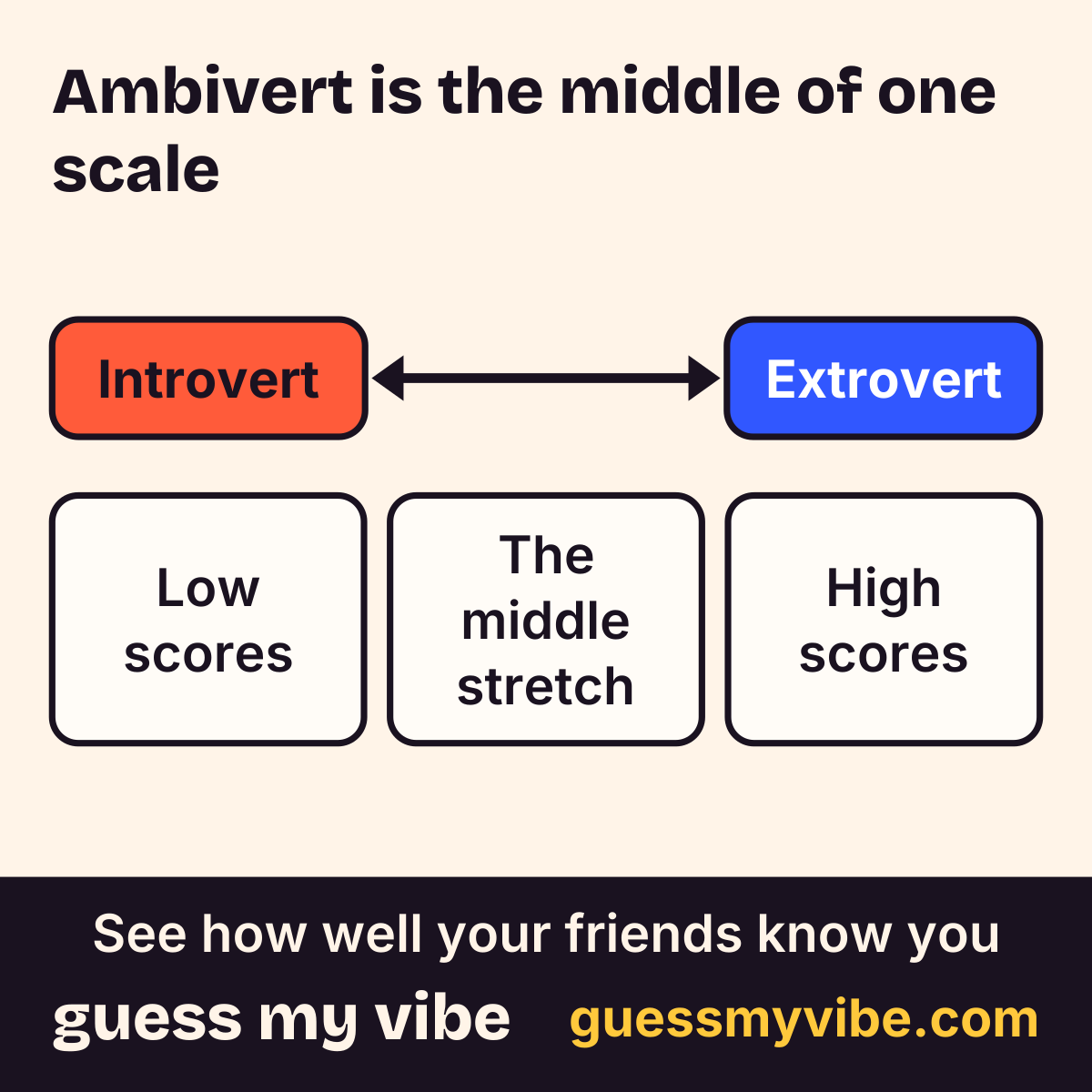
Not in the way the word implies. "Ambivert" suggests a third category sitting between introvert and extrovert, like a separate lane on the same road. Personality research doesn't work that way. Extraversion is measured on one continuous scale running from low to high, and like most measured human traits, scores pile up in the middle and thin out toward the ends. Most people, including most people who've never heard the word "ambivert," score somewhere in that middle stretch rather than at either extreme. Calling yourself an ambivert isn't wrong, exactly. It's just naming the most common place to be on a scale that was never actually split into two camps to begin with. And the same person acts out nearly the whole range of outgoing behavior in everyday life anyway [1].
This matters more than it sounds like it should, because the two-camp version of the idea (some people are introverts, some are extroverts, and ambiverts are a lucky mix of both) implies introverts and extroverts are consistent, fixed types in the first place. They aren't. Which is where the more interesting research actually starts.
Cite this figure
Figure: "Ambivert is the middle of one scale." Guess My Vibe (guessmyvibe.com). https://guessmyvibe.com/learn/ambivert#figure-one-scale-middle
What's actually happening when someone sits in the middle
A set of experience-sampling studies had people report how they were actually behaving, several times a day, for two to three weeks. The finding cuts against the whole idea of fixed types: the typical person showed nearly the entire range of extraverted behavior at some point during a single week, from quiet and withdrawn to the loudest person in the room. That was true for people who scored high on extraversion and people who scored low on it. What stayed stable, and what a personality score is actually describing, was each person's own average level across all those moments, not any single one of them [1].
Put plainly: someone who scores in the ambivert middle range isn't "half introvert, half extrovert" the way a smoothie is half banana, half strawberry. They're someone whose average, across a week of real moments, lands in the middle. A person who scores as a strong extravert still has quiet, withdrawn hours. A person who scores as a strong introvert still has loud, outgoing ones. The ambivert's week of moments probably looks less extreme on both ends, not like two separate people taking turns.
The one real study about ambiverts specifically: the sales finding
Most of what gets said about "the ambivert advantage" traces back to a single, specific, genuinely interesting study. For decades, sales research had found only weak and inconsistent links between extraversion and actually selling things, which didn't match the industry's assumption that bigger personalities close more deals. One researcher proposed the relationship isn't a straight line but a curve: people in the middle of the extraversion range would outsell people at either end, because they naturally mix enough assertiveness to make a pitch with enough listening to actually hear what the customer wants. A study of 340 outbound call-center sales representatives supported exactly that curved pattern: sales revenue was highest in the middle of the extraversion range and lower at both the introverted and extraverted ends [2].
Worth being honest about the size of this claim: it's one correlational study, of one specific job (outbound sales calls), with one sample of 340 people. It's real, interesting evidence that extraversion doesn't always help in a straight line. It isn't proof that ambiverts are generally better at jobs, friendships, or anything else, and the paper itself doesn't claim that. Treat the sales finding as exactly what it is: a reason to question "more extraverted is always better," not a new rule that the middle always wins. A curved, inverted-U relationship like this one is also a genuinely unusual shape to find in personality research, where most trait-outcome links are closer to a straight line (more of the trait, a little more or less of the outcome). That's part of why this specific study got so much attention well beyond the sales world it was actually studying.
Curious how your friends would answer?
Free. Answer 10 quick questions about you, then send your link. Friends play in their browser, no app needed.
Start freeCan your friends actually tell you're in the middle?
Extraversion, the whole scale an ambivert sits in the middle of, is a trait that shows up in visible behavior. A meta-analysis covering 263 samples and more than 44,000 people found that closeness to the rater boosted accuracy most for traits that are hard to see from the outside, and only minimally for highly evaluative ones [4], which leaves visible traits like extraversion readable without deep closeness. A separate study checking self-ratings, friend-ratings, and even stranger-ratings against real recorded behavior found all three were about equally accurate specifically for extraversion-linked behavior, unlike more private traits where the person themselves has a real edge [3]. Agreement like this is real but not a mind-read. The practical version: a close friend can usually tell you're more of a middle-of-the-road person than a party-starter or a homebody, even if they couldn't guess your exact score on a 10-question quiz.
What an ambivert test is actually measuring
An online ambivert test is usually just a short extraversion quiz with a third label added for the middle third or half of the score range. It's measuring the same thing an introvert-or-extrovert quiz measures, your self-reported average across a handful of questions about preferring groups or solitude, talking or listening, seeking stimulation or calm. The only thing that changes is where the quiz draws its lines, and how many labels it hands out once you cross them. A quiz result is a snapshot of how someone sees themselves at one point, while the stable thing is the person's average across many moments [1], the same limitation any short self-report quiz runs into. None of that makes the result meaningless. It just means a test result is one honest data point, not a verdict, especially for anyone who already expects to land near the middle.
Why two different ambivert tests can give you different answers
Because "ambivert" is a label slapped onto an already-continuous scale, where exactly the label starts and stops is just an editorial choice, not a scientific line. One quiz might call the middle third of scores "ambivert"; another might use the middle half, or draw the cutoff a few points differently based on its own sample. That's a reasonable source of the frustrating experience of taking two different online quizzes and getting two different verdicts. It isn't a sign either quiz is broken. It's a reminder that the underlying number, your actual average score on the scale, is the more stable, more meaningful thing, and the label stuck on top of it is the part doing the shifting [1].
See where a friend would actually place you
If you suspect you're more of a middle-of-the-scale person than either label fully fits, a friend's guess is a decent gut check, since extraversion is the trait friends read most accurately of the five. Guess My Vibe turns that into an actual daily game instead of a one-time label: a friend guesses your answers to real questions, scored automatically, so you find out whether their read on you matches a true middle, a quiet lean, or an outgoing one, rather than guessing which word to pick for yourself.
Key takeaways
- "Ambivert" is a popular label, not a category researchers use. Extraversion is one continuous scale, and most people score somewhere in its middle range rather than at either extreme. Within a single person, though, behavior swings widely from moment to moment [1].
- Everyone, not just self-described ambiverts, shows wide swings in how outgoing they act from hour to hour. What stays stable is a person's average level over time, not any single moment [1].
- The closest thing to a real "ambivert advantage" in the research: one study of 340 call-center sales reps found people in the middle of the extraversion range sold more than those at either end, though it's one job, one sample, and not proof that ambiverts outperform everywhere [2].
- Extraversion (including the middle range) is a highly visible trait: in one study, friends' and even strangers' ratings of extraversion-linked behavior were about as accurate as people's own [3].
- This isn't therapy, a diagnosis, or a substitute for professional care.
Questions people ask
What is an ambivert, really?
The popular word for someone who scores in the middle of the extraversion scale rather than near the introvert or extrovert end. It isn't a separate personality category researchers measure; it's a label for the most common place to land on one continuous scale.
Is being an ambivert the same as being an extroverted introvert?
Yes, those are two popular names for the same idea: scoring in the middle of the extraversion scale. Neither is an official research category; both describe where someone sits on the same one-dimensional scale, not a blend of two separate fixed types.
Are ambiverts better at sales or social situations in general?
The evidence for a specific "ambivert advantage" is one study: 340 outbound call-center sales reps, where people in the middle of the extraversion range outsold those at either end. That's real but narrow evidence from one job and one sample, not a general finding that the middle always performs best [2].
How do I know if I'm an ambivert?
Notice your average across many real situations, not just one memorable party or one quiet weekend. Research shows everyone's actual behavior swings widely day to day; a trait score describes the average, not any single moment [1]. A single quiz is one snapshot of that average.
Can an ambivert test accurately place me?
It can give a reasonable estimate, with the same limits any short self-report quiz has. A friend's independent read on how outgoing you are tends to agree with your own fairly well too, since extraversion is a visible trait that friends and even strangers can rate about as accurately as you can rate it yourself [3].
See how well your friends know you.
Free. Answer 10 quick questions about you, then send your link. Friends play in their browser, no app needed.
Start freeReferences
- [1] Fleeson, W. (2001). Toward a structure- and process-integrated view of personality: Traits as density distributions of states. Journal of Personality and Social Psychology, 80(6), 1011–1027. PubMed: 11414368 (opens in a new tab)
- [2] Grant, A. M. (2013). Rethinking the extraverted sales ideal: The ambivert advantage. Psychological Science, 24(6), 1024–1030. PubMed: 23567176 (opens in a new tab)
- [3] Vazire, S. (2010). Who knows what about a person? The self-other knowledge asymmetry (SOKA) model. Journal of Personality and Social Psychology, 98(2), 281–300. PubMed: 20085401 (opens in a new tab)
- [4] Connelly, B. S., & Ones, D. S. (2010). An other perspective on personality: Meta-analytic integration of observers' accuracy and predictive validity. Psychological Bulletin, 136(6), 1092–1122. PubMed: 21038940 (opens in a new tab)
How we find and check these sources: how we write. Spotted an error? Report a correction.
Related
- Introvert vs Extrovert: What the Research Actually Shows
- Social Battery: The Science of Why Socializing Drains You
- Friendship Psychology: What the Research Actually Says
- How Well Do You Know Me Questions to Ask Friends
- Agreeableness: The Trait Closeness Barely Helps Friends Read
- Introvert Extrovert Friendship: Why It Works
- Emotional Stability: What It Means and Why It Helps Friends
- Reserved Personality: Why Quiet Isn't the Same as Cold
- Omnivert vs Ambivert: What the Research Says
- Extraversion: What the Trait Is and What It Isn't
Cite this article
- Title
- Ambivert: What the Science Actually Says
- Publisher
- Guess My Vibe
- Updated
- URL
- https://guessmyvibe.com/
learn/ ambivert
Copy this citation
Guess My Vibe. (2026, October 3). Ambivert: What the Science Actually Says. Guess My Vibe. https://guessmyvibe.com/
To point at one section, add that section's anchor (the # link on its heading) to the URL.