A reserved personality is just the low end of extraversion: someone who talks less, prefers smaller groups, and needs less outside stimulation to feel comfortable. It has nothing to do with warmth, which is a separate Big Five trait (agreeableness) that extraversion has nothing to do with. Reserved people can get misread as cold anyway; one plausible reason (not tested directly) is that sociability cues are easy to see fast while warmth cues are less obvious early on, and research finds that different traits are read from different behavioral cues [1].
What "reserved personality" actually means
A reserved personality describes someone on the low end of extraversion, one of the five traits researchers use to describe personality (the Big Five). It shows up as talking less in a group, preferring a smaller gathering over a crowded one, and generally needing less outside stimulation to feel comfortable than someone higher in extraversion does. That's the whole definition. It says nothing about how kind, trustworthy, or easy to get along with someone is. Warmth and cooperation toward other people are measured by a completely separate Big Five trait, agreeableness (the app's plain name for it is Warmth), and the research is clear that extraversion has little to do with it. A reserved person can be extremely warm. An outgoing person can be genuinely cold. The two traits run on separate scales.
Why quiet gets misread as cold: different traits, different cues
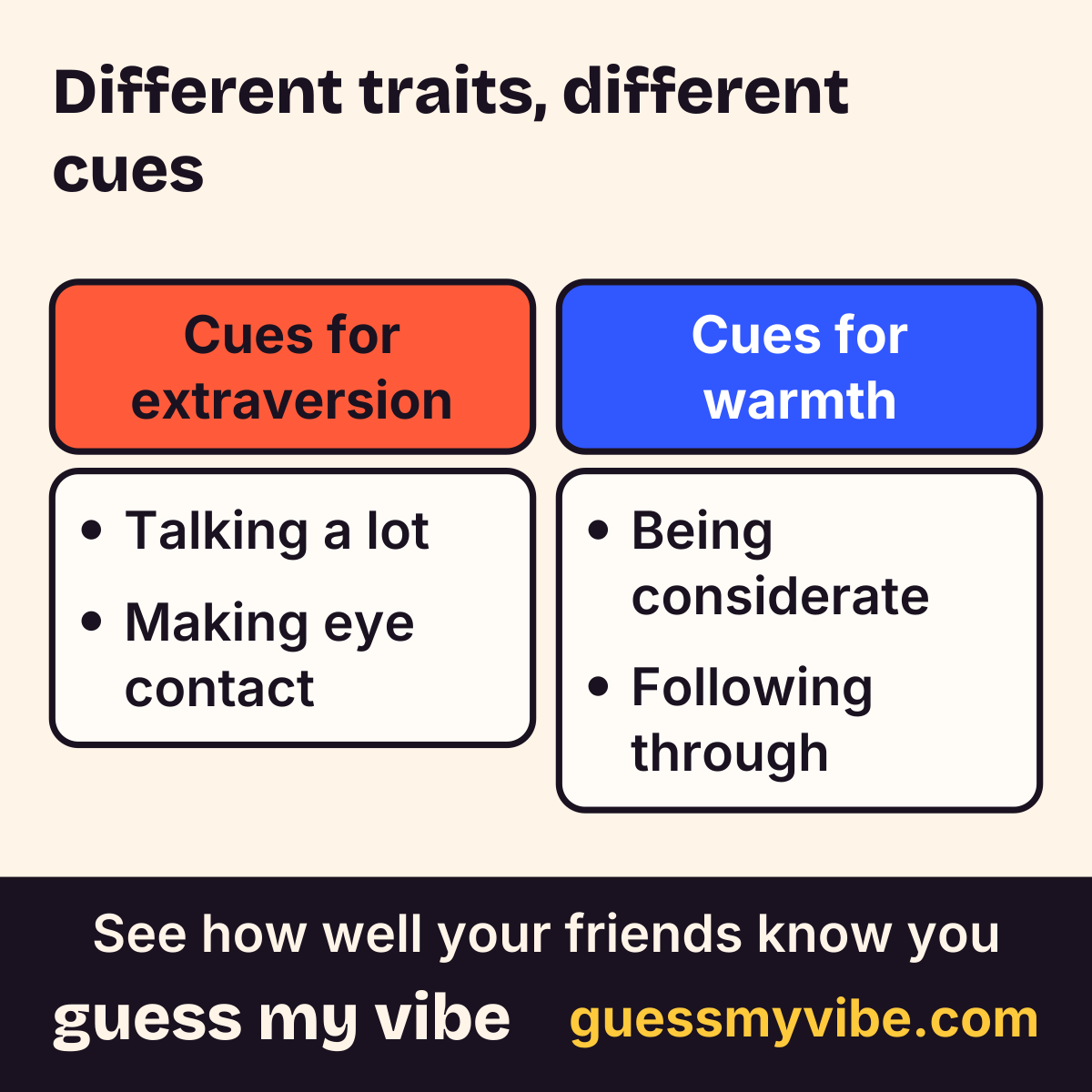
A study that's directly relevant here looked at exactly how an outside observer forms a personality judgment from watching someone's behavior. Researchers videotaped 140 undergraduates in two social interactions, coded 62 distinct behaviors from each tape, and separately had people rate how diagnostic each of those 62 behaviors actually was for each of the five traits. The diagnosticity ratings lined up with which cues strangers actually leaned on when forming a judgment, and lined up closely with which behaviors genuinely related to how knowledgeable informants described that same person [1]. The finding worth sitting with: the behavioral cues that signal one trait are largely different from the cues that signal another. Talking a lot, making eye contact, initiating conversation, these are the kind of cues that mark someone as extraverted. Being considerate, following through, not being harshly critical, these mark someone as warm or agreeable. They're not the same behaviors, and they don't come from the same moments.
That gap matters because of how personality judgments actually work. A separate, influential model of judgment accuracy argues that correctly reading a trait requires a relevant cue to be available in the first place, for the observer to actually notice it, and for the observer to use it the right way [2]. A reserved person in a brief first encounter supplies plenty of extraversion-relevant cues almost immediately, mostly by their absence: less talking, less initiating, less visible energy. Warmth-relevant cues, by contrast, usually take more than a few minutes to show up. Whether someone is considerate, loyal, or quick to help isn't something a stranger can see in a five-minute conversation the way they can see whether someone is loud or quiet. No study cited here directly tested whether that gap causes people to actually mistake quiet for cold, but the two pieces line up in an obvious way: when the only cues available early on are extraversion cues, and a person is naturally offering fewer of them, there isn't much else on hand yet to judge warmth by, which leaves room for an observer to let the one signal they do have stand in for a trait it was never actually measuring.
Cite this figure
Figure: "Different traits, different cues." Guess My Vibe (guessmyvibe.com). https://guessmyvibe.com/learn/reserved-personality#figure-different-cues
Curious how your friends would answer?
Free. Answer 10 quick questions about you, then send your link. Friends play in their browser, no app needed.
Start freeWarmth is the hardest Big Five trait for people to agree on
A meta-analysis of 263 samples and more than 44,000 people adds a caution about how reading warmth works. It found that getting close to someone improved the accuracy of other people's ratings a lot for low-visibility traits, but only minimally for highly evaluative traits like agreeableness, the trait covering warmth, trust and cooperation [3]. That isn't really about reserved people specifically. It's a general pattern: warmth is a hard trait to judge for everybody, outgoing and reserved alike. Reserved people just have one extra disadvantage layered on top, since the trait that's already hard to read correctly is also the one they're most likely to get an unearned negative read on, precisely because their one obviously visible trait (quietness) has nothing to do with it.
The misread fades the longer someone actually knows you
There's a genuinely reassuring finding buried in this research. A study of about 150 undergraduates, each rated by two close acquaintances and separately by two strangers who'd only seen one brief videotaped interaction, found that close acquaintances agreed with each other and with the person's own self-ratings far more than strangers did [4]. Strangers' first-impression judgments still agreed with each other better than chance, but acquaintance made a real, measurable difference, and the traits that were easier to see produced better agreement for strangers too. That maps directly onto the quiet-versus-cold problem. A snap judgment from someone who's only seen you be quiet in one room is working with exactly the thin slice of information most likely to produce the wrong read on warmth. The same person, after a few real hangouts where your actual behavior toward them has had time to show up, is working with a much fuller picture, and the misread tends to correct itself.
What this means if you're the reserved one, or you're judging one
If you're the quieter person in a new group, the honest takeaway isn't to force extra small talk to seem friendlier. It's knowing that the specific trait a stranger is most likely to misjudge about you is the one your quietness has nothing to do with, and that the fix isn't performing extraversion, it's just time and a few real interactions where your actual warmth gets a chance to become visible. If you're the one sizing up a new, quiet person, the same research cuts the other way: a first impression of someone's warmth, formed from watching how much they talk, is working with the wrong cue for the job. It's worth holding that judgment a little more loosely than a first impression of how outgoing they are, since outgoingness is exactly the thing a few minutes of observation can actually tell you.
Guess My Vibe is built around comparing these two traits directly instead of letting one stand in for the other. A friend guesses your actual answers to personality questions covering both how outgoing you are and how warm and cooperative you are, scored separately. That keeps the two traits from blurring together the way a quick first impression tends to blur them, and shows you exactly where a friend's read on your warmth lines up with how you actually see yourself, separate from whatever they'd guess about how loud or quiet you are in a room.
Key takeaways
- Being reserved means low extraversion: quieter, more comfortable in small groups, less driven to seek out stimulation. It isn't a measure of warmth or kindness, which the Big Five tracks as a separate trait, agreeableness [1].
- Different personality traits are read from different behavioral cues. The cues that signal someone is outgoing tend to differ from the cues that signal someone is warm or trustworthy [1].
- Judging someone's personality accurately requires a relevant cue to actually be available, noticed, and used correctly; when a cue for one trait is missing, people don't always have a reliable substitute for it [2].
- Agreeableness (warmth, trust, cooperation) is a highly evaluative trait where, in a large meta-analysis, closeness to the person being rated improved accuracy only minimally, unlike low-visibility traits, which fits with warmth being harder to pin down than sociability is [3].
- Judgments by close acquaintances agreed with each other and with the person's own self-view much better than judgments by strangers who had only seen a single videotaped interaction [4].
- This isn't therapy, a diagnosis, or a substitute for professional care.
Questions people ask
Does having a reserved personality mean I'm unfriendly?
No. Reserved describes low extraversion, how much stimulation and talking you prefer, not how warm or kind you are. Warmth is measured by a separate Big Five trait, agreeableness, which extraversion has little to do with [1].
Why do quiet people get mistaken for being cold?
Research on judgment accuracy finds that different traits are read from different behavioral cues, and the cues that signal sociability (talking, initiating) show up almost immediately, while the cues that signal warmth (follow-through, consideration) plausibly take longer to appear. A reserved person offers fewer early sociability cues, leaving a new observer with less to go on for warmth specifically, which creates room for the wrong read [1] [2].
Is warmth the same thing as being extraverted?
No, they're separate Big Five traits. Extraversion covers sociability and stimulation-seeking; agreeableness (the app's plain name is Warmth) covers trust, cooperation and kindness toward others. A meta-analysis found that closeness improves accuracy only minimally for highly evaluative traits like agreeableness [3].
Will people eventually see my real personality if I'm reserved?
Research on acquaintance and judgment accuracy says yes, in general: close acquaintances agree with each other and with a person's own self-view far more than strangers relying on a single brief interaction do. The traits that were easier to see also produced better agreement among strangers, so visibility matters alongside time [4].
How can I show my warmth if I'm naturally quiet?
No study cited here directly tested specific strategies, so there's no research-backed technique to point to. What the research does support is that warmth cues (consideration, follow-through, reliability) are different from sociability cues and simply take more real interaction to become visible, so consistent small actions over time, not performing extra talkativeness, are what the evidence suggests actually changes the read.
See how well your friends know you.
Free. Answer 10 quick questions about you, then send your link. Friends play in their browser, no app needed.
Start freeReferences
- [1] Funder, D. C., & Sneed, C. D. (1993). Behavioral manifestations of personality: An ecological approach to judgmental accuracy. Journal of Personality and Social Psychology, 64(3), 479–490. PubMed: 8468673 (opens in a new tab)
- [2] Funder, D. C. (1995). On the accuracy of personality judgment: A realistic approach. Psychological Review, 102(4), 652–670. doi.org/10.1037/0033-295X.102.4.652 (opens in a new tab)
- [3] Connelly, B. S., & Ones, D. S. (2010). An other perspective on personality: Meta-analytic integration of observers' accuracy and predictive validity. Psychological Bulletin, 136(6), 1092–1122. PubMed: 21038940 (opens in a new tab)
- [4] Funder, D. C., & Colvin, C. R. (1988). Friends and strangers: Acquaintanceship, agreement, and the accuracy of personality judgment. Journal of Personality and Social Psychology, 55(1), 149–158. PubMed: 3418488 (opens in a new tab)
How we find and check these sources: how we write. Spotted an error? Report a correction.
Related
Cite this article
- Title
- Reserved Personality: Why Quiet Isn't the Same as Cold
- Publisher
- Guess My Vibe
- Updated
- URL
- https://guessmyvibe.com/
learn/ reserved-personality
Copy this citation
Guess My Vibe. (2026, October 3). Reserved Personality: Why Quiet Isn't the Same as Cold. Guess My Vibe. https://guessmyvibe.com/
To point at one section, add that section's anchor (the # link on its heading) to the URL.