The most direct, tested way to be more social is to act talkative, assertive, bold and energetic on purpose, even for a short stretch. Randomized trials find this reliably lifts mood, including for people who call themselves introverts [1] [2]. It isn't free for everyone, though: a week-long trial found more introverted people got a smaller mood boost and more tiredness from sustaining it [3], so the honest advice is to try it in short doses first and watch your own pattern rather than assuming it works the same for you as it did for the average person in a study.
How to be more social: what researchers actually had people do
Most advice on how to be more social is vague: "put yourself out there," "be more confident." The research on this is much more specific, because to actually test whether acting more social changes anything, researchers had to define exactly what "acting more social" means as a concrete behavior, not a feeling. One set of studies operationalized it as acting bold, assertive, talkative, energetic and spontaneous, and had people do exactly that for a set stretch of time, then compared it to acting reserved, quiet and lethargic during a different stretch [1]. That's a genuinely useful starting definition if you're trying to apply any of this yourself: being more social, in the tested sense, isn't a vibe, it's a short list of specific behaviors you can actually choose to do in the next five minutes.
- Talk more than your default: offer an opinion, ask a follow-up question, don't let a silence sit.
- Be more assertive: state a preference directly instead of deferring ("I'd rather get pizza" instead of "whatever you want").
- Act bolder: say the slightly riskier thing, make the suggestion, be the one who initiates.
- Bring more energy: match or slightly exceed the room's energy rather than hanging back at your usual baseline.
- Be more spontaneous: say yes to the plan that wasn't on the schedule.
What actually happens to your mood when you do this
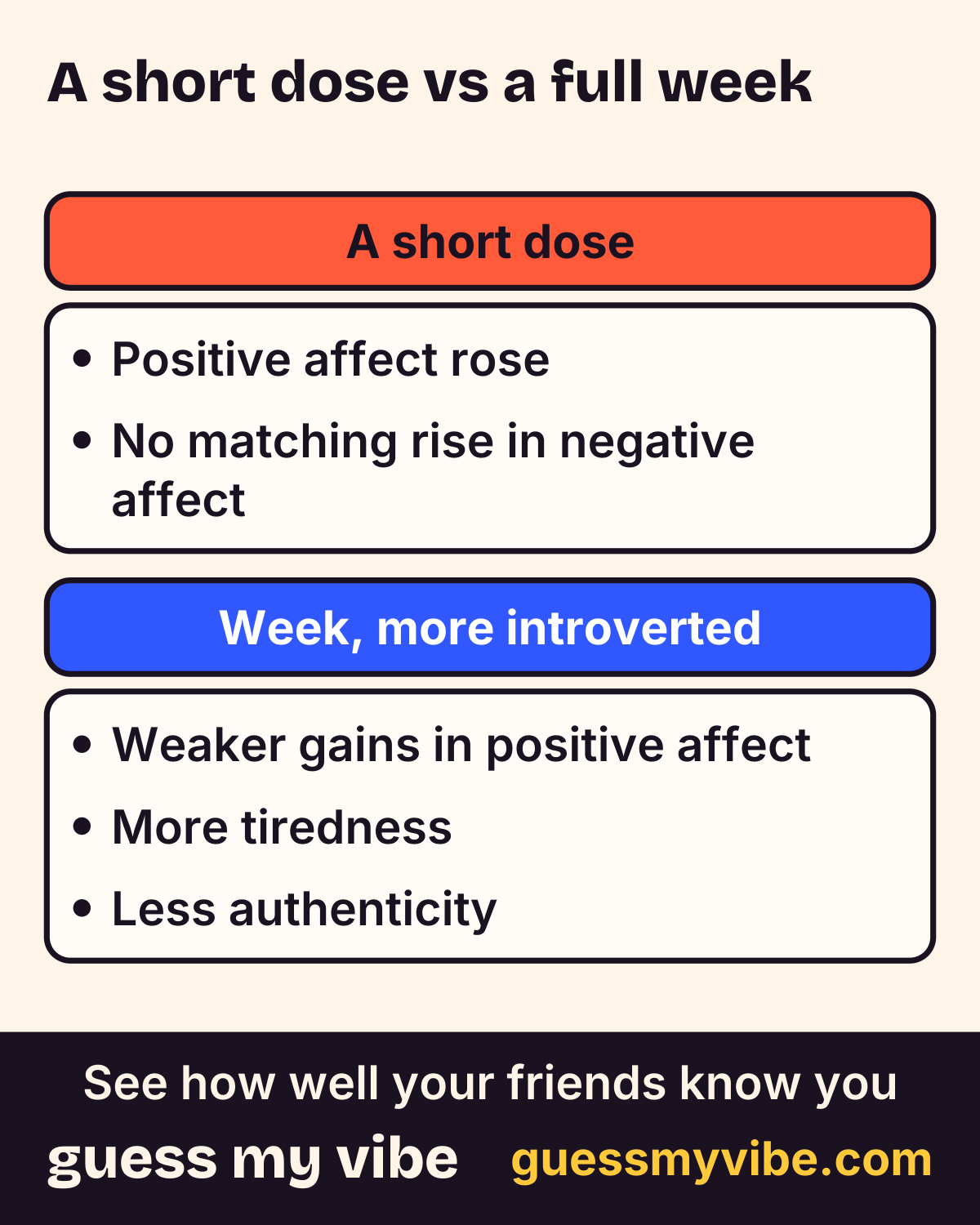
The short-term answer is consistently good news. Two studies that randomly assigned people to act introverted or extraverted found that acting extraverted raised positive affect with no matching rise in negative affect, and this held regardless of someone's own usual personality: introverts got the same mood lift from acting outgoing that extraverts did [2]. That's a genuinely useful, tested finding, not a motivational claim: a short, deliberate burst of talkative, assertive, energetic behavior reliably makes people feel better in the moment, whether or not it matches how they'd normally describe themselves.
A separate study pushed this further, from a single lab task out into a full week of real life. Participants were assigned to act extraverted for one week and act introverted for a different week, with well-being measured both times [4]. Well-being went up during the extraverted week and down during the introverted week. That's a more demanding test than a short lab task, since it's asking whether the effect holds up across an entire week of ordinary days, not just one controlled sitting, and it held.
The cognitive cost people worry about isn't where you'd expect
A common worry about "acting against type" is that it takes mental effort to sustain, leaving less cognitive capacity for everything else. The same study that found the mood benefits tested this directly, having people complete a task measuring mental control and focus after acting introverted or extraverted [2]. The cost showed up, but not for the group most people would guess. Introverts who acted extraverted didn't show the cognitive cost. Extraverts who were assigned to act introverted did. The researchers' own read is that the positive mood introverts get from acting outgoing may actually offset the mental effort of doing something unfamiliar, while extraverts forced to dial down and act quiet don't get that same mood cushion to work with. If you're worried that being more social will leave you mentally drained, the study that tested this says that specific worry isn't well supported, at least for a single task.
Curious how your friends would answer?
Free. Answer 10 quick questions about you, then send your link. Friends play in their browser, no app needed.
Start freeThe real cost: what a full week of it does to the most introverted people
Here's where the honest picture gets more complicated, and where this topic's actual angle matters most. A randomized controlled trial assigned 147 people to either an act-extraverted intervention or a sham intervention for a full week of everyday life, and measured positive affect, negative affect, authenticity and tiredness, both in the moment and in retrospect [3]. Overall, the act-extraverted group showed a real rise in positive affect and authenticity. But that overall average hid a meaningful split: wellbeing outcomes depended on each person's own usual extraversion level. More introverted participants had weaker positive-affect gains, and also reported more negative affect, more tiredness, and less authenticity than the average participant did. The benefit was real at the group level. The cost was real too, and it landed disproportionately on the people who started furthest from the behavior being asked of them.
Why does a full week of sustained acting-extraverted produce a cost that a single lab task or even a full week in the other study didn't clearly show? The honest answer is that the studies aren't identical: a short, one-time lab task, a self-guided week comparing two assigned styles, and a week-long trial measuring costs in fine-grained detail all test slightly different things, at different intensities and durations, and it's a real, open question in this research exactly where the line sits between "a quick confidence boost" and "more than this person can comfortably sustain." What's consistent across all of it is the direction: a short dose helps almost everyone, and the people most likely to pay a real cost for sustaining it are the ones furthest from it already.
Cite this figure
Figure: "A short dose vs a full week." Guess My Vibe (guessmyvibe.com). https://guessmyvibe.com/learn/how-to-be-more-social#figure-short-dose-vs-full-week
How to actually use this without overdoing it
Put together, the research points to a specific, non-generic way to try being more social. Start with a short dose, a single event or a single evening, not a declared one-week project, since that's closer to the lab-task evidence that shows a clean, nearly cost-free mood benefit. Pick one or two of the concrete behaviors above rather than trying to overhaul your whole demeanor at once; assertiveness and talkativeness are each individually testable and individually rewarding, and you don't need all five at once to get a real effect. Pay attention to your own pattern afterward, specifically tiredness and whether you still feel like yourself, since those are exactly the two things the week-long trial found tracked with someone's starting disposition. If a short dose feels good and doesn't leave you drained, that's real evidence you can extend it. If a single evening of it already leaves you flatter than usual, that's useful information too, not a sign you did it wrong.
This is also exactly the kind of pattern that's easier to see with an outside check than by guessing alone. Guess My Vibe has a friend guess your actual answers to personality questions, including ones about how outgoing you are and how you feel after a demanding social stretch, so you get an honest comparison between how social you think you come across and how a friend actually reads you, instead of just assuming where your own starting point is before you try changing it.
Key takeaways
- Research on "acting extraverted" defines it specifically: more talkative, assertive, bold, spontaneous and energetic than your own baseline, not a vague sense of being friendlier [1].
- In lab studies, acting this way for even a short task raised positive mood without raising negative mood, for extraverts and introverts alike [2].
- A full week of deliberately acting extraverted in real life raised both positive affect and feelings of authenticity, in a randomized trial comparing it to a sham intervention [3]; a separate one-week experiment also found well-being rose during an extraverted week [4].
- That same week-long trial found the benefit wasn't even: more introverted participants had a smaller mood lift and reported more tiredness, more negative affect, and feeling less like themselves [3].
- The cognitive cost researchers worried about doesn't fall on introverts acting extraverted. One study found it falls on extraverts forced to act introverted instead [2].
- This isn't therapy, a diagnosis, or a substitute for professional care.
Questions people ask
What's the fastest way to be more social?
Pick one specific behavior and do it deliberately: talk more than your default, state a preference directly, or initiate the plan instead of waiting for one. Research that tested a version of this approach found it reliably lifts mood in the short term, for introverts and extraverts alike [1] [2].
Will acting more outgoing make me tired or drain my energy?
A single dose doesn't seem to, based on the study that directly tested cognitive cost; the cost it found fell on extraverts forced to act introverted, not introverts acting extraverted [2]. A full week of sustained effort is different: a randomized trial found more introverted people did report more tiredness from a week of it [3].
Is it fake or inauthentic to act more extraverted than I really am?
The evidence is mixed by duration. A week-long randomized trial found acting extraverted raised feelings of authenticity on average, but the same trial found more introverted participants specifically felt less like themselves while sustaining it [3]. Both are real findings; they just land differently depending on how introverted you are to start with.
Does being more social work the same for introverts and extraverts?
A short burst of acting outgoing lifts mood about equally regardless of someone's usual personality [2]. A full week of sustaining it doesn't: more introverted participants in one trial got a smaller benefit and a real cost in tiredness and authenticity, so a longer push is where personality starts to matter [3].
How long should I try acting more social before deciding if it's worth it?
Start with a single event or evening rather than a week-long commitment, since that's closest to the lab-task research showing a clean benefit with little downside. Notice afterward whether you feel more tired or less like yourself than usual; the honest research says that's the signal worth tracking for your own pattern, not a fixed rule that applies to everyone equally.
See how well your friends know you.
Free. Answer 10 quick questions about you, then send your link. Friends play in their browser, no app needed.
Start freeReferences
- [1] Fleeson, W., Malanos, A. B., & Achille, N. M. (2002). An intraindividual process approach to the relationship between extraversion and positive affect: Is acting extraverted as "good" as being extraverted?. Journal of Personality and Social Psychology, 83(6), 1409–1422. PubMed: 12500821 (opens in a new tab)
- [2] Zelenski, J. M., Santoro, M. S., & Whelan, D. C. (2012). Would introverts be better off if they acted more like extraverts? Exploring emotional and cognitive consequences of counterdispositional behavior. Emotion, 12(2), 290–303. PubMed: 21859197 (opens in a new tab)
- [3] Jacques-Hamilton, R., Sun, J., & Smillie, L. D. (2019). Costs and benefits of acting extraverted: A randomized controlled trial. Journal of Experimental Psychology: General, 148(9), 1538–1556. PubMed: 30489119 (opens in a new tab)
- [4] Margolis, S., & Lyubomirsky, S. (2020). Experimental manipulation of extraverted and introverted behavior and its effects on well-being. Journal of Experimental Psychology: General, 149(4), 719–731. PubMed: 31368759 (opens in a new tab)
How we find and check these sources: how we write. Spotted an error? Report a correction.
Related
Want to try it with your own friends? Make a friendship quiz to play with your friends
Cite this article
- Title
- How to Be More Social: What the Research Actually Shows
- Publisher
- Guess My Vibe
- Updated
- URL
- https://guessmyvibe.com/
learn/ how-to-be-more-social
Copy this citation
Guess My Vibe. (2026, October 3). How to Be More Social: What the Research Actually Shows. Guess My Vibe. https://guessmyvibe.com/
To point at one section, add that section's anchor (the # link on its heading) to the URL.