How to make friends comes down to a short list research keeps finding: be around the same people more than once, let that repeated contact turn into real conversation, and put in real hours together, not just one good hangout. There's no shortcut that skips the time, but knowing where to spend it helps [1].
How to make friends is less mysterious than it feels when you're new somewhere. Decades of research on how relationships form point to the same handful of ingredients: being around the same people more than once, turning that repeated contact into real conversation, and putting in enough hours for the other person to actually get to know you. None of it is instant, and none of it runs on charm alone.
How to make friends when you're starting from zero
Strip away the advice-column language and the research on friendship formation keeps landing on three things: proximity (being around the same people repeatedly), time (enough of it, spent on the right kind of talk), and a bit of self-disclosure (sharing real things about yourself sooner than feels natural). The sections below go through each one, plus what the evidence does and doesn't support.
Cite this figure
Figure: "Three things linked to making friends." Guess My Vibe (guessmyvibe.com). https://guessmyvibe.com/learn/how-to-make-friends#figure-three-ingredients
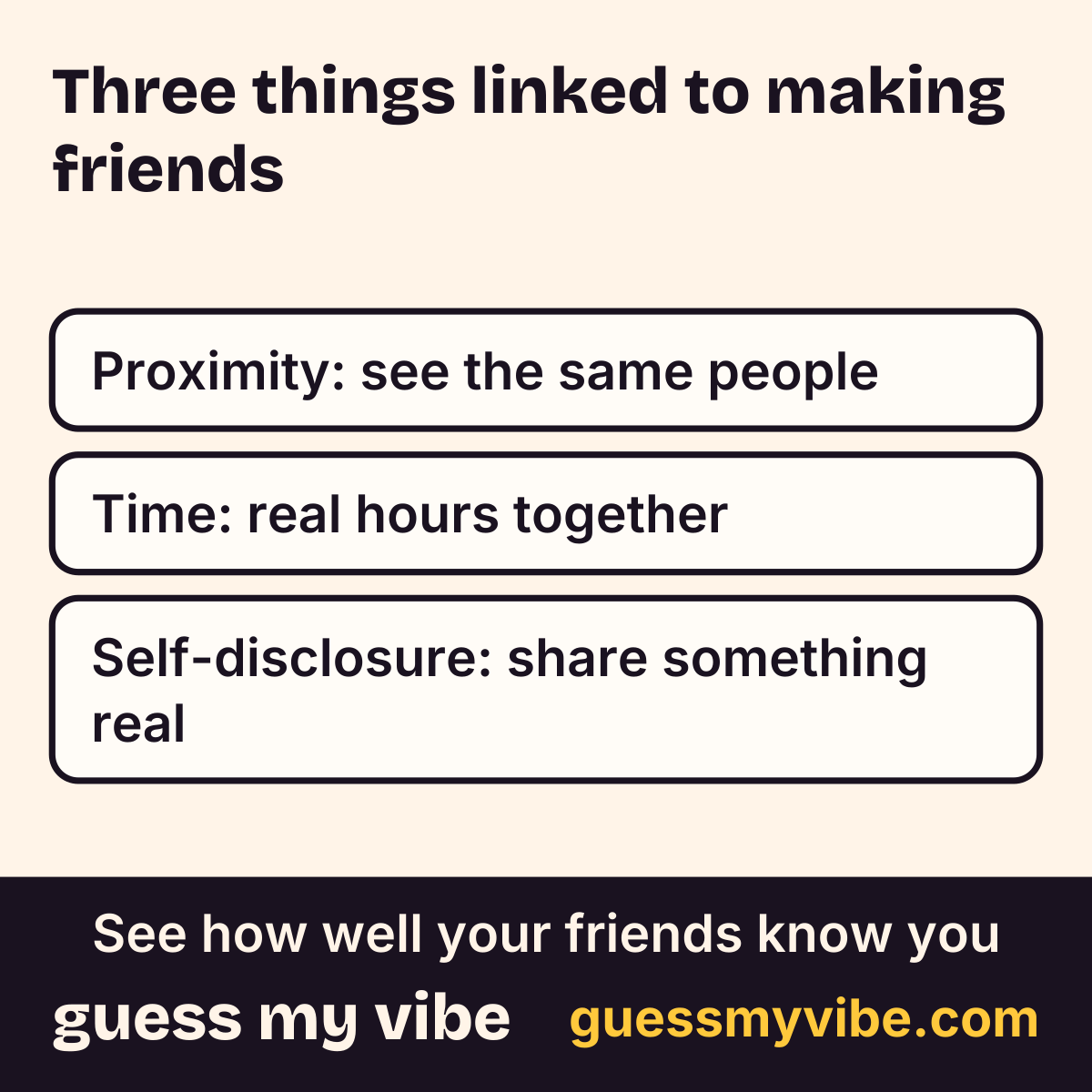
Proximity does more work than charisma
Before two people can become friends, they usually have to run into each other more than once. That sounds obvious, but a classic line of research on the mere-exposure effect shows it's doing more work than it gets credit for: simply being exposed to the same person, place, or thing repeatedly tends to raise how much you like it, even without a single real interaction. A meta-analysis pooling two decades of exposure studies found this effect held up consistently, though its size depends on things like how complex the stimulus is and how long each exposure lasts [1].
The practical version: making friends gets easier when you put yourself somewhere you'll see the same faces again, a recurring class, a weekly pickup game, the same coffee shop at the same time, rather than chasing one-off events where everyone scatters afterward and the exposure never repeats.
It takes real hours, not one good hangout
Proximity gets you in the room. What happens next takes time. Two studies looked directly at this: in the first, 355 adults who'd recently moved somewhere new estimated how many hours they'd spent with a new acquaintance, and more hours together was associated with a closer friendship, with time spent on shared leisure activities mattering too. In the second, 112 first-year college students tracked their hours with two new acquaintances three separate times over nine weeks, and hours together tracked with how much closer the friendship got between check-ins. Two specific kinds of everyday talk also tracked with that growing closeness [2].
You may have seen a specific number of hours floated around online for when an acquaintance becomes a real friend. We read the study behind that claim and couldn't confirm an exact hour count in it, so we're leaving a specific number out rather than repeat a figure we can't verify ourselves. What the study does support is simpler and still useful: more time together, spent on real activities and real talk, reliably tracks with a closer friendship.
Curious how your friends would answer?
Free. Answer 10 quick questions about you, then send your link. Friends play in their browser, no app needed.
Start freeSkip small talk sooner than feels natural
A well-known lab procedure, sometimes nicknamed the '36 questions' task, tested whether closeness could be built on purpose rather than waiting for it to happen. Strangers, matched up two at a time, spent 45 minutes trading questions that started light and escalated into more personal territory, alongside a short relationship-building exercise. Compared to a group who just made small talk for the same amount of time, the group with the escalating questions ended up measurably closer right afterward [3].
That was a controlled lab study with strangers who knew they were in an experiment, so it's not a guarantee the same magic happens over text with a new coworker. The honest takeaway is narrower but still practical: asking a real question (what are you actually into right now, what's been stressful lately) tends to move a new acquaintance toward friend faster than another round of weather and weekend plans.
The part you can't fully control: whether they like you back
Proximity and time explain a lot, but they don't explain everything, because the other person has to be building something too. That part is harder to engineer and easier to misjudge from the outside; a newer friendship often runs on each person's read of the other, which isn't always accurate yet. What does seem to help is simply staying in the picture long enough for a real read to form. As two people spend more time together, their impressions of each other get less generic (less "people in general are like this") and more specific to who the other person actually is, which is a big part of what a new acquaintance turning into an actual friend looks like from the inside [4].
Practical starting points based on the research above
None of the studies above hand you a script, but each one points at something you can actually act on this week, not just something to think about.
- Pick one recurring thing (a class, a league, a standing shift) instead of a one-off event, so the same faces show up more than once.
- Go back to the same few spots rather than spreading yourself across new ones every time; repeated exposure is doing real work even on a day nothing memorable happens.
- Count the actual hours you're spending with a new person, not just the number of times you've met, since the research above tracked time, not meetings.
- Ask one question that's a little more real than the one you'd default to, instead of staying on safe small talk the whole time.
- Give it more than one hangout before deciding whether it's going anywhere. A single good conversation is a start, not the whole case.
What the research doesn't settle
Making friends as an adult often feels harder than it did in school, and the proximity research above is a plausible reason why: school puts you in a room with the same people every day for years without any effort on your part, and adult life usually doesn't. That's a reasonable inference from the pattern above, not a separate, directly tested claim, so it's worth holding a little more loosely than the hours-and-closeness findings themselves.
Once you've found someone, there's a way to track it
Most of the work in making a friend happens before any app gets involved: showing up again, spending the hours, asking the realer question. Guess My Vibe is built for the stage right after that, once you've got someone you see often enough to invite: a daily round where you each guess how the other would actually answer, so the closeness you've been building shows up as something you can both see, instead of staying a feeling neither of you has said out loud.
Key takeaways
- Plain repeated contact with the same people builds liking on its own, even before a real conversation happens [1].
- In two studies, the number of hours people spent with a new acquaintance, and what they did with that time, tracked with how close the friendship became [2].
- Trading increasingly personal questions with someone, the idea behind the well-known '36 questions' task, created more closeness with a stranger than small talk did, in a lab setting [3].
- The longer two people know each other, the better they get at reading what's specifically true about each other, not just a generic guess about people in general [4].
- This isn't therapy, a diagnosis, or a substitute for professional care.
Questions people ask
How long does it really take to make a friend?
Research tracking real hours spent together found that more time, especially time spent on shared activities and real conversation, tracked with closer friendships over weeks. The studies didn't give us a verified specific hour count to repeat, but the direction is consistent: more real time together, not a single hangout, is what moves the needle [2].
Why does making friends as an adult feel so much harder?
A likely reason is proximity: school and childhood put you around the same people daily without effort, while adult routines often don't. Repeated contact with the same people builds liking on its own, so when that repeated contact disappears, so does one of the easiest paths to a new friendship [1].
What's the fastest way to get closer to someone new?
A lab study found that trading increasingly personal questions for 45 minutes built more closeness between strangers than small talk did. It's not guaranteed to work the same way outside a study, but asking a real question sooner, instead of sticking to small talk, is a reasonable way to speed things along [3].
Does it matter where I meet new people, or just how often?
Both, but "how often" is doing more of the work than people expect. Repeated exposure to the same person raises liking even without a real conversation, so a place you'll return to (a class, a team, a regular shift) gives that effect more room to work than a one-off event where you meet someone great and never see them again [1].
Can an app actually help me make friends?
An app can't replace the hours or the in-person contact the research points to. What a game like Guess My Vibe can do is give an existing, budding friendship a reason to keep showing up for each other daily, which is exactly the repeated contact the research above says matters.
See how well your friends know you.
Free. Answer 10 quick questions about you, then send your link. Friends play in their browser, no app needed.
Start freeReferences
- [1] Bornstein, R. F. (1989). Exposure and affect: Overview and meta-analysis of research, 1968–1987. Psychological Bulletin, 106(2), 265–289. doi.org/10.1037/0033-2909.106.2.265 (opens in a new tab)
- [2] Hall, J. A. (2019). How many hours does it take to make a friend?. Journal of Social and Personal Relationships, 36(4), 1278–1296. doi.org/10.1177/0265407518761225 (opens in a new tab)
- [3] Aron, A., Melinat, E., Aron, E. N., Vallone, R. D., & Bator, R. J. (1997). The experimental generation of interpersonal closeness: A procedure and some preliminary findings. Personality and Social Psychology Bulletin, 23(4), 363–377. doi.org/10.1177/0146167297234003 (opens in a new tab)
- [4] Biesanz, J. C., West, S. G., & Millevoi, A. (2007). What do you learn about someone over time? The relationship between length of acquaintance and consensus and self-other agreement in judgments of personality. Journal of Personality and Social Psychology, 92(1), 119–135. PubMed: 17201547 (opens in a new tab)
How we find and check these sources: how we write. Spotted an error? Report a correction.
Related
- How to Be a Good Friend, According to Research
- One-Sided Friendship: What the Research Actually Finds
- Long Distance Friendship: Does It Actually Last?
- Flaky Friends: The Personality Science of Canceling Plans
- BFF Test: A Real One to Take With Your Best Friend
- How to Be More Social: What the Research Actually Shows
- How to Make Friends Online (and if They're Real)
- The Propinquity Effect: Why Nearby People Become Friends
- The Mere Exposure Effect: Why Familiar Faces Grow on You
- How Long Does It Take to Make a Friend? What the Study Says
- Signs Someone Wants to Be Your Friend, and What's Known
- The Stages of Friendship: From Acquaintance to Close Friend
- How to Ask Someone to Hang Out: Less Risky Than It Feels
More in Making friends
- Are Online Friends Real Friends? What Research Finds
- Signs Someone Wants to Be Your Friend, and What's Known
- How Long Does It Take to Make a Friend? What the Study Says
- How to Make Friends in a New City (What Research Says)
- The Stages of Friendship: From Acquaintance to Close Friend
- Reciprocity Psychology: Why We Like People Who Like Us
- How to Ask Someone to Hang Out: Less Risky Than It Feels
- How to Make Friends as an Adult
- How to Make Friends in College
- How to Be More Social: What the Research Actually Shows
- How to Make Friends Online (and if They're Real)
- The Mere Exposure Effect: Why Familiar Faces Grow on You
- The Propinquity Effect: Why Nearby People Become Friends
Want to try it with your own friends? Make a friendship quiz to play with your friends
Cite this article
- Title
- How to Make Friends: What the Research Says
- Publisher
- Guess My Vibe
- Updated
- URL
- https://guessmyvibe.com/
learn/ how-to-make-friends
Copy this citation
Guess My Vibe. (2026, October 3). How to Make Friends: What the Research Says. Guess My Vibe. https://guessmyvibe.com/
To point at one section, add that section's anchor (the # link on its heading) to the URL.