How to make friends as an adult starts with understanding why it got harder in the first place: a large meta-analysis found social networks grow until young adulthood, then shrink steadily for the rest of adulthood, and the friendship network specifically shrinks right along with it [1]. The fix isn't charm. It's rebuilding the repeated contact school used to hand you for free, on purpose, and giving it real hours.
How to make friends as an adult is a different question than how to make friends in general, because the thing that changes isn't your personality. It's your environment. A large meta-analysis of the research on social networks across the lifespan found that the typical network grows until young adulthood and then shrinks steadily from there, and the friendship part of that network shrinks right along with the whole [1]. Making friends as an adult means rebuilding, on purpose, something that used to happen to you automatically.
Why making friends gets harder after school
The meta-analysis behind this pulled together 277 studies and more than 177,000 people, from adolescence into old age, looking at both cross-sectional snapshots and longitudinal tracking of the same people over time. Both kinds of study agreed on the same shape: the overall social network grows until young adulthood, then declines steadily afterward. The personal network and the friendship network specifically both shrink throughout adulthood. The family network, by contrast, stays roughly the same size from adolescence into old age. Networks built around coworkers or neighbors only showed up as sizable at specific ages, not as a steady presence across adulthood [1].
The same research also found that specific life events, starting a job, becoming a parent, losing a spouse, tend to produce network changes that look a lot like the broader age-related pattern, which suggests a lot of the shrinkage is tied to the transitions adult life keeps throwing at you, not to anything going wrong with how likable you are. One more detail worth knowing: personal and friendship networks have also gotten smaller as a general trend over roughly the last 35 years, a separate effect from plain aging. If making friends as an adult feels harder than it used to, for anyone, that's some evidence it's not only in your head [1].
What school gave you for free: repeated contact
School, and to a lesser extent college, hands you something most adult routines don't: the same people, in the same room, on a schedule you didn't have to build. That matters more than it sounds like it should. A meta-analysis of two decades of research on the mere-exposure effect found that simply being exposed to the same person repeatedly raises how much you like them, even before a real conversation happens, with the size of the effect depending on things like how long each exposure lasts [2]. A classroom, a dorm floor, or a shared locker room delivers that kind of repeated exposure automatically. A full-time job that's mostly remote, or a city where your commute and your friends' commutes never overlap, doesn't.
This is the real reason making friends as an adult feels like starting from zero: the automatic version of proximity disappeared, and nothing replaced it on its own. Adult life doesn't come with a built-in schedule that puts the same twenty people in front of you every weekday. If you want that back, you have to build it, which is a different, more deliberate task than it was at eighteen.
Curious how your friends would answer?
Free. Answer 10 quick questions about you, then send your link. Friends play in their browser, no app needed.
Start freeRebuilding repeated contact on purpose
The practical task is to manufacture a version of what school used to do automatically: put yourself in front of the same people, on a repeating schedule, often enough that mere exposure starts doing its quiet work. A few ways adults actually do this:
- A recurring class or league (a weekly run club, a pottery class, a rec-league team) beats a one-off event, because it guarantees the same faces show up again.
- A standing shift or volunteer slot works the same way: the same coworkers or fellow volunteers, on the same day, week after week.
- Saying yes to the same coffee shop, gym class time, or dog park slot repeatedly does real work even on days nothing memorable happens there.
- A hobby group tied to something you'd do anyway (a book club for a genre you actually read, a pickup sport you already play) survives longer than one picked purely to meet people, since the activity itself keeps you coming back.
None of this requires being outgoing. It requires picking something recurring over something one-off, since recurring is what lets repeated contact happen at all.
Once you've found the people, the hours still matter
Repeated contact gets you in the room. What happens after that still takes real time, at any age. Two studies tracked this directly: in the first, 355 adults who had recently moved somewhere new estimated how many hours they'd spent with a new acquaintance, and more hours together tracked with a closer friendship, with time spent on shared activities mattering too. In the second, 112 first-year college students tracked their hours with two new acquaintances three separate times over nine weeks, and hours together tracked with how much closer the friendship got between check-ins [3]. Neither study gives a single magic hour count worth repeating here, but the pattern is consistent and useful on its own: count actual hours, not just hangouts.
Skip the small talk sooner than feels natural
Adult small talk defaults hard to logistics: work, commute, kids, whatever's on the calendar. A well-known lab study tested whether closeness could be built on purpose instead of waiting for it. Strangers who spent 45 minutes trading questions that escalated from light to personal ended up measurably closer afterward than a group who just made small talk for the same amount of time [4]. That was a controlled study with people who knew they were in an experiment, so it's not a script to copy word for word. The honest, transferable version: asking a new coworker or neighbor one real question, what's actually been stressful lately, what they're into outside work, tends to move things along faster than another round of commute complaints.
Cite this figure
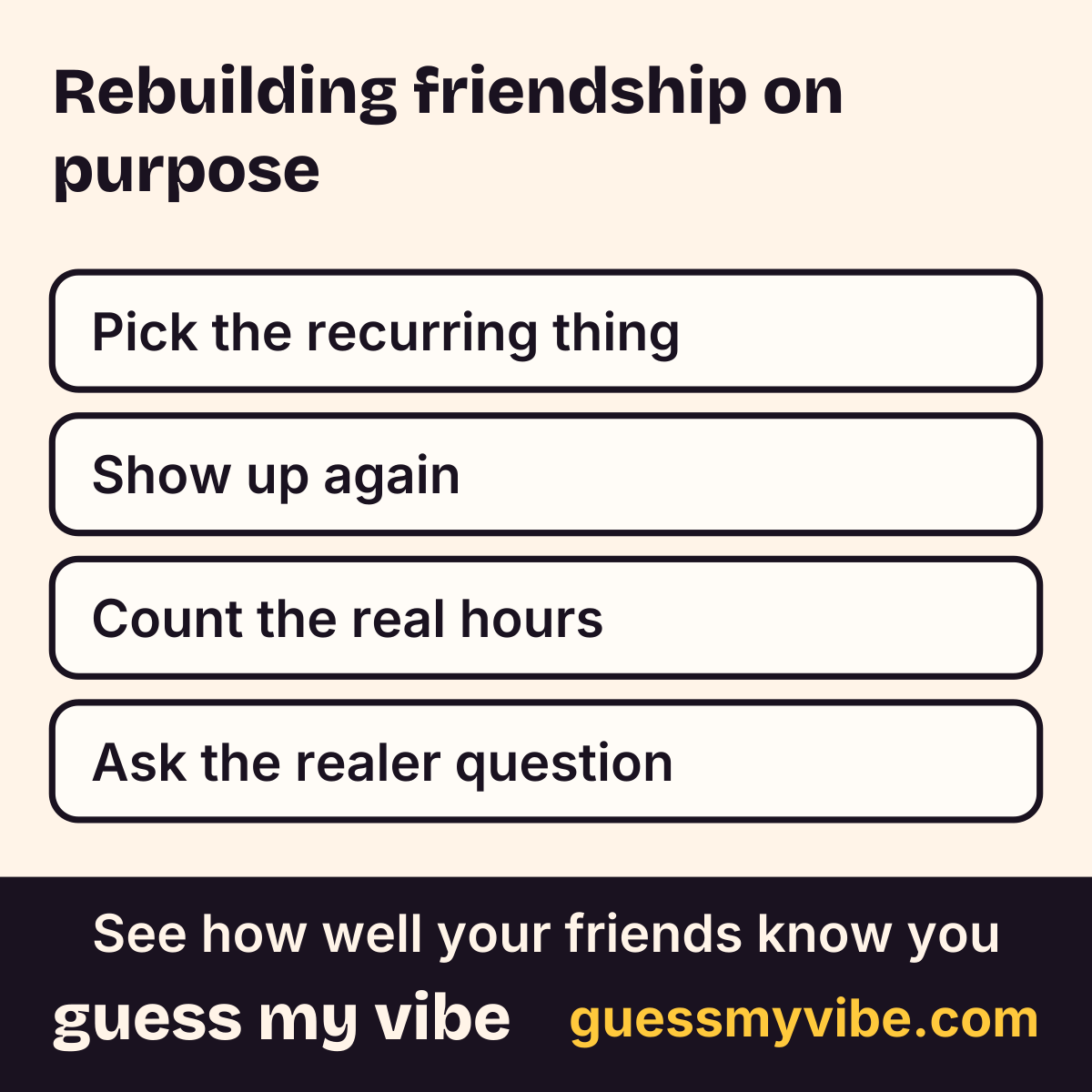
Figure: "Rebuilding friendship on purpose." Guess My Vibe (guessmyvibe.com). https://guessmyvibe.com/learn/how-to-make-friends-as-an-adult#figure-rebuild-contact
Once you've got someone, there's a way to track it
Most of the work in making an adult friendship happens before any app gets involved: picking the recurring thing, showing up again, counting the real hours, asking the realer question. Guess My Vibe is built for right after that, once you've got someone you see often enough to invite: a daily round where you each guess how the other would actually answer, so the closeness you've been building on purpose shows up as something you can both see.
Key takeaways
- Social networks peak around young adulthood and then shrink steadily for the rest of adulthood, with the friendship network declining along with the overall network [1].
- Personal and friendship networks have also gotten smaller as a broad trend over the last several decades, not just as something that happens to any one person [1].
- Plain repeated exposure to the same people builds liking on its own, even before a real conversation happens, which is exactly what a structured routine like school provides and adult life usually doesn't [2].
- More hours spent together tracked with how close a new friendship became in research following real new acquaintances over time [3].
- This isn't therapy, a diagnosis, or a substitute for professional care.
Questions people ask
Why is it so much harder to make friends after college?
College, like school before it, puts the same people in front of you on a schedule you didn't have to build. Research on social networks across the lifespan finds the network keeps shrinking through adulthood, which fits with why making friends after college feels like starting over [1].
How long does it actually take to make a friend as an adult?
Research tracking real hours spent with new acquaintances found that more time together, especially time spent on shared activities and real conversation, tracked with a closer friendship over weeks. There's no single verified hour count behind the specific figures some sites repeat, but the direction holds at any age: more real time together moves the needle, not one good hangout [3].
Do friendships actually get fewer as people get older?
On average, yes, at least from young adulthood onward. A meta-analysis of 277 studies and over 177,000 people found the friendship network declines steadily through adulthood, alongside the personal network overall, while the family network stays roughly stable [1].
What's the single best way to meet people as an adult?
Pick something recurring over something one-off. Plain repeated exposure to the same people builds liking before a real conversation even happens, so a weekly class, league, or shift outperforms a one-time event where you meet someone great and never see them again [2].
Can an app actually help me make friends as an adult?
An app can't replace the recurring contact or the real hours the research points to. What a game like Guess My Vibe can do is give an existing, forming friendship a reason to keep showing up for each other daily, once you've already found someone worth building that repeated contact with.
See how well your friends know you.
Free. Answer 10 quick questions about you, then send your link. Friends play in their browser, no app needed.
Start freeReferences
- [1] Wrzus, C., Hänel, M., Wagner, J., & Neyer, F. J. (2013). Social network changes and life events across the life span: A meta-analysis. Psychological Bulletin, 139(1), 53–80. PubMed: 22642230 (opens in a new tab)
- [2] Bornstein, R. F. (1989). Exposure and affect: Overview and meta-analysis of research, 1968–1987. Psychological Bulletin, 106(2), 265–289. doi.org/10.1037/0033-2909.106.2.265 (opens in a new tab)
- [3] Hall, J. A. (2019). How many hours does it take to make a friend?. Journal of Social and Personal Relationships, 36(4), 1278–1296. doi.org/10.1177/0265407518761225 (opens in a new tab)
- [4] Aron, A., Melinat, E., Aron, E. N., Vallone, R. D., & Bator, R. J. (1997). The experimental generation of interpersonal closeness: A procedure and some preliminary findings. Personality and Social Psychology Bulletin, 23(4), 363–377. doi.org/10.1177/0146167297234003 (opens in a new tab)
How we find and check these sources: how we write. Spotted an error? Report a correction.
Related
Want to try it with your own friends? Make a friendship quiz to play with your friends
Cite this article
- Title
- How to Make Friends as an Adult
- Publisher
- Guess My Vibe
- Updated
- URL
- https://guessmyvibe.com/
learn/ how-to-make-friends-as-an-adult
Copy this citation
Guess My Vibe. (2026, October 3). How to Make Friends as an Adult. Guess My Vibe. https://guessmyvibe.com/
To point at one section, add that section's anchor (the # link on its heading) to the URL.