It takes a lot of time together, but nobody can give you one reliable number. The best-known study found that more hours together went with closer friendships, in both a sample of recent movers and a group of first-year students followed for nine weeks. You may have seen exact hour counts repeated online; we couldn't confirm them in the paper, so we don't present them as fact.
How long does it take to make a friend?
How long does it take to make a friend? The research answer is that it takes a lot of time together, and the amount isn't fixed. The most-cited study on the question, by Jeffrey Hall, found that the more hours people spent together, the closer their friendship was, in two separate samples [1]. That's a useful finding, and it's the reason the question has a famous answer in hours. But the exact hour counts you may have seen repeated online are another matter, and this article is careful about them, because we couldn't verify them.
What the study confirms
The paper reports two studies. In the first, 355 adults recruited through an online platform, all of whom had recently relocated, estimated how much time they'd spent with a new acquaintance. Hours together went with closer friendships, and time spent on shared leisure activities also went with closeness [1].
In the second, 112 first-year students reported the number of hours they'd spent with two new acquaintances, three times over nine weeks. This design is stronger, because it follows the same people forward. More hours together went with changes in closeness between the check-ins, and two types of everyday talk also went with changes in closeness [1]. The author framed the work around two ideas, the social brain hypothesis and a theory of how communication builds bonds, and examined friendship status as a function of hours together, shared activities and everyday talk [1].
What about the famous hour counts?
You've probably seen specific numbers attached to this study, with roughly 50 hours for a casual friend, about 90 for a friend, and 200 or more for a close friend. Those figures are widely repeated. But they don't appear in the study's abstract, and the full text sits behind a bot-check that stopped us from opening it, so we couldn't confirm them. We'd rather say that than repeat a number we haven't seen. If the exact figures matter to you, read the paper itself, which is listed in the references below.
What we can say without reservation is the pattern the abstract reports: friendship closeness went up with time together. That's enough to be useful. And it's a good reason to be skeptical of any source that gives one tidy number with no caveats, since a count of hours can't capture how people spend them.
Limits to keep in mind
- It's about association. The abstract says hours together was "associated" with closeness and went with changes in it. That is not an experiment that assigned people to spend more time together [1].
- People estimated their hours. In the first study, participants estimated time spent with an acquaintance, and estimates are rarely exact [1].
- The samples are narrow. One was adults who had recently moved, the other first-year college students, so neither is a random slice of everyone [1].
- Time can't be the whole story. People who click with someone may simply choose to spend more time with them, so the direction of cause can run both ways.
Curious how your friends would answer?
Free. Answer 10 quick questions about you, then send your link. Friends play in their browser, no app needed.
Start freeWhy a single number misleads
A tidy number is appealing because it turns something vague into a plan: put in this many hours and you'll have a friend. But friendship closeness in these studies went up with time together as a general pattern across people, not on a schedule that applies to any one friendship [1]. Some people will click sooner and some later, and what you do during the hours matters. If you take any hour count seriously, treat it as a rough average from a specific sample, not a deadline.
Can you speed it up?
There's a famous lab procedure that suggests conversation, rather than hours alone, can build closeness in a short time. In the first of three studies, two strangers at a time spent 45 minutes on tasks that escalated in personal intensity, a mix of self-disclosure and relationship-building. They reported more closeness afterward than strangers doing comparable small-talk tasks [2]. That is closeness in a lab setting after 45 minutes, not a friendship, and it's a different thing from the months of repeated contact that the hours research describes.
The same paper also reported null findings worth knowing. In later studies, closeness was not significantly affected by whether the two people were matched on attitudes, whether they were led to expect mutual liking, or whether getting close was made an explicit goal, despite adequate power [2]. The takeaway is modest: in that lab, what the two people did together moved closeness, and good intentions alone did not. Combining more hours with more real conversation is consistent with both bodies of research.
What counting hours looks like in practice
The second study is a handy model for how to think about your own friendships. The students reported actual hours spent with two specific new acquaintances, and did it at three points across nine weeks [1]. Try the same mental exercise. Think of someone you'd like to be closer to and estimate the time you've actually spent together, not the time you've known each other. A coworker you've known for a year but only seen in meetings has fewer shared hours than a classmate you've seen twice a week for a month.
The studies also point to what fills those hours. Shared leisure activities went with closeness in the first study, and two types of everyday talk went with changes in closeness in the second [1]. The abstract doesn't say which two types of talk, and we couldn't open the full text to check, so we won't guess. What it does support is that hours of just being near each other aren't the whole picture: what you do and say in those hours seems to matter too, though these studies can't show it causes closeness.
Why it can feel slower than it is
Part of the frustration of making a friend is that you can't see the other person's side of it. After getting acquainted, people systematically underestimated how much their conversation partners liked them, and the gap lasted for months as dorm neighbors developed their relationships [3]. If a new friendship feels like it's moving slowly, the other person may be warmer toward you than you think.
There's also a simple cost. A review of friendship research describes friendships as extremely costly to create and maintain, in the time that has to be invested and in the mental effort behind it [4]. If it feels like a lot of work, that's not a sign you're doing it wrong; the work is real.
How to use this
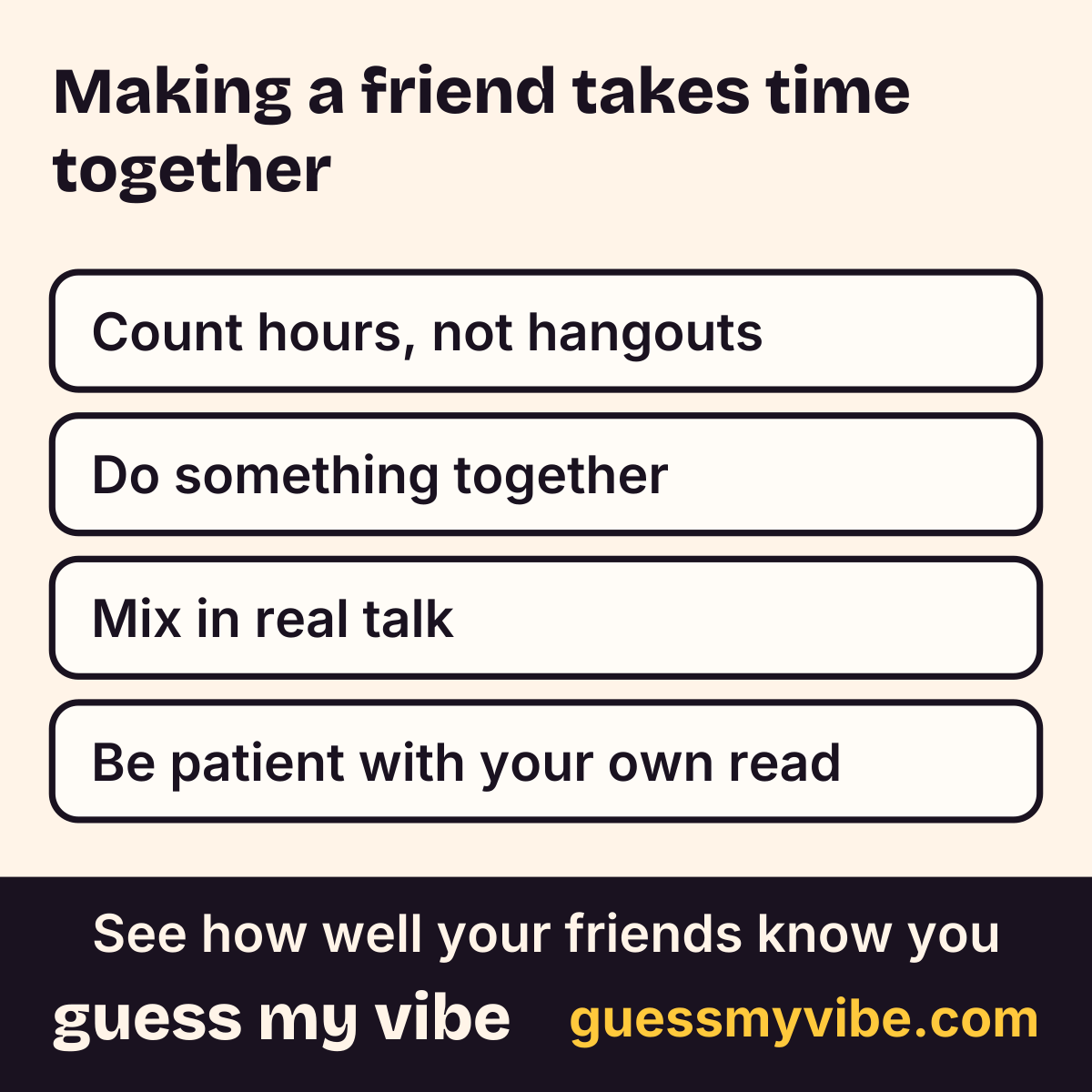
- Count hours, not hangouts. Time together went with closeness, so keep a rough tally of actual time spent in each other's company [1].
- Do something together. Time on shared leisure activities also went with closeness [1].
- Mix in real talk. Escalating personal conversation produced more closeness than small talk did in the lab [2].
- Be patient with your own read. You probably underestimate how much they like you [3].
Cite this figure
Figure: "Making a friend takes time together." Guess My Vibe (guessmyvibe.com). https://guessmyvibe.com/learn/how-long-does-it-take-to-make-a-friend#figure-making-a-friend-steps
A way to see how close you've gotten
Hours together are one way to measure a friendship. Another is how well a friend can guess your answers. Guess My Vibe lets a friend guess how you'd answer everyday social questions, and you see how close they came. It is a quick, low-pressure check on how well they already know you.
Key takeaways
- In a study of 355 adults who had recently relocated, more hours spent with a new acquaintance went with closer friendships, and time on shared leisure activities also went with closeness [1].
- In a second study, 112 first-year students reported hours with two new acquaintances at three points over nine weeks, and more hours went with increases in closeness between those points [1].
- The widely repeated hour counts could not be confirmed here, because they aren't in the abstract and the full text wasn't available to us, so treat any single number as unverified.
- Time isn't the only route to closeness: a 45-minute lab procedure with escalating personal questions produced more closeness between strangers than small talk did [2].
- This isn't therapy, a diagnosis, or a substitute for professional care; it's a plain-English summary of what friendship research does and doesn't show.
Questions people ask
How many hours does it take to make a friend?
More time together goes with closer friendship, but we couldn't confirm any exact hour count. The study's abstract reports that hours together was associated with closeness in two samples [1]. The popular hour figures are widely repeated but not verified here.
How long does it take to make a close friend?
The research doesn't give one reliable number. In a nine-week study of first-year students, more hours together went with increases in closeness [1].
Can you become friends faster?
Possibly through conversation. In a lab study, 45 minutes of escalating personal questions produced more closeness than small talk between strangers [2], though that's closeness in a lab, not a friendship.
Is it harder to make friends as an adult?
Friendships take time and effort to build and keep up [4]. The Hall samples were recent movers and first-year students, so they don't settle how age changes it [1].
Does the other person like me as much as it feels?
Probably more. People systematically underestimated how much their conversation partners liked them [3].
See how well your friends know you.
Free. Answer 10 quick questions about you, then send your link. Friends play in their browser, no app needed.
Start freeReferences
- [1] Hall, J. A. (2019). How many hours does it take to make a friend?. Journal of Social and Personal Relationships, 36(4), 1278–1296. doi.org/10.1177/0265407518761225 (opens in a new tab)
- [2] Aron, A., Melinat, E., Aron, E. N., Vallone, R. D., & Bator, R. J. (1997). The experimental generation of interpersonal closeness: A procedure and some preliminary findings. Personality and Social Psychology Bulletin, 23(4), 363–377. doi.org/10.1177/0146167297234003 (opens in a new tab)
- [3] Boothby, E. J., Cooney, G., Sandstrom, G. M., & Clark, M. S. (2018). The Liking Gap in Conversations: Do People Like Us More Than We Think?. Psychological Science, 29(11), 1742–1756. PubMed: 30183512 (opens in a new tab)
- [4] Dunbar, R. I. M. (2018). The Anatomy of Friendship. Trends in Cognitive Sciences, 22(1), 32-51. PubMed: 29273112 (opens in a new tab)
How we find and check these sources: how we write. Spotted an error? Report a correction.
Related
Want to try it with your own friends? Make a friendship quiz to play with your friends
Cite this article
- Title
- How Long Does It Take to Make a Friend? What the Study Says
- Publisher
- Guess My Vibe
- Updated
- URL
- https://guessmyvibe.com/
learn/ how-long-does-it-take-to-make-a-friend
Copy this citation
Guess My Vibe. (2026, October 4). How Long Does It Take to Make a Friend? What the Study Says. Guess My Vibe. https://guessmyvibe.com/
To point at one section, add that section's anchor (the # link on its heading) to the URL.