How to maintain friendships comes down to treating upkeep as something both people do, not a chore one person carries alone: research tracking actual friendship dyads found maintenance behavior mostly happens at the level of the dyad, not the individual [1]. It also means expecting a dip during a big life transition like the move to college, since that's common, and knowing that staying in touch, not staying nearby, is what goes with whether the friendship survives it [2].
How to maintain friendships is really a question about upkeep over time, not about how to be likable in the first place. Research that's tracked actual friendship dyads, not just asked one person to describe the friendship, finds maintenance works differently than a lot of advice assumes: it's less a list of things you personally do right and more a two-way pattern that either keeps running or doesn't, especially once a real transition (a move, a new job, a new school) puts it under pressure.
Maintenance is a two-way thing, not a solo project
A study that surveyed both people in 148 real friendship dyads, not just one side's perspective, used a statistical model built specifically for this kind of two-person data to ask a basic question: does friendship maintenance behave like an individual trait (something one person is just good or bad at) or a dyadic one (a property of the two-person relationship, built from both people)? The answer came back clearly dyadic: maintenance behavior showed up mainly as a feature of the dyad, while a related thing, each person's own problem-solving STYLE, behaved more like an individual trait [1]. In plain terms, a friendship that feels like it's being maintained is usually a joint production, not a solo performance by whichever person texts first.
That has a direct, practical implication: if you're the only one doing the maintaining, the research above suggests that's a harder, less typical pattern to sustain, not simply a sign you need to try harder. Maintenance research generally measures both people doing the work together, not one person compensating for the other.
How you handle friction matters more than how often you hang out
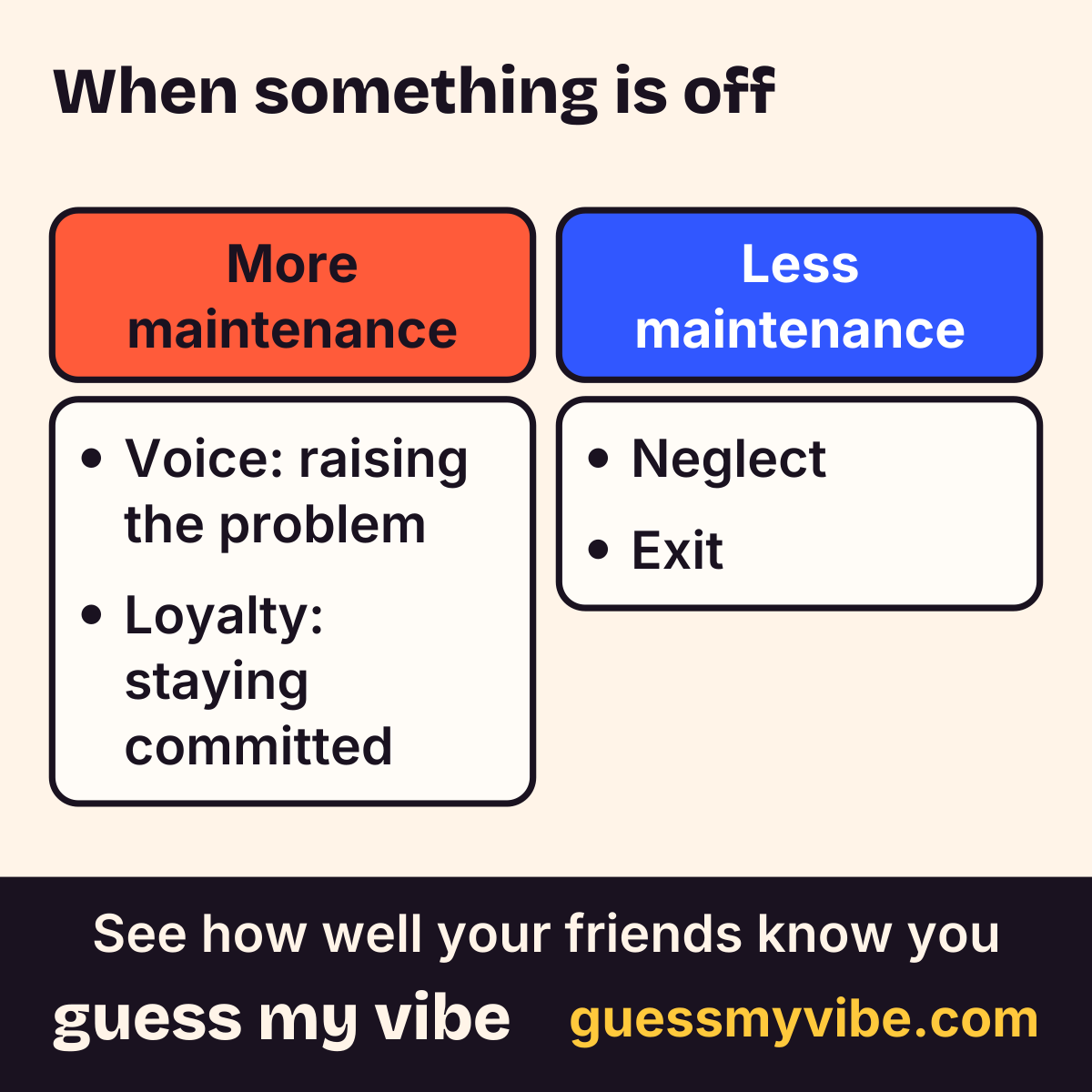
The same dyadic study also looked at how friends respond when something in the friendship goes wrong, using a classic framework with four response styles named voice, loyalty, neglect, and exit (in that framework, voice means raising the problem and loyalty means staying committed; the abstract itself only names them). Maintenance behavior went up alongside voice and loyalty, and down alongside neglect and exit. Maintenance behavior also went with the dyad's shared, dyadic-level satisfaction and commitment, while individual problem-solving style mainly went with each person's own, individual-level satisfaction [1]. The practical version: when something's off, actually saying something (not dramatically, just honestly) or simply staying patient about it tends to go with a friendship that keeps getting maintained. Going quiet or checking out tends to go with one that doesn't.
Cite this figure
Figure: "When something is off." Guess My Vibe (guessmyvibe.com). https://guessmyvibe.com/learn/how-to-maintain-friendships#figure-friction-responses
What happens to maintenance during a real transition
Day-to-day upkeep is one thing; a real transition is a harder test. A study that followed high-school best friendships through students' first year of college found these friendships declined, on average, in satisfaction, commitment, and how rewarding they felt, while the costs and alternatives to keeping them up rose, the kind of dip that can make a friendship feel like it's quietly ending. But the study also split friendships into two groups: ones that stayed "best" friendships through the year, and ones that slid down to close or casual. People whose friendships stayed best friendships reported doing more of the standard maintenance behaviors, positivity, support, self-disclosure, and interaction, than people whose friendships slid. Keeping the friendship up also appeared to protect against feeling socially lonely during the move [2]. The honest reading isn't that distance is irrelevant. It's that distance alone wasn't linked to the decline in this study; the level of communication two people actually kept up was, which is the part a person has some real control over during a move, a new job, or a new school, even when the geography isn't something either of you chose.
Curious how your friends would answer?
Free. Answer 10 quick questions about you, then send your link. Friends play in their browser, no app needed.
Start freeThe upkeep that works isn't identical for everyone
A study that tracked people's entire active personal networks over 18 months, across a major life transition, found friendships decline in quality without real investment, while family relationships behaved differently. But the specific kind of effort that protected a friendship from decline differed by gender: more contact and talking protected women's friendships most, while more shared activity protected men's friendships most [3]. That's a useful thing to know if a maintenance habit you've tried (a standing phone call, say) isn't landing the way it does for someone else; the research suggests the type of upkeep that actually works can differ by person, not just the amount of it.
All of this sits on top of a more basic, earlier finding: the foundational measure of friendship maintenance behavior itself, built and tested across three studies, found it breaks down into four concrete parts, positivity, supportiveness, openness, and interaction, and that friendships people called "best" showed more maintenance behavior overall than ones they called close or casual [4]. The dyadic and transition research above doesn't replace those four categories; it explains how they actually operate in practice, as a joint habit rather than a solo one, and as something that specifically needs defending during a transition rather than something that runs on its own.
What maintenance actually looks like week to week
- Say something small when it's off, rather than letting a minor annoyance pile up silently. The research above ties talking it out, not avoiding it, to friendships that keep getting maintained.
- Don't carry the whole friendship alone for long. If you're consistently the only one initiating, that's worth naming directly rather than assuming more effort on your end will eventually balance it out.
- Match the upkeep to what actually works for both of you, a standing call, a shared activity, a running group chat, rather than assuming one format (usually talking) is the only real kind of contact.
- Expect a dip during any real transition. A move, a new job, or a new school year is exactly when maintenance research finds friendships are most likely to slide, and that's normal, not a sign the friendship is already over.
- Keep the contact going even in a smaller, lower-effort form during a busy stretch. The research above ties ongoing communication, not grand gestures, to the friendships that make it through a transition.
A small, built-in reason to keep the contact going
Guess My Vibe won't replace an actual conversation, but it gives a friendship a tiny, repeatable piece of contact that's easy to keep up even during a busy or transitional stretch: a daily round where you each guess how the other would answer. It's a low-effort way to make sure a friendship doesn't quietly go a month with zero contact, which the research above ties directly to the ones that slide.
Key takeaways
- Friendship maintenance behavior mostly operates at the level of the DYAD, not just one person's individual effort, according to a study of 148 actual friendship dyads [1].
- That same study found maintenance went up alongside two specific habits when problems came up: the problem-solving styles called voice and loyalty, and went down alongside the styles called neglect and exit [1].
- Through a major transition (high school into the first year of college), physical distance did not go with how much a best friendship declined; the level of communication kept up did, and the people who kept it up stayed closer [2].
- The specific kind of effort that protects a friendship from fading isn't identical for everyone: a study tracking real social networks over 18 months found more contact and talking protected women's friendships most, while more shared activity protected men's friendships most [3].
- This isn't therapy, a diagnosis, or a substitute for professional care.
Questions people ask
What's the single best way to maintain a friendship?
There isn't one single behavior, but research on actual friendship dyads finds maintenance mostly operates as a joint effort, not a solo one, and that talking through friction (rather than avoiding it) goes with friendships that stay maintained [1].
Is it normal for friendships to need more work during a big life change?
Yes. A study tracking high-school best friendships through the first year of college found these friendships declined on average during the transition, with the ones that stayed close being the ones where people kept up real communication, not the ones who happened to live nearby [2].
What if I feel like I'm the only one maintaining a friendship?
Research finds maintenance behavior mostly operates at the level of the dyad, not one person's individual effort, which suggests carrying it alone for a long stretch is a harder pattern, not simply a sign you need to do more [1].
Does distance ruin a friendship if you don't maintain it the same way?
Distance itself wasn't what went with decline in research on friendships going through a transition; ongoing communication was. The kind of contact that works best can also differ by person: more talking tends to protect women's friendships most, more shared activity tends to protect men's most [2], [3].
How often do you need to talk to maintain a friendship?
The research behind this article doesn't give one verified frequency that applies to everyone. What it does support is a direction: regular contact, even a small or low-effort kind, tracks with friendships that keep going, while long stretches of silence track with the ones that fade.
See how well your friends know you.
Free. Answer 10 quick questions about you, then send your link. Friends play in their browser, no app needed.
Start freeReferences
- [1] Oswald, D. L., & Clark, E. M. (2006). How do friendship maintenance behaviors and problem-solving styles function at the individual and dyadic levels?. Personal Relationships, 13(3), 333–348. doi.org/10.1111/j.1475-6811.2006.00121.x (opens in a new tab)
- [2] Oswald, D. L., & Clark, E. M. (2003). Best friends forever?: High school best friendships and the transition to college. Personal Relationships, 10(2), 187–196. doi.org/10.1111/1475-6811.00045 (opens in a new tab)
- [3] Roberts, S. B. G., & Dunbar, R. I. M. (2015). Managing Relationship Decay: Network, Gender, and Contextual Effects. Human Nature, 26(4), 426-450. PubMed: 26489745 (opens in a new tab)
- [4] Oswald, D. L., Clark, E. M., & Kelly, C. M. (2004). Friendship maintenance: An analysis of individual and dyad behaviors. Journal of Social and Clinical Psychology, 23(3), 413–441. doi.org/10.1521/jscp.23.3.413.35460 (opens in a new tab)
How we find and check these sources: how we write. Spotted an error? Report a correction.
Related
- How to Be a Good Friend, According to Research
- Signs of a True Friend, According to Research
- Long Distance Friendship: Does It Actually Last?
- Growing Apart From Friends: Why It Happens
- How to Reconnect With an Old Friend Without It Feeling Weird
- How Often Should You See Friends? What the Research Says
- Friendship and Happiness: What the Research Shows
- Male Friendship: What Research Says About Men's Friends
- Friend Ditching You for a Partner: What the Research Says
- How to Thank a Friend (It Lands Better Than You Think)
Want to try it with your own friends? Make a friendship quiz to play with your friends
Cite this article
- Title
- How to Maintain Friendships Through Life's Transitions
- Publisher
- Guess My Vibe
- Updated
- URL
- https://guessmyvibe.com/
learn/ how-to-maintain-friendships
Copy this citation
Guess My Vibe. (2026, October 3). How to Maintain Friendships Through Life's Transitions. Guess My Vibe. https://guessmyvibe.com/
To point at one section, add that section's anchor (the # link on its heading) to the URL.