Signs of a true friend line up with what research on friendship standards finds people actually want from a friend: someone who is reciprocal, enjoyable to be around, helpful, similar to you, and open with you [1]. Separate research on friendship "rules" found that six of them, mostly about exchanging rewards and intimacy, distinguished friendships that lasted from ones that lapsed [2].
Looking for signs of a true friend usually starts from a nagging feeling: is this friendship as real as it feels, or am I reading more into it than is actually there? Research on friendship doesn't hand over a magic checklist, but it does something more useful: it's measured what people actually expect from a friend, across thousands of people, and separately studied what distinguishes friendships that last from ones that quietly dissolve. Both lines of work point to a small, consistent set of signs, not a personality type to look for and not a reason to start grading the people already in your life.
Signs of a true friend: what people actually expect from one
A multi-study project built specifically to map out people's IDEAL standards for friendship, what they want from a friend, not what any one friendship happens to deliver, found the answer sorts into six consistent factors. The six are named symmetrical reciprocity, agency, enjoyment, instrumental aid, similarity, and communion. In the related meta-analysis below, reciprocity is illustrated by loyalty and genuineness and communion by self-disclosure and intimacy [3]. The six-factor structure held up consistently across different ages and across men and women, meaning it describes what a range of people look for in a friend, not just one group's preference [1].
None of these six require a dramatic gesture. A true friend, by this research, is less a type of person and more a pattern across those six areas: reciprocity, enjoyment, help, similarity, openness, and so on. A friendship missing one of these isn't automatically fake. But a friendship hitting most of them is doing what the research says people genuinely want from a friend.
The friendship "rules" that go with a friendship lasting
A separate, older line of research took a more behavioral angle: instead of asking what people wanted in the abstract, it asked what informal "rules" friends seem to follow, and then checked which of those rules actually distinguished friendships that survived from ones that lapsed. Across four studies (the first two surveyed British, Italian, Hong Kong, and Japanese samples on how strongly they endorsed 43 rules), rule-keeping differed between sustained and lapsed friendships, and between ongoing friendships rated high versus low in quality. Six rules, dealing mainly with the exchange of rewards and intimacy, were rated very important and distinguished lapsed from current friendships; breakdown was attributed to breaking a number of the endorsed rules [2]. The study is correlational and from 1984, so treat it as a landmark rather than the last word.
That's a genuinely useful reframe. A true friend isn't defined by never having an off day or never disappointing you once. The research points to something narrower and more forgiving: a true friendship is one where the handful of rules around exchanging rewards and intimacy mostly hold, even if plenty of smaller things don't.
Curious how your friends would answer?
Free. Answer 10 quick questions about you, then send your link. Friends play in their browser, no app needed.
Start freeLoyalty expectations differ little by gender
People's exact expectations aren't identical from person to person, and a large meta-analysis of 37 studies and more than 8,800 people found a real, if modest, average difference by gender. Women reported somewhat higher overall friendship expectations, with the biggest gap around intimacy and self-disclosure specifically. Men reported higher expectations around agency (status). The gap was small for overall expectations and for loyalty and genuineness (d=.17), and medium for intimacy and for status, with women higher on the first and men on the second [3]. The honest takeaway is that the weight people put on any one sign varies, and a gender average is a weak guide to any one friend.
A true friend keeps doing the behaviors, not just has the qualities
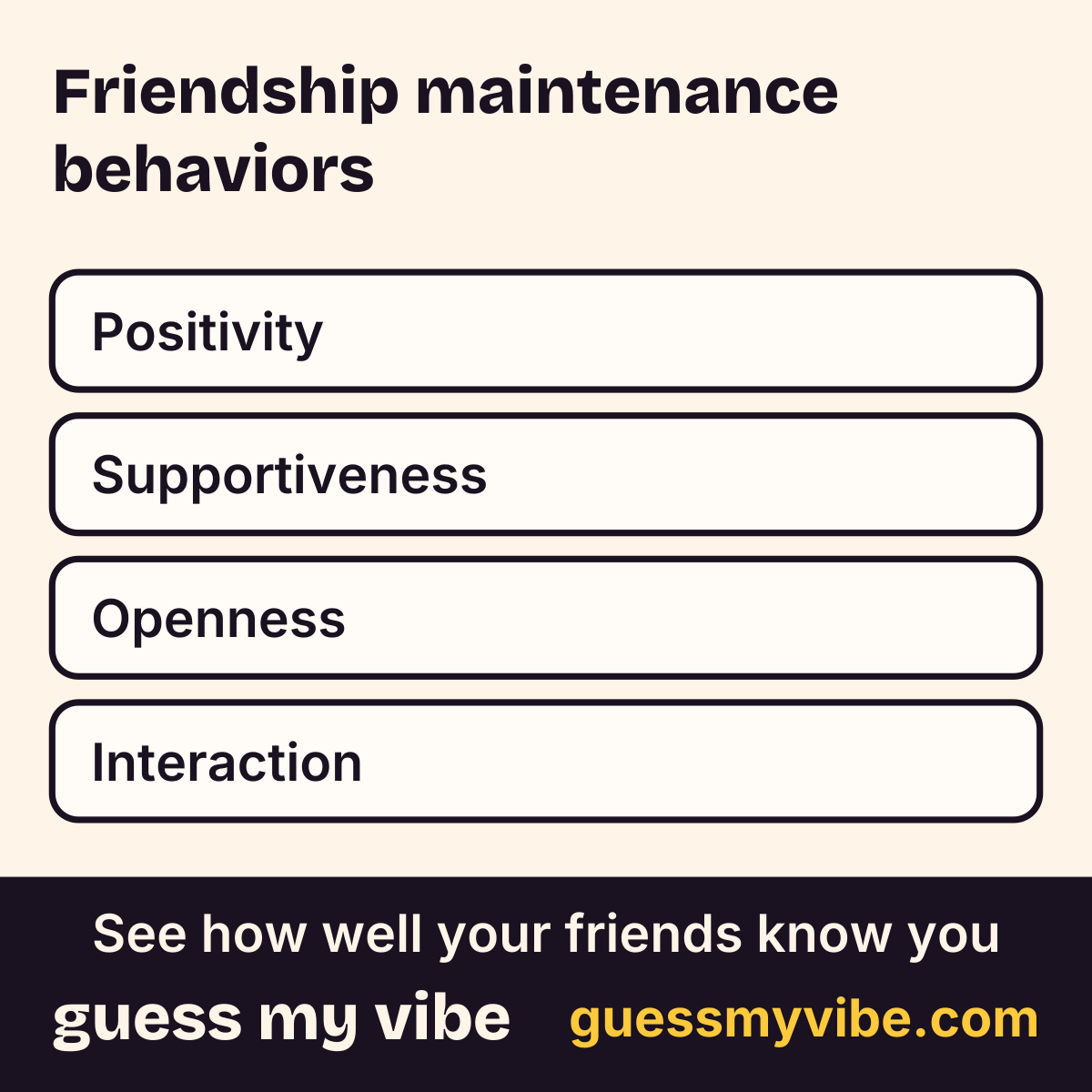
Expectations and rules describe what a true friendship should look like. Separate research on what people actually DO to maintain a friendship describes how it stays that way. A measure built and tested across three studies found friendship maintenance behavior breaks into four parts: positivity (being upbeat and pleasant), supportiveness (showing up when it counts), openness (real self-disclosure), and interaction (actually spending time together). People who described their closest friendships as "best" friendships reported doing noticeably more maintenance behavior overall than people describing close or casual friendships [4]. Put plainly: a true friend isn't identified by a fixed trait you can spot in one conversation. It shows up as a pattern of ongoing behavior, the kind the standards and rules research above both independently point back to: are they actually there, do they actually open up, and does the relationship feel reasonably equal.
Cite this figure
Figure: "Friendship maintenance behaviors." Guess My Vibe (guessmyvibe.com). https://guessmyvibe.com/learn/signs-of-a-true-friend#figure-expect-and-do
What this isn't: a checklist for judging someone's character
It's worth being direct about what the research above doesn't support. None of it hands you a diagnostic tool for labeling a friend "fake" or a relationship "toxic" based on missing one or two signs from a list. Friendships vary in what they emphasize (plenty of real friendships lean more on shared activity than deep conversation, or the reverse) and people are inconsistent, busy, and imperfect without that meaning the friendship isn't real. The research describes patterns across large groups of people, not a test for any one specific relationship. If a friendship consistently leaves you feeling unequal, unsupported, or unable to be honest, that's worth paying attention to; a single rough week, a friend who's bad at texting back, or a friendship built more around doing things than talking about feelings isn't evidence of anything being wrong.
A low-stakes way to check where you actually stand
Most signs of a true friend show up slowly, in ordinary moments, not in a single test. Guess My Vibe gives one small piece of that a concrete shape: you and a friend each answer real personality questions and guess how the other one answered, then see where your reads line up and where they don't. It won't tell you whether someone is a true friend. It does give you a daily, low-stakes reason to notice how well you actually know each other, which the research above treats as part of the same picture.
Key takeaways
- Research on ideal friendship standards found people's expectations sort into six consistent dimensions: symmetrical reciprocity, agency, enjoyment, instrumental aid, similarity, and communion [1].
- A study on the informal "rules" of friendship found that rule-keeping differed between friendships that lasted and ones that had lapsed, and that friendship breakdown was attributed to breaking a number of the rules people endorsed; the six rules that best separated lapsed from current friendships dealt mostly with exchanging rewards and intimacy [2].
- On average, people's friendship expectations lean slightly differently by gender: a meta-analysis of over 8,800 people found women report somewhat higher expectations around intimacy and self-disclosure, while men report somewhat higher expectations around status. Expectations around loyalty and genuineness showed only a small gap between women and men [3].
- The same four maintenance behaviors, positivity, supportiveness, openness, and actually spending time together, show up more in friendships people call "best" than in ones they call close or casual, which is closer to a true friendship's actual signature than any single trait is [4].
- This isn't therapy, a diagnosis, or a substitute for professional care.
Questions people ask
What are the main signs of a true friend?
Research on ideal friendship standards finds people consistently want six things from a friend: being treated as an equal, a friend with some standing and drive of their own (what the researchers call agency), genuine enjoyment, practical help when needed, real similarity, and openness. A friendship hitting most of these lines up with what people broadly describe as a real, solid friendship [1].
Is loyalty really the most important sign of a true friend?
It's one of the things people expect, though the research doesn't rank it above the others. A study of friendship "rules" found that breakdown was attributed to breaking a number of the rules people endorsed, mostly about exchanging rewards and intimacy, and a meta-analysis found only a small gap between women and men on loyalty and genuineness [2], [3].
Can you tell if someone is a true friend just by how they act in one conversation?
Not reliably. The research behind this article describes patterns across many people and over time, not a one-time read. A friendship's maintenance behaviors, positivity, support, openness, and actually spending time together, are closer to a reliable sign than any single interaction [4].
Do men and women look for different signs in a true friend?
On average, somewhat, though the differences are modest. A meta-analysis of over 8,800 people found women report slightly higher expectations around intimacy and self-disclosure, and men report higher expectations around status, with only a small gap on loyalty [3].
Is it fair to call a friend 'not a true friend' if they're missing one sign on a list?
No. This research describes broad patterns in what people want and what goes with a friendship lasting, not a diagnostic checklist for any one relationship. Real friendships vary in what they emphasize, and an off week or a different friendship style isn't evidence that it isn't real.
See how well your friends know you.
Free. Answer 10 quick questions about you, then send your link. Friends play in their browser, no app needed.
Start freeReferences
- [1] Hall, J. A. (2012). Friendship standards: The dimensions of ideal expectations. Journal of Social and Personal Relationships, 29(7), 884–907. doi.org/10.1177/0265407512448274 (opens in a new tab)
- [2] Argyle, M., & Henderson, M. (1984). The Rules of Friendship. Journal of Social and Personal Relationships, 1(2), 211–237. doi.org/10.1177/0265407584012005 (opens in a new tab)
- [3] Hall, J. A. (2011). Sex differences in friendship expectations: A meta-analysis. Journal of Social and Personal Relationships, 28(6), 723–747. doi.org/10.1177/0265407510386192 (opens in a new tab)
- [4] Oswald, D. L., Clark, E. M., & Kelly, C. M. (2004). Friendship maintenance: An analysis of individual and dyad behaviors. Journal of Social and Clinical Psychology, 23(3), 413–441. doi.org/10.1521/jscp.23.3.413.35460 (opens in a new tab)
How we find and check these sources: how we write. Spotted an error? Report a correction.
Related
- How to Be a Good Friend, According to Research
- What Is a Best Friend? What Makes Someone Your Best Friend
- One-Sided Friendship: What the Research Actually Finds
- How to Maintain Friendships Through Life's Transitions
- Growing Apart From Friends: Why It Happens
- Frenemy: What Mixed Feelings About a Friend Do to You
Want to try it with your own friends? Make a friendship quiz to play with your friends
Cite this article
- Title
- Signs of a True Friend, According to Research
- Publisher
- Guess My Vibe
- Updated
- URL
- https://guessmyvibe.com/
learn/ signs-of-a-true-friend
Copy this citation
Guess My Vibe. (2026, October 3). Signs of a True Friend, According to Research. Guess My Vibe. https://guessmyvibe.com/
To point at one section, add that section's anchor (the # link on its heading) to the URL.