A best friend isn't just your closest friend by rank, it's usually the one who has built up the most accurate, specific read on who you actually are, not a generic sense of "people like you." Research on acquaintance finds that kind of individuated understanding grows specifically with real time spent together [1], and research on friendship maintenance finds it's sustained by consistent self-disclosure and support, not just history [2].
Want to take it for real? Take the best friend test
What is a best friend? Depth, not just rank
What is a best friend, exactly, if not just "the friend I like most"? The useful research answer isn't about rank or how long you've known each other. It's about depth: a best friend is usually the person who has built up the most specific, individuated understanding of who you actually are, through real time and real disclosure, and who you can count on to keep doing that over time. "Best" describes a kind of knowing, not a label you earn by seniority.
A best friendship is built, not declared
A study that followed high-school best friendships through the first year of college is blunt about what actually sustains the title. On average, these friendships declined in satisfaction, commitment, rewards, and investment once people scattered to different colleges, and the costs of keeping in touch rose. But physical distance wasn't what went with the decline, communication was. Friends who kept up positivity, support, self-disclosure, and regular interaction were more likely to stay best friends through the transition, and maintaining the friendship buffered against social loneliness along the way [2]. In other words, "we've been best friends since middle school" isn't what keeps a best friendship alive. Doing the ongoing work that phrase implies is.
Why a best friend 'just gets you': what acquaintance research finds
There's a reason a best friend's read on you feels different from a new acquaintance's. A study tracking how judgments of personality change with length of acquaintance found that as people spent more real time together, their agreement about each other's traits, and specifically their distinctive, individual-specific accuracy, improved, while reliance on a generic "what people in general are like" stereotype dropped. Interestingly, overall accuracy on any one trait didn't necessarily jump by much; what sharpened with time was precision about the specific person in front of them [1]. A best friend isn't necessarily better than anyone else at guessing a single personality trait correctly. They're better at seeing you as you, rather than as a stand-in for "people in general."
Best friend vs. close friend: what's actually different?
"Best friend" and "close friend" often get used interchangeably, and the research suggests the real difference is a matter of degree on a few specific dimensions, not a hard category line. A meta-analysis of 37 studies on friendship expectations (more than 8,800 people) found that what people want from a friendship breaks down into a few measurable pieces: communion (intimacy, self-disclosure), symmetrical reciprocity (loyalty, genuineness), solidarity (mutual activities, companionship), and agency (status, physical fitness). Women reported somewhat higher overall friendship expectations than men on average, with the clearest gap in communion specifically (men averaged higher only on agency, and the gap on spending time together was close to zero) [3]. A "best" friend, for most people, is simply the friend where these expectations, especially the communion ones, are being met most fully and most consistently, not a separate category with its own rules. That reframing also explains why the line between "close friend" and "best friend" so often feels blurry in real life: it's a gradient of how well a few specific expectations are being met, not a fence with a clear side for each friend to stand on.
Curious how your friends would answer?
Free. Answer 10 quick questions about you, then send your link. Friends play in their browser, no app needed.
Start freeWhere a best friend sits in your social world
Zoom out from any one friendship and a consistent structural pattern shows up. A review of personal social networks across different populations and methods finds they reliably form a hierarchy: a very small number of extremely close ties, nested inside a somewhat larger circle of close friends and family, nested inside a much larger circle of looser contacts, and so on outward. Building and maintaining any tie in that structure is genuinely costly in time and emotional effort, which the review points to as part of why personal networks show such consistent size and hierarchical structure [4]. A best friend is, structurally, whoever occupies that innermost layer for you, which is also why most people only have room for one or a small handful of them at a time: that specific slot in the structure is small by nature, not by choice.
Best friend expectations aren't one-size-fits-all
It's worth saying clearly that there's no single right amount of intimacy a best friendship is supposed to deliver. The same meta-analysis on friendship expectations found real variation beyond the average gender difference: the differences it reports are averages between men and women: women higher on communion, men higher on agency (status), and almost no gap on solidarity, meaning plain time spent together [3]. Averages say little about any one friendship, so a best friend who shows love mainly through doing things together rather than through long, personal conversations isn't failing at being a best friend. They may simply be meeting a different, equally valid set of expectations than a friendship built mostly around disclosure would.
That variation is also a reason "what is a best friend" resists a single, universal checklist. The research above gives real, measurable dimensions, individuated understanding built over time, consistent maintenance behavior, and expectations around communion and reciprocity, but how much of each matters, and in what proportion, differs from person to person and friendship to friendship. Two people can each have a completely legitimate best friendship that looks almost nothing alike from the outside, and neither version is the more correct one.
A better test than a label
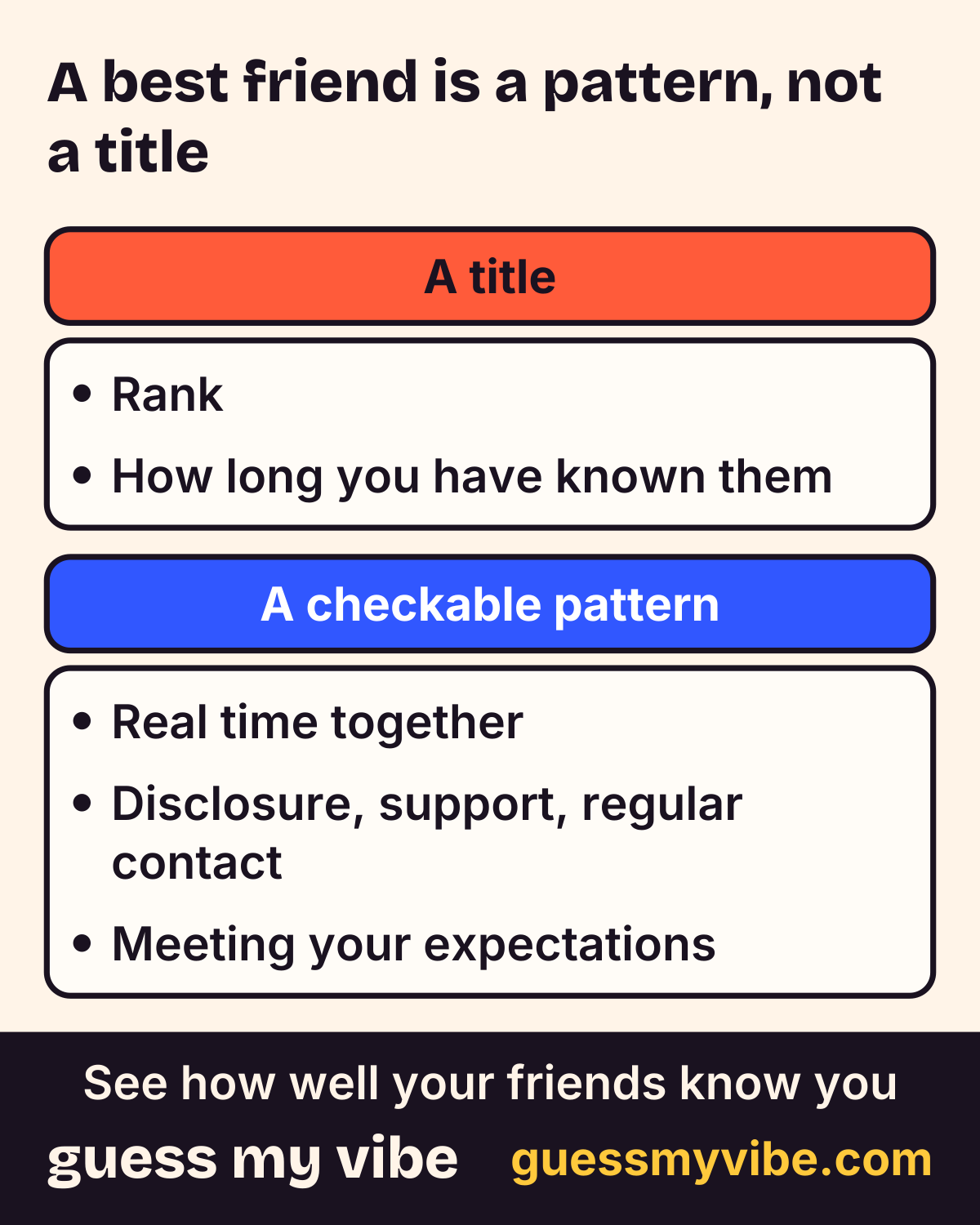
Put the research together and "best friend" stops being a title and starts being a checkable pattern: has this person spent enough real time with you to understand you specifically, not just people in general [1]? Have you both kept up the actual behaviors, disclosure, support, regular contact, that sustain closeness rather than coasting on shared history [2]? Does the relationship meet your particular expectations for intimacy and openness, whatever those happen to be for you [3]? That's a more honest test than how long you've known someone, and it's exactly the kind of thing worth checking rather than assuming. Guess My Vibe turns that into something concrete: your closest friend answers real personality questions and guesses yours, and you see directly how much of that specific, individuated understanding is actually there.
Cite this figure
Figure: "A best friend is a pattern, not a title." Guess My Vibe (guessmyvibe.com). https://guessmyvibe.com/learn/what-is-a-best-friend#figure-title-vs-pattern
Key takeaways
- As people spend more real time together, their understanding of each other gets more individuated, more about that specific person and less reliant on a generic stereotype, even when raw accuracy on any one trait doesn't jump dramatically [1].
- What keeps a best friendship going isn't shared history alone. A year-long study of friendships moving from high school into college found that friends who kept up positivity, support, self-disclosure, and regular interaction were more likely to stay best friends, while those who let it slide weren't [2].
- Friendship expectations lean more on intimacy and self-disclosure for some people than others. A meta-analysis of 37 studies found women report higher expectations specifically around communion (intimacy, openness) than men do, on average [3].
- Personal social networks consistently show a hierarchical structure, a small number of very close ties nested inside much larger, progressively less-close circles, which is the structural slot a 'best friend' usually fills: the innermost layer [4].
- This isn't therapy, a diagnosis, or a substitute for professional care.
Questions people ask
What makes someone your best friend instead of just a close friend?
Mostly a matter of degree: a best friend tends to have built a more specific, individuated understanding of you through real time together [1], and the friendship keeps being actively maintained through disclosure, support, and regular contact rather than running on shared history alone [2].
Is a best friend defined by how long you've known them?
Not directly. Research on long-term best friendships found communication and ongoing maintenance behaviors, not time known or physical distance, went with whether a friendship stayed a best friendship through a major life change like starting college [2].
Why does my best friend seem to understand me better than other friends do?
Real time together builds a more individuated, person-specific understanding over the length of an acquaintance, separate from improving on any single trait judgment [1]. A best friend has usually had more of that specific kind of time than a newer or more casual friend.
Can you have a best friend you haven't known very long?
Research doesn't point to a minimum time requirement. What goes with a lasting best friendship is ongoing maintenance behavior like self-disclosure, support, and contact, which can build up faster or slower depending on the two people involved [2].
Is wanting more intimacy from a best friend normal?
Yes, on average. A large meta-analysis found real differences in how much men and women, on average, expect communion (intimacy and self-disclosure) from their friendships, with women reporting somewhat higher expectations on this dimension than men [3].
See how well your friends know you.
Free. Answer 10 quick questions about you, then send your link. Friends play in their browser, no app needed.
Start freeReferences
- [1] Biesanz, J. C., West, S. G., & Millevoi, A. (2007). What do you learn about someone over time? The relationship between length of acquaintance and consensus and self-other agreement in judgments of personality. Journal of Personality and Social Psychology, 92(1), 119–135. PubMed: 17201547 (opens in a new tab)
- [2] Oswald, D. L., & Clark, E. M. (2003). Best friends forever?: High school best friendships and the transition to college. Personal Relationships, 10(2), 187–196. doi.org/10.1111/1475-6811.00045 (opens in a new tab)
- [3] Hall, J. A. (2011). Sex differences in friendship expectations: A meta-analysis. Journal of Social and Personal Relationships, 28(6), 723–747. doi.org/10.1177/0265407510386192 (opens in a new tab)
- [4] Dunbar, R. I. M. (2018). The Anatomy of Friendship. Trends in Cognitive Sciences, 22(1), 32-51. PubMed: 29273112 (opens in a new tab)
How we find and check these sources: how we write. Spotted an error? Report a correction.
Related
Want to try it with your own friends? Make a friendship quiz to play with your friends
Cite this article
- Title
- What Is a Best Friend? What Makes Someone Your Best Friend
- Publisher
- Guess My Vibe
- Updated
- URL
- https://guessmyvibe.com/
learn/ what-is-a-best-friend
Copy this citation
Guess My Vibe. (2026, October 3). What Is a Best Friend? What Makes Someone Your Best Friend. Guess My Vibe. https://guessmyvibe.com/
To point at one section, add that section's anchor (the # link on its heading) to the URL.