Yes. Research on how personal social networks are actually structured finds that most people's innermost circle of closest relationships, family included, holds a handful of people, not just one [1]. Having more than one best friend fits that normal pattern; it isn't a sign you're spreading yourself thin or that neither friendship is 'real.'
Can you have more than one best friend? Yes, by design
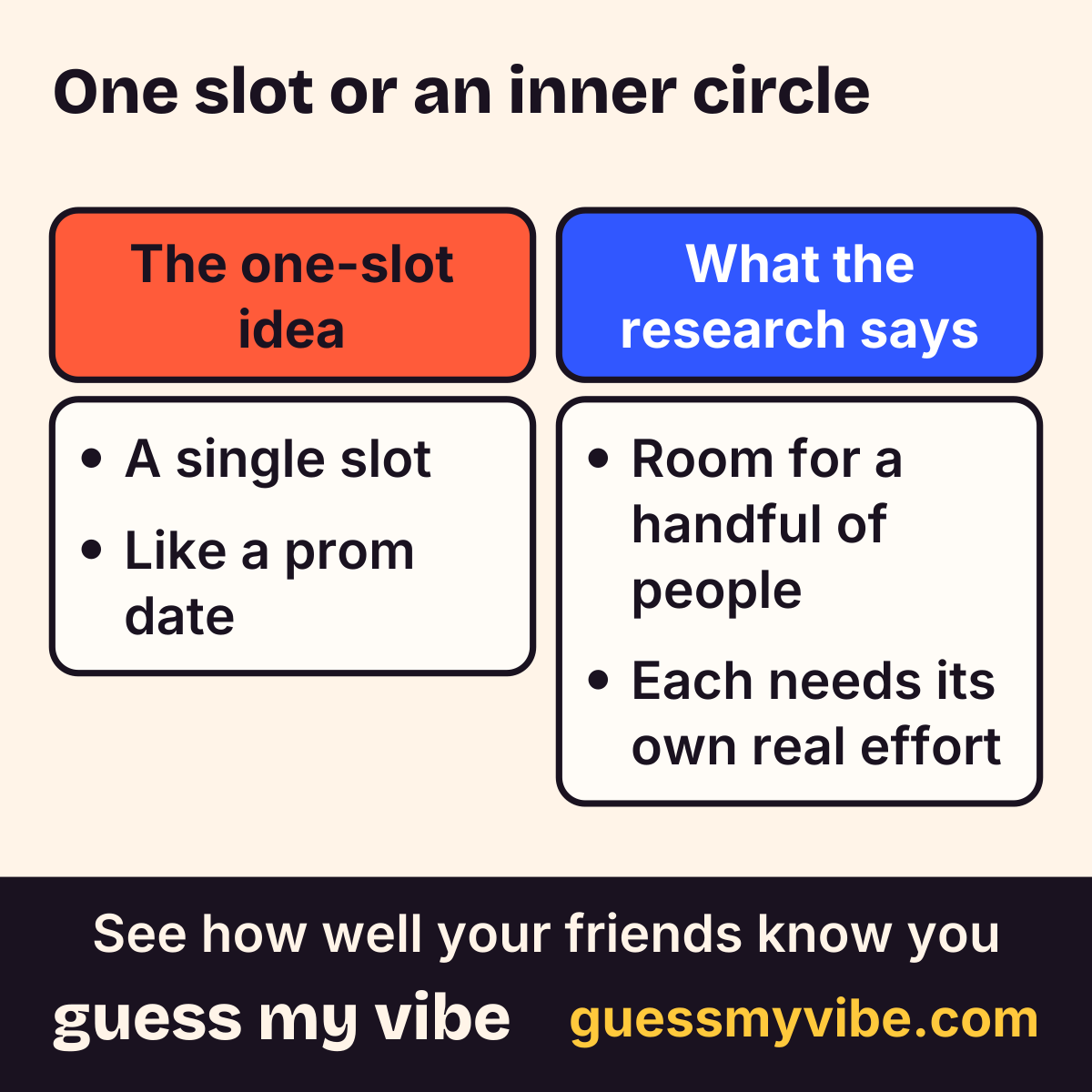
Can you have more than one best friend? The question assumes "best friend" is a single slot, like a prom date. The research on how personal relationships are actually organized doesn't back that up. People's closest circle of relationships, the one "best friend" usually describes, reliably holds more than one person for most people, most of the time. Having two or three best friends isn't diluting the title. It's what the structure of real social networks looks like when researchers actually go measure it.
The inner circle holds a few people, not one
A study using fractal analysis on human grouping patterns found personal networks don't spread out smoothly from most-close to least-close. Instead, they cluster into a discrete hierarchy of layers, with each layer roughly three times the size of the one inside it: an innermost circle of about 3 to 5 people, then a wider circle of about 9 to 15, then about 30 to 45, and onward outward [1]. That innermost 3-to-5 figure is the layer "best friend" is really describing, and it's already built to hold more than one relationship. It's also worth being precise about who's actually in it: in a separate study using Christmas-card exchange data, kin made up a fairly constant 21% of a person's network across age and household types [2], so networks are a mix of family and friends, and the closest layer is likely not a pure best-friend ranking.
About "Dunbar's number": the honest version
It's worth pausing on the famous "150" figure ("Dunbar's number") that often gets attached to this whole area of research, because the layered-circle finding above is more solid than that specific headline number is. The 150 figure was originally extrapolated from a regression line relating neocortex size to group size across primate species, then checked against real human network data showing a mean maximum of around 153.5 contacts [2]. A 2021 re-analysis tested that statistical approach directly: applying different methods to complementary datasets produced wildly different estimates, averages ranging from 16 to 109, with individual confidence intervals as wide as 4 to 520. The authors' conclusion was that no single, precise cognitive-limit number can actually be derived this way [3]. The layered structure itself (a small inner circle, then progressively larger, less-close circles) has shown up consistently across different studies and methods. The specific headline number people repeat hasn't held up nearly as well, so it's worth treating "150" as a rough, contested figure rather than a precise limit, and treating the innermost layer's size the same way: a small handful, not one fixed seat.
Curious how your friends would answer?
Free. Answer 10 quick questions about you, then send your link. Friends play in their browser, no app needed.
Start freeKeeping more than one best friendship going takes real, separate effort
Having room in your network for more than one best friend doesn't mean it happens automatically. A study that tracked people's entire active personal networks over 18 months, across a major life transition, found that friendships, unlike family relationships, decline in quality without continued investment, and the specific kind of effort that protects a friendship from decline differed by gender: more contact and talking for women, more shared activity for men [4]. The takeaway for more than one best friend isn't that it's harder than having just one, it's that each friendship needs its own, separate upkeep. Time and attention spent on one close friendship doesn't automatically carry over and maintain another one; the review on friendship's overall structure makes a related point, that building and sustaining any close tie is genuinely costly in time and cognitive effort, which fits the pattern that personal networks stay small and hierarchically structured rather than growing without limit [5].
Different best friends often know different sides of you
The gendered maintenance difference found in the 18-month network study is a useful window into why more than one best friend doesn't have to compete for the same role. Friendships protected mostly by talking and staying in touch look and feel different from friendships protected mostly by shared activity, and plenty of people keep both kinds going at once [4]. A friend you talk to for hours on the phone and a friend you mainly see at the climbing gym or on a weekly run can both sit in your innermost circle, built and maintained through genuinely different routines, without either one being a lesser version of the other.
That also means a single ranking misses something real. The review of friendship's overall structure notes that creating and maintaining friendships costs real time and cognitive effort [5], which means the specific mix of closeness you get from each best friend depends heavily on what you've actually spent that time and effort doing together. One best friend might know your family history in detail because you grew up two houses apart; another might have no idea about that but could guess your reaction to almost any piece of news because you talk every single day. Both are real, earned closeness. Neither cancels out the other. It is also fine if the two friendships look nothing alike on paper, since different kinds of closeness can sit side by side without competing for the same space.
What this actually means, day to day
Put together, the research says two things that both matter here. First, structurally, your closest circle of relationships is built to hold a handful of people, so more than one best friend isn't an exception to how social networks work, it's closer to the norm [1]. Second, each of those friendships still needs its own real investment to stay in that inner circle rather than drift outward [4]. That's also a good reason not to treat "best friend" as a single competition between the people you're closest to. Different best friends can know different sides of you, at different depths, built through different amounts and kinds of time together. Guess My Vibe is built around exactly that: play it with more than one friend, and you'll often see each one nail different questions, a real, checkable picture of how your closest circle actually knows you, rather than a single ranked "who's really my best friend" verdict.
Cite this figure
Figure: "One slot or an inner circle." Guess My Vibe (guessmyvibe.com). https://guessmyvibe.com/learn/more-than-one-best-friend#figure-one-slot-vs-inner-circle
Key takeaways
- Personal social networks reliably show a layered structure: a small innermost circle of roughly 3 to 5 very close relationships, then wider, progressively less-close layers around 9 to 15 and 30 to 45 [1].
- A person's network isn't only friends. In one large Christmas-card dataset, kin stayed a roughly constant 21% of the network across age and household types [2].
- The famous '150' figure behind 'Dunbar's number' has a real statistical problem: re-testing the same underlying data with different valid methods produced wildly different estimates, from averages of 16 up to 109, with confidence intervals as wide as 4 to 520 [3].
- Maintaining more than one close friendship takes separate, ongoing effort for each one. Friendships (unlike family ties) decay in quality without continued investment, and people manage several at once, each needing its own upkeep [4].
- This isn't therapy, a diagnosis, or a substitute for professional care.
Questions people ask
Is it normal to have more than one best friend?
Yes. Research on personal social networks finds the innermost circle of closest relationships typically holds around 3 to 5 people, not one, so having more than one best friend fits the normal pattern rather than being an exception to it [1].
Does having multiple best friends mean none of them are 'real' best friends?
No, there's no research basis for that. The closest layer of a personal network is structurally built to hold a small handful of people [1]; what matters for each friendship staying close is ongoing investment, not how many other close friendships you also have [4].
Is Dunbar's number of 150 friends real?
The specific number is contested. A 2021 re-analysis of the same data found wildly different results depending on the statistical method used, concluding no single precise number can be reliably derived [3]. The broader finding that personal networks form layered circles, from a small inner group outward, has held up better than any one specific headline number [1].
Can your closest friends include family members, not just friends?
Yes, commonly. In one large Christmas-card dataset, family members made up a roughly constant 21% of a person's network across age and household types, so a person's network is typically a mix of family and friends [2].
Why does it feel hard to keep up with more than one close friendship?
Because each one genuinely requires separate, ongoing investment. A study following personal networks over 18 months found friendships specifically decline in quality without continued effort, and the kind of effort that works best differed by gender [4].
See how well your friends know you.
Free. Answer 10 quick questions about you, then send your link. Friends play in their browser, no app needed.
Start freeReferences
- [1] Zhou, W.-X., Sornette, D., Hill, R. A., & Dunbar, R. I. M. (2005). Discrete hierarchical organization of social group sizes. Proceedings of the Royal Society B: Biological Sciences, 272(1561), 439–444. doi.org/10.1098/rspb.2004.2970 (opens in a new tab)
- [2] Hill, R. A., & Dunbar, R. I. M. (2003). Social network size in humans. Human Nature, 14(1), 53–72. PubMed: 26189988 (opens in a new tab)
- [3] Lindenfors, P., Wartel, A., & Lind, J. (2021). 'Dunbar's number' deconstructed. Biology Letters, 17(5), 20210158. doi.org/10.1098/rsbl.2021.0158 (opens in a new tab)
- [4] Roberts, S. B. G., & Dunbar, R. I. M. (2015). Managing Relationship Decay: Network, Gender, and Contextual Effects. Human Nature, 26(4), 426-450. PubMed: 26489745 (opens in a new tab)
- [5] Dunbar, R. I. M. (2018). The Anatomy of Friendship. Trends in Cognitive Sciences, 22(1), 32-51. PubMed: 29273112 (opens in a new tab)
How we find and check these sources: how we write. Spotted an error? Report a correction.
Related
Want to try it with your own friends? Make a friendship quiz to play with your friends
Cite this article
- Title
- Can You Have More Than One Best Friend?
- Publisher
- Guess My Vibe
- Updated
- URL
- https://guessmyvibe.com/
learn/ more-than-one-best-friend
Copy this citation
Guess My Vibe. (2026, October 3). Can You Have More Than One Best Friend?. Guess My Vibe. https://guessmyvibe.com/
To point at one section, add that section's anchor (the # link on its heading) to the URL.