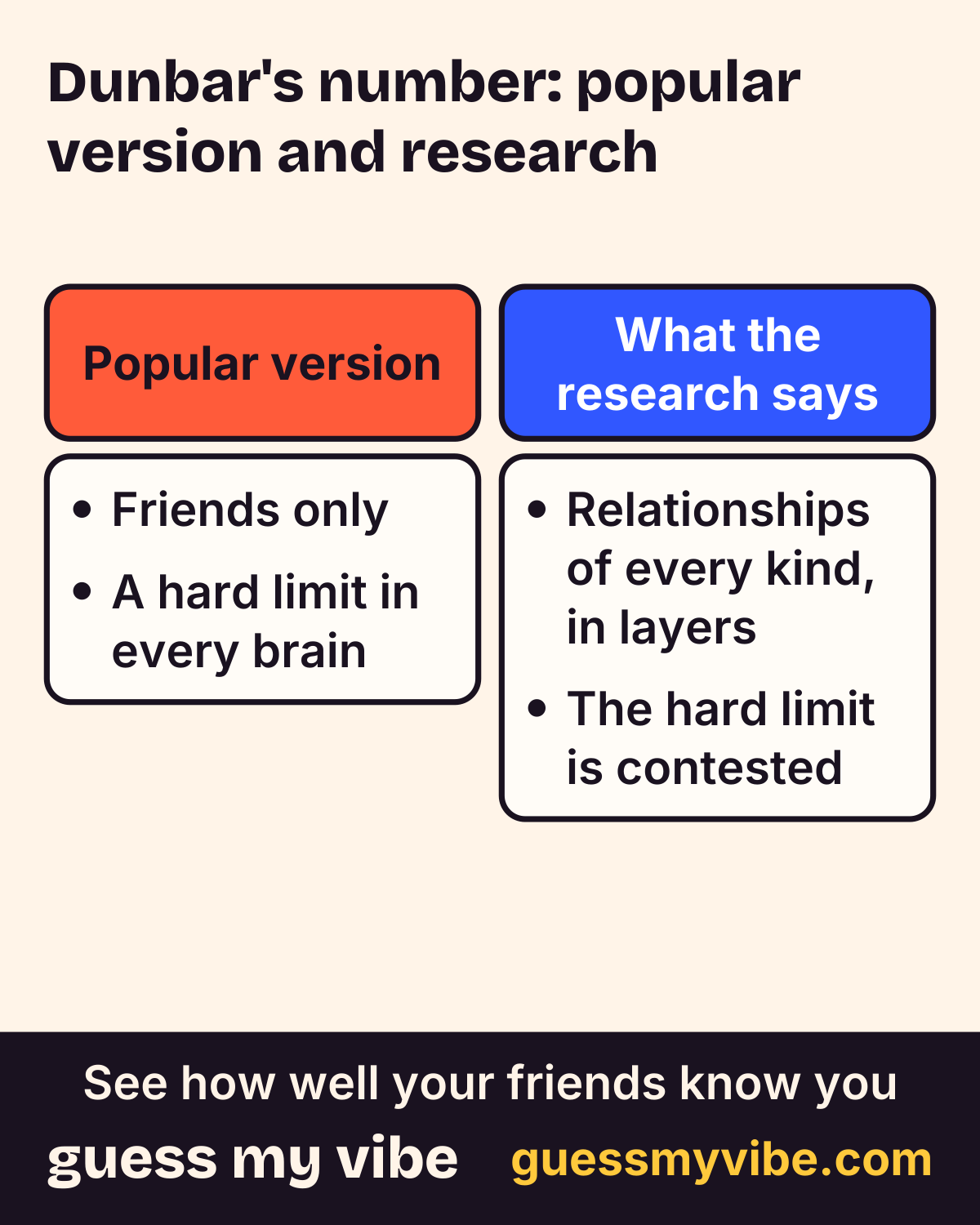
Dunbar's number is the idea that people can keep up roughly 150 stable relationships, a figure that came from extrapolating a brain-size and group-size pattern across primates [1]. Some human data land near it: a Christmas-card study of contemporary Western society found people's maximum networks averaged about 153 people [2]. But a 2021 re-analysis found the statistics behind the extrapolation can't pin down any single number [1], and the part of the research that has held up better is the layered shape of social networks, not the 150.
Dunbar's number is the claim that humans can only keep track of about 150 stable relationships. It's one of the most repeated numbers in popular psychology, and it deserves a closer look, because the evidence behind it is a mix of real data, a clever extrapolation, and a serious statistical objection. The short version: some measurements do land near 150, but the idea that 150 is a hard limit built into every human brain is much shakier than the headlines suggest. What the research supports more firmly is that your relationships come in layers, from a handful of very close people out to a wide ring of acquaintances. This article lays out what each major paper actually found, and who disagrees.
What Dunbar's number actually claims
Start with what the number is not. It isn't "you can have 150 friends." The research describes a typical personal social network as about 150 relationships in total, including kin, friends and acquaintances, arranged in layers that get bigger as emotional intensity gets lower [3]. Your close friends are a small slice of that. Most of the 150 are people you'd be glad to see but wouldn't call on a bad night.
The number comes from comparative biology, not from asking people about friends. In nonhuman primates, group size goes up with the relative volume of the neocortex, the outer layer of the brain involved in social thinking. A 1993 paper laid out the argument: that regression equation implies a group size for modern humans very similar to the size of hunter-gatherer and traditional horticulturalist societies, and the author proposed that language evolved partly as a faster way to maintain relationships than the grooming that primates rely on [5]. The same paper reports that about 60% of human conversation is gossip about relationships and personal experiences [5]. In plain terms, the argument runs: bigger social brains support bigger groups, humans have a big social brain, so a typical human group should be a particular size. That size came out near 150.
Cite this figure
Figure: "Dunbar's number: popular version and research." Guess My Vibe (guessmyvibe.com). https://guessmyvibe.com/learn/dunbars-number#figure-what-the-number-means
The evidence that lands near 150
The best-known human test used a very ordinary source: who people send Christmas cards to. In a study of contemporary Western society, maximum network size averaged 153.5 people, and the average was 124.9 for the people respondents explicitly contacted. The authors called these values remarkably close to the 150 expected from neocortex size [2]. The same study found the share of kin stayed fairly constant at around 21% of a network, and that how often people kept in touch depended on both passive factors, like distance or being a work colleague, and active ones, like emotional closeness [2]. Their cautious conclusion was that there may be cognitive constraints on network size, not that they'd proven one.
A few caveats are worth keeping in mind. A Christmas-card list is one way of counting relationships in one country,, collected through one custom. The fit with 150 is striking, but it's one data point, not a law. It also helps to know that most of the supporting studies below were written by Dunbar and his collaborators. That doesn't make them wrong, but it does mean the fairest independent check is the critique that came later.
The layers hold up better than the number
The most useful idea in this literature may be the layering. A fractal analysis of human grouping data found that people don't form groups of just any size. Instead there's a discrete hierarchy of preferred sizes with a scaling ratio close to three, approximating 3-5, 9-15, 30-45 and so on upward [6]. That matches how a social life feels: a very small inner circle, a wider circle of close friends, then a looser ring.
Later work has tested the layers in other data. A phone-call study found strong evidence for a layered structure based on how often people called each contact. The clustering matched earlier studies well for the innermost and outermost layers, but for the layers in between the researchers saw large variability [4]. A modeling paper then asked why layers would form at all. It proposed that unequal costs of relationships, in time or mental effort, combined with a limited total capacity to invest, can explain nested layers and, when the cost rises in a straight line, the constant scaling between them. The model fit the empirical data well, and it also pointed to an unusual case that the authors then tested in five communities: in small communities the layers should be inverted, with more people in the closest layers [3]. Read together, these papers say the layered shape shows up across several datasets, while the exact size of each middle layer is less settled.
Curious how your friends would answer?
Free. Answer 10 quick questions about you, then send your link. Friends play in their browser, no app needed.
Start freeThe 2021 critique: why one number can't be pinned down
The strongest direct objection targets the extrapolation itself. A 2021 paper noted that the popular belief about a cognitive limit of about 150 stable relationships "originates from an extrapolation of a regression line" relating neocortex size to group size in primates, then tested whether the statistics actually support that idea [1]. Using complementary datasets and different methods, the authors got wildly different numbers. Bayesian methods gave average group size estimates of 69-109, while generalized least-squares phylogenetic methods gave 16-42. The 95% confidence intervals were enormous, 4-520 and 2-336, which the authors took to mean that specifying any one number is futile. Their conclusion: a cognitive limit on human group size cannot be derived in this manner [1].
It's worth being exact about what this does and doesn't show. The critique is about the primate-to-human extrapolation. It doesn't say the Christmas-card averages were miscounted, and it doesn't say networks have no structure. What it says is that you can't derive "150" from the brain-size pattern with any confidence. So there are two honest readings. One is that 150 is a rough, descriptive average that some surveys happen to find. The other, which the critique supports, is that it's not a precise biological limit. Either way, "exactly 150" is more precision than the data can bear.
Does social media change the number?
A natural question is whether online life lets people blow past any limit. Dunbar tested this with two UK surveys, each randomly stratified by age, gender and regional population size. The number of Facebook friends was similar to the size of offline face-to-face networks, and for one sample the inner layers people reported (formally, the support clique and sympathy group) were also similar in size to those seen offline [7]. Dunbar read this as a sign that a cognitive constraint on network size survives the communication advantages of online media, and suggested that real relationships, as opposed to casual ones, need at least occasional face-to-face contact to maintain [7]. That's the originator of the hypothesis interpreting his own data, and it measures a count of online contacts, not how close anyone felt to them. It's one study, so treat it as suggestive.
So how many friends do you need?
Nothing in this research tells you how many friends you need. It describes how many relationships people tend to have and how those relationships are organized, which is a different question. A 2018 review by Dunbar argues that friendship is extremely costly to create and maintain in time and in the mental machinery behind it, yet personal networks show constancies in their size and their hierarchical structure [8]. The practical takeaway doesn't need a magic number: closeness takes time, time is limited, and so most people end up with a few people in the inner layers and many more further out.
If you're someone with a small circle and you've been told you're "below" a number, the evidence doesn't back that framing. If you're someone with a huge contact list and few people to call, the layers idea explains that too. Both are ordinary variations on the same structure, and nothing here counts as a verdict on you.
A better question than the number
Instead of asking whether you've hit 150, ask who sits in your inner layers and whether they actually know you. That's what Guess My Vibe is built around: friends guess how you'd answer real personality questions, so you can see which of the people you feel closest to can read you well, and which ones you might know less than you think. It's a playful look at one layer of your network, not a measurement of your whole social life.
Key takeaways
- The 150 is about relationships of every kind, not 150 friends: the research describes a typical personal network as about 150 relationships including kin, friends and acquaintances [3].
- A Christmas-card study of contemporary Western society found maximum network size averaged 153.5 people, with 124.9 for the people actually contacted, and the authors suggested there may be cognitive constraints on network size [2].
- A 2021 re-analysis of the primate data got average estimates of 69-109 with one method and 16-42 with another, with 95% confidence intervals of 4-520 and 2-336, and concluded a cognitive limit on human group size cannot be derived this way [1].
- Layers are the part with more going for it: a phone-call study found strong evidence of a layered structure, with the inner and outer layers matching earlier work well while the layers in between varied a lot [4].
- This isn't therapy, a diagnosis, or a substitute for professional care.
Questions people ask
What is Dunbar's number?
It's the idea that humans can maintain about 150 stable relationships. It was extrapolated from a pattern linking relative neocortex size to group size across primates [1], and the 150 counts relationships of all kinds, including kin, friends and acquaintances [3].
Is Dunbar's number debunked?
Not entirely, but the strong version is contested. A 2021 re-analysis found that different methods on the primate data give very different averages, with confidence intervals so wide that no single number can be derived this way [1]. Separate human data, like a Christmas-card study of contemporary Western society, did find a maximum network size averaging about 153 [2].
Is Dunbar's number 150 friends?
No. The 150 is the size of a whole personal network, including family and acquaintances. The research describes it as layered, with the layers getting smaller as emotional intensity rises [3], and one analysis of human grouping data found preferred group sizes of about 3-5 and 9-15, far smaller than 150 [6].
Do online friends count toward Dunbar's number?
In two UK surveys, the number of Facebook friends was similar to the size of offline networks, and the author concluded online media didn't break through the constraint [7]. That's one author's reading of two surveys.
How many close friends do most people have?
One analysis of human grouping data found preferred group sizes of roughly 3-5 people, then 9-15 [6]. Those are patterns in grouping data, not targets, and actual numbers vary by person.
See how well your friends know you.
Free. Answer 10 quick questions about you, then send your link. Friends play in their browser, no app needed.
Start freeReferences
- [1] Lindenfors, P., Wartel, A., & Lind, J. (2021). 'Dunbar's number' deconstructed. Biology Letters, 17(5), 20210158. doi.org/10.1098/rsbl.2021.0158 (opens in a new tab)
- [2] Hill, R. A., & Dunbar, R. I. M. (2003). Social network size in humans. Human Nature, 14(1), 53–72. PubMed: 26189988 (opens in a new tab)
- [3] Tamarit, I., Cuesta, J. A., Dunbar, R. I. M., & Sánchez, A. (2018). Cognitive resource allocation determines the organization of personal networks. Proceedings of the National Academy of Sciences, 115(33), 8316–8321. PubMed: 30049707 (opens in a new tab)
- [4] Mac Carron, P., Kaski, K., & Dunbar, R. (2016). Calling Dunbar's numbers. Social Networks, 47, 151–155. doi.org/10.1016/j.socnet.2016.06.003 (opens in a new tab)
- [5] Dunbar, R. I. M. (1993). Coevolution of neocortical size, group size and language in humans. Behavioral and Brain Sciences, 16(4), 681–694. doi.org/10.1017/S0140525X00032325 (opens in a new tab)
- [6] Zhou, W.-X., Sornette, D., Hill, R. A., & Dunbar, R. I. M. (2005). Discrete hierarchical organization of social group sizes. Proceedings of the Royal Society B: Biological Sciences, 272(1561), 439–444. doi.org/10.1098/rspb.2004.2970 (opens in a new tab)
- [7] Dunbar, R. I. M. (2016). Do online social media cut through the constraints that limit the size of offline social networks?. Royal Society Open Science, 3(1), 150292. PubMed: 26909163 (opens in a new tab)
- [8] Dunbar, R. I. M. (2018). The Anatomy of Friendship. Trends in Cognitive Sciences, 22(1), 32-51. PubMed: 29273112 (opens in a new tab)
How we find and check these sources: how we write. Spotted an error? Report a correction.
Related
Want to try it with your own friends? Make a friendship quiz for your friend group
Cite this article
- Title
- Dunbar's Number: Do You Really Have Only 150 Friends?
- Publisher
- Guess My Vibe
- Updated
- URL
- https://guessmyvibe.com/
learn/ dunbars-number
Copy this citation
Guess My Vibe. (2026, October 4). Dunbar's Number: Do You Really Have Only 150 Friends?. Guess My Vibe. https://guessmyvibe.com/
To point at one section, add that section's anchor (the # link on its heading) to the URL.