Yes, online friends can be real friends, but on average they are rated a little lower in quality than friends you also see in person. In a survey of 2,188 Dutch social-network users, friendship quality rose over time for online, offline and mixed friendships, and the gap between mixed (met online, extended offline) and offline friendships disappeared [1]. How real a friend feels depends more on the relationship than on the app.
Want to take it for real? See how well your friends know you, wherever they live
People ask whether online friends are real friends because they are trying to decide how much a friendship they can't hold in person is worth. The short research answer is that they can be real, they tend to be rated a bit lower than friendships that include face-to-face time, and the gap gets smaller as the friendship ages. The honest complication is that the studies disagree on some details, and most of them were done a while ago.
Before the findings, a word about the question. Real is doing a lot of work. In these studies, researchers define a friendship's quality by measurable things like closeness, understanding, commitment and how much two people depend on each other. They don't measure whether a friend counts, which is for you to decide. What follows is what the data say about quality, not a ruling on your friendships.
How online and offline friendships compare
One of the best-known comparisons asked 162 Hong Kong Internet users to think of two friends, one they knew through face-to-face interaction and one they knew through the Internet, and describe each. Offline friendships involved more interdependence, breadth, depth, understanding and commitment than online ones, among other measures. But both kinds got better as the relationship lasted longer, and the differences between online and offline friendships diminished over time [2]. One more result stood out: unlike offline friendships, cross-sex online friendships were rated higher than same-sex online ones. The authors read that as a sign that the usual limits of face-to-face life work differently online.
The caution is that this is self-report from one city in the early 2000s, with each person choosing which friends to describe. Online life has changed a lot since, so treat the pattern as a clue, not a rule.
The in-between friendship: met online, then met up
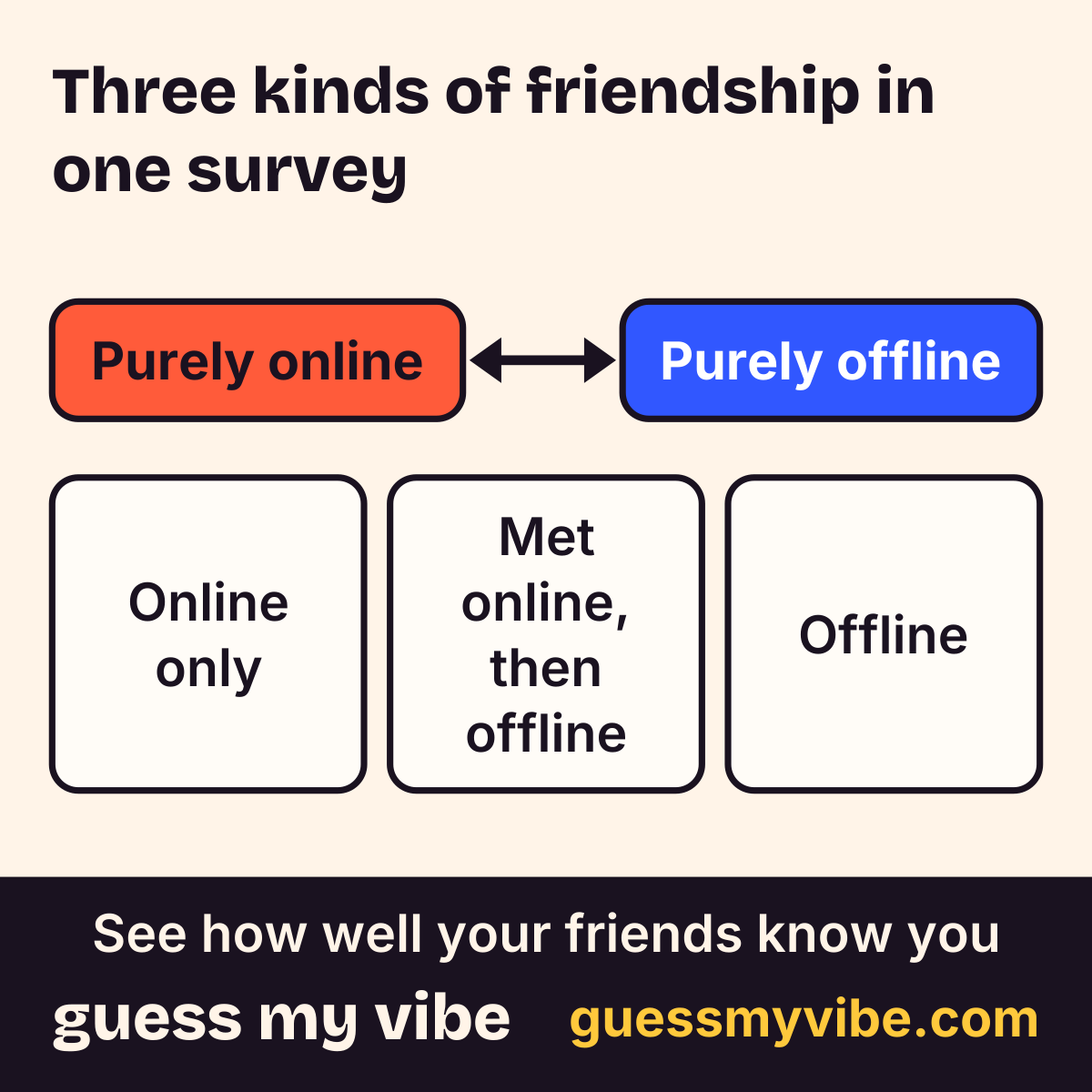
A larger survey separated friendships into three types: purely online, purely offline, and mixed-mode, meaning friendships that began online and extended to offline settings. It covered 2,188 members of a Dutch social networking site. The quality of all three types rose over time. The gap between online and offline friendships stayed significant, but the gap between mixed-mode and offline friendships disappeared. The study also asked what drives quality. Perceived similarity was the most important predictor for online friendships, while social attraction was the most important for mixed-mode and offline friendships [1].
This is the part where the evidence is mixed. The Hong Kong survey found that the online-offline gap narrowed with time, while the Dutch survey found that the gap between purely online and offline friendships remained but the mixed-mode gap vanished. Both agree on the big picture, that time helps. They differ on whether purely online friendships fully catch up. A fair reading is that meeting at least once, or finding ways to share some real-world context, seems to help, but neither study proves it.
Cite this figure
Figure: "Three kinds of friendship in one survey." Guess My Vibe (guessmyvibe.com). https://guessmyvibe.com/learn/are-online-friends-real-friends#figure-three-kinds-of-friendship
Curious how your friends would answer?
Free. Answer 10 quick questions about you, then send your link. Friends play in their browser, no app needed.
Start freeDoes online contact help or hurt existing friendships?
A separate question is whether time online takes away from real friendships. A survey of 1,210 Dutch teenagers aged 10 to 17 tested two opposing ideas. The displacement idea says online communication reduces well-being because it takes time away from existing friends. The stimulation idea says it raises well-being because it increases time with existing friends and the quality of those friendships. The data supported stimulation, not displacement. Instant messaging, mostly used with existing friends, was positively linked to well-being through more time with friends and better friendship quality. Chat in public chatrooms, used relatively often with strangers, had no such effect [3].
That study is about teenagers in the mid-2000s, so it can't speak for every platform or every age. But it carries a useful distinction: who you are talking to seems to matter more than the fact that you are online. Chatting with friends you already have behaved differently from chatting with strangers.
Is there a ceiling on online friendship?
Two UK surveys, randomly stratified by age, gender and region, tested whether social media let people keep far larger networks than they do offline. They found that the size and range of online networks, measured as Facebook friends, was similar to offline face-to-face networks. In one sample, the innermost layers of the network were also similar in size online and offline. The author concludes there is a cognitive constraint on network size that the communication advantages of online media cannot overcome, and suggests that real, as opposed to casual, relationships may require at least occasional face-to-face interaction to maintain them [4].
Note that the last part is a suggestion in the abstract (the author writes that it may reflect this), not something the surveys directly tested. Still, it matches the mixed-mode result above: friendships with some real-world contact held up best in the data we have.
What actually makes a friend real
Putting the studies together, a few things show up as markers of a friendship that feels real, whatever the medium. Time is one: quality rose with the length of the friendship in both friendship surveys. Understanding and commitment were two of the measures on which offline friendships scored higher in the Hong Kong survey, which makes them good things to build on purpose.
- Time. In both friendship surveys, quality improved with length. A friend of three years online is not the same thing as someone you chatted with twice.
- Understanding. Real friends know things about you that aren't on your profile. Asking and answering real questions builds this, in any medium.
- Commitment. Showing up for the friend, replying, remembering, making time, is what the studies' commitment measures were getting at.
- A bridge to the rest of your life. Where you can, add a video call, a visit or a shared activity. It isn't required, but mixed-mode friendships matched offline ones in one large survey.
- Balance with the people near you. The teenage study didn't find that online contact crowded out existing friendships, but that is not a license to let the nearby ones go.
What the evidence can't tell you
These studies are a decade or more old, and platforms, games and group chats have changed what an online friendship looks like. They are surveys, so they show what goes with what and not what causes what. They also come from specific groups, Hong Kong Internet users, Dutch social-network members and teenagers, and may not describe you. And none of them measured how it feels to be a person with mostly online friends, which is exactly the question many people are really asking.
How Guess My Vibe fits in
A guessing game is a simple way to add real knowledge to any friendship, online or not. You each answer questions about yourself, you each guess how the other answered, and the gaps show you how well you actually know each other. It works across any distance.
Key takeaways
- In a survey of 162 Hong Kong Internet users, offline friendships rated higher than online ones on interdependence, depth and commitment, but the quality of both types improved with the length of the friendship and the differences shrank over time [2].
- In a survey of 2,188 Dutch social-network users, online-only friendships stayed rated lower than offline ones even over time, while friendships that began online and extended to offline settings caught up with offline friendships [1].
- Among 1,210 Dutch teenagers, instant messaging, mostly used with existing friends, went with higher well-being through more time with friends and better friendship quality, while public chat with strangers did not [3].
- Two UK surveys found that the number of Facebook friends and of people in the innermost circles looked similar to offline networks, which the author suggests reflects a limit that online media don't overcome [4].
- This isn't therapy, a diagnosis, or a substitute for professional care.
Questions people ask
Are online friends real friends?
They can be. Studies find online friendships rated somewhat lower on average than offline ones, but quality rises with the age of the friendship and the gap narrows [2]. Friendships that started online and extended offline matched offline friendships in a survey of 2,188 people [1].
Do online friendships last?
The research here measures quality, not how long friendships last. It found that the quality of online friendships grew with the length of the relationship, as it did for offline ones [1]. How long any friendship lasts depends on the effort both people put in.
Is it healthy to have mostly online friends?
That question is outside what these studies cover. The teenage survey found that instant messaging with existing friends went with higher well-being, while public chat with strangers did not [3]. If a friendship feels good and mutual, that matters more than the app.
Can you have a best friend you've never met?
People do, and the survey data show online friendships can reach high quality over time. In one survey, online friendships still rated lower than offline friendships on average [1], so averages favor a bit of real-world contact, but individual friendships vary a lot.
How do I make an online friendship feel more real?
Spend time, share real things about yourself and, if you both want to, add a video call or a visit. These are our suggestions, built from findings that time, understanding and commitment mark close friendships, and that mixed-mode friendships matched offline ones [1].
See how well your friends know you.
Free. Answer 10 quick questions about you, then send your link. Friends play in their browser, no app needed.
Start freeReferences
- [1] Antheunis, M. L., Valkenburg, P. M., & Peter, J. (2012). The quality of online, offline, and mixed-mode friendships among users of a social networking site. Cyberpsychology: Journal of Psychosocial Research on Cyberspace, 6(3), article 6. doi.org/10.5817/cp2012-3-6 (opens in a new tab)
- [2] Chan, D. K.-S., & Cheng, G. H.-L. (2004). A comparison of offline and online friendship qualities at different stages of relationship development. Journal of Social and Personal Relationships, 21(3), 305-320. doi.org/10.1177/0265407504042834 (opens in a new tab)
- [3] Valkenburg, P. M., & Peter, J. (2007). Online communication and adolescent well-being: Testing the stimulation versus the displacement hypothesis. Journal of Computer-Mediated Communication, 12(4), 1169-1182. doi.org/10.1111/j.1083-6101.2007.00368.x (opens in a new tab)
- [4] Dunbar, R. I. M. (2016). Do online social media cut through the constraints that limit the size of offline social networks?. Royal Society Open Science, 3(1), 150292. PubMed: 26909163 (opens in a new tab)
How we find and check these sources: how we write. Spotted an error? Report a correction.
Related
Want to try it with your own friends? Make a friendship quiz to play with your friends
Cite this article
- Title
- Are Online Friends Real Friends? What Research Finds
- Publisher
- Guess My Vibe
- Updated
- URL
- https://guessmyvibe.com/
learn/ are-online-friends-real-friends
Copy this citation
Guess My Vibe. (2026, October 7). Are Online Friends Real Friends? What Research Finds. Guess My Vibe. https://guessmyvibe.com/
To point at one section, add that section's anchor (the # link on its heading) to the URL.