Social connection matters for wellbeing: in a meta-analysis of 148 studies, people with stronger social relationships had a 50% higher likelihood of survival over the follow-up periods [1], and in an everyday-life study, more frequent and deeper social interaction went with greater well-being [2]. Both findings are correlational, so they show a link, not proof of cause.
Social connection is the sense of being in touch with other people: the contact you have, how deep it goes, and how connected you feel. Research links more of it to better wellbeing. A meta-analysis of 148 studies found that people with stronger social relationships had a 50% higher likelihood of survival over the studies' follow-up periods [1], and a week-long everyday-life study found people felt better in moments with more social interaction [2]. This article covers what those studies measured, what they can and can't tell you, and what "connection" turns out to mean in practice.
What social connection actually means
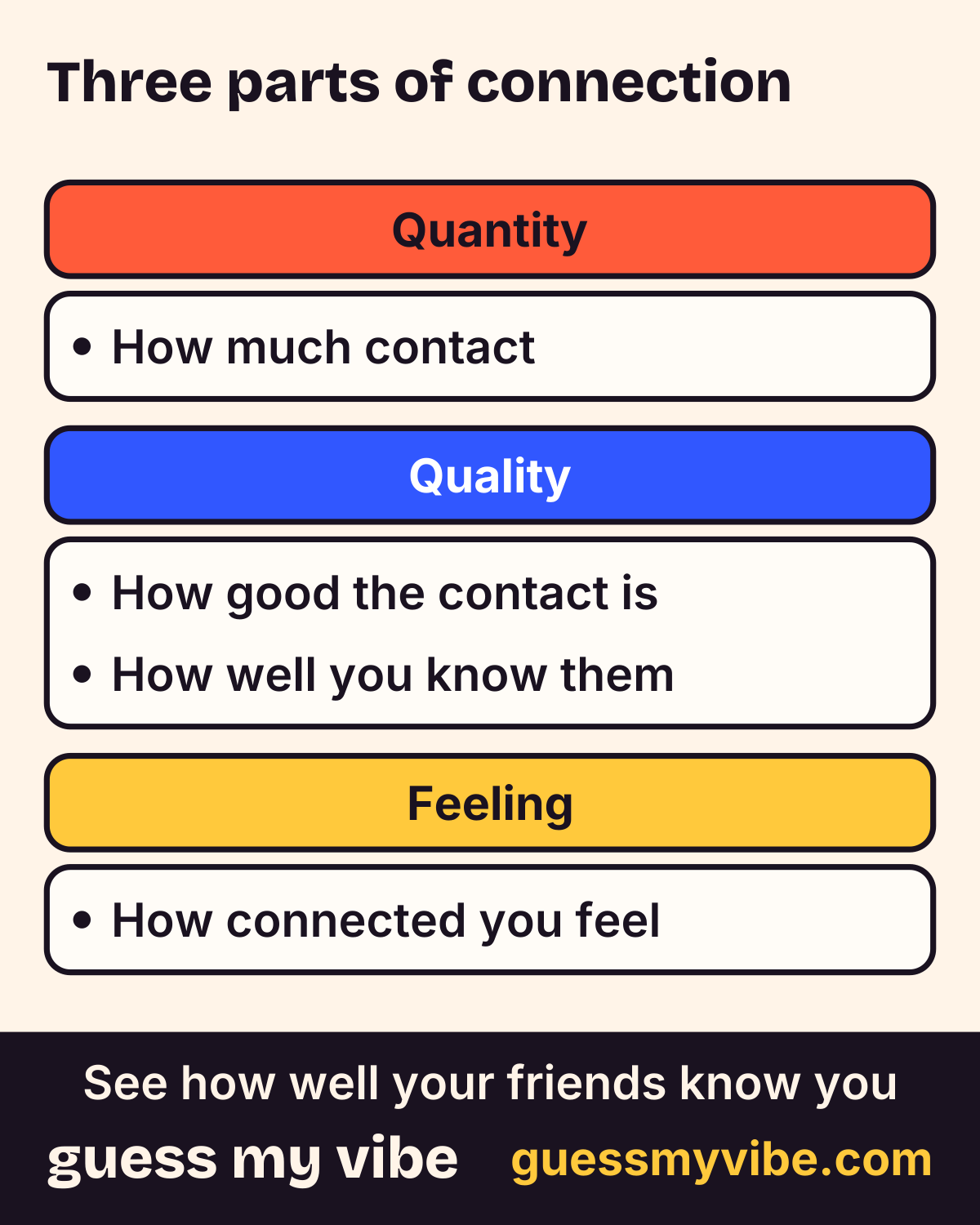
In everyday speech, social connection can mean anything from a deep friendship to a nod at the barista. Researchers tend to break it apart. One question is how much contact you have, the quantity of your interactions. Another is how good that contact is and how well you know the person. A third is how connected you feel, which is a perception and not a count. The studies below measure different pieces of this, which is why their findings fit together without being identical.
Cite this figure
Figure: "Three parts of connection." Guess My Vibe (guessmyvibe.com). https://guessmyvibe.com/learn/social-connection#figure-three-parts-of-connection
The big review: relationships and survival
One major study on the importance of social connection is a meta-analysis by Holt-Lunstad and colleagues. It combined 148 studies with 308,849 participants and found that people with stronger social relationships had a 50% increased likelihood of survival over the follow-up period [1]. The finding remained consistent across age, sex, initial health status, cause of death and length of follow-up [1].
What counts as a "stronger relationship" matters. The link was strongest for complex measures of social integration, with an odds ratio of 1.91. It was lowest for a simple yes-or-no indicator of living alone versus with others, at 1.19, a figure whose confidence interval (0.99 to 1.44) reaches down to no difference at all [1]. In plain words, the association was strongest when social relationships were measured in a broad, complex way and weakest when the measure was just who lived in the house.
Now the honest limits, which are our own reading and not a claim from the paper. These studies followed people over time rather than assigning them to conditions, so they can't prove that relationships themselves lead to longer life. Healthier people may find it easier to keep up a busy social life, and other differences between people could play a part. The authors' own conclusion is that the influence of social relationships on mortality risk is comparable with well-established risk factors [1]. It's a large, consistent association, and worth taking seriously, but it isn't a promise about any one person.
Connection in everyday life: what a week of recordings showed
A big review of mortality is far from daily life, so it helps to see what connection looks like hour to hour. In a study by Sun, Harris and Vazire, 256 participants wore an unobtrusive audio recorder and, four times a day for a week, reported on their interactions, their happiness and how socially connected they felt. That produced 3,206 observations. Outside observers also rated the quantity and quality of participants' interactions from the recordings at the same time points [2]. The observer ratings were a way to check that the findings didn't depend only on what people said about themselves.
Across the week, a greater quantity of social interaction went with greater well-being, both in the moment and on average, whether it was measured by self-report or by observers [2]. Quality counted, too. Deeper conversation, meaning more depth and self-disclosure, and knowing and liking the people you're with were also generally linked to greater well-being [2]. The authors add some detail: the effects were larger and more consistent for self-reported quality than for observer-reported quality, for changes within the same person than for differences between people, and for feeling socially connected than for happiness [2].
One more line in the abstract is relevant for people who consider themselves introverts. Most associations were similar for introverts and extraverts, and an exploratory result suggested introverts might get a bigger boost in social connectedness from deeper conversations [2]. "Exploratory" is the key word: it is a lead to test, not a settled finding. It is also still correlational. Feeling good might lead people to talk more, as well as the other way around.
A quick note on one phrase in that summary. "Within-person" means comparing you with yourself, such as you on a day with lots of conversation versus you on a quiet day. "Between-person" means comparing you with someone else. The within-person link was the larger and more consistent one [2]. That fits an everyday intuition that the same person tends to feel a bit more connected on days with more and better contact, though the study can't say whether the contact lifted the mood, the mood prompted the contact, or both. It also means the findings don't tell you that you need more contact than a friend does.
Curious how your friends would answer?
Free. Answer 10 quick questions about you, then send your link. Friends play in their browser, no app needed.
Start freeCasual contact counts too
Social connection isn't only about close friends and family. In a study of students, people reported greater happiness and greater feelings of belonging on days when they interacted with more classmates than usual. Two further studies that included all daily interactions found that contact with acquaintances, so-called weak ties, was also related to social and emotional well-being [3]. The authors conclude that even interactions with the more peripheral members of a social network seem to contribute to well-being [3].
There is a related finding about how we guess our own preferences. In experiments with commuters on trains and buses, people instructed to connect with a stranger reported a more positive commute than those told to stay disconnected, and no less productive a one, yet separate participants expected the opposite and expected solitude to feel better [4]. The authors trace part of that mistaken preference to underestimating how interested others are in connecting [4]. That doesn't mean everyone should chat on every commute. It suggests that when we skip a small chance to connect because we assume it will be awkward, our forecast can be off.
What this doesn't mean
- More contact isn't always better for every person. These are averages across groups, and individuals differ in how much company they want.
- Time alone isn't the opposite of connection. Many people use solitude to recharge, and our article on alone versus lonely looks at that research.
- The studies show associations. We can't say that connecting more would raise any particular person's wellbeing or health.
- There's no quota. Nothing in these papers sets a number of friends or hours that counts as enough.
If you feel short on connection, that is a common feeling and not a flaw or a diagnosis. If it has been heavy for a while, a friend, family member, counselor or doctor is a reasonable person to talk to. This isn't therapy, a diagnosis, or a substitute for professional care.
Putting it to use: small, ordinary ways to connect
The everyday-life research points to modest steps. A longer, more personal conversation with someone you already know is one way to add depth, since depth and self-disclosure were part of what went with greater well-being [2]. A brief exchange with a classmate or neighbor is another, since weak ties counted in the data too [3]. Neither is a prescription. They are simply the kinds of contact the studies measured.
Guess My Vibe is a low-pressure way to do the first one. A friend guesses how you'd answer real personality questions, then you compare. It tends to start the kind of conversation where you learn something you didn't know about each other, and it takes a few minutes. It's a game, not a measure of your wellbeing.
Key takeaways
- A meta-analysis of 148 studies and 308,849 participants found stronger social relationships went with a 50% higher likelihood of survival, and the link was biggest for broad measures of social integration and smallest for simply living alone versus with others [1].
- In a week-long study of 256 people that combined phone check-ins with audio recordings, more frequent social interaction went with greater well-being in the moment and on average [2].
- Deeper conversation, and knowing and liking the people you're talking to, were generally linked to greater well-being too, with larger effects for self-reported quality and for feelings of social connectedness than for happiness [2].
- Even casual contact counts in the data: on days when students interacted with more classmates than usual, they reported more happiness and belonging [3].
- This isn't therapy, a diagnosis, or a substitute for professional care; the research describes averages across groups of people, not what any one person's life should look like.
Questions people ask
Why is social connection important?
Research links it to wellbeing. In a meta-analysis of 148 studies, people with stronger social relationships had a 50% higher likelihood of survival over follow-up [1], and in a week-long everyday-life study, more and deeper social interaction went with greater well-being [2]. Both are associations, not proof of cause.
Does quality or quantity of social interaction matter more?
In one study both mattered: more frequent interaction and deeper, more personal conversation were each linked to greater well-being, with effects that were larger and more consistent for feeling socially connected than for happiness [2]. The study doesn't rank one above the other.
Do casual interactions count as social connection?
In one set of studies, yes. Students felt happier and more like they belonged on days when they interacted with more classmates than usual, and weak ties were related to social and emotional well-being more broadly [3].
Is it bad to want time alone?
No. Wanting time alone is normal, and nothing here says otherwise. Studies show averages across groups, not what any one person needs. Our article on alone versus lonely covers the research on solitude. This isn't therapy, a diagnosis, or a substitute for professional care.
Do introverts benefit from social connection as much as extraverts?
In one everyday-life study, most associations were similar for introverts and extraverts, and an exploratory result suggested introverts may get a larger boost in social connectedness from deeper conversations [2]. Exploratory findings need confirming.
See how well your friends know you.
Free. Answer 10 quick questions about you, then send your link. Friends play in their browser, no app needed.
Start freeReferences
- [1] Holt-Lunstad, J., Smith, T. B., & Layton, J. B. (2010). Social relationships and mortality risk: A meta-analytic review. PLoS Medicine, 7(7), e1000316. PubMed: 20668659 (opens in a new tab)
- [2] Sun, J., Harris, K., & Vazire, S. (2020). Is well-being associated with the quantity and quality of social interactions?. Journal of Personality and Social Psychology, 119(6), 1478-1496. PubMed: 31647273 (opens in a new tab)
- [3] Sandstrom, G. M., & Dunn, E. W. (2014). Social Interactions and Well-Being: The Surprising Power of Weak Ties. Personality and Social Psychology Bulletin, 40(7), 910–922. PubMed: 24769739 (opens in a new tab)
- [4] Epley, N., & Schroeder, J. (2014). Mistakenly seeking solitude. Journal of Experimental Psychology: General, 143(5), 1980–1999. PubMed: 25019381 (opens in a new tab)
How we find and check these sources: how we write. Spotted an error? Report a correction.
Related
- Loneliness: What It Is and Who Feels It Most
- Loneliness Epidemic: What the Data Actually Shows
- Alone vs Lonely: Why Solitude Isn't the Same Thing
- Friendship Psychology: What the Research Actually Says
- How to Have Deep Conversations, Backed by Research
- Sense of Belonging: The Need to Belong, Explained
- Friendship and Happiness: What the Research Shows
- The Strength of Weak Ties: Why Acquaintances Matter
Cite this article
- Title
- Social Connection: Why It Matters for Wellbeing
- Publisher
- Guess My Vibe
- Updated
- URL
- https://guessmyvibe.com/
learn/ social-connection
Copy this citation
Guess My Vibe. (2026, October 4). Social Connection: Why It Matters for Wellbeing. Guess My Vibe. https://guessmyvibe.com/
To point at one section, add that section's anchor (the # link on its heading) to the URL.