Loneliness is common, but "epidemic" is a headline more than a measurement. A 2022 meta-analysis found substantial loneliness in many countries while saying the evidence on trends over time is insufficient [1], and two U.S. national studies of older adults found no sign that loneliness rose from 2005 to 2016 [2].
Search for the loneliness epidemic and you will find dramatic claims on both sides. Some say loneliness is spreading like a disease. Others say the whole idea is hype. The research sits in between, and it is more interesting than either headline. Loneliness is common, but the data on whether there is a loneliness epidemic, in the sense of a steady rise over time, are patchy. A large 2022 meta-analysis found substantial loneliness in many countries and also said evidence on trends is insufficient [1]. This article walks through what the studies measured, what they didn't, and why the honest answer is "it depends on what you mean."
Where the loneliness epidemic idea comes from
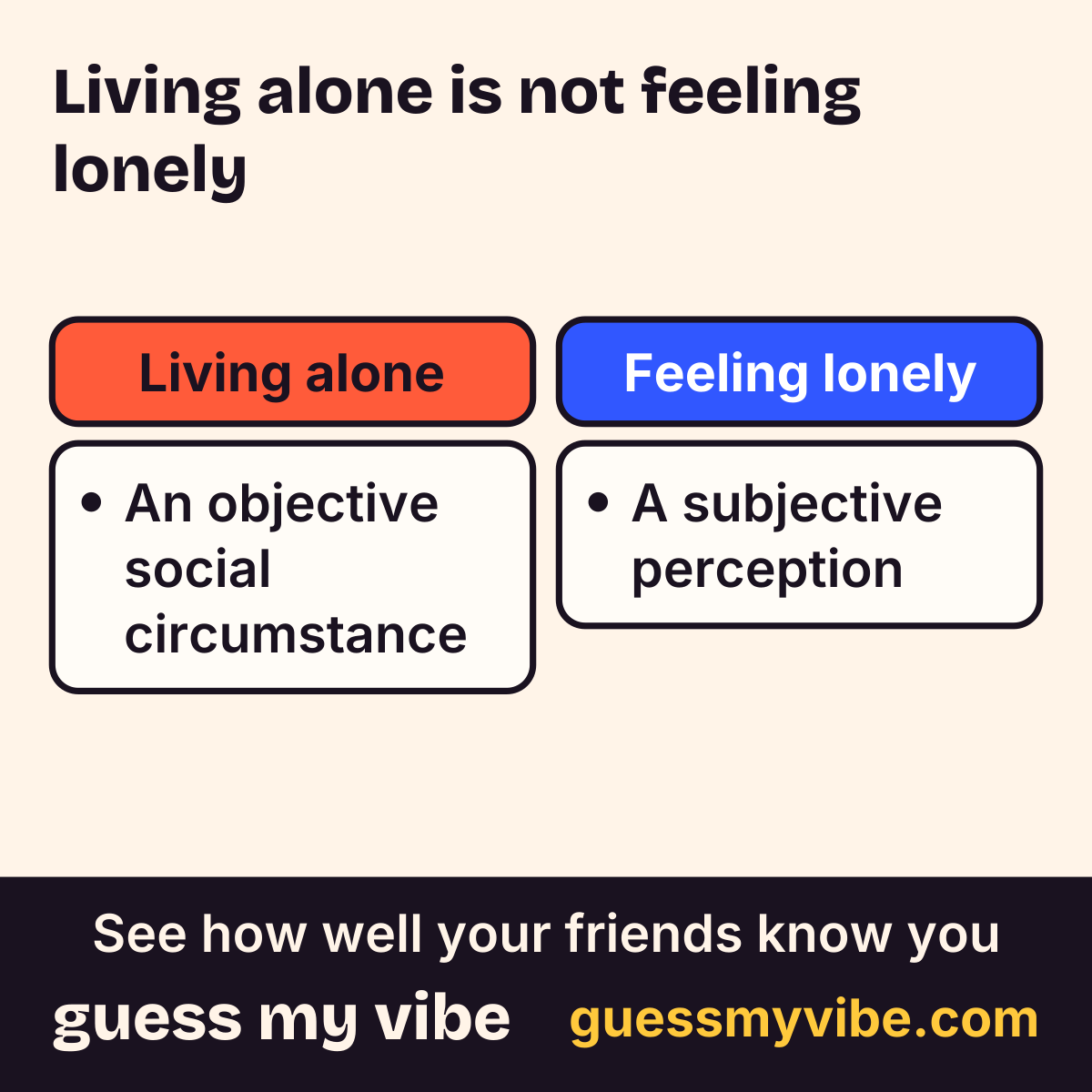
One researcher team describes the media version of the story this way: portrayals of a loneliness "epidemic" rest on a rise in the share of people living alone and on declines in civic engagement and religious affiliation over recent decades [2]. Those social changes are real and worth tracking. But the same team points out a catch: loneliness is a subjective perception, and it does not line up perfectly with someone's objective social circumstances [2]. Living alone is not the same as feeling lonely, so a rise in one doesn't automatically mean a rise in the other.
A second reason people worry is health. A meta-analysis of observational studies found that loneliness was linked to a 26% higher likelihood of dying over the follow-up periods, once several other factors were statistically accounted for, with similar numbers for social isolation and for living alone [4]. Because those are observational studies, they show an association rather than proving loneliness itself shortens life. They help explain why researchers care, though, and why a word as alarming as "epidemic" gets attached to the topic.
Cite this figure
Figure: "Living alone is not feeling lonely." Guess My Vibe (guessmyvibe.com). https://guessmyvibe.com/learn/loneliness-epidemic#figure-living-alone-vs-feeling-lonely
How common is loneliness? What a large review found
One key source on prevalence is a systematic review in the BMJ. It pulled together nationally representative studies from 2000 to 2019 and found prevalence data for 113 countries or territories, from 57 studies [1]. Among adolescents, the pooled share who were lonely ranged from 9.2% in South-East Asia to 14.4% in the Eastern Mediterranean region [1]. For adults, the authors could run a meta-analysis only for Europe, and there they saw a consistent geographic pattern: the lowest loneliness in northern European countries and the highest in eastern European ones [1].
The numbers show how wide the spread is. Among young adults in Europe, 2.9% were lonely in northern countries and 7.5% in eastern ones. For older adults, the range was 5.2% to 21.3% [1]. Those are very different pictures depending on where you live, and they come with a warning from the authors: data for most adult age groups were lacking outside Europe, and the findings are limited by data scarcity and by studies measuring loneliness in different ways [1]. Put plainly, a statement like "X% of people are lonely" depends heavily on the place, the age group, and the questionnaire used. The review's overall conclusion was that problematic levels of loneliness are experienced by a substantial proportion of the population in many countries [1].
A different kind of dataset points the same direction on one question, who reports loneliness, without settling the trend question. The BBC Loneliness Experiment analyzed 46,054 people aged 16 to 99 across 237 countries, islands and territories, and found that loneliness decreased with age and was greater in men than in women, with younger men in individualistic cultures the most vulnerable [5]. That is a snapshot of one survey, not a trend, so it can't tell you whether anyone is getting lonelier over the years.
Curious how your friends would answer?
Free. Answer 10 quick questions about you, then send your link. Friends play in their browser, no app needed.
Start freeIs loneliness actually increasing over time?
This is the heart of the epidemic claim, and it is where the evidence is weakest. The BMJ review set out to examine temporal trends where data exist, and ended up concluding that evidence on trends is insufficient [1]. That is not the same as saying loneliness isn't rising. It means that the right kind of data, collected the same way over many years across many places, mostly doesn't exist yet.
Where researchers do have comparable data, the findings are not dramatic. In two U.S. national studies of older adults, the National Social Life, Health and Aging Project and the Health and Retirement Study, loneliness decreased with age through the early 70s and rose after that [2]. The authors found no evidence that Baby Boomers, born 1948 to 1965, were substantially lonelier than people born earlier, and no evidence that loneliness increased over the decade from 2005 to 2016 [2]. They also noted that the actual number of lonely people could still grow as Boomers reach their 80s and beyond [2]. Two caveats matter here. This study covers older adults only, so it says nothing directly about teens or twenty-somethings. And it ends in 2016, before the pandemic.
For the pandemic years, a meta-analysis pooled 34 studies with 215,026 participants that had measured loneliness both before and during COVID-19. Looking only at the studies that followed the same people over time, loneliness scores and prevalence rose compared with before the pandemic, but the effect sizes were small [3]. The findings varied widely from study to study, and the authors say that spread points to a need to look more closely at risk and protective factors [3]. So the best available evidence for a recent jump points to a modest average change with a lot of variation, not a uniform surge.
Why the "epidemic" label is contested
Taken together, the studies support a careful sentence rather than a slogan. Loneliness is common, and for a meaningful share of people in many countries it is a real problem [1]. What is far less clear is whether it is getting steadily worse. Some recent evidence either finds no rise in the group it studied [2] or finds a small average rise tied to a specific event, with large differences between studies [3].
There are also reasons the word itself is a poor fit, which are our own reading of the evidence rather than something the studies tested. "Epidemic" implies spread from person to person and a single cause, while loneliness figures vary by age, place and measurement method. And a scary label can make someone who is lonely feel like part of a crisis rather than a person having an ordinary human experience. A fairer way to say it might be: loneliness is widespread, uneven across groups, and not yet well tracked over time.
What to take from the loneliness data
- Be wary of any single percentage. Prevalence depends on the country, the age group and the questions asked, and the BMJ authors flag that studies measured loneliness differently [1].
- Don't equate living alone with feeling lonely. The two overlap but don't match [2].
- Look for the age group in any statistic. The older-adult trend data and the global survey of 16 to 99 year-olds answer different questions [2] [5].
- Treat "it is rising" and "it isn't rising" both as unproven for most groups, because trend data are scarce [1].
If you came here because you personally feel lonely, the statistics may be beside the point. Nothing here is a diagnosis or a test. Loneliness is a common, ordinary feeling, and if it has been weighing on you, a friend, family member, counselor or doctor is a reasonable person to talk to. This isn't therapy, a diagnosis, or a substitute for professional care.
A small step that doesn't need a statistic
Whatever the national numbers turn out to be, one small, concrete thing is to spend a few minutes of real attention on a friendship you already have. Guess My Vibe is built for that: a friend guesses your answers to real personality questions, and you both see where you know each other well and where you're surprised. It doesn't measure or treat loneliness, and it isn't meant to. It is just a low-pressure way to talk about what you each think of the other.
Key takeaways
- A BMJ meta-analysis covering 113 countries and territories concluded that problematic levels of loneliness affect a substantial share of people in many places, but that data for adults are lacking outside Europe [1].
- The same review says evidence on whether loneliness is rising is insufficient, so no single number can settle the "epidemic" question [1].
- In two U.S. national studies of older adults, loneliness did not rise over 2005 to 2016, and Baby Boomers were not substantially lonelier than earlier-born adults [2].
- Pooled studies that followed people from before to during the COVID-19 pandemic found loneliness rose with small effect sizes, and the effects varied a lot from study to study [3].
- This isn't therapy, a diagnosis, or a substitute for professional care; feeling lonely is a common human experience, and if it feels heavy, talking with someone you trust or a professional is a reasonable step.
Questions people ask
Is there really a loneliness epidemic?
Loneliness is common, but whether it is an "epidemic" in the sense of a steady rise is not settled. A 2022 meta-analysis found substantial loneliness in many countries and called the evidence on trends insufficient [1], and a study of older U.S. adults found no rise from 2005 to 2016 [2].
How many people are lonely?
It varies a lot by place, age and how loneliness is measured. In a BMJ meta-analysis, adolescent prevalence ranged from 9.2% to 14.4% across world regions, and in Europe, adult figures ranged from 2.7% to 21.3% depending on region and age group [1].
Is loneliness increasing?
Not clearly. Trend data are scarce [1]. Older U.S. adults did not get lonelier from 2005 to 2016 [2], while pooled pandemic-era studies found a small average increase with a lot of variation between studies [3].
Are young people lonelier than older people?
In one large global survey, loneliness decreased with age [5]. In a U.S. study of older adults, loneliness fell until the early 70s and then rose [2]. Different samples and age ranges give different pictures, so it is best not to generalize from one study.
Does loneliness shorten life?
A meta-analysis of observational studies found loneliness was associated with about a 26% higher likelihood of dying over follow-up, after several factors were controlled for [4]. Those studies show an association, not that loneliness itself causes early death. This isn't therapy, a diagnosis, or a substitute for professional care.
See how well your friends know you.
Free. Answer 10 quick questions about you, then send your link. Friends play in their browser, no app needed.
Start freeReferences
- [1] Surkalim, D. L., Luo, M., Eres, R., Gebel, K., van Buskirk, J., Bauman, A., & Ding, D. (2022). The prevalence of loneliness across 113 countries: systematic review and meta-analysis. BMJ, 376, e067068. PubMed: 35140066 (opens in a new tab)
- [2] Hawkley, L. C., Wroblewski, K., Kaiser, T., Luhmann, M., & Schumm, L. P. (2019). Are U.S. older adults getting lonelier? Age, period, and cohort differences. Psychology and Aging, 34(8), 1144-1157. PubMed: 31804118 (opens in a new tab)
- [3] Ernst, M., Niederer, D., Werner, A. M., Czaja, S. J., Mikton, C., Ong, A. D., Rosen, T., Brähler, E., & Beutel, M. E. (2022). Loneliness before and during the COVID-19 pandemic: A systematic review with meta-analysis. American Psychologist, 77(5), 660-677. PubMed: 35533109 (opens in a new tab)
- [4] Holt-Lunstad, J., Smith, T. B., Baker, M., Harris, T., & Stephenson, D. (2015). Loneliness and social isolation as risk factors for mortality: a meta-analytic review. Perspectives on Psychological Science, 10(2), 227-237. PubMed: 25910392 (opens in a new tab)
- [5] Barreto, M., Victor, C., Hammond, C., Eccles, A., Richins, M. T., & Qualter, P. (2021). Loneliness around the world: Age, gender, and cultural differences in loneliness. Personality and Individual Differences, 169, 110066. PubMed: 33536694 (opens in a new tab)
How we find and check these sources: how we write. Spotted an error? Report a correction.
Related
Cite this article
- Title
- Loneliness Epidemic: What the Data Actually Shows
- Publisher
- Guess My Vibe
- Updated
- URL
- https://guessmyvibe.com/
learn/ loneliness-epidemic
Copy this citation
Guess My Vibe. (2026, October 4). Loneliness Epidemic: What the Data Actually Shows. Guess My Vibe. https://guessmyvibe.com/
To point at one section, add that section's anchor (the # link on its heading) to the URL.