Loneliness in college is common, especially early on, because starting college reshuffles your social network dramatically: one study found first-year students gained or lost about 58% of their social connections across the move, and more loneliness afterward went along with perceiving less network support [1]. It's also consistent with a broader pattern: younger people report more loneliness than older people on average [2], so feeling it in your late teens or twenties isn't unusual.
Loneliness in college, especially in the first year, is extremely common, and it's not a sign that you're bad at making friends or that everyone else has it figured out. Research that's looked specifically at the move to university, not loneliness in general, finds a clear reason it hits this particular transition so hard: starting college doesn't just add some new people to your life, it reshuffles almost the entire thing at once, which is a genuinely unusual amount of social change to go through all in one stretch.
Why the transition itself, not just being new, is the trigger
A 2026 study built specifically to measure this asked 79 first-year students to map out their social networks twice, once recalling who was in it before university and once after, and separately measured loneliness after the move. The scale of the change was substantial: on average, 58% of a student's social connections were gained or lost across the transition. Networks that came out the other side were larger overall, but also less close-knit, more spread out geographically, less emotionally close on average, and more varied in who was in them. The researchers' own framing is that this level of network churn was normal and widespread across the group, not a sign of anything going wrong for the people experiencing it [1].
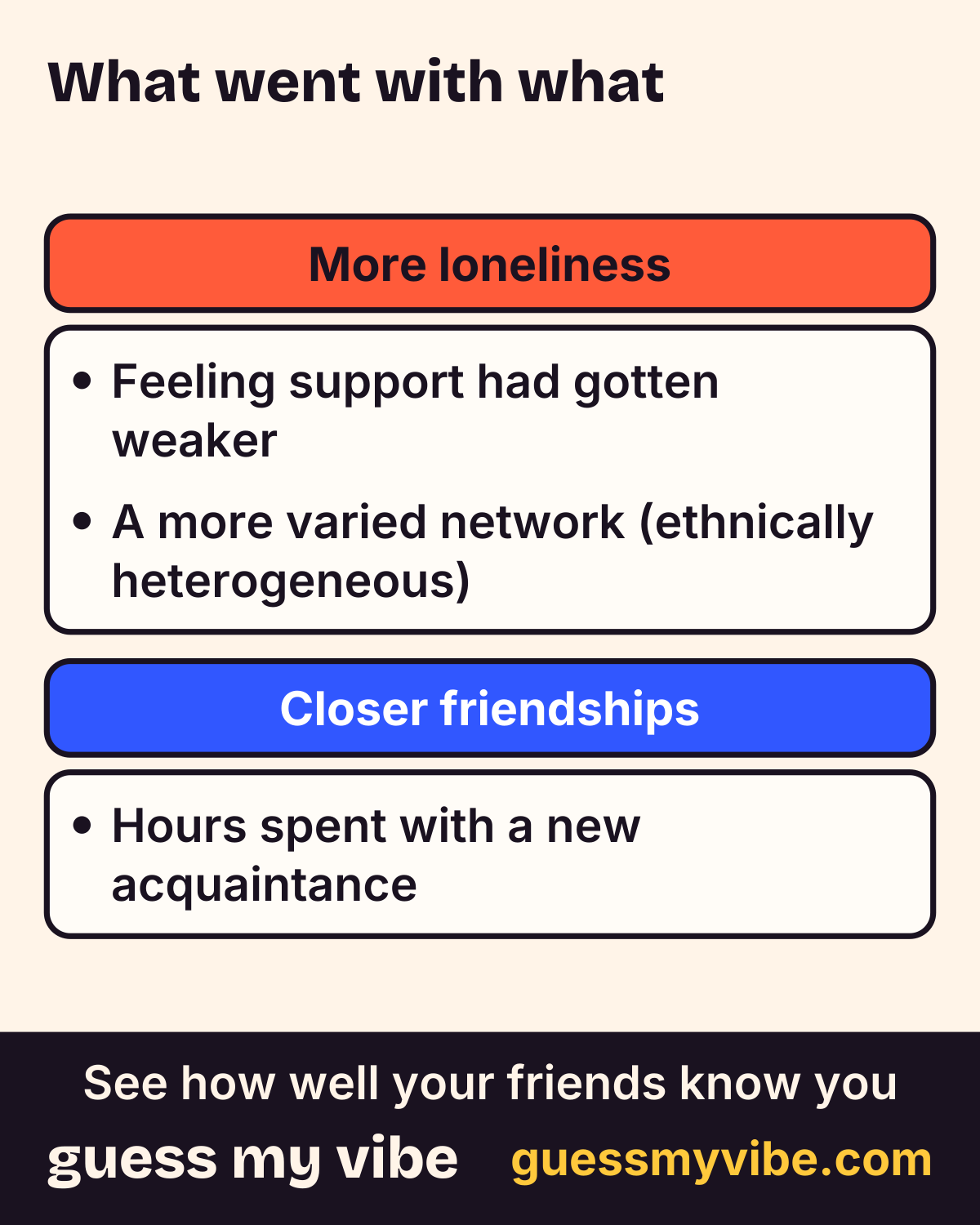
The more useful finding, though, is what specifically went with loneliness and what didn't. The abstract reports two associations. What went with more loneliness after the transition was feeling like the SUPPORT available in the new network had gotten weaker, along with having a more varied (ethnically heterogeneous) network, a pattern the study's small size (79 students) means is worth treating as a lead rather than a settled fact [1]. In plain terms: network change was widespread, and the loneliness link the study reports is with perceiving less support.
It's not just you, and it's not just this generation
Beyond the specific mechanics of the college transition, loneliness in your late teens and twenties fits a broader, well-documented age pattern. The BBC Loneliness Experiment, a global survey of 46,054 people aged 16 to 99 across 237 countries and territories, found loneliness was reported more often by younger people than older people, more by men than women, and most of all by younger men in individualistic cultures [2]. That doesn't mean every older adult has it figured out and every young adult is struggling. It does mean that if loneliness feels more present for you right now than it seems to for people decades older, a large global dataset says that's a common pattern at this life stage, not an unusual one specific to you.
What research on new college friendships finds actually helps
Since the network research above points to support, not sheer turnover, as what went with loneliness, the practical question becomes how new college friendships actually build real support quickly. A study across six Canadian universities, combining a survey with in-depth interviews, found the quality of the NEW friendships students formed during their first year was positively linked to how well they adjusted to university overall, and that link was stronger for students living in residence than for students commuting in [3]. A separate study followed 112 first-year students three times across their first nine weeks on campus and found something concrete and buildable: hours spent with a new acquaintance tracked with how much closer that friendship became between each check-in [4]. Neither study promises a specific number of friends or a specific timeline. Together they point in a clear direction: the new friendships that form during the first stretch of college aren't a consolation prize for the ones left behind, they're tied to how well that transition goes, and closeness grew with ordinary, repeated time together, not through finding an instant best match.
Cite this figure
Figure: "What went with what." Guess My Vibe (guessmyvibe.com). https://guessmyvibe.com/learn/loneliness-in-college#figure-loneliness-and-time
Curious how your friends would answer?
Free. Answer 10 quick questions about you, then send your link. Friends play in their browser, no app needed.
Start freeLiving on campus versus commuting
One detail from the six-university study is worth sitting with. The link between new-friendship quality and adjustment was stronger for students living in residence than for students commuting to university [3]. The abstract doesn't say why, and the study can't show that living on campus causes the difference. A reasonable reading is that residence life puts more people in the same place more often, which is the setup the hours-together finding above depends on [4]. If you commute, that isn't a verdict on your first year. It's a reason to pick one or two recurring things on campus, like a weekly club or a study group, so the repeated time together has somewhere to happen.
Small things that fit the research
None of these studies tested a specific fix, so treat the list below as ways to act on the patterns, not as proven treatments. Since the 2026 network study points to perceived support, it makes sense to notice whose support actually feels real to you, whether that's someone new or someone from before you moved [1]. Since hours together went with closer new friendships, it makes sense to protect regular time with the same few people [4]. And since new-friendship quality went with adjustment, it makes sense to treat a new friend as worth real attention, not as a placeholder [3].
- Pick one or two people you keep seeing, and make a small standing plan with them, like a weekly meal or a study hour.
- Keep a low-effort thread going with one or two people from before you moved. Support from them still counts.
- Say yes to the second invitation, not just the first. Friendships in the nine-week study grew with repeated time, not a single good night.
- Look up what your school offers. Most campuses have a counseling office, a student-life or residence-life office, and clubs. Check your school's own website for what exists and how to reach it.
What this doesn't mean
None of the research above means loneliness in college is something to just wait out, or that it doesn't matter because it's common. Common and easy aren't the same thing, and some first-year students will have a genuinely harder transition than others, for reasons the studies above don't fully explain (being far from home for the first time, financial stress, being the first in a family to attend college, and plenty else). This article also isn't a diagnosis or a clinical assessment of anything. If loneliness has been sitting heavy for more than a few weeks, or it's making it hard to get through ordinary days, that's worth talking to someone about: a friend, a family member, or your school's counseling or student-life office, which exists for exactly this kind of ordinary, common first-year experience.
A small way to build the thing that actually tracks with feeling less lonely
The research above points at ordinary, repeated time together as what actually builds a new friendship's support, not a single good conversation. Guess My Vibe gives a brand-new college friendship a small, daily reason to keep doing that: a round where you each guess how the other would answer real questions, turning the kind of repeated contact the research ties to closeness into something that happens automatically instead of needing to be planned every time.
Key takeaways
- A 2026 study of 79 first-year students found their social networks turned over by about 58% across the move to university on average, becoming larger, less close-knit, and more spread out, while perceived support stayed broadly stable at the group level [1].
- In that same study, more loneliness after the transition went with perceiving reduced network support (and with more ethnic heterogeneity in the network); it was a small, correlational study [1].
- A global survey of 46,054 people across 237 countries found loneliness was reported more by younger people than older people, so loneliness showing up more in your college years than it seems to for older adults around you fits a well-documented pattern [2].
- A study of new friendships forming during college found the quality of those new friendships was positively linked to how well students adjusted to university, especially for students living in residence [3], and a separate study of first-year students found hours spent with a new acquaintance tracked with how much closer that friendship became over the following weeks [4].
- This isn't therapy, a diagnosis, or a substitute for professional care; if it's been heavy for a while, your school's counseling or student-life office is a reasonable place to start.
Questions people ask
Is it normal to feel lonely during your first year of college?
Yes, very. A 2026 study found first-year students' social networks turned over by about 58% on average across the move to university, a level of social change the researchers describe as normal and widespread, not unusual [1].
Why does starting college cause loneliness even when you're meeting lots of new people?
Meeting new people doesn't automatically mean feeling supported. One small study found loneliness after the transition went with perceiving reduced network support [1].
Do younger people really feel lonelier than older people?
On average, yes, in a large global survey: a survey of 46,054 people across 237 countries found loneliness reported more often by younger people than older ones [2]. It's a common pattern at this life stage, not a personal failing.
How long does it take to feel less lonely in college?
Research doesn't give one verified timeline, but a study following first-year students over their first nine weeks found hours spent with a new acquaintance tracked with how much closer that friendship became at each check-in, which points to ordinary, repeated time together, not a single turning point [4].
What should I do if loneliness in college isn't getting better?
This article isn't a diagnosis or treatment. If it's been heavy for more than a few weeks or it's affecting your daily life, talk to someone you trust or reach out to your school's counseling or student-life office, which exists for exactly this common first-year experience.
See how well your friends know you.
Free. Answer 10 quick questions about you, then send your link. Friends play in their browser, no app needed.
Start freeReferences
- [1] Slack, H. R., Byrom, N., Bate, C., Hościłowicz, A., Homer, S., Fuhrmann, D., Foster, J., Crook, S., & Long, E. (2026). From Familiar Faces to New Spaces: Perceived Social Network Change and Its Association With Loneliness During the Transition to University. Journal of Adolescence. PubMed: 42557916 (opens in a new tab)
- [2] Barreto, M., Victor, C., Hammond, C., Eccles, A., Richins, M. T., & Qualter, P. (2021). Loneliness around the world: Age, gender, and cultural differences in loneliness. Personality and Individual Differences, 169, 110066. PubMed: 33536694 (opens in a new tab)
- [3] Buote, V. M., Pancer, S. M., Pratt, M. W., Adams, G., Birnie-Lefcovitch, S., Polivy, J., & Wintre, M. G. (2007). The Importance of Friends: Friendship and Adjustment Among 1st-Year University Students. Journal of Adolescent Research, 22(6), 665–689. doi.org/10.1177/0743558407306344 (opens in a new tab)
- [4] Hall, J. A. (2019). How many hours does it take to make a friend?. Journal of Social and Personal Relationships, 36(4), 1278–1296. doi.org/10.1177/0265407518761225 (opens in a new tab)
How we find and check these sources: how we write. Spotted an error? Report a correction.
Related
Cite this article
- Title
- Loneliness in College: Why the First Year Hits So Hard
- Publisher
- Guess My Vibe
- Updated
- URL
- https://guessmyvibe.com/
learn/ loneliness-in-college
Copy this citation
Guess My Vibe. (2026, October 3). Loneliness in College: Why the First Year Hits So Hard. Guess My Vibe. https://guessmyvibe.com/
To point at one section, add that section's anchor (the # link on its heading) to the URL.