A one sided friendship, where you'd call someone a friend but they wouldn't say the same about you, is a lot more common than it feels. In one study, people expected their friendships to be mutual almost all the time, but when actually checked, only about half were [1]. That gap usually says more about how hard friendship is to perceive accurately than about either person doing something wrong.
A one sided friendship is the uneasy feeling that you think of someone as a real friend and they don't quite think of you the same way. It's an uncomfortable thing to wonder about, but it turns out to be a genuinely common state, not a sign that something unusual or wrong is happening in just your friendships. Researchers who've actually measured this, instead of just asking people to guess, keep finding the same basic pattern: we assume mutual friendship far more often than it's actually there.
One sided friendship: how common is it, really?
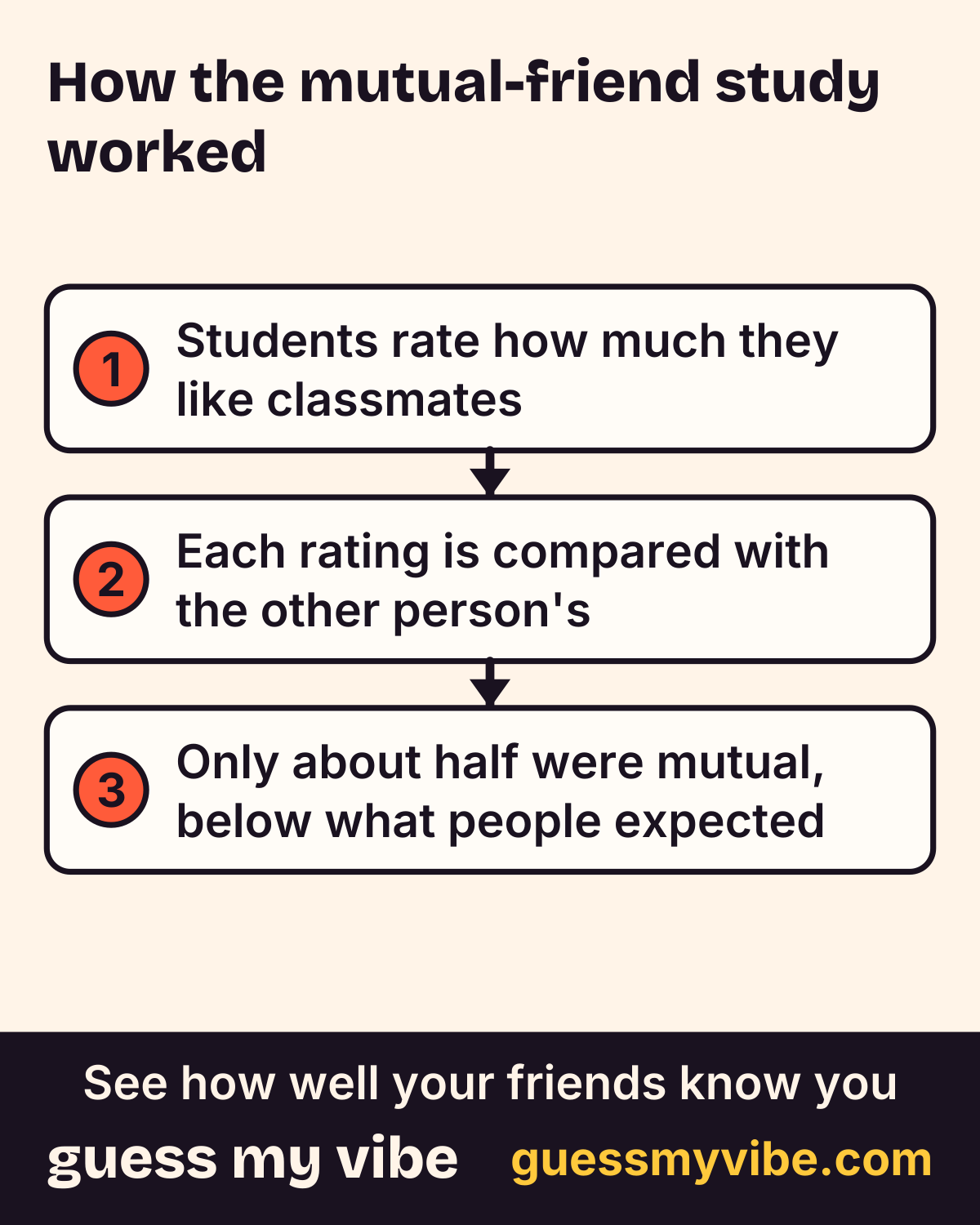
A study that directly measured this asked 84 students to rate how much they liked and considered various classmates to be friends, then compared each person's rating of another against that other person's rating of them. People expected mutual friendship almost by default: in 94% of cases where someone called another person a friend, they assumed that person felt the same way back. The actual overlap was far lower. Only about half of those friendship ties, 53%, were genuinely reciprocal [1].
That's not a one-off result from an unusual group. The same researchers checked the pattern against five other previously published social network datasets, covering different groups and settings across three continents, and found reciprocity rates of 45%, 34%, 35%, 49%, and 53%, every one of them well below the near-universal expectation of mutuality people start with [1]. Across all six datasets, actual mutual friendship landed somewhere around a coin flip, not the sure thing most of us assume.
That rate isn't fixed across every group, either. The same researchers pointed to an earlier study of adolescents, who were asked to nominate up to 10 of their best school friends, which found a higher reciprocity rate of 64% [1]. The honest reading is that how mutual friendship looks depends somewhat on age, group, and how the question gets asked, not that one single percentage applies to everyone.
Cite this figure
Figure: "How the mutual-friend study worked." Guess My Vibe (guessmyvibe.com). https://guessmyvibe.com/learn/one-sided-friendship#figure-how-the-study-worked
A one sided friendship isn't the same as a draining one
It's worth separating two different ideas that both get called "one-sided." The research above is about whether two people would both call each other a friend at all, a basic, factual mismatch in how the relationship is labeled. A separate, more popular idea is about effort: one person always texts first, always plans, always listens, while the other rarely reciprocates the work. That's a real pattern worth noticing in its own right, but it's a different question from reciprocity of labeling, and it hasn't been studied here with the same numbers. Don't assume the 53% figure above describes effort imbalance specifically; it describes whether the friendship was mutual at all.
Curious how your friends would answer?
Free. Answer 10 quick questions about you, then send your link. Friends play in their browser, no app needed.
Start freeWhy you might not know your friendship is one-sided
Part of the reason this gap is so wide is that figuring out how someone else actually sees you is a genuinely hard problem, not a failure of attention. A review of research on meta-perception, separate from friendship specifically, finds people are fairly good at guessing their broad, general reputation but much worse at guessing exactly how one specific person sees them. A lot of what feels like "I know how they see me" turns out to be a person's own self-image reflected back, not real information about the other person's actual view [2].
Put simply: you don't get a reliable readout of how someone else ranks the friendship. You get your own impression, built partly from how you feel about them, and it's easy to mistake that feeling for shared, mutual information.
It's not necessarily anyone's fault
It's worth being honest about what a one-sided friendship isn't. A gap between how two people rate the same friendship doesn't mean the other person is using you, doesn't like you, or is a bad friend. The research above found this gap in the majority of friendships studied, which means lopsided perception is closer to the normal condition of friendship than a red flag specific to one relationship. People invest in friendships at different speeds, notice different things, and carry different baseline assumptions about what counts as "close." Separate research on how accurately people judge each other more broadly backs this up: both sides of a relationship can be working from real, honest information and still land on different answers, because closeness, trust, and the rest aren't equally visible to everyone watching [4]. A mismatch is more often a difference in perspective and timing than a verdict on anyone's character.
Does more time together close the gap?
There's a reasonable case that it does. Separate research tracking how accurately people read each other over time found that as acquaintance length increased, people's impressions of each other shifted away from a generic, "people in general" guess and toward something specific and accurate to that particular person [3]. A newer friendship runs on thinner, more guess-based information in both directions, which is exactly the condition that makes a one-sided mismatch more likely. That doesn't guarantee every friendship becomes mutual with enough time, but it does suggest that a new friendship feeling lopsided isn't necessarily the end of the story.
What you can actually do about it
The research above doesn't point to a confrontation or an ultimatum; it points to more direct information. Since the gap mostly comes from guessing instead of knowing, the most reliable fix is replacing the guess: making plans and seeing whether they're reciprocated over time, sharing something real and noticing whether it's met in kind, or simply asking a direct, low-stakes question about getting together more. None of that requires assuming the worst about the other person first, and all of it works whether the friendship turns out to be fully mutual, still forming, or just slower on one side than the other.
A lower-stakes way to see where you both actually stand
Guess My Vibe won't tell you whether a specific friendship is mutual, but it does give two friends a small, repeatable way to compare notes: you each guess how the other would answer the same question, and the gap or the match between your guesses becomes something you can actually see, instead of something you're left to assume.
Key takeaways
- In a survey of 84 students, people expected their friendships to be reciprocated 94% of the time, but only 53% actually were [1].
- Checked against five other real-world social network datasets, actual friendship reciprocity ranged from 34% to 53%, consistently far below what people assume [1].
- People are fairly good at guessing their general reputation but much worse at guessing exactly how one specific person sees them, which is part of why a one-sided friendship can go unnoticed for a long time [2].
- The longer two people have actually known each other, the more their impressions of each other shift from a generic guess toward something accurate and specific to that person, so a newer friendship is more likely to feel lopsided than a long one [3].
- This isn't therapy, a diagnosis, or a substitute for professional care.
Questions people ask
What are signs of a one sided friendship?
There's no single validated checklist, but the research above points to a perception gap rather than a specific list of behaviors: you consistently initiate, remember details, and make time, while that effort doesn't come back the same way over a long enough stretch. One slow week isn't a sign of anything on its own [1].
Is a one sided friendship actually common?
Yes. One study found only 53% of friendships people expected to be mutual actually were, and reciprocity across five other real-world social networks ranged from 34% to 53%. A lopsided friendship is closer to typical than rare [1].
Does a one sided friendship mean the other person doesn't like me?
Not necessarily. The research found most friendships studied weren't fully mutual, which suggests mismatched perception is common and not a reliable sign of dislike. People can genuinely value a friendship and still rate its closeness differently than you do [1].
Can a one sided friendship become mutual over time?
It's plausible. Research on acquaintance length found people's impressions of each other get more accurate and specific the longer they've known each other, which is the kind of change that could close a perception gap, though no study followed one-sided friendships specifically to prove it always happens [3].
How do I find out if a friendship is actually mutual?
Ask directly or watch what happens over time rather than guessing. Since the research suggests the gap comes from assumption, not evidence, the most reliable fix is replacing the assumption: making plans and seeing if they're returned, or simply asking.
See how well your friends know you.
Free. Answer 10 quick questions about you, then send your link. Friends play in their browser, no app needed.
Start freeReferences
- [1] Almaatouq, A., Radaelli, L., Pentland, A., & Shmueli, E. (2016). Are you your friends' friend? Poor perception of friendship ties limits the ability to promote behavioral change. PLOS ONE, 11(3), e0151588. PubMed: 27002530 (opens in a new tab)
- [2] Kenny, D. A., & DePaulo, B. M. (1993). Do people know how others view them? An empirical and theoretical account. Psychological Bulletin, 114(1), 145–161. PubMed: 8346325 (opens in a new tab)
- [3] Biesanz, J. C., West, S. G., & Millevoi, A. (2007). What do you learn about someone over time? The relationship between length of acquaintance and consensus and self-other agreement in judgments of personality. Journal of Personality and Social Psychology, 92(1), 119–135. PubMed: 17201547 (opens in a new tab)
- [4] Connelly, B. S., & Ones, D. S. (2010). An other perspective on personality: Meta-analytic integration of observers' accuracy and predictive validity. Psychological Bulletin, 136(6), 1092–1122. PubMed: 21038940 (opens in a new tab)
How we find and check these sources: how we write. Spotted an error? Report a correction.
Related
- How to Make Friends: What the Research Says
- How to Be a Good Friend, According to Research
- Long Distance Friendship: Does It Actually Last?
- Flaky Friends: The Personality Science of Canceling Plans
- Self-Perception vs. How Others See You
- Female Friendship: What the Research Actually Shows
- Friendship Breakup: Why Friendships End, Research Says
- Friend Who Only Talks About Themselves: What Research Says
Want to try it with your own friends? Make a friendship quiz to play with your friends
Cite this article
- Title
- One-Sided Friendship: What the Research Actually Finds
- Publisher
- Guess My Vibe
- Updated
- URL
- https://guessmyvibe.com/
learn/ one-sided-friendship
Copy this citation
Guess My Vibe. (2026, October 3). One-Sided Friendship: What the Research Actually Finds. Guess My Vibe. https://guessmyvibe.com/
To point at one section, add that section's anchor (the # link on its heading) to the URL.