A long distance friendship can genuinely last, and research comparing it to friendships where people live nearby finds it isn't automatically weaker. One study found both kinds of friendship showed high, fluctuating commitment over time, and most people with a long-distance friend said their commitment to the relationship was currently increasing, not fading [1]. What tracks with whether it lasts is communication, not the miles.
A long distance friendship gets treated, by default, like the weaker version of the real thing: something that survives on good intentions until it eventually fades. The research comparing long-distance friendships directly against geographically close ones tells a more specific story, and it's less grim than the default assumption. It also lines up with something a lot of people with a long-distance best friend already suspect from experience: the friendship hasn't gotten worse, it's just being judged by the wrong measuring stick.
Does a long distance friendship actually last?
A study that tracked turning points in young-adult friendships, the specific events that moved a friendship closer or further apart over its history, compared geographically close friends against long-distance ones directly. Both types showed high, fluctuating commitment over time rather than a steady decline, which pushes back on the assumption that distance alone erodes commitment. Over 80% of people with a long-distance friend reported their commitment was currently increasing, not decreasing [1].
What makes a long-distance friendship feel close
A separate survey of college undergraduates compared how people in geographically close and long-distance friendships each defined closeness in the first place, rather than assuming the two groups meant the same thing by the word. It found they didn't: physical distance changed which factors mattered for feeling close to a friend [2]. In practice, that means measuring a long-distance friendship against the exact same yardstick as a nearby one, shared plans, spontaneous hangouts, seeing each other weekly, may miss what's actually keeping it alive. A long-distance friendship often runs on a different, but no less real, definition of closeness.
Neither study pinned down the exact factors that shift when distance enters the picture, but the direction fits what the other research below points to: a long-distance friendship that gets judged against a nearby friendship's definition of closeness (how often you see each other in person, whether you show up to the same things) will tend to look worse than it actually is, simply because it's being measured by the wrong ruler.
Distance isn't what keeps a friendship alive, communication is
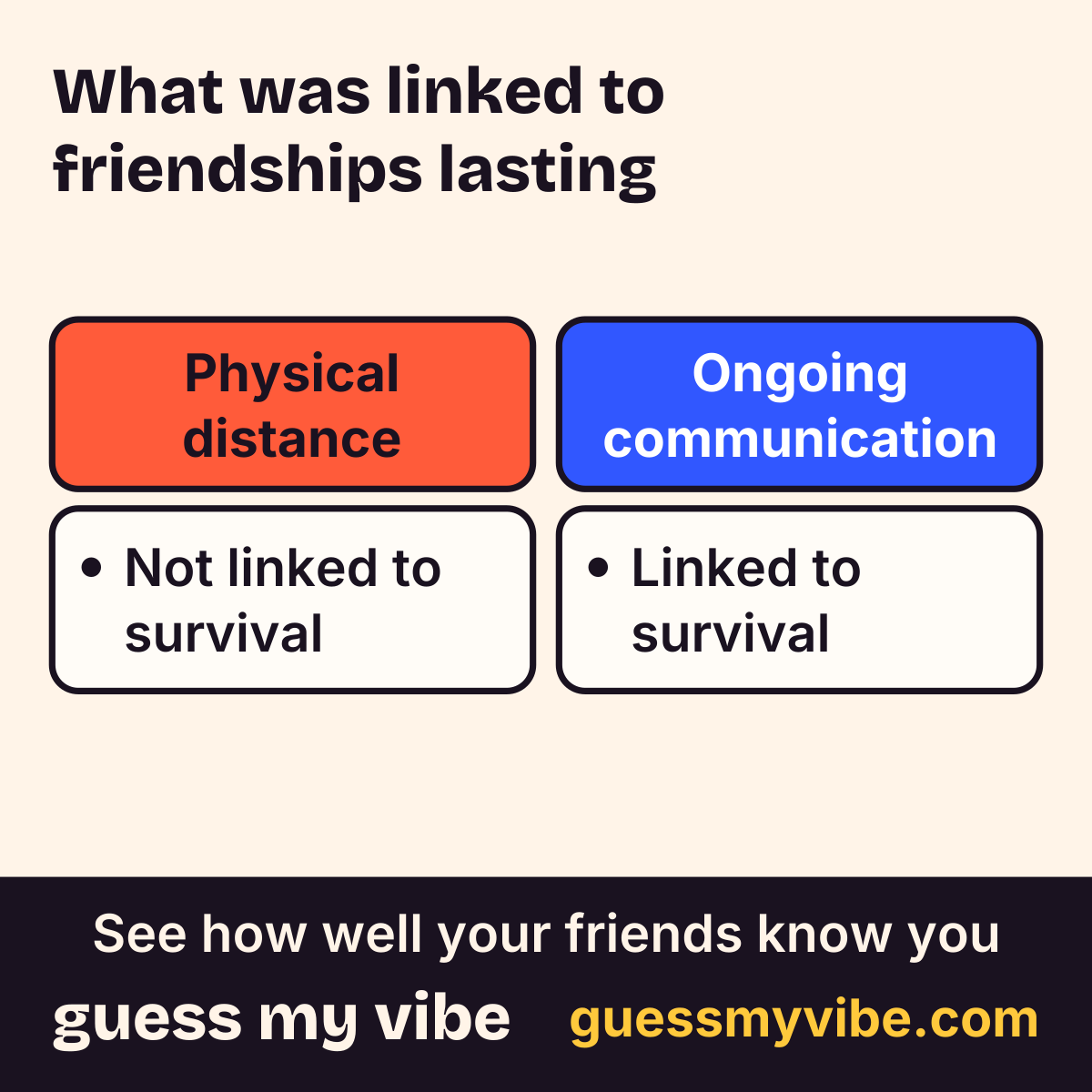
A year-long study followed high-school best friendships through students' first year of college, a transition that puts real distance between a lot of close friends all at once. On average, these friendships did decline over the year: satisfaction, commitment, rewards, and investment all dropped, while the costs and alternatives to keeping the friendship up rose. But physical distance itself wasn't linked to which friendships declined and which didn't. The level of communication between the two friends was. People who kept up positivity, support, self-disclosure, and actual interaction were more likely to stay best friends rather than drift down to close or casual, and maintaining the friendship also appeared to buffer against social loneliness during the transition [3].
Cite this figure
Figure: "What was linked to friendships lasting." Guess My Vibe (guessmyvibe.com). https://guessmyvibe.com/learn/long-distance-friendship#figure-distance-vs-communication
Curious how your friends would answer?
Free. Answer 10 quick questions about you, then send your link. Friends play in their browser, no app needed.
Start freeLong-distance friendships bend, they don't just break
A turning-point study of 100 college students' friendships, comparing geographically close and long-distance same-sex friendships directly, found friendship level and commitment were strongly linked in both. The interesting difference was in the shape of the change over time: long-distance friendships were more likely than close ones to dip down to a 'casual' level and then recover, rather than decline in a straight line. The researchers' own framing fits the data well: these friendships are flexible, not fragile, bending under distance rather than snapping [4].
What actually helps a long-distance friendship
Put the four findings above together and a practical picture forms: distance by itself isn't the threat it feels like, but losing communication is. The friendships that survive aren't the ones where two people happen to live close enough; they're the ones where both people keep doing the ordinary maintenance work (checking in, sharing real updates, making time to talk) regardless of the miles between them. A dip in closeness after a move isn't a sign the friendship is ending; the research above found that dip-and-recover pattern is actually typical for long-distance friendships that go on to last.
None of the studies above tested specific tools head to head, so there's no verified answer for whether a call beats a text or a video chat beats a voice note. What they do support is a direction: the specific medium matters less than whether contact keeps happening at all. A standing weekly call, a running group chat, or a shared show you both watch and text about during are all just different vehicles for the same underlying behaviors, positivity, support, openness, and interaction, that the friendship-maintenance research ties to friendships lasting, distance or not.
It's also worth expecting the occasional rough patch without reading too much into it. A visit that falls through, a busy month with barely any contact, or a conversation that feels more awkward than it used to are exactly the kind of turning points the research above found long-distance friendships absorb and recover from more often than they end over. A single quiet stretch is closer to normal than a verdict on where the friendship is headed.
What the research doesn't settle
None of the studies above followed friendships for decades, and all of them focused on young adults, mostly college students navigating a specific transition like moving away for school. Whether the same pattern holds for a friendship that's been long-distance for ten or twenty years, or for people well outside their early twenties, hasn't been directly tested in what's cited here. The honest version is that the core finding, distance matters less than communication, is well supported for the life stage these studies looked at, and a reasonable but not fully proven bet for friendships outside it.
A daily habit that doesn't care about the miles
Guess My Vibe runs entirely on a link, so a friend 500 miles away can play the same daily round as one who lives down the street. It won't replace a phone call or a visit, but it gives a long-distance friendship exactly the kind of small, repeated interaction the research above ties to friendships that last: a reason to check in today, not just whenever you both happen to be free.
Key takeaways
- A turning-point study found both geographically close and long-distance friendships showed high, fluctuating commitment over their history, with over 80% of people with a long-distance friend reporting their commitment was currently increasing rather than decreasing [1].
- Geographically close and long-distance friends don't define closeness identically; what counts as feeling close to a friend shifts depending on whether you see them in person [2].
- In a year-long study of high-school best friendships during the first year of college, physical distance from the friend wasn't linked to whether the friendship survived; how much the two friends actually communicated was [3].
- Long-distance friendships are more likely to dip toward 'casual' and then recover than to decline in a straight line, evidence that they bend under distance rather than simply break [4].
- This isn't therapy, a diagnosis, or a substitute for professional care.
Questions people ask
Can a long distance friendship really last as long as one where you live nearby?
Yes, based on the research comparing the two directly. One study found both geographically close and long-distance friendships showed high, fluctuating commitment over time, with over 80% of people with a long-distance friend reporting their commitment was currently increasing rather than decreasing [1].
What matters more for a long-distance friendship: how often you talk, or how close you used to be?
How much you actually communicate now. A year-long study of friendships going through a geographic transition found physical distance wasn't linked to whether the friendship survived, but the level of ongoing communication was [3].
Is it normal for a long-distance friendship to feel less close for a while?
Yes. Research tracking long-distance friendships over time found they're more likely than nearby friendships to dip to a more casual level and then recover, rather than decline steadily. A rough patch isn't necessarily the friendship ending [4].
Do long-distance friends define closeness differently than friends who live nearby?
Research comparing the two groups found yes: physical distance changes which factors matter most for feeling close to a friend. Judging a long-distance friendship by the same standard as a nearby one may undercount what's actually working [2].
What's the single biggest thing that keeps a long-distance friendship alive?
Communication, not proximity. Across the research above, the friendships that lasted were the ones where both people kept up real contact, positivity, support, and self-disclosure, regardless of how far apart they lived [3].
See how well your friends know you.
Free. Answer 10 quick questions about you, then send your link. Friends play in their browser, no app needed.
Start freeReferences
- [1] Johnson, A. J., Becker, J. A. H., Craig, E. A., Gilchrist, E. S., & Haigh, M. M. (2009). Changes in friendship commitment: Comparing geographically close and long-distance young-adult friendships. Communication Quarterly, 57(4), 395–415. doi.org/10.1080/01463370903313430 (opens in a new tab)
- [2] Johnson, A. J., Haigh, M. M., Craig, E. A., & Becker, J. A. H. (2009). Relational closeness: Comparing undergraduate college students' geographically close and long-distance friendships. Personal Relationships, 16(4), 631–646. doi.org/10.1111/j.1475-6811.2009.01243.x (opens in a new tab)
- [3] Oswald, D. L., & Clark, E. M. (2003). Best friends forever?: High school best friendships and the transition to college. Personal Relationships, 10(2), 187–196. doi.org/10.1111/1475-6811.00045 (opens in a new tab)
- [4] Becker, J. A. H., Johnson, A. J., Craig, E. A., Gilchrist, E. S., Haigh, M. M., & Lane, L. T. (2009). Friendships are flexible, not fragile: Turning points in geographically-close and long-distance friendships. Journal of Social and Personal Relationships, 26(4), 347–369. doi.org/10.1177/0265407509344310 (opens in a new tab)
How we find and check these sources: how we write. Spotted an error? Report a correction.
Related
- How to Make Friends: What the Research Says
- How to Be a Good Friend, According to Research
- One-Sided Friendship: What the Research Actually Finds
- Flaky Friends: The Personality Science of Canceling Plans
- BFF Test: A Real One to Take With Your Best Friend
- How to Make Friends Online (and if They're Real)
- How to Make Friends in a New City (What Research Says)
- Are Online Friends Real Friends? What Research Finds
Want to try it with your own friends? Make a friendship quiz to play with your friends
Cite this article
- Title
- Long Distance Friendship: Does It Actually Last?
- Publisher
- Guess My Vibe
- Updated
- URL
- https://guessmyvibe.com/
learn/ long-distance-friendship
Copy this citation
Guess My Vibe. (2026, October 3). Long Distance Friendship: Does It Actually Last?. Guess My Vibe. https://guessmyvibe.com/
To point at one section, add that section's anchor (the # link on its heading) to the URL.