How to make friends online, in short: find a shared-interest space you'll actually keep showing up to, talk to the same few people repeatedly instead of everyone once, and let the conversation get specific and personal rather than staying surface-level. Are online friends real friends? A survey of over 2,000 social networking site users found friendships that started online and later moved partly offline reached the same quality as offline friendships over time; friendships that stayed entirely online lagged behind, but still real [1].
How to make friends online starts with a question underneath the practical one: do online friends actually count, or is it a consolation prize for friendship that didn't happen in person? The research says online friendships are real, measurably so, with one honest asterisk: friendships that stay entirely online tend to run a little lower in quality than ones that move at least partly offline, though even online-only friendships are a genuine, documented source of closeness, not a hollow substitute for the real thing.
Are online friends real friends?
A study surveyed 2,188 users of a social networking site and compared three kinds of friendship: entirely online, entirely offline, and mixed-mode, meaning the friendship started online and later extended into offline contact [1]. The quality of all three types rose over time, which is itself worth noting: online friendships weren't frozen at some lower starting quality, they kept developing the same way offline ones do. The gap between online-only and offline friendships stayed statistically real even as time passed. But the gap between mixed-mode and offline friendships disappeared. A friendship that started as a shared interest in a group chat or a game and later added a call, a visit, or ongoing contact outside the original platform wasn't a lesser version of an offline friendship by the time enough time had passed. It was, by this measure, no longer distinguishable from one.
The same study found something useful about what actually drives quality in each type. Perceived similarity, the sense that you and this person just get each other, was the factor most strongly linked to quality for online-only friendships specifically. Social attraction (liking someone, wanting to spend time with them) mattered most for mixed-mode and offline friendships. Online, in other words, feeling like you click with someone carries even more weight than it does in person, maybe because you have less other information (a shared physical space, mutual friends, body language) to go on.
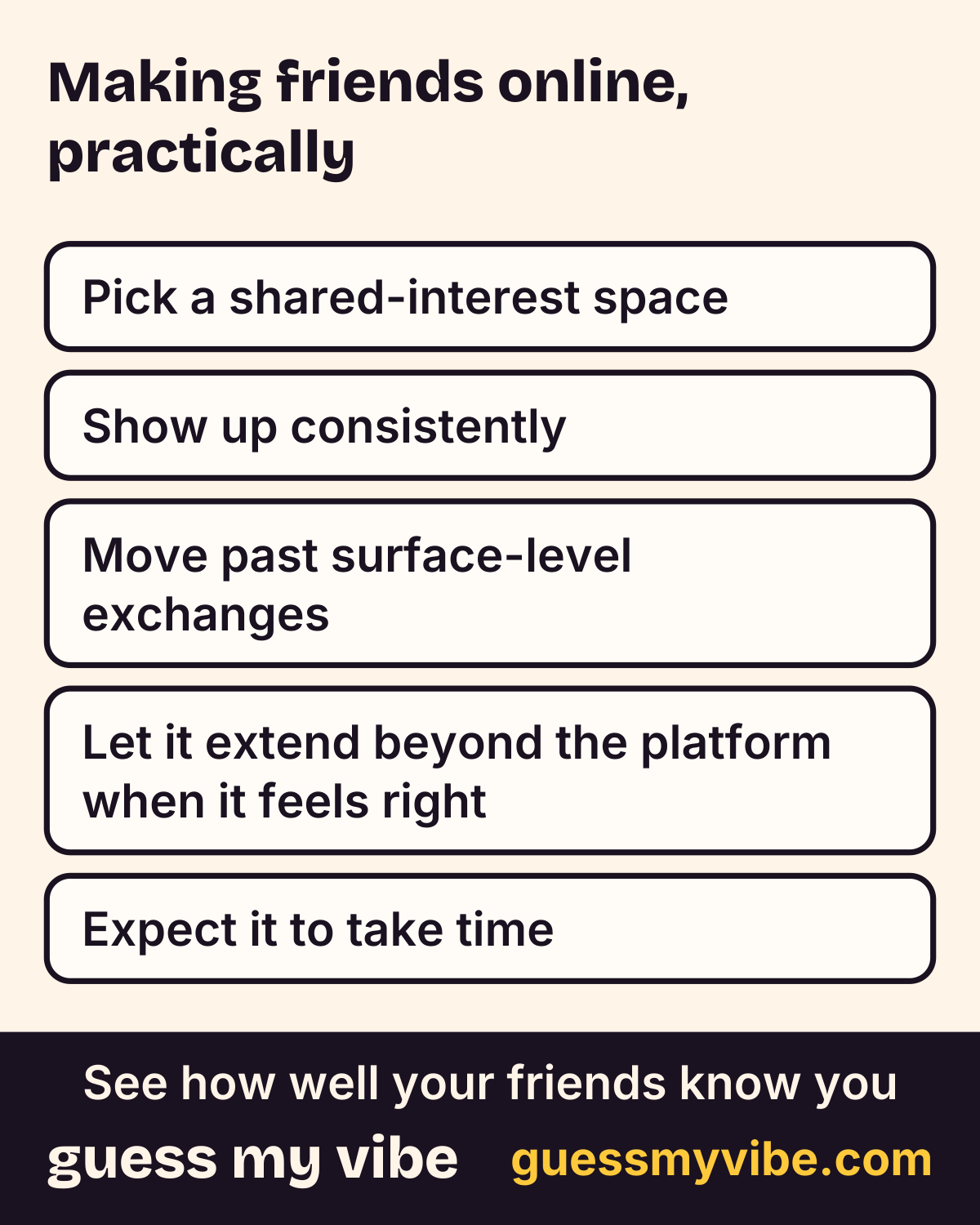
How to make friends online, practically
- Pick a space built around a shared interest, not a general one. A Discord server for a specific game or hobby, a subreddit, a niche online community, a group tied to something you're actually into gives you a real reason to keep showing up and something concrete to talk about besides small talk.
- Show up consistently to the same place instead of spreading thin across many. Repeated contact with the same handful of people builds a real sense of "we know each other" much faster than one-off conversations in ten different places.
- Move past surface-level exchanges on purpose. Ask a real question, share something specific about your actual week, respond to what someone said instead of just reacting to it. The hyperpersonal model suggests text-based exchanges can become unusually open when both people are motivated to connect, which is a reason to go specific instead of staying surface-level [2].
- Let a friendship extend beyond the original platform when it feels right, a DM, a voice call, eventually video. The research above found that friendships which extended into offline contact showed no remaining quality gap with offline friendships over time, though a survey can't show the extension itself caused that [1].
- Expect it to take time, the same way an in-person friendship does. Nothing in the research suggests online friendships form faster than offline ones on average; the advantage of an online community is more about access (finding people who share a specific interest) than about speed.
Cite this figure
Figure: "Making friends online, practically." Guess My Vibe (guessmyvibe.com). https://guessmyvibe.com/learn/how-to-make-friends-online#figure-online-friend-steps
Curious how your friends would answer?
Free. Answer 10 quick questions about you, then send your link. Friends play in their browser, no app needed.
Start freeWhy a text-based friendship can get close, sometimes faster than you'd expect
There's a reason online friendships aren't automatically shallower, and it has a name in communication research: the hyperpersonal model. The theory, laid out in a widely cited paper on computer-mediated communication, argues that text-based channels aren't simply a thinner version of face-to-face talk [2]. Under the right conditions, mainly time and two people who are actually motivated to connect, they can produce communication that's more selectively presented, more deliberately open, and sometimes more intimate than an in-person conversation manages. Part of why: typing gives you a beat to choose your words, you're not managing tone of voice and body language at the same time, and a shared text thread is, in its own way, a record you can both look back on. None of that makes online friendship better than in-person by default. It does explain why "we've never met in person but I tell her things I don't tell anyone else" isn't a contradiction; it's the kind of pattern the theory describes.
Does who you click with online work the same way as in person?
Mostly, yes. A study of 980 adolescents in Israel compared friends met at school, in the neighborhood, and online, and found friends met online were less likely to share basics like age, gender, or location than friends met at school, and reported somewhat less closeness on average [3]. But among the online-met friends specifically, more similarity in gender and location still meant a stronger tie. That study looked at adolescents rather than adults, so the exact numbers may not carry over directly to an 18-to-24-year-old audience, but the underlying mechanism, similarity still mattering even when the usual in-person cues (seeing someone daily, living nearby) aren't there, is a reasonable one to expect holds up.
A practical word on safety, not a scare
Making friends online doesn't need a long list of warnings to take seriously, but a few practical habits hold up regardless of how close an online friendship feels: keep identifying details (your address, your daily schedule, financial information) out of early conversations no matter how well you think you've clicked, verify someone's identity with a video call before you consider meeting in person, and meet in a public place the first time if you do. None of this means treat every online friend with suspicion; it means apply the same basic judgment you'd use meeting anyone new, adjusted for the fact that you have less context than you would meeting through a mutual friend in person.
Is an online friendship actually good for you?
One study measured this directly rather than assuming it: it found that Facebook-derived social connectedness is statistically distinct from offline social connectedness, meaning it isn't just a weaker copy of the same thing, and that higher online connectedness correlated with lower depression and anxiety and greater life satisfaction in a sample of Facebook users [4]. That's a correlation, not proof that online connection causes better mental health, and it isn't a claim that online friendship can treat or replace anything. It's one more piece of evidence that an online friendship is a real, separately useful kind of connection, not a lesser stand-in for the in-person version.
Where distance stops being the obstacle
A lot of what makes a friendship feel distant isn't the number of miles between two people, it's whether you have an easy, repeatable way to actually do something together. Guess My Vibe works by sending a link, which means an online friend in a different time zone, a friend from a community you've never met in person, and a friend who lives three blocks away all play the exact same way: answer questions about each other, see how close the guesses land. The distance that usually makes an online friendship harder to build on doesn't apply here, because the whole thing happens over a link either of you can open from anywhere.
Key takeaways
- Friendships that start online and extend into some offline contact (meeting up in person, for example) caught up to offline friendships in quality over time, in a survey of 2,188 social networking site users [1].
- Friendships that stayed entirely online scored lower in quality than offline ones, even after time passed, but perceived similarity, feeling like you actually click with someone, was the factor most strongly linked to how good an online-only friendship felt [1].
- Text-based communication isn't automatically a worse way to build closeness. A classic communication theory argues it can become 'hyperpersonal,' producing more open, sometimes more intimate exchanges than face-to-face conversation under the right conditions [2].
- Among online-met friends specifically, more similarity in basics like location and gender still meant a stronger social tie (in a sample of Israeli adolescents) [3].
- This isn't therapy, a diagnosis, or a substitute for professional care.
Questions people ask
Are online friends real friends?
Yes, with one honest nuance. A study of 2,188 social networking site users found friendships that stayed entirely online scored lower in quality than offline friendships, but friendships that started online and later extended into some offline contact caught up to offline friendships' quality over time [1].
How do you actually make friends online?
Find a space built around a specific shared interest, show up to the same place repeatedly instead of spreading across many, and let conversations get genuinely personal rather than staying surface-level. Extending contact beyond the original platform, a call, a DM thread, eventually meeting, went with friendships that showed no quality gap compared with offline ones in one survey [1].
Can you really get close to someone you've never met in person?
Yes. The hyperpersonal model of computer-mediated communication argues text-based conversation can, under the right conditions, produce more open and sometimes more intimate exchanges than face-to-face talk, not just a thinner version of it [2].
Does personality similarity matter for online friendships too?
Yes. Among friends met online specifically, more similarity in basics like gender and location still meant a stronger social tie, and in a separate study, feeling similar to an online friend was the factor most strongly linked to how good that friendship felt [3] [1].
Is making friends online actually good for your well-being?
One study found online social connectedness is a distinct thing from offline connectedness, and higher online connectedness correlated with lower depression and anxiety and greater life satisfaction. That's a correlation from Facebook users, not proof that it causes better mental health [4].
What's the one safety habit worth keeping even in a close online friendship?
Verify who someone actually is (a video call is a simple way) before sharing identifying details or agreeing to meet up, and meet in public the first time if you do. It's the same judgment you'd use meeting anyone new, not a sign of distrust specific to online friends.
See how well your friends know you.
Free. Answer 10 quick questions about you, then send your link. Friends play in their browser, no app needed.
Start freeReferences
- [1] Antheunis, M. L., Valkenburg, P. M., & Peter, J. (2012). The quality of online, offline, and mixed-mode friendships among users of a social networking site. Cyberpsychology: Journal of Psychosocial Research on Cyberspace, 6(3), article 6. doi.org/10.5817/cp2012-3-6 (opens in a new tab)
- [2] Walther, J. B. (1996). Computer-mediated communication: Impersonal, interpersonal, and hyperpersonal interaction. Communication Research, 23(1), 3–43. doi.org/10.1177/009365096023001001 (opens in a new tab)
- [3] Mesch, G., & Talmud, I. (2007). Similarity and the quality of online and offline social relationships among adolescents in Israel. Journal of Research on Adolescence, 17(2), 455–466. doi.org/10.1111/j.1532-7795.2007.00529.x (opens in a new tab)
- [4] Grieve, R., Indian, M., Witteveen, K., Tolan, G. A., & Marrington, J. (2013). Face-to-face or Facebook: Can social connectedness be derived online?. Computers in Human Behavior, 29(3), 604–609. doi.org/10.1016/j.chb.2012.11.017 (opens in a new tab)
How we find and check these sources: how we write. Spotted an error? Report a correction.
Related
Want to try it with your own friends? Make a friendship quiz to play with your friends
Cite this article
- Title
- How to Make Friends Online (and if They're Real)
- Publisher
- Guess My Vibe
- Updated
- URL
- https://guessmyvibe.com/
learn/ how-to-make-friends-online
Copy this citation
Guess My Vibe. (2026, October 3). How to Make Friends Online (and if They're Real). Guess My Vibe. https://guessmyvibe.com/
To point at one section, add that section's anchor (the # link on its heading) to the URL.