Loneliness is the gap between the amount of social connection you want and the amount you actually have, not simply a matter of being physically alone [1]. It's a common, ordinary human experience rather than a flaw or a diagnosis, it shows up at every age, and a large meta-analysis linked stronger social relationships to a higher likelihood of survival [2].
What loneliness actually is
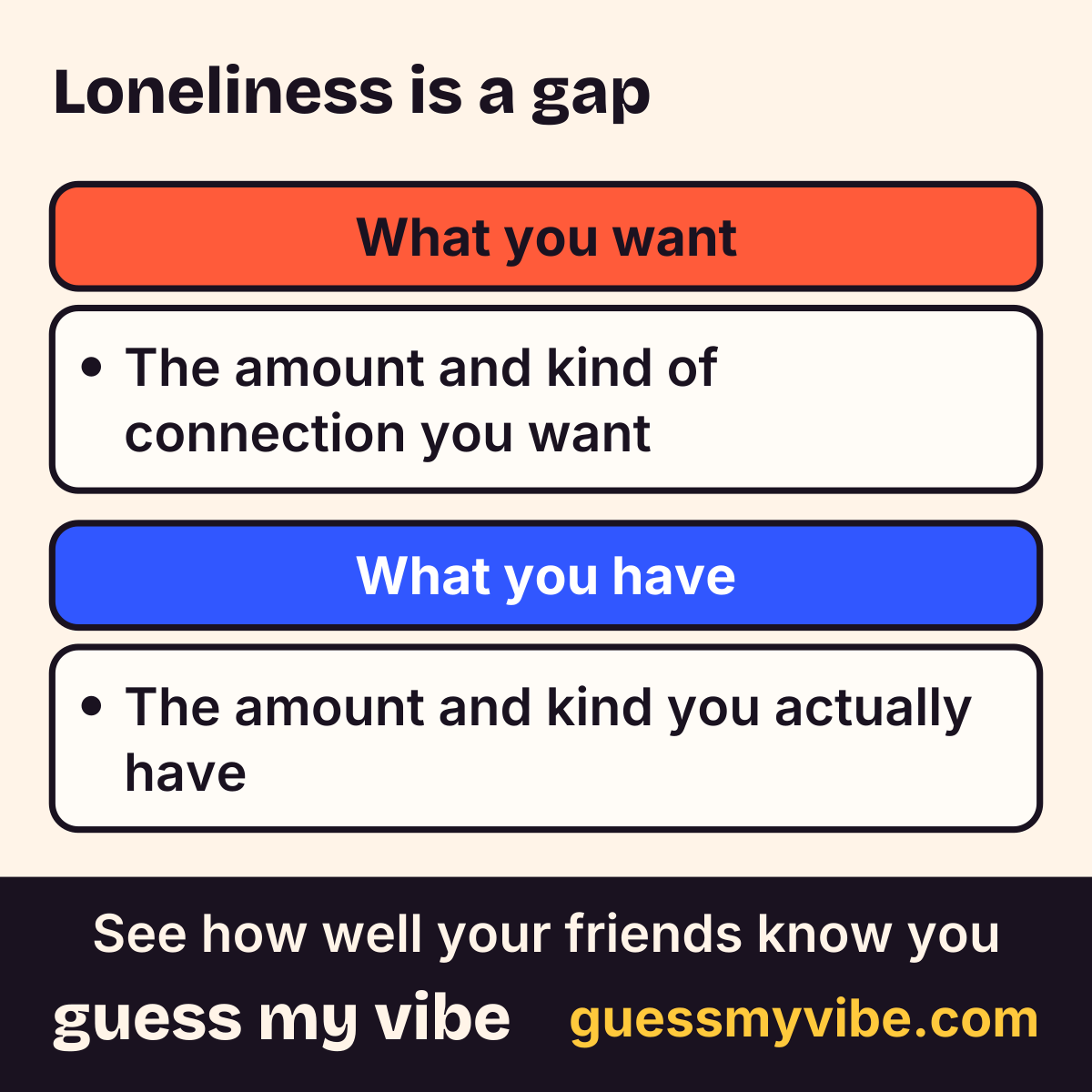
Loneliness isn't the same thing as being alone, and it isn't the same thing as not having friends. Researchers generally define it as a gap: the difference between the amount and kind of social connection a person wants and the amount they actually have, a definition that goes back to Peplau and Perlman in 1982 and is quoted in the introduction to the BBC Loneliness Experiment paper [1]. It's why someone can be surrounded by people and still feel lonely (the connection they have doesn't match the connection they want), and why someone else can spend a weekend alone by choice and feel perfectly fine. The feeling tracks the gap, not the headcount.
That gap framing also explains why loneliness and solitude aren't the same experience, even though they can look identical from the outside. A person who chooses a quiet night alone, with no particular wish for company right then, usually isn't lonely in the way researchers mean it: their actual connection matches what they want in that moment. Someone at a crowded party who feels unseen by everyone there is a clearer example of the gap itself, plenty of people physically present, not much of the connection they actually wanted. Solitude is about how many people are around; loneliness is about whether the connection you have matches the connection you're looking for.
It's also worth saying plainly: loneliness is a common, ordinary human experience, not a character flaw and not a diagnosis. Everyone feels it at some point, often more than once, and feeling it doesn't mean something is wrong with you. One clinical literature review, with a focus on adolescence, reviews the prototypic features of loneliness through its affective, cognitive and behavioral correlates, and argues that clinicians should pay attention to it in its own right [4].
Cite this figure
Figure: "Loneliness is a gap." Guess My Vibe (guessmyvibe.com). https://guessmyvibe.com/learn/loneliness#figure-loneliness-is-a-gap
Who tends to feel lonely most? The age pattern is more complicated than it looks
A common assumption is that loneliness is mainly an older person's experience. A large cross-cultural survey says otherwise, at least on average. The BBC Loneliness Experiment surveyed 46,054 people aged 16 to 99 across 237 countries and territories, and found loneliness was reported more often by younger people than by older people, more often by men than by women, and most of all by younger men in individualistic cultures [1]. If you're in your late teens or twenties and feel like loneliness shows up more for you than it seems to for people decades older, this large, global dataset says that's a genuinely common pattern, not an unusual one.
The honest complication: not every study finds the same direction. A survey of 26,342 adults aged 19 to 65 across the Netherlands found loneliness prevalence actually rose with age across that working-age range, from 39.7% among 19-34 year-olds up to 48.2% among 50-65 year-olds [3]. That's the opposite direction from the global survey above, within a narrower age band and a single country. The most honest summary is that the age pattern isn't fully settled across every sample and age range studied; what's consistent across both is that loneliness shows up substantially at every adult age studied, including in young adulthood, not just later in life.
Curious how your friends would answer?
Free. Answer 10 quick questions about you, then send your link. Friends play in their browser, no app needed.
Start freeWhat loneliness actually feels like, day to day
Loneliness research sorts its features into three kinds rather than one single symptom: affective (feelings), cognitive (thoughts) and behavioral (what people do) correlates [4]. In everyday terms, our own illustration rather than a finding from that review, the feeling side might be a sense of being on the outside of connection you can see happening around you, the thinking side might be extra watchfulness for signs of being left out, and the behavioral side might be finding it harder to reach out. None of this means something is broken, and it isn't a checklist to measure yourself against.
Why social connection matters for health, according to a large review
One reason researchers take social connection seriously, beyond how it feels in the moment, is a large body of health evidence. A meta-analysis combining 148 separate studies and more than 308,000 people found that having stronger social relationships went with a 50% higher likelihood of survival over each study's follow-up period, a pattern that held up consistently across age, sex, health status, cause of death and length of follow-up [2]. The link was strongest for richer, more complex measures of social integration, and weakest for a simple yes/no measure of living alone versus with others, so how connected someone's social life is, as measured broadly, went with survival more than simply who lives in the house [2]. The review's own conclusion is that the influence of social relationships on mortality risk is comparable with well-established risk factors for mortality. These are associations from studies that followed people over time, so they don't prove that relationships themselves cause longer life.
If loneliness has been heavy for you lately
Nothing on this page is a diagnosis or a test, and feeling lonely sometimes, or even often, doesn't mean something is wrong with you. If it's been sitting heavy for a while and it's affecting how your days go, that's worth talking about with someone you trust, whether that's a friend, a family member, or a professional like a counselor or doctor. Reaching out is also, quite literally, one way of starting to close the exact gap loneliness research describes: the space between the connection you want and the connection you currently have.
Closing the gap starts with the people already in your life
One small, concrete way to work on the actual-vs-wanted connection gap is to notice how well you and the people already around you really know each other. Guess My Vibe is built around exactly that: a friend guesses your honest answers to real personality questions, and you see where your sense of each other holds up. It's a small, low-stakes way to spend a few real minutes of attention on a friendship you already have, which is a genuine, if modest, step toward more of the connection loneliness research says people are often missing.
Key takeaways
- Loneliness is often defined, following Peplau and Perlman (1982), as a discrepancy between actual and desired social relationships, a definition quoted in the introduction to the global survey below [1].
- A global survey of 46,054 people across 237 countries found loneliness was reported more often by younger people than older people, and more by men than women, with younger men in individualistic cultures reporting the most [1].
- That age pattern isn't perfectly settled: a Dutch survey of 26,342 working-age adults found loneliness prevalence rising slightly from 39.7% among 19-34 year-olds to 48.2% among 50-65 year-olds, the opposite direction, which is an honest reminder that findings can vary by sample and life stage [3].
- A meta-analysis of 148 studies and over 308,000 people found stronger social relationships went with a 50% higher likelihood of survival over the studies' follow-up periods, with the authors concluding that the influence of social relationships on mortality risk is comparable with well-established risk factors [2].
- This isn't therapy, a diagnosis, or a substitute for professional care; if loneliness has been sitting heavy for you lately, talking to someone you trust, or a counselor or doctor, is a reasonable next step.
Questions people ask
What is the definition of loneliness?
Loneliness is often defined as a discrepancy between the social relationships a person wants and the ones they actually have, a definition quoted in the introduction to a large global survey [1]. It's about that gap, not simply about being physically alone.
Is loneliness more common in young people or older people?
It depends on the sample. A global survey of 46,054 people found loneliness was reported more by younger people [1], while a Dutch survey of working-age adults found prevalence rising slightly with age [3]. The honest summary: loneliness shows up substantially at every adult age, not just in later life.
Is loneliness a mental health condition?
No. Loneliness is a common human experience, not a diagnosis. This article describes it as researchers study it, not as a clinical assessment, and it isn't therapy, a diagnosis, or a substitute for professional care.
Why does loneliness matter for physical health?
A meta-analysis of 148 studies and over 308,000 people found stronger social relationships went with a 50% higher likelihood of survival over each study's follow-up period, a pattern holding across age, sex and health status [2].
What should I do if I've been feeling lonely a lot?
Feeling lonely sometimes is common and not a sign something is wrong with you. If it's been heavy for a while, talking to someone you trust or a professional, like a counselor or doctor, is a reasonable step. This page isn't therapy, a diagnosis, or a substitute for professional care.
See how well your friends know you.
Free. Answer 10 quick questions about you, then send your link. Friends play in their browser, no app needed.
Start freeReferences
- [1] Barreto, M., Victor, C., Hammond, C., Eccles, A., Richins, M. T., & Qualter, P. (2021). Loneliness around the world: Age, gender, and cultural differences in loneliness. Personality and Individual Differences, 169, 110066. PubMed: 33536694 (opens in a new tab)
- [2] Holt-Lunstad, J., Smith, T. B., & Layton, J. B. (2010). Social relationships and mortality risk: A meta-analytic review. PLoS Medicine, 7(7), e1000316. PubMed: 20668659 (opens in a new tab)
- [3] Franssen, T., Stijnen, M., Hamers, F., & Schneider, F. (2020). Age differences in demographic, social and health-related factors associated with loneliness across the adult life span (19-65 years): A cross-sectional study in the Netherlands. BMC Public Health, 20, 1118. PubMed: 32758200 (opens in a new tab)
- [4] Heinrich, L. M., & Gullone, E. (2006). The clinical significance of loneliness: A literature review. Clinical Psychology Review, 26(6), 695-718. PubMed: 16952717 (opens in a new tab)
How we find and check these sources: how we write. Spotted an error? Report a correction.
Related
- FOMO: What Research Says About Fear of Missing Out
- Social Battery: The Science of Why Socializing Drains You
- One-Sided Friendship: What the Research Actually Finds
- Feeling Left Out by Friends: What's Actually Happening
- How Many Close Friends Does the Average Person Have?
- Loneliness in College: Why the First Year Hits So Hard
- Loneliness Epidemic: What the Data Actually Shows
- Social Connection: Why It Matters for Wellbeing
- Alone vs Lonely: Why Solitude Isn't the Same Thing
- Sense of Belonging: The Need to Belong, Explained
- Social Support: What Helps and Why It's Often Invisible
- Why Am I Lonely Even With Friends? What Research Says
More in Loneliness and belonging (non-clinical)
- Fitting In vs Belonging: Being Liked for Who You Are
- Loneliness Epidemic: What the Data Actually Shows
- Social Connection: Why It Matters for Wellbeing
- Alone vs Lonely: Why Solitude Isn't the Same Thing
- Sense of Belonging: The Need to Belong, Explained
- Social Support: What Helps and Why It's Often Invisible
- Social Comparison: Why We Measure Ourselves Against Others
- Why Am I Lonely Even With Friends? What Research Says
- FOMO: What Research Says About Fear of Missing Out
- Feeling Left Out by Friends: What's Actually Happening
- Loneliness in College: Why the First Year Hits So Hard
Cite this article
- Title
- Loneliness: What It Is and Who Feels It Most
- Publisher
- Guess My Vibe
- Updated
- URL
- https://guessmyvibe.com/
learn/ loneliness
Copy this citation
Guess My Vibe. (2026, October 3). Loneliness: What It Is and Who Feels It Most. Guess My Vibe. https://guessmyvibe.com/
To point at one section, add that section's anchor (the # link on its heading) to the URL.