FOMO (fear of missing out) is defined in the research that coined the term as a pervasive apprehension that other people might be having rewarding experiences you're not part of [1]. It's more strongly linked to unmet psychological needs, like feeling connected to others, than to any fixed personality type, and a separate study found personality is more strongly linked to overall well-being than FOMO is [2].
What FOMO actually is, according to the study that named it
FOMO, short for fear of missing out, got its formal definition and its first measurement tool from a single 2013 study, which described it as "a pervasive apprehension that others might be having rewarding experiences from which one is absent," along with a pull to stay continually aware of what everyone else is doing [1]. Before that paper, FOMO was mostly a word people used casually; the study turned it into something researchers could actually measure with a 10-item scale, built and tested across three separate studies rather than assumed from the start.
The scale itself was built carefully, not assumed. The researchers started with 32 candidate statements, tested them on 1,013 adults recruited online (ages 18 to 62), and used statistical modeling to narrow that list down to the 10 items that most reliably captured the full range of the feeling, from barely any FOMO to a lot of it. That 10-item Fear of Missing Out scale (FoMOs) is still the version most later studies use [1]. Starting from a careful measurement tool, rather than a loose cultural idea of FOMO, is part of why the findings below hold up: the researchers were measuring the same specific thing study after study.
Where FOMO actually comes from: unmet needs, not a fixed trait
The same research team tested a specific idea: that FOMO shows up more strongly in people whose basic psychological needs, for feeling capable, free to be themselves, and connected to others, aren't being met day to day. Using a nationally representative sample of 2,079 working-age adults in the UK, they found exactly that: people lower in day-to-day need satisfaction reported meaningfully higher FOMO, even after accounting for age and gender [1]. That framing matters. It reframes FOMO as a reaction to something missing, connection, competence, a sense of freedom, rather than as a fixed personality quirk some people just have and others don't.
This lines up closely with how loneliness researchers define loneliness itself: a gap between the social connection someone wants and what they actually have [3]. FOMO looks like a related, more specific reaction, the anxious edge that shows up when a feed makes that gap visible in real time, moment to moment, rather than as a quiet background feeling.
Who feels FOMO most: age and gender patterns
In that same 2,079-person British sample, FOMO was clearly linked to age: it went down as age went up, a real and statistically reliable pattern. It was also slightly higher among men than women overall, but that gender gap only showed up among younger respondents; among older respondents, there was no meaningful difference between men and women [1]. Put plainly, the study's own summary of this pattern was that younger people, and younger men especially, reported the most FOMO, which matches earlier industry reports on the same trend. If FOMO feels like more of a daily presence for you now than it seems to for people decades older, that lines up with what this research actually found, not just a personal quirk.
Curious how your friends would answer?
Free. Answer 10 quick questions about you, then send your link. Friends play in their browser, no app needed.
Start freeFOMO and personality: a real but modest link
It's tempting to assume FOMO is really just a personality trait wearing a trendy name, but the research actually opened for this article doesn't support that strong a claim. A study of 495 people aged 18 to 30 measured the Big Five personality traits alongside FOMO and problematic internet use, looking at how all three related to overall well-being. Conscientiousness, Extraversion, Emotional Stability and Agreeableness each independently went with higher overall well-being, and FOMO made its own separate, negative contribution to well-being on top of that [2]. The study's own highlighted finding was that personality was a stronger factor in well-being than either FOMO or problematic internet use was, which suggests FOMO works somewhat independently of personality rather than being just another personality trait by a different name. The honest summary: FOMO connects more clearly to unmet needs and well-being in the moment than to any one personality trait.
FOMO and social media: which one drives which?
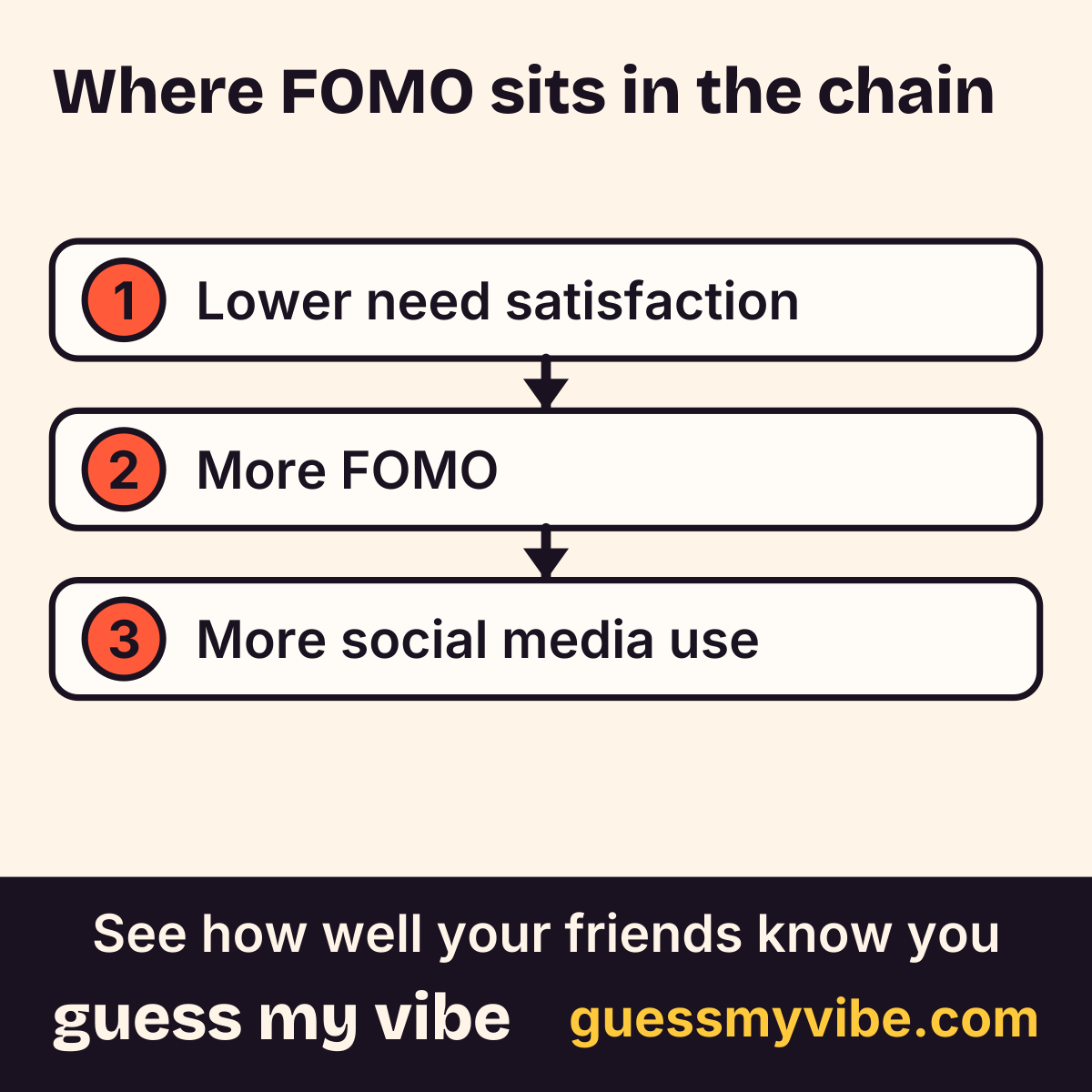
The 2013 study also tested how FOMO relates to actual social media behavior, and found FOMO sits in the middle of the chain, not off to the side of it. Lower need satisfaction, lower mood, and lower life satisfaction each went with more social media engagement on their own, but once FOMO was added to the statistical model, those direct links mostly disappeared: FOMO itself was the thing most strongly and consistently tied to more social media use [1]. In a separate sample of first-year university students, higher FOMO also went with more Facebook use during lectures and more phone-checking while driving [1]. The pattern across both studies points the same direction: FOMO looks less like a side effect of using social media and more like the specific feeling that drives reaching for the phone in the first place.
That same student sample also showed something worth knowing if FOMO feels confusing from the inside: higher FOMO went with feeling both more positive and more negative emotion while using Facebook, not simply more bad feelings. In plain terms, FOMO isn't just unpleasant; it's genuinely mixed, pulling someone toward something that feels rewarding in the moment and uncomfortable at the same time, which helps explain why it's a hard habit to simply will yourself out of with willpower alone [1].
Cite this figure
Figure: "Where FOMO sits in the chain." Guess My Vibe (guessmyvibe.com). https://guessmyvibe.com/learn/fomo#figure-fomo-in-the-middle
Why this matters beyond just checking your phone less
Treating FOMO as mainly a social-media problem misses what the research actually points to underneath it: an unmet need for real connection. The same large body of research linking strong social relationships to better health outcomes [4] suggests that the fix FOMO is quietly asking for isn't less time on a feed by itself, it's more of the actual connection the feed is only a thin substitute for. That's a genuinely different, and more useful, target than just "use your phone less."
Spend a few real minutes with a friend instead of the feed
If FOMO is really about a gap in connection rather than a gap in information, closing that gap with one real friend does more than another scroll through everyone else's highlight reel. Guess My Vibe is built for exactly that: a friend guesses your honest answers to real personality questions, you compare notes, and you spend a few genuine minutes actually being known by someone, instead of watching what everyone else is up to.
Key takeaways
- FOMO was formally defined and first measured by a 2013 study as "a pervasive apprehension that others might be having rewarding experiences from which one is absent" [1].
- In a nationally representative British sample of 2,079 adults, FOMO went down with age and was slightly higher in men, an effect found mainly in younger respondents [1].
- Lower satisfaction of basic psychological needs (feeling capable, free to be yourself, and connected to others) independently went with higher FOMO, which in turn went with more social media engagement [1].
- A study of 495 18-to-30-year-olds found personality traits like Conscientiousness and Extraversion were more strongly linked to overall well-being than FOMO was, so FOMO looks less like a fixed personality trait and more like its own separate factor [2].
- This isn't therapy, a diagnosis, or a substitute for professional care.
Questions people ask
What does FOMO actually mean?
FOMO (fear of missing out) is defined by the research that coined the term as a pervasive apprehension that other people might be having rewarding experiences you're not part of, along with a pull to stay constantly aware of what others are doing [1].
Is FOMO linked to a specific personality type?
Only modestly. A study of 495 18-to-30-year-olds found personality traits were more strongly linked to overall well-being than FOMO was, which points to FOMO being its own separate factor rather than just a stand-in for personality [2].
Who experiences the most FOMO?
In a nationally representative British sample, FOMO was higher in younger people, and slightly higher in younger men specifically; the gender difference disappeared among older respondents [1].
Does social media cause FOMO, or does FOMO cause social media use?
The research points to FOMO driving social media use more than the reverse: once FOMO was accounted for, the direct links from need satisfaction, mood and life satisfaction to social media engagement mostly disappeared, with FOMO itself carrying most of that connection [1].
Is FOMO a mental health condition?
No. FOMO is a researched psychological construct linked to unmet needs and lower well-being, not a diagnosis. This isn't therapy, a diagnosis, or a substitute for professional care.
See how well your friends know you.
Free. Answer 10 quick questions about you, then send your link. Friends play in their browser, no app needed.
Start freeReferences
- [1] Przybylski, A. K., Murayama, K., DeHaan, C. R., & Gladwell, V. (2013). Motivational, emotional, and behavioral correlates of fear of missing out. Computers in Human Behavior, 29(4), 1841-1848. doi.org/10.1016/j.chb.2013.02.014 (opens in a new tab)
- [2] Stead, H., & Bibby, P. A. (2017). Personality, fear of missing out and problematic internet use and their relationship to subjective well-being. Computers in Human Behavior, 76, 534-540. doi.org/10.1016/j.chb.2017.08.016 (opens in a new tab)
- [3] Barreto, M., Victor, C., Hammond, C., Eccles, A., Richins, M. T., & Qualter, P. (2021). Loneliness around the world: Age, gender, and cultural differences in loneliness. Personality and Individual Differences, 169, 110066. PubMed: 33536694 (opens in a new tab)
- [4] Holt-Lunstad, J., Smith, T. B., & Layton, J. B. (2010). Social relationships and mortality risk: A meta-analytic review. PLoS Medicine, 7(7), e1000316. PubMed: 20668659 (opens in a new tab)
How we find and check these sources: how we write. Spotted an error? Report a correction.
Related
Cite this article
- Title
- FOMO: What Research Says About Fear of Missing Out
- Publisher
- Guess My Vibe
- Updated
- URL
- https://guessmyvibe.com/
learn/ fomo
Copy this citation
Guess My Vibe. (2026, October 3). FOMO: What Research Says About Fear of Missing Out. Guess My Vibe. https://guessmyvibe.com/
To point at one section, add that section's anchor (the # link on its heading) to the URL.