A sense of belonging is the feeling of being part of ongoing, stable relationships where you matter to other people. Psychologists Baumeister and Leary argued that the need for this is powerful, fundamental and extremely pervasive, and that what it takes is frequent, nonaversive interactions within an ongoing relational bond, not just contact [1].
A sense of belonging is the feeling that you are part of something and that people in it would notice and care if you weren't there. In 1995, Baumeister and Leary published a long review arguing that humans have a need for exactly this. They evaluated the hypothesis against the empirical literature and concluded that the need to belong is a powerful, fundamental and extremely pervasive motivation [1]. This article explains what they meant, what the evidence behind the idea looks like, and where it's thinner than the confident phrase "basic human need" might suggest.
What the need to belong theory actually says
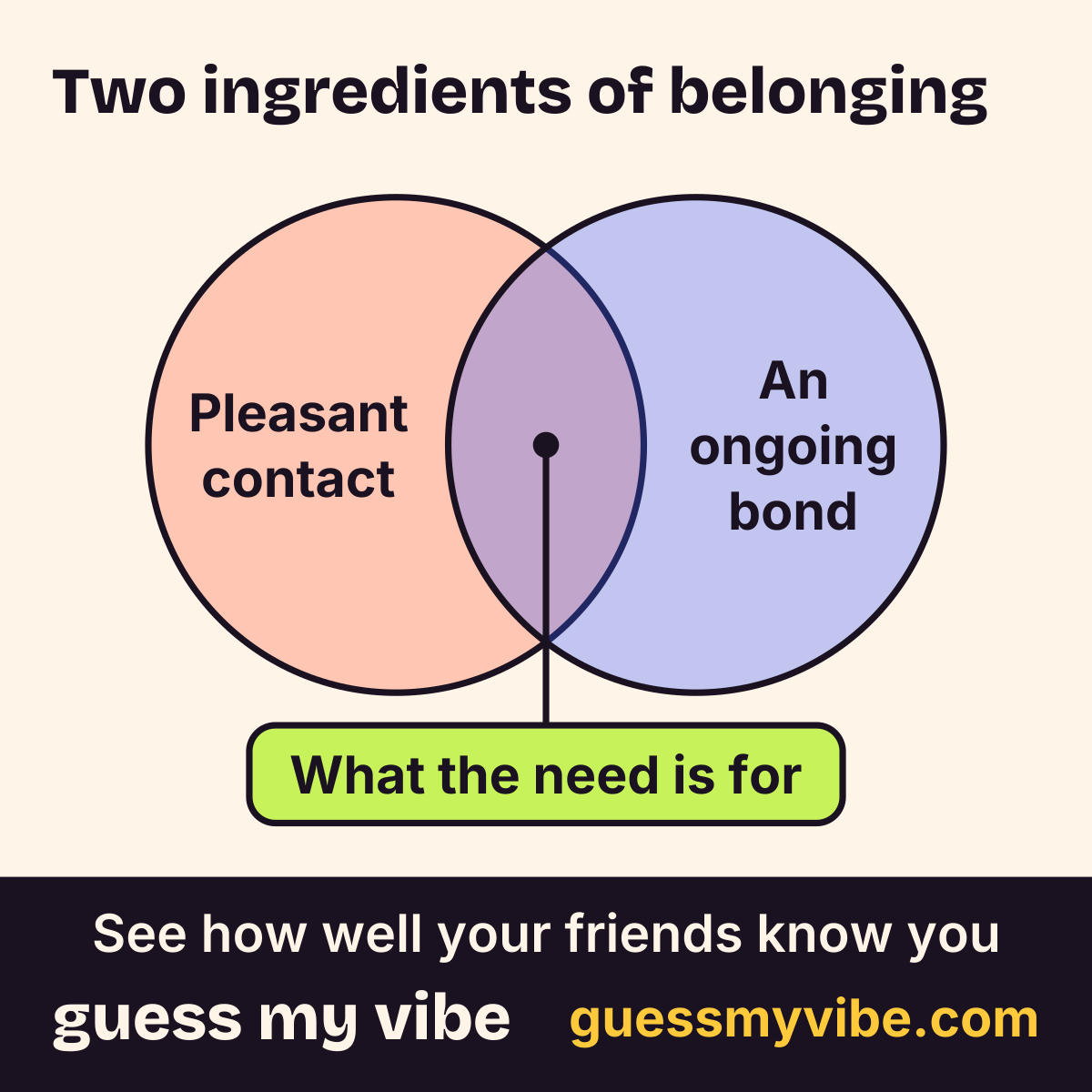
The core claim is more specific than "people like company." Baumeister and Leary proposed a need to form and maintain strong, stable interpersonal relationships. The need is for frequent, nonaversive interactions within an ongoing relational bond [1]. Two ingredients are in that sentence. One is frequent, pleasant contact. The other is an ongoing bond, meaning the relationship has a future. A hundred friendly one-off encounters don't fully fit the description, and neither does a single close relationship you see twice a year.
Their evidence came from many directions. According to the review, people form social attachments readily under most conditions and resist the ending of existing bonds. Belongingness appears to have multiple and strong effects on emotional patterns and on cognitive processes, and a lack of attachments is linked to a variety of ill effects on health, adjustment and well-being [1]. The authors also examined evidence on satiation, substitution and behavioral consequences and found it consistent with the hypothesis, and concluded that several apparent counterexamples did not disconfirm it [1].
A fair-minded note on what kind of paper this is. It is a review, an argument assembled from existing research, and not a single experiment. It dates from 1995. It also frames belonging as a hypothesis that the evidence supports, so it is best read as a well-known theory with a lot of evidence behind it and not as a law. We haven't tested here how well the theory holds up in every culture or against newer research, and this article doesn't claim to.
Cite this figure
Figure: "Two ingredients of belonging." Guess My Vibe (guessmyvibe.com). https://guessmyvibe.com/learn/sense-of-belonging#figure-two-ingredients
What happens when belonging is threatened
If belonging is a basic need, then threatening it should have expected effects, and experiments can test that. A meta-analysis by Gerber and Wheeler combined 88 experimental studies of rejection. The findings fit a needs account, which holds that rejection frustrates basic psychological needs, and did not fit a numbness account, which holds that rejection causes physical and emotional numbness [2]. Rejection moderately lowered mood (an effect size of d = -0.50) and self-esteem (d = -0.70), but did not decrease arousal or flatten affect [2].
Most relevant to this topic, the analysis found that both belonging (d = 0.69) and control (d = 1.16) were frustrated by rejection [2]. By common rules of thumb, those are medium-to-large effects. The authors' reading is that rejection makes people feel bad and ready to act to restore control or belonging [2]. In ordinary words, being shut out stings, and it tends to push people toward fixing the situation, not toward feeling nothing. If you want more on what that looks like with friends, our article on feeling left out by friends goes through it.
It helps to translate those numbers. A d of 0.5 means the average rejected person scored about half a standard deviation lower on mood than the average person who was not rejected, a moderate gap rather than a collapse. The same analysis says rejection did not flatten affect or lower arousal [2], so the experiments describe people who feel worse and stay switched on, not people who go numb. These were experiments, often brief and often in a lab, so they speak to the immediate sting of exclusion more than to long stretches of life.
Curious how your friends would answer?
Free. Answer 10 quick questions about you, then send your link. Friends play in their browser, no app needed.
Start freeBelonging in small, daily moments
Belonging isn't only a grand feeling about your whole life. In a study of students' days, people reported greater happiness and greater feelings of belonging on days when they interacted with more classmates than usual [4]. Follow-up studies that counted all daily interactions found that weak ties, meaning acquaintances, were related to social and emotional well-being as well [4]. This is an association within people's days, so it can't show which way the influence runs, but it fits an everyday picture in which belonging is built from lots of small moments, not only from a few deep bonds.
Belonging in a new place: one small trial
A well-known experiment looked at belonging during the college transition. In a randomized controlled trial with 92 first-year students, Walton and Cohen tested a brief intervention that aimed to lessen perceptions of threat on campus by framing social adversity as common and transient [3]. It was expected to help African American students most, and it did: over three years, it raised African Americans' grade point average relative to control groups and halved the minority achievement gap [3]. The authors found that the effect was mediated by how students construed adversity, in that it prevented them from seeing adversity on campus as an indictment of their belonging [3]. The intervention also improved African Americans' self-reported health and well-being and reduced their reported doctor visits three years later [3].
Two cautions. First, this was one trial with 92 students, 49 of them African American, so it is a promising result and not a settled one. Second, the reported effects were for African American students, and the authors expected the intervention to matter less for European American students [3]. What the study does suggest is an idea that is easy to relate to: early bumps in a new place, like not hearing back or sitting alone at a meal, are common, and reading them as proof you don't belong is a separate step from the bump itself.
Belonging and being known
The need-to-belong theory is about ongoing bonds, and bonds are made of people who know each other. That is our own link and not a finding from the papers above, but it is a reasonable one: it's hard to feel you belong with people who don't really know you. Our article on fitting in versus belonging explores that line of research in depth. The short version is that a bond where you can be yourself tends to feel different from one where you are managing an impression.
What this doesn't mean
- It doesn't mean you need a big friend group. The theory is about stable, ongoing bonds, and nothing in it sets a number of friends.
- It doesn't mean something is wrong with you if you don't feel you belong somewhere right now. Rejection frustrating belonging is the average finding across experiments [2], not a sign of personal failure.
- It doesn't mean one exercise fixes belonging. The college study was one trial with a specific group [3].
- It isn't a diagnosis or a score. Belonging is a feeling you can notice, not a number you can fail.
If a lack of belonging has been weighing on you for a while, that is worth talking about with a friend, family member, counselor or doctor. This isn't therapy, a diagnosis, or a substitute for professional care.
Small ways to build belonging with people you already know
Since the theory points to frequent, pleasant contact in an ongoing bond [1], the most direct move is often small: another conversation with someone who matters to you. Guess My Vibe is one low-key way to have it. A friend guesses how you'd answer real personality questions, and you compare, which tends to surface things you each didn't know. It's a game and not a measure of belonging, but it's a few minutes of attention on a relationship that already exists.
Key takeaways
- The "need to belong" is a hypothesis that Baumeister and Leary evaluated against the research literature in 1995; their conclusion was that the evidence supports it as a powerful and extremely pervasive motivation [1].
- The need they describe isn't just for company: it is for frequent, nonaversive interactions within an ongoing relational bond [1].
- A meta-analysis of 88 experimental studies found that rejection moderately lowered mood and self-esteem and frustrated feelings of belonging [2].
- In one small randomized trial with first-year college students, a brief exercise that framed social adversity as common and temporary was linked to better grades and well-being for African American students over three years [3].
- This isn't therapy, a diagnosis, or a substitute for professional care; feeling that you don't fully belong somewhere is a common human experience and not a flaw.
Questions people ask
What is a sense of belonging?
It's the feeling of being part of ongoing, stable relationships where you matter to other people. Baumeister and Leary described the underlying need as one for frequent, nonaversive interactions within an ongoing relational bond [1].
Is belonging a basic human need?
Baumeister and Leary reviewed the literature in 1995 and concluded that the need to belong is a powerful, fundamental and extremely pervasive motivation [1]. It's a major theory with substantial evidence behind it, though it is a review and not a single experiment.
What happens when your sense of belonging is threatened?
In a meta-analysis of 88 experimental studies, rejection moderately lowered mood and self-esteem and frustrated feelings of belonging and control [2].
Is belonging the same as fitting in?
Not exactly. Baumeister and Leary describe the need to belong as a need for ongoing bonds [1], which is a different thing from matching a group. Our article on fitting in versus belonging covers the difference. This isn't therapy, a diagnosis, or a substitute for professional care.
Can you build a sense of belonging?
Research is limited. In one small trial, a brief exercise that framed early social adversity at college as common and temporary was linked to better outcomes for African American students over three years [3]. It was a single trial of 92 students, so treat it as promising and not proven.
See how well your friends know you.
Free. Answer 10 quick questions about you, then send your link. Friends play in their browser, no app needed.
Start freeReferences
- [1] Baumeister, R. F., & Leary, M. R. (1995). The need to belong: desire for interpersonal attachments as a fundamental human motivation. Psychological Bulletin, 117(3), 497–529. PubMed: 7777651 (opens in a new tab)
- [2] Gerber, J., & Wheeler, L. (2009). On being rejected: A meta-analysis of experimental research on rejection. Perspectives on Psychological Science, 4(5), 468-488. PubMed: 26162220 (opens in a new tab)
- [3] Walton, G. M., & Cohen, G. L. (2011). A brief social-belonging intervention improves academic and health outcomes of minority students. Science, 331(6023), 1447-1451. PubMed: 21415354 (opens in a new tab)
- [4] Sandstrom, G. M., & Dunn, E. W. (2014). Social Interactions and Well-Being: The Surprising Power of Weak Ties. Personality and Social Psychology Bulletin, 40(7), 910–922. PubMed: 24769739 (opens in a new tab)
How we find and check these sources: how we write. Spotted an error? Report a correction.
Related
Cite this article
- Title
- Sense of Belonging: The Need to Belong, Explained
- Publisher
- Guess My Vibe
- Updated
- URL
- https://guessmyvibe.com/
learn/ sense-of-belonging
Copy this citation
Guess My Vibe. (2026, October 4). Sense of Belonging: The Need to Belong, Explained. Guess My Vibe. https://guessmyvibe.com/
To point at one section, add that section's anchor (the # link on its heading) to the URL.