In everyday talk, fitting in means adjusting yourself to be accepted, and belonging means being accepted as you are. That split is a popular framing, not a researched one. The research that does exist points the same way: the need to belong is described as a need for frequent, nonaversive interactions within an ongoing relational bond [1], and in studies of choosing partners, wanting to be seen the way you see yourself sat alongside wanting to be seen favorably [2].
Fitting in vs belonging is a distinction you see in books, captions and group chats. Fitting in means reading a room and adjusting yourself so the room accepts you. Belonging means being accepted as the person you already are. It is a useful way to name a real feeling, but it is a popular framing, not a result from psychology, so it helps to see what the research does and does not back up. The research that comes closest describes belonging as a need for ongoing relational bonds [1], and finds that wanting to be seen the way you see yourself sits alongside wanting to be seen favorably [2]. Neither finding is a verdict on any particular friendship, but both are useful to hold next to the slogan.
Fitting in vs belonging: what is the difference?
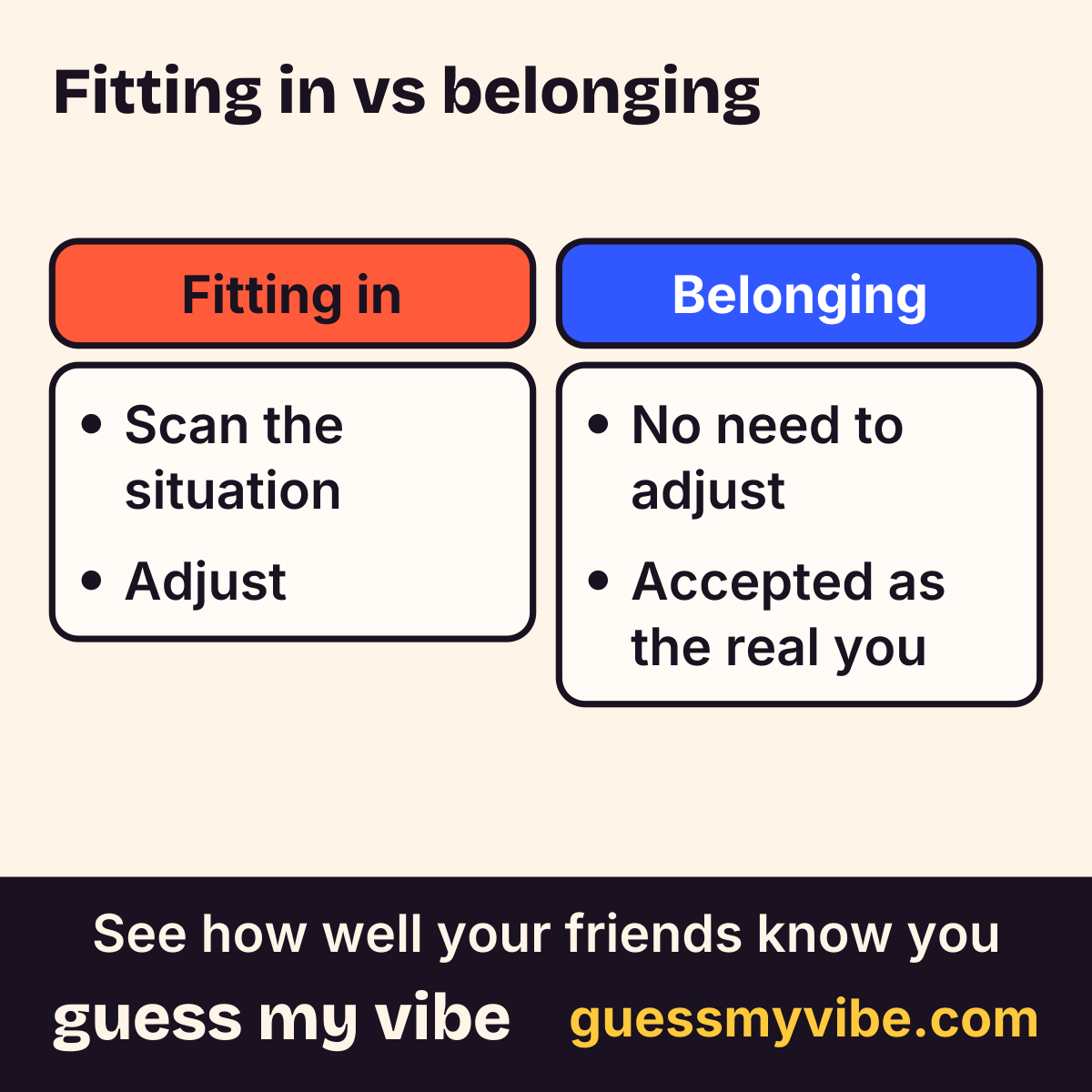
The popular version goes like this. When you are fitting in, you scan the situation, work out what is expected and adjust, so you can be part of it. When you belong, you do not have to adjust, because the group already accepts the real you. There is truth in the contrast. The same person can feel very different in two rooms, tense and watchful in one and relaxed in the other.
The tidy version has limits, though. Adjusting yourself to a setting is also a normal part of being social, and it is not always a sign that something is wrong. Most people talk differently to a boss, a grandparent and a best friend. A more useful question is whether there is anywhere you do not have to adapt much, and whether the people there know the real version of you. That is where the research is more helpful than the slogan.
Cite this figure
Figure: "Fitting in vs belonging." Guess My Vibe (guessmyvibe.com). https://guessmyvibe.com/learn/fitting-in-vs-belonging#figure-fitting-in-vs-belonging
What the research says belonging actually is
A well-known review of the evidence defined the need to belong as a need to form and maintain strong, stable interpersonal relationships. The need is for frequent, nonaversive interactions within an ongoing relational bond. People form attachments readily under most conditions and resist ending existing ones, and lack of attachments is linked to ill effects on health, adjustment and well-being [1].
Two words matter in that definition: ongoing and bond. Standing near a group at a party, or being included in a chat nobody replies to, fits the "interaction" part but not the "bond" part. This is our reading of the definition, not a test the review ran. But it suggests that fitting in with a crowd can feel good without meeting the need, while a few steady, warm relationships can meet it even when you are not at the center of any big group. It is a 1995 review, so it describes the state of the evidence then, and it is not an effect size.
Being known: what self-verification adds
A separate line of research asks what people want from the people close to them. Self-verification theory says people want others to see them the way they see themselves, because it makes the world feel predictable. The competing idea is that people just want to be seen favorably. In two studies in which people chose interaction partners, positivity strivings and self-verification both pulled people with positive self-views toward partners who rated them well. For people with negative self-views, wanting to be seen consistently with how they saw themselves best explained their choices [2].
That last result is easy to misread, so to be clear, it does not say people should seek out criticism, and nothing here suggests that. It says the pull to be understood is strong enough that it shows up even when the picture is not flattering. A related set of three studies found that people prefer feedback about their positive self-views, but that the same people seek unfavorable feedback about their negative self-views, so the pattern depends on the self-view in question, not on the type of person [4].
Put next to the slogan, this gives a more precise version. Belonging probably involves acceptance by people who have an accurate picture of you, on top of acceptance itself. Being liked for a version of you that is not quite right is the "fitting in" feeling in research terms, and being known and still welcome is the "belonging" feeling. That is an interpretation, but it follows what the studies measured.
Curious how your friends would answer?
Free. Answer 10 quick questions about you, then send your link. Friends play in their browser, no app needed.
Start freeDoes being known matter more as relationships deepen?
One survey of 176 married and dating couples suggests it might. Married people were most intimate with spouses whose evaluations verified their self-views. Dating people were most intimate with partners who evaluated them favorably. The authors read this as a shift from wanting positive evaluations early on to wanting self-verifying evaluations once a relationship is established [3].
Treat that with care. It is a survey of couples, not friends, and it was one study, so we cannot say the same happens in friendships. It does fit a plausible story that early closeness leans on being liked and long-term closeness leans on being understood. If that holds for friends, it would explain why a friendship can feel warm but a little thin until someone sees the less polished parts of you.
Authenticity and fit: why some rooms feel easier
Researchers who study authenticity use the term state authenticity for the sense of being in alignment with your true or real self in the moment [5]. One framework built on that idea argues that people seek out situations that fit, and that fit comes in three kinds: fit with your self-concept, fit with your goals and social fit with the people around. When those line up, the authors argue, it is easier to think, to stay motivated and to interact, which promotes authenticity [6].
The same framework makes a point worth keeping in mind if you ever feel like you do not fit somewhere. It argues that contexts subtly signal which social identities belong, eliciting a sense of authenticity for advantaged groups and a sense of inauthenticity for disadvantaged ones [6]. This is a conceptual paper that proposes and argues, not one that tests each piece. But it offers a kinder view of the feeling, because sometimes not fitting says something about the room.
How to fit in without losing yourself
None of these studies tested a plan for fitting in, so the ideas below are reasonable applications, not proven methods.
- Adapt on the surface, stay steady underneath. Tone, topics and energy can flex with the room. What you value does not need to.
- Let people see a small true thing early. One honest opinion or one odd interest gives people something accurate to like, which is the self-verification point.
- Look for ongoing contact, not just big events. The review's definition stresses frequent interaction within a continuing bond [1], so a weekly coffee can do more than a huge party.
- Notice where you feel like yourself. State authenticity is the sense of being in line with your real self [5], so the rooms where you feel that are worth spending more time in.
- Give a new group time. Fit often builds slowly, and the first few weeks are a weak basis for deciding you do not belong.
If the feeling of not fitting anywhere is heavy or does not lift, that is worth talking through with someone you trust or a professional. This article cannot tell you what is behind it.
Find out whether your friends know the real you
Being known is the part of belonging you can check. In Guess My Vibe, you and a friend each answer questions about yourselves and guess how the other answered, and the reveal shows where your picture of each other matched and where it missed. It is a light way to see how well the people close to you know the version of you that you would pick.
Key takeaways
- "Fitting in versus belonging" is a popular framing, not a research construct, but several real lines of research bear on it.
- A major review concluded the need to belong is a need for frequent, nonaversive interactions within an ongoing relational bond [1].
- In studies of how people choose partners, wanting to be seen the way you see yourself (self-verification) sat alongside wanting to be seen favorably, so both matter [2].
- In one survey of couples, married people were closest to spouses who saw them as they saw themselves, while dating people were closest to partners who rated them favorably, and that was a couples sample, not friends [3].
- This isn't therapy, a diagnosis, or a substitute for professional care.
Questions people ask
What is the difference between fitting in and belonging?
In popular use, fitting in means changing yourself to be accepted and belonging means being accepted as you are. That is not a research distinction, but the research on belonging describes it as a need for ongoing, stable relationships with frequent, nonaversive interactions [1], which our reading takes to be more than membership in a group.
Why do I feel like I do not fit in?
There are many possible reasons, and no article can tell you yours. One framework argues that fit depends partly on the environment, and that contexts can signal who belongs and so affect how authentic people feel [6]. So the feeling can reflect the room as well as you.
Do people want to be seen as they really are?
Often, yes, alongside wanting to be seen favorably. In studies of how people chose partners, both self-verification and positivity strivings mattered [2]. In a couples survey, married people were closest to spouses who verified their self-views, while dating people were closest to partners who rated them favorably [3].
What is state authenticity?
It is the sense that you are currently in alignment with your true or real self [5]. It is a momentary feeling that can vary by situation, which is why you can feel more like yourself in some rooms than in others.
Is it bad to change yourself to fit in?
Not by itself. Adapting to different settings is a normal part of being social. The more useful question is whether you have at least some relationships where people know the real you and stay, which is what the research on belonging and self-verification points toward [1] [2].
See how well your friends know you.
Free. Answer 10 quick questions about you, then send your link. Friends play in their browser, no app needed.
Start freeReferences
- [1] Baumeister, R. F., & Leary, M. R. (1995). The need to belong: desire for interpersonal attachments as a fundamental human motivation. Psychological Bulletin, 117(3), 497–529. PubMed: 7777651 (opens in a new tab)
- [2] Swann, W. B., Jr., Stein-Seroussi, A., & Giesler, R. B. (1992). Why people self-verify. Journal of Personality and Social Psychology, 62(3), 392–401. PubMed: 1560335 (opens in a new tab)
- [3] Swann, W. B., Jr., De La Ronde, C., & Hixon, J. G. (1994). Authenticity and positivity strivings in marriage and courtship. Journal of Personality and Social Psychology, 66(5), 857–869. doi.org/10.1037/0022-3514.66.5.857 (opens in a new tab)
- [4] Swann, W. B., Jr., Pelham, B. W., & Krull, D. S. (1989). Agreeable fancy or disagreeable truth? Reconciling self-enhancement and self-verification. Journal of Personality and Social Psychology, 57(5), 782–791. PubMed: 2810025 (opens in a new tab)
- [5] Sedikides, C., Slabu, L., Lenton, A., & Thomaes, S. (2017). State authenticity. Current Directions in Psychological Science, 26(6), 521–525. doi.org/10.1177/0963721417713296 (opens in a new tab)
- [6] Schmader, T., & Sedikides, C. (2018). State authenticity as fit to environment: The implications of social identity for fit, authenticity, and self-segregation. Personality and Social Psychology Review, 22(3), 228–259. PubMed: 28975851 (opens in a new tab)
How we find and check these sources: how we write. Spotted an error? Report a correction.
Related
Cite this article
- Title
- Fitting In vs Belonging: Being Liked for Who You Are
- Publisher
- Guess My Vibe
- Updated
- URL
- https://guessmyvibe.com/
learn/ fitting-in-vs-belonging
Copy this citation
Guess My Vibe. (2026, October 4). Fitting In vs Belonging: Being Liked for Who You Are. Guess My Vibe. https://guessmyvibe.com/
To point at one section, add that section's anchor (the # link on its heading) to the URL.