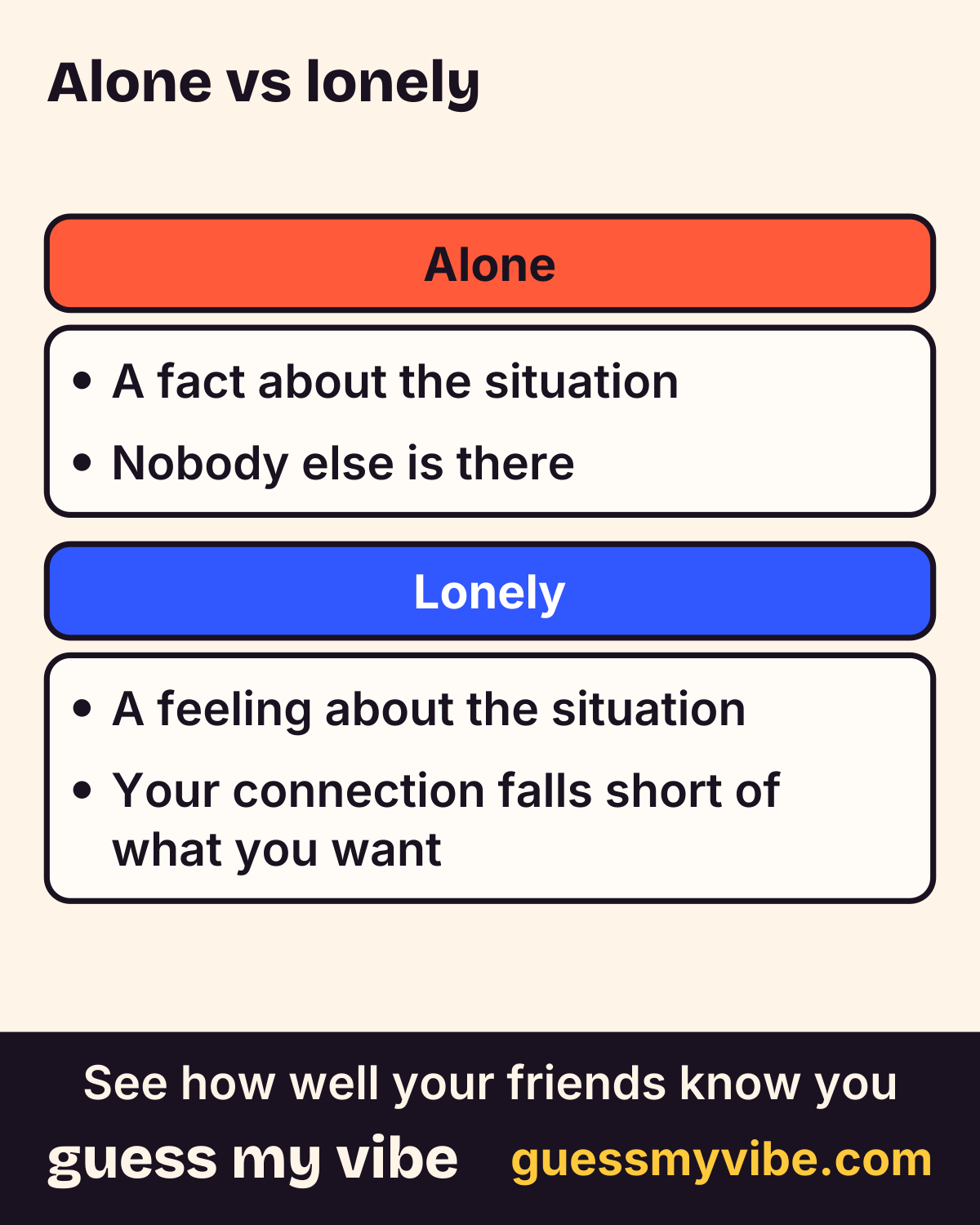
Being alone is a fact about who's around; feeling lonely is a painful sense that your connection falls short of what you want. The two overlap but aren't the same: loneliness is a subjective perception that doesn't line up perfectly with someone's actual social circumstances [1], and in one set of studies, time alone could lead to relaxation and less stress when people chose it [2].
Alone vs lonely is a distinction worth getting right, because the words get used as if they meant the same thing. Being alone is a fact: nobody else is there. Feeling lonely is an experience: a sense that the connection you have falls short of the connection you want. You can be alone and content, and you can be in a crowd and lonely. Researchers back this up. Loneliness is a subjective perception that does not correspond perfectly with a person's objective social circumstances [1], and in one set of studies, time alone could lead to relaxation and less stress when people chose it [2].
Alone and lonely are different things
A simple way to hold the difference: "alone" describes the situation, and "lonely" describes how you feel about it. Loneliness is usually described as a gap between the connection you want and the connection you have, though that is a common shorthand and not a test with a cutoff. Because it depends on what you want, two people in the same empty apartment on the same Saturday can feel completely different. One is recharging. The other is missing someone.
The data fit this. A study of older U.S. adults, using two national surveys, framed loneliness as a subjective perception that doesn't line up perfectly with objective circumstances [1]. The same study did find that loneliness was associated with living alone or without a spouse or partner, with fewer close family and friends, and with poor health [1]. So the link between being alone and feeling lonely is real in that group. It is just not a one-to-one match. And since the sample was older adults, it can't tell us how this plays out for people in their late teens or twenties.
Cite this figure
Figure: "Alone vs lonely." Guess My Vibe (guessmyvibe.com). https://guessmyvibe.com/learn/alone-vs-lonely#figure-alone-vs-lonely
What solitude research finds
For a long time, psychologists studied being alone mostly through its downside. Long and Averill, in a 2003 review, noted that psychologists had focused on the negative experiences of being alone, particularly loneliness, even though solitude, in contrast to loneliness, is often a positive state that may be sought rather than avoided [4]. Their paper is a conceptual review, not an experiment. It examines benefits that have been attributed to solitude, namely freedom, creativity, intimacy and spirituality, and it also discusses potential dangers related to the attractiveness of solitude [4]. Treat those benefits as ideas the authors lay out and discuss, not as measured findings.
Experiments have followed. Nguyen, Ryan and Deci ran four studies on what being alone does to feelings. Across them, solitude generally had a deactivation effect, lowering both positive and negative high-arousal feelings. In Study 1 this showed up when people were alone but not when they were with another person, and Study 2 found it didn't depend on whether people were doing something like reading while alone [2]. In plain terms, being alone tended to turn the volume down on both excitement and agitation.
The part that matters most for the alone-versus-lonely question is choice. When participants engaged in positive thinking or actively chose what to think about, high-arousal positive feeling did not drop. And in Study 4, solitude could lead to relaxation and reduced stress when individuals actively chose to be alone [2]. The authors' summary is that solitude has different effects depending on factors that moderate it [2]. Choosing time alone seems to be part of what makes it restful.
Curious how your friends would answer?
Free. Answer 10 quick questions about you, then send your link. Friends play in their browser, no app needed.
Start freeChoice and the everyday picture: a 21-day diary study
Lab studies are one thing, and real days are another. In a registered-report diary study, 178 participants reconstructed their daily events for 21 days, which let the researchers count hours of solitude with less reliance on memory [3]. The findings were mixed in an informative way.
On days when people spent more hours alone, they were lonelier and less satisfied. But those detrimental links were nullified or reduced when the day's solitude was autonomous, meaning chosen, and they did not accumulate across days. People who were generally alone more were not, on the whole, lonelier [3]. On days with more time alone, people also felt less stress and more autonomy satisfaction, meaning they felt freer, more authentic and less pressured, and those benefits did accumulate: people who spent more time alone across the study were less stressed and more autonomy satisfied overall [3].
The authors found no evidence for a one-size-fits-all optimal balance between solitude and social time, and concluded that solitude time risks lowering well-being on some metrics but may hold key advantages for other aspects of well-being [3]. That is a useful corrective to both slogans. "Alone time is always healthy" and "alone time is always bad" both go beyond the evidence.
Two terms in that study are worth unpacking. A registered report means the plan for the study was reviewed and accepted before the data were collected, which makes it harder to bend the analysis afterward. And autonomy satisfaction means feeling that your time is your own. In plain words, the diary found that time alone can leave a person both a bit lonelier and a bit freer on the same day, which is why a single verdict on solitude is hard to give.
What about introverts?
A common claim is that introverts benefit most from solitude. It makes intuitive sense, and our social battery article looks at what is known about it. But none of the studies cited here tested solitude separately for introverts and extraverts, so we can't say from this research that introverts get more out of time alone. What these studies do show is that choice seems to matter for how time alone feels, and that is true to whoever is choosing it.
When being alone stops feeling like a choice
Here is a reasonable rule of thumb, which is our own reading of the research and not a clinical test: pay attention to whether the time alone feels chosen or imposed, and whether you come out of it restored or emptier. Solitude that feels like a break tends to look different from solitude that feels like being left out. If it is the second kind, that is a common human experience, not a flaw. Our article on feeling left out by friends covers what happens when exclusion is part of it.
There is also a twist: our forecasts about solitude can be wrong. In experiments with commuters, people told to connect with a stranger reported a more positive commute than those told to stay disconnected, while other participants expected the opposite [5]. That doesn't mean company is always better, and it is a single context, trains and buses. It does suggest that a quick "I'd rather be alone" can occasionally be a guess about how we'll feel and not a certainty.
None of this is a diagnosis or a way to measure anyone's feelings. If being alone has begun to feel painful and not restful, and it has lasted a while, talking with a friend, family member, counselor or doctor is a reasonable step. This isn't therapy, a diagnosis, or a substitute for professional care.
Knowing what you actually want from company
Part of telling solitude from loneliness is knowing what kind of company you want and how much. Friends often have a better read on that than we expect. Guess My Vibe has a friend guess how you'd answer real personality questions, and then you compare. It can open up an easy conversation about how much time with people feels right to each of you. It's a game, not a measure of loneliness.
Key takeaways
- Loneliness is a subjective perception that does not correspond perfectly with objective social circumstances, which is why being alone and feeling lonely can come apart [1].
- In four studies, being alone generally lowered high-arousal feelings, both positive and negative, and in the fourth study, solitude could lead to relaxation and reduced stress when people actively chose to be alone [2].
- In a 21-day diary study of 178 people, days with more hours alone went with more loneliness and less satisfaction, but those links were nullified or reduced when the solitude was chosen [3].
- The same diary study found no one-size-fits-all balance of solitude and social time [3], so how much time alone is right is personal.
- This isn't therapy, a diagnosis, or a substitute for professional care; if being alone has started to feel painful and not restful, talking with someone you trust or a professional is a reasonable step.
Questions people ask
What is the difference between alone and lonely?
Alone describes the situation (no one else is there); lonely describes a feeling that your connection falls short of what you want. Loneliness is a subjective perception that does not correspond perfectly with objective social circumstances [1].
Can you be alone and not lonely?
Yes. In four studies, being alone generally lowered high-arousal feelings, and in the fourth, solitude could lead to relaxation and reduced stress when people actively chose it [2]. In a 21-day diary study, the links between time alone and loneliness were nullified or reduced when the solitude was chosen [3].
Can you be lonely in a crowd?
Because loneliness is a perception and not a headcount, it can happen around other people [1]. This article doesn't cite a study that tested crowds directly, so treat that as the logical consequence of how loneliness is defined, not a measured result.
Is spending a lot of time alone bad for you?
The evidence is mixed. On days with more hours alone, people in a diary study were lonelier and less satisfied, but also less stressed and more autonomous, and the downsides shrank when solitude was chosen [3]. Nothing in these studies sets a healthy number of hours. This isn't therapy, a diagnosis, or a substitute for professional care.
See how well your friends know you.
Free. Answer 10 quick questions about you, then send your link. Friends play in their browser, no app needed.
Start freeReferences
- [1] Hawkley, L. C., Wroblewski, K., Kaiser, T., Luhmann, M., & Schumm, L. P. (2019). Are U.S. older adults getting lonelier? Age, period, and cohort differences. Psychology and Aging, 34(8), 1144-1157. PubMed: 31804118 (opens in a new tab)
- [2] Nguyen, T. T., Ryan, R. M., & Deci, E. L. (2018). Solitude as an approach to affective self-regulation. Personality and Social Psychology Bulletin, 44(1), 92-106. PubMed: 29072531 (opens in a new tab)
- [3] Weinstein, N., Vuorre, M., Adams, M., & Nguyen, T. V. (2023). Balance between solitude and socializing: everyday solitude time both benefits and harms well-being. Scientific Reports, 13, 21160. PubMed: 38052821 (opens in a new tab)
- [4] Long, C. R., & Averill, J. R. (2003). Solitude: An exploration of benefits of being alone. Journal for the Theory of Social Behaviour, 33(1), 21-44. doi.org/10.1111/1468-5914.00204 (opens in a new tab)
- [5] Epley, N., & Schroeder, J. (2014). Mistakenly seeking solitude. Journal of Experimental Psychology: General, 143(5), 1980–1999. PubMed: 25019381 (opens in a new tab)
How we find and check these sources: how we write. Spotted an error? Report a correction.
Related
- Loneliness: What It Is and Who Feels It Most
- Social Battery: The Science of Why Socializing Drains You
- Introvert vs Extrovert: What the Research Actually Shows
- Social Connection: Why It Matters for Wellbeing
- Feeling Left Out by Friends: What's Actually Happening
- Loneliness Epidemic: What the Data Actually Shows
Cite this article
- Title
- Alone vs Lonely: Why Solitude Isn't the Same Thing
- Publisher
- Guess My Vibe
- Updated
- URL
- https://guessmyvibe.com/
learn/ alone-vs-lonely
Copy this citation
Guess My Vibe. (2026, October 4). Alone vs Lonely: Why Solitude Isn't the Same Thing. Guess My Vibe. https://guessmyvibe.com/
To point at one section, add that section's anchor (the # link on its heading) to the URL.