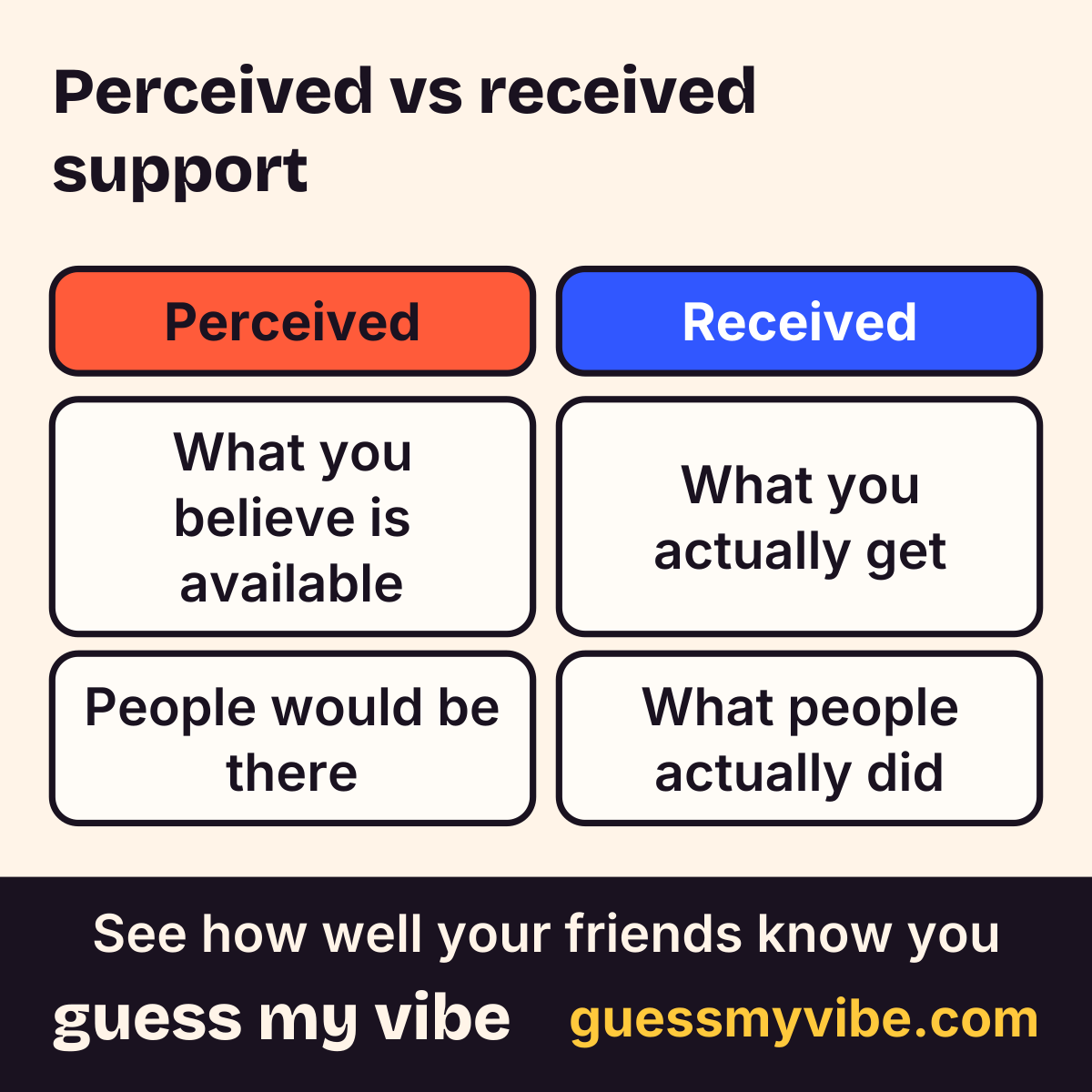
Social support is the help, comfort and care you get from people around you, and researchers separate the support you believe is available (perceived) from the support you actually get (received) [1]. In lab experiments, support that stayed invisible to the person receiving it lowered their emotional reactions to a stressful task more than support they noticed [2].
Social support is the help, comfort and care that you get from the people in your life, such as friends, family and partners. Researchers often split it in two: perceived support, meaning how much you believe people would be there for you, and received support, meaning what people actually did for you [1]. The surprising part of this research is that more visible help is not automatically better. In lab experiments, support that the recipient didn't register as support reduced emotional reactions to stress more than support they noticed [2]. This article explains what that means, with the limits of each study stated along the way.
Perceived and received social support
Imagine two friends. One has people who, they feel sure, would show up if something went wrong. The other had a stack of people actually helping last week. Those aren't the same thing, and Uchino argues in a 2009 theoretical review that they shouldn't be treated as the same thing. The paper says social support has been reliably related to physical health outcomes, but that the conceptual basis of those links needs more development, and it calls for distinguishing measures of perceived and received support [1].
It's worth being clear about what that paper is. It's a review that makes an argument, and its abstract has no numbers and doesn't say which kind of support matters more. All we can take from it is that the author argues for treating the two as separate ideas, and not much beyond that. A related finding shows why the difference is useful. An earlier paper noted that the perceived availability of support is well documented as a buffer against the effects of stressors on mental health, while research on actual receipt of support had failed to show an association with adjustment [3]. That puzzle is what led to the idea of invisible support.
Cite this figure
Figure: "Perceived vs received support." Guess My Vibe (guessmyvibe.com). https://guessmyvibe.com/learn/social-support#figure-perceived-vs-received
Invisible support: the idea and the evidence
Bolger, Zuckerman and Kessler proposed a possible explanation for the puzzle: that awareness of receiving support entails an emotional cost, and that the most effective support might be unnoticed by the person getting it [3]. They tested it with a daily diary study of support in couples. Many of the support transactions that supporters reported were not reported by recipients, and these invisible support transactions promoted adjustment to a major stressor [3]. That is a study of couples, so we can't assume the same pattern among friends, and it shows association within diary reports, not a controlled test.
It helps to picture what "invisible" can look like, though this is our own illustration and not an example from the paper. A friend who quietly takes care of a small task, or who changes the subject to something lighter at the right moment, may never be thought of by the other person as having "supported" them at all. Whether that kind of help is invisible because the recipient didn't notice it, or because it was done in a way that didn't feel like help, is not something the abstracts we read separate.
A controlled test came later. Bolger and Amarel ran three experiments with 257 female participants who expected to give a stressful speech. A confederate peer provided support in a way that was either visible or invisible [2]. Invisible support, practical and emotional, reduced emotional reactivity relative to visible support and to no support. Visible support was either ineffective or exacerbated reactivity [2].
Why would help backfire? The authors' explanatory analyses found that support was effective when it avoided communicating a sense of inefficacy to recipients [2]. In plain terms, help that quietly says "I'm sure you can't handle this" may not land well, while help that doesn't carry that message can. That is the authors' reading of their data, and there are limits to it: the participants were all women, the support came from a confederate acting as a peer, and the stress was a short, lab-based speech task. Real friendships are longer and messier.
Curious how your friends would answer?
Free. Answer 10 quick questions about you, then send your link. Friends play in their browser, no app needed.
Start freeEmotional support: what it is and what we know
Emotional support is the caring, listening and reassurance side of support, as opposed to practical help like doing a task or giving a ride. (Researchers also often count advice as its own kind, informational support.) The Bolger and Amarel experiments tested both practical and emotional support, and found that the invisible versions of both reduced emotional reactivity [2]. So the visible-versus-invisible difference wasn't only about one type of help.
A short review by Reblin and Uchino summarizes recent research linking social and emotional support to physical health. Recent findings often show a robust relationship in which social and emotional support from others can be protective for health [4]. The same review is cautious, though. It says the next generation of studies must explain why the relationship exists and how specific the links are, and that the long-term effects of interventions based on support on physical health remain to be determined [4]. So the honest statement is that support and health are linked in many studies, the reasons are still being worked out, and nothing here promises that any particular person's health will change.
What this might suggest for how friends help each other
None of the studies above tested advice for friends, so what follows is our own cautious reading and not a research finding. One idea is that how help is offered may matter alongside whether it's offered. In the experiments, support worked when it didn't signal that the person couldn't cope [2]. For a friend, that might mean help that is low-key and doesn't make a big show of itself. Another is that people may not always notice the help they get, which, if the couples study is any guide, doesn't mean it isn't helping [3].
- Perceived and received support are different, so counting how many people helped you last week isn't the same as knowing who you could call [1].
- Visible help isn't always better help, at least for the short, stressful lab task in one set of experiments [2].
- Noticing support is a separate step from getting it. Supporters and recipients don't always agree on what happened [3].
- Support and health are linked in many studies, and the reasons are still being investigated [4].
What this doesn't mean
It doesn't mean you should hide help from friends or never say you care. The experiments tested a specific moment: a stressful speech, with a confederate peer giving support. It doesn't mean asking for support is a problem, and it doesn't rank perceived above received support, since the review we cite argues for telling them apart and, in its abstract, doesn't choose a winner [1]. And it isn't advice about what anyone should do in a hard time. If you're going through something heavy, a friend, family member, counselor or doctor is a reasonable person to talk to. This isn't therapy, a diagnosis, or a substitute for professional care.
Knowing who's in your support system
Because perceived support is about who you feel you could count on, it can be worth noticing who those people are and how well they know you. Guess My Vibe is a small, light way to do that: a friend guesses how you'd answer real personality questions, and you see how well they know you. It's a game, not a measure of your support system, but it can start a good conversation with someone who matters to you.
Key takeaways
- Researchers distinguish perceived support (what you believe is available) from received support (what you actually get), and one review argues for measuring the two separately, as part of a life-span view that looks at distinct antecedent processes and links to more specific diseases [1].
- In three experiments with 257 women facing a stressful speech task, invisible support, both practical and emotional, reduced emotional reactivity compared with visible support or none, and visible support was either ineffective or made reactions worse [2].
- In the authors' explanatory analyses, support was effective when it avoided communicating a sense of inefficacy to the person getting it [2].
- A daily diary study of couples found many support acts that supporters reported were not reported by recipients, and these invisible acts promoted adjustment to a major stressor [3].
- This isn't therapy, a diagnosis, or a substitute for professional care; if you're going through something hard, talking with someone you trust or a professional is a reasonable step.
Questions people ask
What is social support?
It's the help, comfort and care you get from people around you. Researchers distinguish perceived support (what you believe is available) from received support (what you actually get) [1].
What is invisible support?
Support that the person receiving it doesn't register as support. In a daily diary study of couples, many support acts reported by supporters weren't reported by recipients, and these invisible acts promoted adjustment to a major stressor [3]. In experiments with 257 women, invisible support reduced emotional reactivity to a stressful speech task [2].
What counts as emotional support?
Generally it means caring, listening and reassurance, as opposed to practical help like running an errand. The Bolger and Amarel experiments tested both practical and emotional support, and the invisible versions of both reduced emotional reactivity [2].
Is social support good for your health?
A review found recent studies often show a robust relationship in which social and emotional support can be protective for health, but the authors say the reasons still need to be explained and long-term intervention effects remain to be determined [4]. This isn't therapy, a diagnosis, or a substitute for professional care.
Is perceived or received support more important?
The sources here don't say. A review argues for measuring the two separately, with attention to distinct antecedent processes and links to more specific diseases [1], and earlier work found perceived availability of support buffers stress effects while actual receipt had failed to show an association [3].
See how well your friends know you.
Free. Answer 10 quick questions about you, then send your link. Friends play in their browser, no app needed.
Start freeReferences
- [1] Uchino, B. N. (2009). Understanding the links between social support and physical health: A life-span perspective with emphasis on the separability of perceived and received support. Perspectives on Psychological Science, 4(3), 236-255. PubMed: 26158961 (opens in a new tab)
- [2] Bolger, N., & Amarel, D. (2007). Effects of social support visibility on adjustment to stress: experimental evidence. Journal of Personality and Social Psychology, 92(3), 458-475. PubMed: 17352603 (opens in a new tab)
- [3] Bolger, N., Zuckerman, A., & Kessler, R. C. (2000). Invisible support and adjustment to stress. Journal of Personality and Social Psychology, 79(6), 953-961. PubMed: 11138764 (opens in a new tab)
- [4] Reblin, M., & Uchino, B. N. (2008). Social and emotional support and its implication for health. Current Opinion in Psychiatry, 21(2), 201-205. PubMed: 18332671 (opens in a new tab)
How we find and check these sources: how we write. Spotted an error? Report a correction.
Related
- Loneliness: What It Is and Who Feels It Most
- Social Connection: Why It Matters for Wellbeing
- How to Be a Good Friend, According to Research
- Signs of a True Friend, According to Research
- Active Listening: What Research Says It Actually Does
- Trauma Dumping on Friends: What Co-Rumination Research Says
- How to Ask a Friend for Help: Easier Than You Think
Cite this article
- Title
- Social Support: What Helps and Why It's Often Invisible
- Publisher
- Guess My Vibe
- Updated
- URL
- https://guessmyvibe.com/
learn/ social-support
Copy this citation
Guess My Vibe. (2026, October 4). Social Support: What Helps and Why It's Often Invisible. Guess My Vibe. https://guessmyvibe.com/
To point at one section, add that section's anchor (the # link on its heading) to the URL.