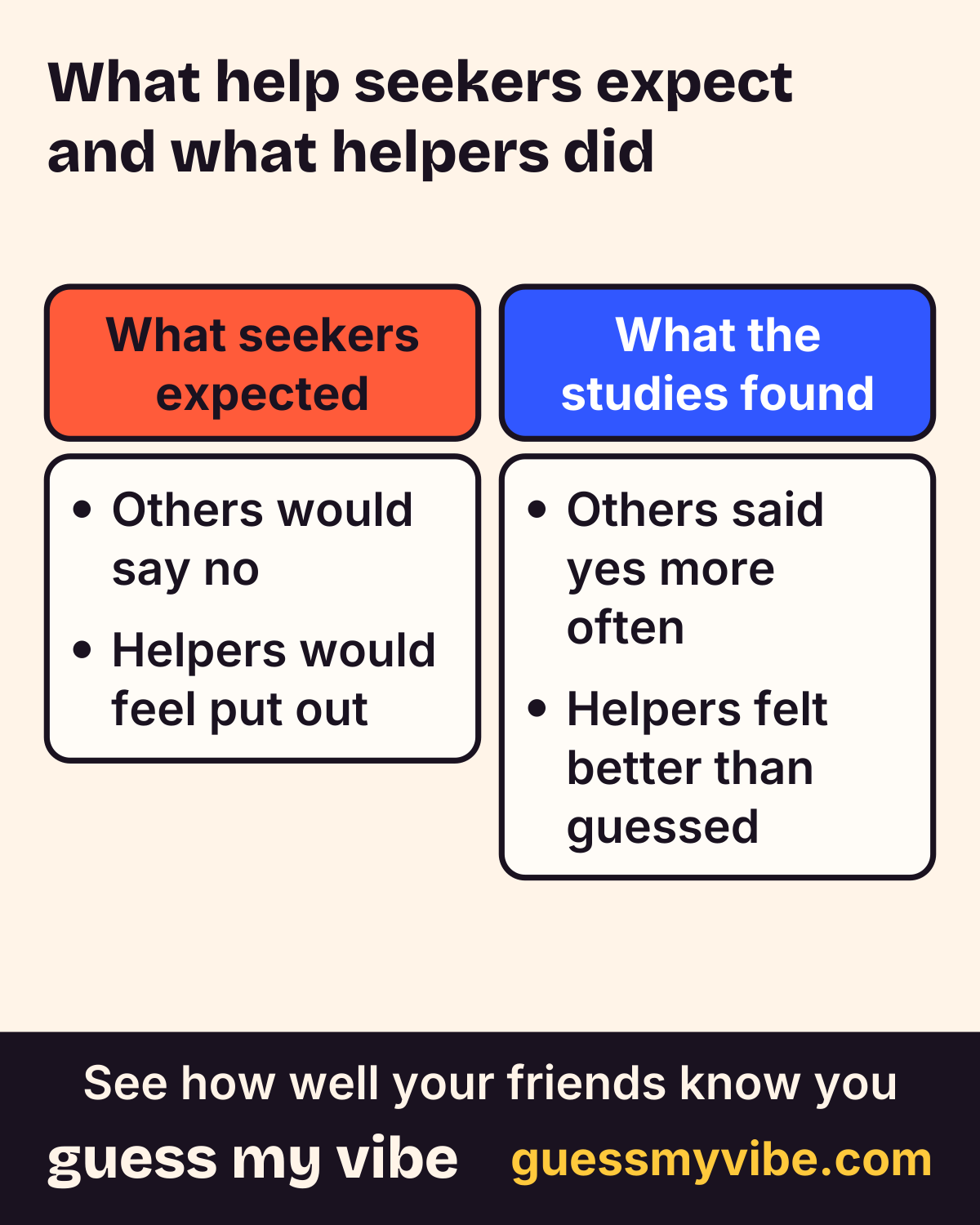
Ask directly and be specific, because people who need help consistently expect a no more often than they get one. In a series of studies, people underestimated by as much as 50% the likelihood that others would agree to a direct request for help [1], and in a later set of studies with US adults (total N = 2,118), they also underestimated how good the helper would feel afterward [2].
If you find it hard to ask a friend for help, you are probably doing the math wrong in a predictable way. The research on how to ask a friend for help starts from a simple finding: people who need a favor expect to be turned down much more often than they actually are, and expect the helper to be more put out than the helper actually feels. That gap is the barrier. This article covers what the studies found, what they didn't test, and a simple way to ask.
A caution about scope. The requests in these studies were direct asks, studied in experiments, field settings, scenarios and recalled experiences, and the abstracts describe no test of very large favors such as money or months of someone's time. So the findings are a good reason to ask more often for ordinary things, and a weaker guide for very big requests.
We expect no far more often than we get it
A series of studies tested whether people underestimate the chance that others will say yes to a direct request. In the first three studies, across experimental and natural field settings, people underestimated by as much as 50% the likelihood that others would agree. Studies four and five showed that experimentally manipulating whether people took the perspective of the help seeker or the potential helper could produce the underestimate. The final study explored why. Help seekers were less willing than potential helpers to appreciate the social cost of refusing, the cost of saying no, and attended instead to the cost of saying yes [1].
That last point is the useful one. When you ask, you picture the friend weighing the effort. What you miss is how uncomfortable it is to say no to someone's face. For many people, agreeing may be the easier path, though the studies didn't measure that directly.
Helpers feel better than you expect
A later set of studies, using scenarios, recalled experiences and live interactions among US adults (total N = 2,118), added a second piece. People needing help consistently underestimated others' willingness to help, underestimated how positively helpers would feel, and overestimated how inconvenienced helpers would feel. The authors traced this to underestimating helpers' prosocial motivation while overestimating compliance motivation, the sense that people only help because they feel obliged. They suggest this undervaluing of kindness could create a misplaced barrier to asking for help when it is needed [2].
The practical point is that asking can be a gift as well as a favor. A friend who helps often feels good about it, and the research suggests you are probably guessing too low on that. It doesn't mean every helper is thrilled every time. It means the default guess, that you are an imposition, is skewed.
Cite this figure
Figure: "What help seekers expect and what helpers did." Guess My Vibe (guessmyvibe.com). https://guessmyvibe.com/learn/how-to-ask-a-friend-for-help#figure-expect-vs-reality
Curious how your friends would answer?
Free. Answer 10 quick questions about you, then send your link. Friends play in their browser, no app needed.
Start freeWhy your own asking looks worse to you than to them
Seven studies looked at a related gap. Showing vulnerability, such as confessing feelings, revealing imperfections or asking for help, can feel risky, so many people decide against it. The researchers found that people evaluate showing vulnerability less positively when they imagine doing it themselves than when they imagine someone else doing it. They explain this with construal level: when you are the one in the vulnerable spot, the situation is concrete and the negatives loom, while when you picture someone else you see it more abstractly and notice the positives. The effect appeared in different situations, including asking for help, and in a real-life situation too [3].
A simple way to use that: before you decide not to ask, picture a friend asking you the same thing in the same way. How would you feel? Many people would feel trusted and glad to be asked, and that is the view the research suggests you may be missing about your own request.
Friends may be an easier audience than strangers
Another set of experiments, this one on deeper conversations, found that strangers systematically underestimated how much their partners would care about their disclosures and overestimated how awkward a deep conversation would be. The expectations were better calibrated with close friends, family or partners, whose care and interest were more clearly known [4].
That study was about conversation, not favors, and its participants were mostly strangers. But it fits the pattern: when you know someone cares, your guesses about how they will react get more accurate. That is a reason to ask friends for help before asking acquaintances, not after.
How to ask a friend for help
The studies tell you whether to ask, not how to word it. The suggestions below are our own reading of the findings, so treat them as options, not a tested script.
- Ask directly. The research is about direct requests, so skip the hints. A clear question like could you give me a ride to the airport on Friday is easy to say yes to.
- Be specific about what, and when. A vague ask makes the friend do the planning. A specific one lets them decide quickly.
- Give an easy out. Saying no problem if you can't is kind, and it may help because refusing is the uncomfortable part. It also tells your friend you will not be hurt.
- Ask in person or on a call for bigger things. The studies include live interactions, and a voice makes it harder to ignore and easier to read.
- Say thank you, and tell them what it meant. Helpers who feel good are a feature of the findings, so let them hear the result: it really helped.
- Offer to help back when you can. This is common sense, not a finding of these studies, and it keeps a friendship balanced over time.
- Start small if you are nervous. Asking for something modest builds the habit, and the evidence suggests asks go better than people expect.
When this doesn't apply
The research makes asking easier, not obligatory, and some situations are bigger than it covers. If you need serious help, with your safety, your health or your mental health, please reach out to the right professional or service as well as to friends. A friend can be a good first call, but they are not a substitute. And if a particular friend has said no to reasonable requests many times, it is fine to adjust your expectations of that friend. The studies describe averages, not guarantees.
How Guess My Vibe fits in
A guessing game is a small way to ask a friend for a few minutes of their attention, which makes it good practice for asking them for more. Send your link, see how it goes, and notice how often the answer is yes.
Key takeaways
- People needing help underestimated by as much as 50% the likelihood that others would say yes to a direct request, because help seekers focused on the cost of helping and underweighted how awkward it is to refuse [1].
- In studies with US adults (N = 2,118), people needing help underestimated helpers' willingness, underestimated how positively helpers would feel, and overestimated how inconvenienced they would be [2].
- Across seven studies, people evaluated showing vulnerability, including asking for help, more positively when someone else did it than when they did it themselves [3].
- Strangers underestimated how much their partner would care about their disclosures, and expectations were more accurate with close friends, family and partners, a hint that friends may be an easier audience than you fear [4].
- This isn't therapy, a diagnosis, or a substitute for professional care.
Questions people ask
Why is it so hard to ask friends for help?
Partly because we misjudge how it will go. People needing help underestimated by as much as 50% how likely others were to agree [1], and underestimated how good helpers would feel [2]. The fear is real, but it is calibrated too pessimistically on average.
Do people like being asked for help?
Often more than we expect. In studies with US adults, helpers felt more positive and less inconvenienced than help seekers guessed [2]. That doesn't mean every request is welcome, but the typical guess is too low.
How likely is a friend to say yes to a request?
More likely than you probably think. The studies did not give a single rate for friends, but they showed that people underestimate agreement to direct requests, in some studies by as much as 50% [1]. The studies tested direct requests, so direct is the safest way to ask.
Does asking for help make you look weak?
The research suggests you judge it more harshly in yourself than others would. People evaluated showing vulnerability, including asking for help, more positively when someone else did it than when they did it themselves [3].
What if my friend says no?
Then you have the answer, and a polite, easy out in your request makes it easier on both of you. One no isn't a verdict on the friendship; the research describes how often people say yes, not that they always do.
See how well your friends know you.
Free. Answer 10 quick questions about you, then send your link. Friends play in their browser, no app needed.
Start freeReferences
- [1] Flynn, F. J., & Lake, V. K. B. (2008). If you need help, just ask: Underestimating compliance with direct requests for help. Journal of Personality and Social Psychology, 95(1), 128-143. PubMed: 18605856 (opens in a new tab)
- [2] Zhao, X., & Epley, N. (2022). Surprisingly happy to have helped: Underestimating prosociality creates a misplaced barrier to asking for help. Psychological Science, 33(10), 1708-1731. PubMed: 36067802 (opens in a new tab)
- [3] Bruk, A., Scholl, S. G., & Bless, H. (2018). Beautiful mess effect: Self-other differences in evaluation of showing vulnerability. Journal of Personality and Social Psychology, 115(2), 192–205. PubMed: 30024240 (opens in a new tab)
- [4] Kardas, M., Kumar, A., & Epley, N. (2022). Overly shallow? Miscalibrated expectations create a barrier to deeper conversation. Journal of Personality and Social Psychology, 122(3), 367–398. PubMed: 34591541 (opens in a new tab)
How we find and check these sources: how we write. Spotted an error? Report a correction.
Related
Want to try it with your own friends? Make a friendship quiz to play with your friends
Cite this article
- Title
- How to Ask a Friend for Help: Easier Than You Think
- Publisher
- Guess My Vibe
- Updated
- URL
- https://guessmyvibe.com/
learn/ how-to-ask-a-friend-for-help
Copy this citation
Guess My Vibe. (2026, October 7). How to Ask a Friend for Help: Easier Than You Think. Guess My Vibe. https://guessmyvibe.com/
To point at one section, add that section's anchor (the # link on its heading) to the URL.