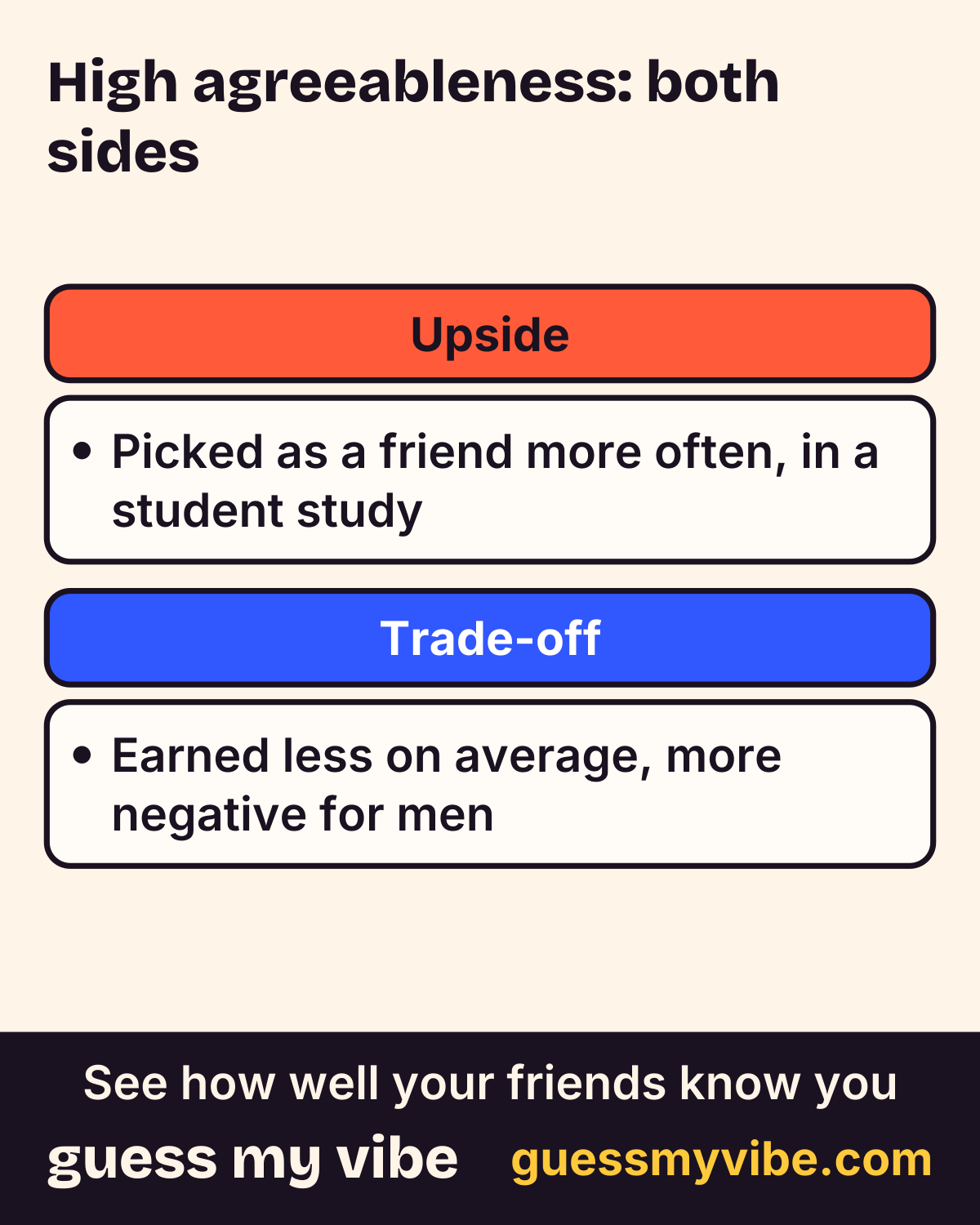
"People pleaser" is an everyday label, not a scientific category, but the closest studied trait is high agreeableness (the app calls it Warmth): being cooperative, trusting and quick to help. Research finds real upsides, such as being picked as a friend more often [1], and real trade-offs, such as lower average income in a set of four studies [2]. It's a trait pattern with costs and benefits, not a flaw.
What a people pleaser looks like in research terms
A people pleaser, in everyday use, is someone who goes along, says yes, smooths things over and puts other people's comfort first, often at their own expense. Psychologists don't study "people pleaser" as a category, and none of the papers below measured it directly. What they did study is a close cousin: agreeableness, the Big Five trait that captures how cooperative, trusting and good-natured someone tends to be with others. Agreeableness is a dimension, not a type. Everyone sits somewhere on it, and a high score describes a tendency, not a script.
That matters for the label. Someone high in agreeableness might say yes a lot because they enjoy helping, because they dislike friction, or because the situation really does call for it. Research can tell us what the trait goes with on average. It can't tell any one person why they do what they do, and it certainly can't tell them they should change. If you want the trait explained from scratch, our agreeableness article covers the definition and how it differs from simply being nice.
What high agreeableness gets right
Start with the upside, because it's large and often skipped in "how to stop being a people pleaser" advice. In a study of 205 late adolescents tracked across their first year at university, researchers asked who ended up friends with whom. Students high in agreeableness were selected as friends more often than others, and people also tended to pick friends who were similar to them in agreeableness [1]. In plain words, warmth is a trait other people reward with closeness. That fits a wider pattern: a research program with several studies and samples ranging from 87 to 622 people linked prosocial motivation to agreeableness, to empathy-related feelings, and to helping across many situations and kinds of victims [5].
So the thing people worry about, caring a lot about others, is also one of the more reliably valued things about a friend. It's worth keeping that in view before looking at costs. Most of what follows is a trade-off, and trade-offs have two sides.
How agreeable people handle conflict
Conflict is where "pleasing" shows up most. In one study, 263 participants rated how good eleven different conflict tactics were across five kinds of relationships. Everyone, high or low in agreeableness, rated negotiation and walking away as better choices than power assertion (forcing your way). But low-agreeable participants rated power assertion as a better choice than high-agreeable participants did [3]. A second study in the same paper videotaped 124 people resolving two problems with an assigned partner, and agreeableness differences, sex and partner type were all linked to the conflict patterns observers coded [3].
A separate set of studies of adolescents, using both hypothetical conflicts and two weeks of diary entries about real ones, found that among the Big Five, agreeableness was most closely associated with what happened during interpersonal conflict, and that destructive conflict tactics were linked to how knowledgeable raters judged a person's adjustment [4]. Notice what that does and doesn't say. The first study above suggests agreeable people are less drawn to forceful tactics, not that they never disagree. Our conflict styles article goes deeper on the tactics, and avoiding conflict looks at the common case where staying quiet is the whole strategy.
Do nice guys (and gals) really finish last?
Here is the finding behind the "too nice" worry. Judge, Livingston and Hurst proposed that more agreeable people would earn less than less agreeable people, that women would earn less than men, and that the agreeableness-income link would be more negative for men. Their reasoning was about gender roles: an agreeable man goes against what many people expect of men, and a disagreeable man goes along with it. Across four studies, those expectations held [2]. Study 1 confirmed the separate effects of sex and agreeableness on income, with a more negative agreeableness-income relationship for men than for women. Study 2 replicated the result while controlling for the other four Big Five traits, so it wasn't simply about being outgoing or hardworking. A fourth, experimental study gave evidence that the joint effect reflects backlash against agreeable men [2].
A few honest cautions. The abstract reports no effect sizes, so "earns less" should be read as an average tendency, not a big or guaranteed gap. Most of the evidence is correlational, so it can't prove that being agreeable itself lowers pay; the experimental study speaks to one proposed reason, backlash, rather than settling every explanation. And the authors framed income as a result partly shaped by how other people respond, not just by what agreeable people do. In other words, the finding is as much about how workplaces react to warmth as about warmth itself.
Cite this figure
Figure: "High agreeableness: both sides." Guess My Vibe (guessmyvibe.com). https://guessmyvibe.com/learn/people-pleaser#figure-agreeableness-trade-offs
Curious how your friends would answer?
Free. Answer 10 quick questions about you, then send your link. Friends play in their browser, no app needed.
Start freeThe assertiveness trade-off, in both directions
A different line of research shows why "just be more assertive" isn't the simple fix it sounds like. Ames and Flynn studied perceptions of leaders and found that people seen as markedly low in assertiveness, and people seen as high in it, were generally judged less effective than people in the middle. They tied this to a trade-off: high assertiveness worsens relationships, while low assertiveness limits goal achievement [6]. That study is about leaders, not agreeableness directly, so treat it as an analogy rather than a verdict on warm people. But it captures the shape of the problem well. Neither end of the dial is free. Turning it up buys results and costs relationships, and turning it down does the reverse.
Seen this way, the question stops being "how do I stop being too nice" and becomes "where on the dial do I want to be in this situation." A person who is warm by default can still be direct when it counts, the same way a person who is blunt by default can learn to soften things. Research on traits describes where people tend to start, not where they have to end up. If you're curious about the other end of the dial, our low agreeableness article covers what it actually means and what it's good for.
The situation matters as much as the trait
One more finding keeps this from becoming a personality verdict. In the helping research, the link between prosocial motivation and helping held across a range of situations, but cost mattered: when helping was expensive, trying to induce empathy could actually undermine helping in people low in prosocial motivation [5]. The general lesson is that traits and situations interact. The same person may say yes freely to a friend who needs a ride and say no more easily to a request that costs them a lot, because the situation changes what the trait does.
It's also worth noting how hard this trait is to see from outside. Your closest friends often read agreeableness less well than they read traits like how outgoing you are, which our agreeableness article covers. So if you think of yourself as a pleaser, your friends might not experience you that way, and they might not notice what you give up to keep things smooth. The label lives mostly in your own head, which is a good reason to check it against what the people around you actually see. A blunt "you can tell me no" can do more for a friendship than a hundred silent yeses.
What this research can't tell you
A few limits are worth stating plainly. First, none of these studies measured "people pleasing" as people use the term, so everything here is about agreeableness, a related but broader trait. Second, the income finding comes from a specific set of studies and says nothing about how any one person will do at work. Third, the conflict studies include adolescents and strangers matched up in a lab, which doesn't map neatly onto adult friendships. Finally, traits are only part of the picture: culture, workplace, family and friends all shape what saying yes costs and rewards. If saying yes is causing you real distress, a licensed professional is the right person to talk to, not a personality article.
What the research does support is a more generous way to think about warmth. High agreeableness is a trait with real social rewards and some real costs, and both ends of the dial have trade-offs. Guess My Vibe turns that into something you can test: friends guess how you'd answer personality questions, including the ones about Warmth, and you see how well they know you, and where their guess and your own answer differ. It's a low-pressure way to find out whether the "people pleaser" you picture is the one your friends see.
Key takeaways
- "People pleaser" isn't a research term; the closest measured trait is high agreeableness, which describes a tendency to cooperate, trust and help, not a rule about how anyone behaves.
- In a study that followed 205 new university students, more agreeable students were picked as friends more often, so the trait has a real social payoff [1].
- Across four studies, more agreeable people earned less on average, and the link was more negative for men than for women; the experimental study pointed to backlash against agreeable men [2].
- In studies of conflict, high-agreeable people rated forceful tactics as worse choices than low-agreeable people did, and Agreeableness was the Big Five trait most tied to how conflict went [3] [4].
- This isn't therapy, a diagnosis, or a substitute for professional care; it's a plain-English summary of personality research on one trait.
Questions people ask
Is being a people pleaser a personality trait?
"People pleaser" is an everyday label rather than a research category. The closest studied trait is agreeableness, a Big Five dimension describing how cooperative, trusting and good-natured someone tends to be. Everyone has a level of it, and a high level describes a tendency, not a fixed script.
Do nice people really earn less money?
On average, in four studies, more agreeable people earned less than less agreeable people, and the link was more negative for men than for women. The abstract reports no effect sizes, most of the evidence is correlational, and the experimental study pointed to backlash against agreeable men as one explanation [2].
How do agreeable people act in conflict?
In one study, high-agreeable people rated forceful tactics as worse choices than low-agreeable people did, though everyone rated negotiation and walking away as better than forcing the issue [3]. Among the Big Five, agreeableness was also the trait most tied to how conflict went in adolescent diary and hypothetical-conflict data [4].
Is high agreeableness good or bad?
Neither. New university students who were more agreeable were picked as friends more often [1], and agreeableness is linked to helping behavior [5]. It also goes with some costs, such as lower average income in one set of studies [2]. It is a trade-off, not a flaw.
Can you be assertive and warm at the same time?
Traits describe where people tend to start, not where they must end up. Research on leaders suggests extreme assertiveness and very low assertiveness each carry costs, one for relationships and one for reaching goals, which means the middle is not a compromise so much as a skill [6].
See how well your friends know you.
Free. Answer 10 quick questions about you, then send your link. Friends play in their browser, no app needed.
Start freeReferences
- [1] Selfhout, M., Burk, W., Branje, S., Denissen, J., van Aken, M., & Meeus, W. (2010). Emerging late adolescent friendship networks and Big Five personality traits: A social network approach. Journal of Personality, 78(2), 509–538. PubMed: 20433629 (opens in a new tab)
- [2] Judge, T. A., Livingston, B. A., & Hurst, C. (2012). Do nice guys--and gals--really finish last? The joint effects of sex and agreeableness on income. Journal of Personality and Social Psychology, 102(2), 390-407. PubMed: 22121889 (opens in a new tab)
- [3] Graziano, W. G., Jensen-Campbell, L. A., & Hair, E. C. (1996). Perceiving interpersonal conflict and reacting to it: The case for agreeableness. Journal of Personality and Social Psychology, 70(4), 820–835. PubMed: 8636901 (opens in a new tab)
- [4] Jensen-Campbell, L. A., & Graziano, W. G. (2001). Agreeableness as a moderator of interpersonal conflict. Journal of Personality, 69(2), 323–361. PubMed: 11339802 (opens in a new tab)
- [5] Graziano, W. G., Habashi, M. M., Sheese, B. E., & Tobin, R. M. (2007). Agreeableness, empathy, and helping: A person × situation perspective. Journal of Personality and Social Psychology, 93(4), 583–599. PubMed: 17892333 (opens in a new tab)
- [6] Ames, D. R., & Flynn, F. J. (2007). What breaks a leader: the curvilinear relation between assertiveness and leadership. Journal of Personality and Social Psychology, 92(2), 307-324. PubMed: 17279851 (opens in a new tab)
How we find and check these sources: how we write. Spotted an error? Report a correction.
Related
- Agreeableness: The Trait Closeness Barely Helps Friends Read
- What Makes Someone a Warm Person?
- Conflict Styles: How Personality Shapes How You Fight
- Avoiding Conflict: When It Helps and When It Backfires
- Honesty in Friendship: Why It Hurts Less Than You Think
- Low Agreeableness: What It Means (and Doesn't)
- Assertive Communication: What the Research Says
Cite this article
- Title
- People Pleaser: The Agreeableness Research Behind It
- Publisher
- Guess My Vibe
- Updated
- URL
- https://guessmyvibe.com/
learn/ people-pleaser
Copy this citation
Guess My Vibe. (2026, October 4). People Pleaser: The Agreeableness Research Behind It. Guess My Vibe. https://guessmyvibe.com/
To point at one section, add that section's anchor (the # link on its heading) to the URL.