Low agreeableness is the low end of a Big Five trait (the app calls it Warmth). It describes someone who tends to be more skeptical, direct and competitive and less driven to keep everyone comfortable, which is different from being cruel. Research finds real upsides, such as higher average income in four studies [1], and real costs, such as being picked as a friend less often [2].
What low agreeableness means in plain words
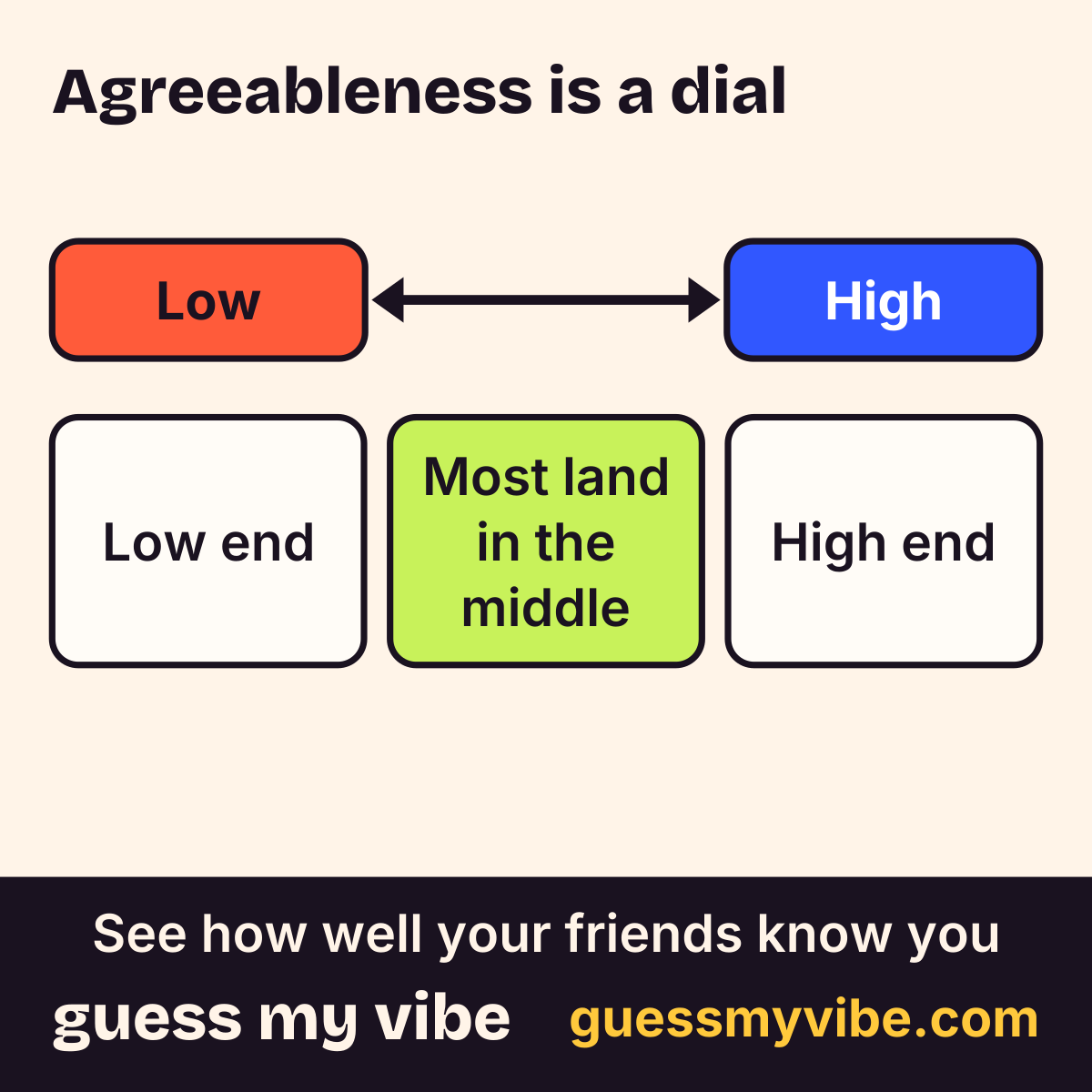
Agreeableness is one of the Big Five personality traits. It describes how cooperative, trusting and good-natured a person tends to be with other people. Low agreeableness is the other end of that scale: people who tend to be more skeptical about others' motives, more willing to argue, more focused on their own goals and less bothered by being disliked. The research name for that end is "disagreeable," which sounds like an insult. It isn't meant as one. It is a description of where someone sits on a dial that everyone sits somewhere on.
Two clarifications up front. First, low agreeableness is not the same as not caring. A person can be blunt and still be loyal, generous and funny. Second, it isn't a category you either are or aren't. Most people land somewhere in the middle, and the same person can behave more or less agreeably depending on who they're with and what's at stake. This article is about the tendency, what studies find it goes with, and why both ends of the dial have good and bad sides. If you want the trait explained from scratch, our agreeableness article covers the basics, and people pleaser looks at the high end.
Cite this figure
Figure: "Agreeableness is a dial." Guess My Vibe (guessmyvibe.com). https://guessmyvibe.com/learn/low-agreeableness#figure-agreeableness-dial
How low-agreeable people handle conflict
The clearest difference shows up when people disagree. In one study, 263 participants rated how good eleven conflict tactics were across five kinds of relationships. Everyone, whether high or low in agreeableness, rated negotiation and walking away as better choices than power assertion, meaning pushing to get your way. But low-agreeable participants rated power assertion as a better choice than high-agreeable participants did [3]. A second study in the same paper matched 124 participants with partners to solve two conflict problems on video, and agreeableness differences were linked to the patterns observers saw [3].
Plain-English reading: a low-agreeable person is more likely to see pressing hard as a reasonable move, and a high-agreeable person is more likely to avoid it. Neither group thought force was the best option. The difference is one of degree, which is a good reminder not to turn a modest average gap into a stereotype. Our conflict styles article goes deeper on what each tactic looks like in practice.
The upsides of low agreeableness: income, directness, negotiating
The best-known finding is about money. Judge, Livingston and Hurst expected that less agreeable people would earn more than more agreeable people, and that the link between agreeableness and income would be more negative for men than for women, because an agreeable man goes against common expectations of men. Across four studies those expectations were supported. The second study controlled for the other four Big Five traits, and a fourth, experimental study gave evidence that the pattern reflects backlash against agreeable men [1]. So there is a documented pay edge, on average, for the low end of the dial, and it's not just a side effect of being outgoing or hardworking.
Keep the caveats in view. The abstract reports no effect sizes, so "earns more" means a tendency across groups, not a guaranteed or large gap for any individual. The evidence is largely correlational. And part of the explanation, according to the authors, is how others react to agreeable and disagreeable people, which means some of the "upside" is the world rewarding bluntness more than it is bluntness being intrinsically better. It's also a result about income, not about being happy, healthy or well-liked.
A second upside is easier to see in daily life: directness. A person who isn't trying to keep everyone comfortable can say the thing nobody else will say, push back on a bad plan, ask for the raise, or hold a line in a negotiation. Research on leaders helps frame why this has value. Ames and Flynn found that people seen as markedly low in assertiveness were generally judged less effective leaders, and tied it to a trade-off in which low assertiveness limits goal achievement [5]. That study is about leaders and assertiveness, not agreeableness itself, so treat it as an analogy. Still, it describes what a more direct style can buy: results.
Curious how your friends would answer?
Free. Answer 10 quick questions about you, then send your link. Friends play in their browser, no app needed.
Start freeThe costs of low agreeableness
The same studies show the other side. In the Ames and Flynn work, high assertiveness also made people seem less effective as leaders, because it worsens relationships [5]. Friendship shows a similar pattern. In a study that tracked 205 students through their first year at university, individuals high in agreeableness tended to be selected as friends more than others [2]. That doesn't mean low-agreeable people don't have friends. It means that, on average, warmth is a trait other people choose toward, so a more skeptical or abrasive style can shrink the pool of people who volunteer to get close early on.
Who you're talking with matters too. In a study of 87 first-time, unstructured conversations between strangers, personality similarity helped conversations between two extraverts or between two introverts but produced uniquely poor ones between two low-agreeable people [6]. These were strangers meeting once, not friends who've built a rhythm over years, so this should not be read as a warning about low-agreeable friends or couples. It does suggest that two people who both default to pushing back can struggle to get a first conversation going.
There is also a wider social finding worth stating carefully. A meta-analysis of 71 studies and 22,068 participants found that social dominance orientation, a preference for some social groups ranking above others, was linked to low agreeableness, and that the effect of agreeableness on prejudice ran largely through it [4]. That is an average, correlational pattern across many studies. It does not mean low-agreeable people are prejudiced, and it says nothing about any individual. It does show that the low end of this trait comes with measurable social costs as well as measurable benefits.
Why both ends of the dial are fine
Put the findings side by side and a pattern appears. The high end of agreeableness is rewarded socially and tends to avoid forceful conflict tactics but may earn less. The low end tends to earn more and press harder in conflict but may be chosen as a friend less often and can clash with a similar partner. Neither end wins on every measure.
That is also why the label "disagreeable" deserves a light touch. It describes a tendency that shows up in some situations and not others, and it comes with strengths that other people rely on, including honest feedback. The people who are most useful in a friend group are often the ones willing to say "that text sounds harsh" or "I don't think they're being straight with you." Our honest feedback from friends article looks at when that kind of directness lands well.
How other people read low agreeableness
One more complication is that agreeableness is a hard trait for other people to read accurately, even close friends, as our agreeableness article explains. That cuts both ways. A friend might think of you as more disagreeable than you see yourself, because a single blunt comment is vivid and memorable. Or you might think of yourself as easygoing while your friends experience you as stubborn. Neither self-view nor outside view is automatically right, and the gap between them is often the interesting part.
This is where a game helps more than a quiz. A quiz gives you only your own answer. Guess My Vibe asks friends to guess how you'd answer questions about Warmth and the other traits, then shows you where their guess matched yours and where it didn't. If your friends rate you as warmer than you rate yourself, or colder, that gap tells you something about how you come across that your own score can't.
Key takeaways
- Low agreeableness is a position on a dial, not a verdict: it means a tendency toward skepticism, directness and competition, not a lack of caring.
- Across four studies, less agreeable people earned more on average, and the link was stronger for men than for women, with backlash against agreeable men offered as one explanation [1].
- Low-agreeable people rated forceful, power-based conflict tactics as better choices than high-agreeable people did, although everyone ranked negotiation and walking away above them [3].
- The costs are real too: in a first-year university study, more agreeable students were selected as friends more often, and a meta-analysis linked low agreeableness to a preference for group hierarchy [2] [4].
- This isn't therapy, a diagnosis, or a substitute for professional care; it's a plain-English summary of personality research on one trait.
Questions people ask
What does low agreeableness mean?
It means being toward the low end of the Big Five trait that measures cooperation, trust and good nature. In plain words, a more skeptical, direct and competitive style. In one study, low-agreeable people rated forceful conflict tactics as better choices than high-agreeable people did, though everyone ranked negotiating higher [3].
Is being disagreeable the same as being mean?
No. Disagreeable is the research term for the low end of a scale, and it describes a tendency to be more skeptical and direct, not a lack of caring. A person can be blunt and still be loyal and generous. The research reports averages across groups, which can't describe any one person.
Do disagreeable people earn more money?
On average, across four studies, less agreeable people earned more, and the link was stronger for men than for women. The abstract reports no effect sizes, the evidence is mostly correlational, and backlash against agreeable men was one proposed explanation [1].
Are low-agreeable people worse friends?
Not on this evidence. More agreeable new students were chosen as friends more often [2], but that describes who gets picked early, not how good a friend someone is. Many people value a direct friend who gives honest feedback.
Can two disagreeable people get along?
Sometimes. In a study of first conversations between strangers, two low-agreeable people had uniquely poor interactions [6], but those were one-off meetings. It says little about friends or partners who know each other well.
See how well your friends know you.
Free. Answer 10 quick questions about you, then send your link. Friends play in their browser, no app needed.
Start freeReferences
- [1] Judge, T. A., Livingston, B. A., & Hurst, C. (2012). Do nice guys--and gals--really finish last? The joint effects of sex and agreeableness on income. Journal of Personality and Social Psychology, 102(2), 390-407. PubMed: 22121889 (opens in a new tab)
- [2] Selfhout, M., Burk, W., Branje, S., Denissen, J., van Aken, M., & Meeus, W. (2010). Emerging late adolescent friendship networks and Big Five personality traits: A social network approach. Journal of Personality, 78(2), 509–538. PubMed: 20433629 (opens in a new tab)
- [3] Graziano, W. G., Jensen-Campbell, L. A., & Hair, E. C. (1996). Perceiving interpersonal conflict and reacting to it: The case for agreeableness. Journal of Personality and Social Psychology, 70(4), 820–835. PubMed: 8636901 (opens in a new tab)
- [4] Sibley, C. G., & Duckitt, J. (2008). Personality and prejudice: a meta-analysis and theoretical review. Personality and Social Psychology Review, 12(3), 248-279. PubMed: 18641385 (opens in a new tab)
- [5] Ames, D. R., & Flynn, F. J. (2007). What breaks a leader: the curvilinear relation between assertiveness and leadership. Journal of Personality and Social Psychology, 92(2), 307-324. PubMed: 17279851 (opens in a new tab)
- [6] Cuperman, R., & Ickes, W. (2009). Big Five predictors of behavior and perceptions in initial dyadic interactions: personality similarity helps extraverts and introverts, but hurts "disagreeables". Journal of Personality and Social Psychology, 97(4), 667-684. PubMed: 19785485 (opens in a new tab)
How we find and check these sources: how we write. Spotted an error? Report a correction.
Related
Cite this article
- Title
- Low Agreeableness: What It Means (and Doesn't)
- Publisher
- Guess My Vibe
- Updated
- URL
- https://guessmyvibe.com/
learn/ low-agreeableness
Copy this citation
Guess My Vibe. (2026, October 4). Low Agreeableness: What It Means (and Doesn't). Guess My Vibe. https://guessmyvibe.com/
To point at one section, add that section's anchor (the # link on its heading) to the URL.