Conflict styles are the different ways people tend to handle disagreement, from giving in to pushing back to trying to work it out together. The popular "five conflict styles" (the Thomas-Kilmann model) is a planning framework, not a tested personality theory. The real research finding is narrower but solid: one Big Five trait, Agreeableness, is consistently linked to which tactics someone reaches for in a real disagreement, with warmer, more agreeable people leaning toward negotiation over power plays.
What "conflict styles" actually means
Search "conflict styles" and nearly every result sorts you into one of five boxes: competing, collaborating, compromising, avoiding, or accommodating. That's the Thomas-Kilmann model, and it's genuinely useful shorthand for a real pattern: people do have a tactic they reach for first when a disagreement starts. But it's worth knowing what kind of claim it actually is before you take an online quiz and get handed one of five labels for life. The honest, research-backed version of conflict style isn't a five-box sorting hat. It's a scale, the same way personality itself is a scale, and the Big Five trait that scale tracks most closely is Agreeableness: how cooperative, trusting and good-natured someone tends to be with other people.
The Thomas-Kilmann model: a useful framework, not a research finding
The five-style model traces back to a 1977 paper that set out to build a better questionnaire for measuring how people handle conflict. The two psychologists behind it, Ralph Kilmann and Kenneth Thomas, noticed that earlier conflict surveys were easy to game: people answered the way they wanted to look, not the way they actually acted, so the questionnaire's five modes, competing, collaborating, compromising, avoiding and accommodating, were put into a forced-choice format specifically to cut down on that habit of answering to look good [1]. That's a real, useful piece of measurement work. What it isn't is a discovery that human conflict behavior sorts neatly into five types the way blood sorts into four groups. Nobody ran a large study and found five natural clusters of people. It's a practical tool for a workshop or a negotiation class, in the same category as the Johari window or a leadership "styles" diagram: worth knowing, not worth mistaking for a personality trait a quiz can nail down for good.
The real finding: Agreeableness is linked to how people handle conflict
Underneath the five-box model sits a narrower, better-tested claim, and it holds up. A study that combined hypothetical conflict scenarios with two full weeks of diary entries about real daily disagreements in adolescents found that, among all five Big Five traits, Agreeableness was the one most closely tied to how people actually respond to conflict, in both their self-reported feelings and their real, recorded behavior [2]. It wasn't just a mood correlation either: use of destructive conflict tactics, the kind that escalate rather than resolve, was linked to worse adjustment as rated independently by the teenagers' own teachers. People who handle conflict more destructively don't just feel worse about it afterward; other people who know them notice something off too.
A companion study gets more specific about what that difference looks like in practice. Across two methods, participants rating conflict tactics in hypothetical relationships, and separate two-person teams of strangers actually working through two real disagreements on video, one pattern held up every time: almost everyone, agreeable or not, rated negotiation and quietly stepping back as better tactics than raw power assertion, things like threats, pulling rank, or simply overpowering the other person [3]. The split showed up in degree, not kind. Less agreeable participants still rated power assertion worse than negotiation, but meaningfully less worse than more agreeable participants did. Nobody studied here thinks a power play is the best option. Less agreeable people are just more willing to reach for it when negotiation stalls.
Curious how your friends would answer?
Free. Answer 10 quick questions about you, then send your link. Friends play in their browser, no app needed.
Start freeWhy agreeableness changes someone's go-to conflict tactic
One real mechanism behind this is empathy. A large research program spanning several studies and hundreds of participants found that Agreeableness is linked to empathic, prosocial feeling, which is in turn linked to actually helping people, including strangers, across a range of situations [4]. That's not a conflict study specifically, but it points at the plumbing underneath the conflict findings above: someone who more easily feels what the other person in a disagreement is feeling has a harder time treating that person as an obstacle to push past. Negotiation keeps the other person's perspective in view. Power assertion, by definition, doesn't need to. The same empathic wiring that makes an agreeable person more likely to help a stranger may also make them less likely to steamroll a friend.
Does being agreeable mean giving in?
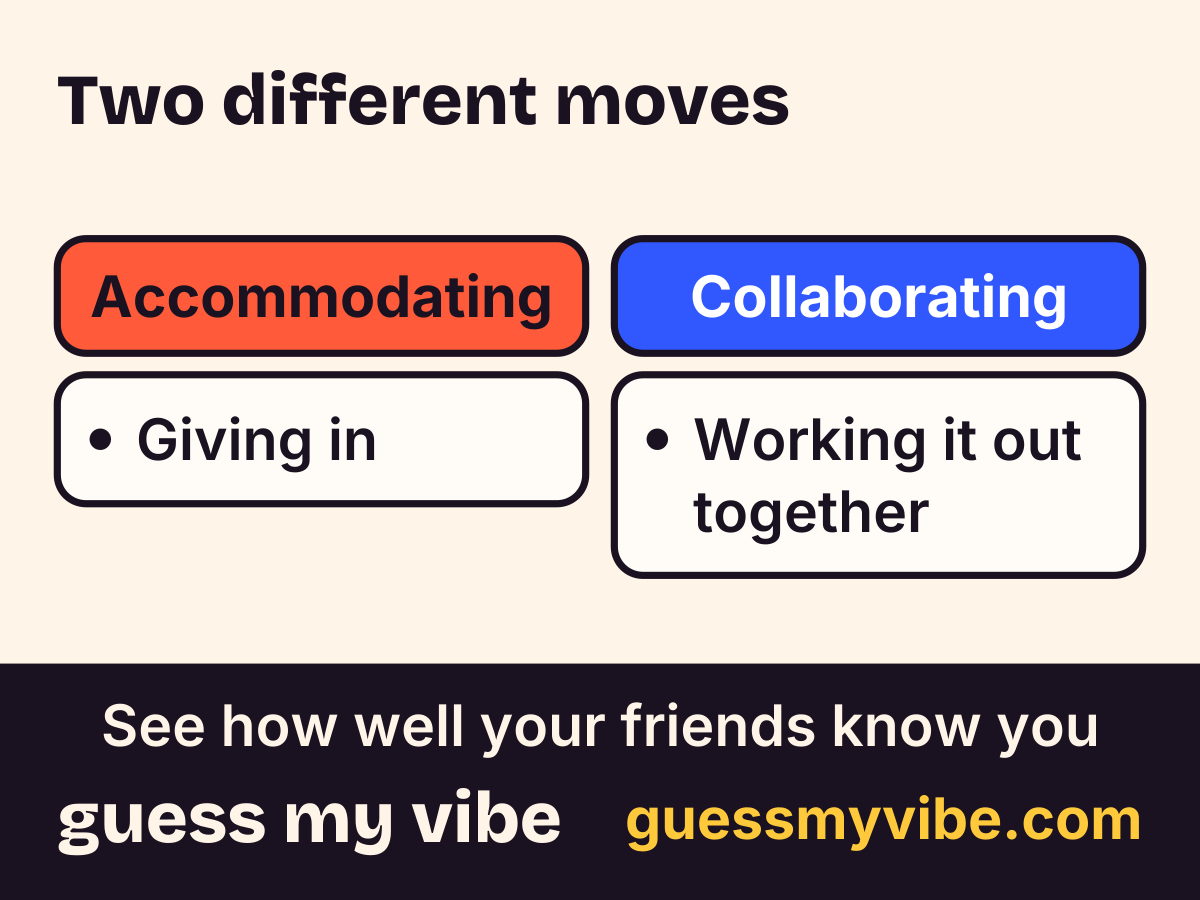
No, and this is where the five-box version of conflict styles actually muddies the research. "Accommodating" (giving in) and "collaborating" (working it out together) are two completely different moves in the Thomas-Kilmann framework, but a casual read of "agreeable people avoid conflict" lumps them together as if being warm just means losing every argument. The actual studies above don't support that. What they show is a preference for negotiation specifically, working toward an outcome both people can live with, over raw power assertion, not a blanket preference for giving up your own position. An agreeable person disagreeing with a friend is more likely to say what they actually want and work toward something that holds up for both of them than to either explode or fold. Warmth changes the tactic, not whether someone has a position worth defending.
Cite this figure
Figure: "Two different moves." Guess My Vibe (guessmyvibe.com). https://guessmyvibe.com/learn/conflict-styles#figure-two-different-moves
Guessing a friend's conflict style instead of assuming it
Most people think they already know how a close friend handles a disagreement, and they're often working from one memorable blowup rather than an actual pattern. Agreeableness (the app calls its version of this trait Warmth) is one of the five traits Guess My Vibe scores from real personality-science questions, the same kind used in the studies above, not an invented quiz. A friend guesses how you'd answer questions about trust, cooperation and how you treat people, then you see how close their guess actually landed next to your own answer. It's a smaller, more honest version of the same question this whole article is about: not "what's your conflict style," a label a five-minute quiz can't really earn, but "does the person who knows you well actually know how warm and cooperative you are," which is a real, measurable thing two people can compare.
What this means for an actual disagreement
None of this research hands anyone a script for the next argument. What it does offer is a more honest starting point than a five-letter label. If a friend tends to go quiet and avoid a fight, that's worth naming directly rather than reading as agreement; the research above says warmth shows up as a preference for negotiation, not for disappearing. If a disagreement keeps tipping toward threats or ultimatums on either side, that's the specific pattern the research flags as the one almost everyone, across the whole Agreeableness scale, already rates as the worse option. The useful move isn't memorizing which of five boxes you're in. It's noticing which tactic you and the people close to you actually reach for when it matters, and whether that's negotiation or something closer to a power play.
Key takeaways
- The famous "five conflict styles" (competing, collaborating, compromising, avoiding, accommodating) come from a 1977 questionnaire built to measure conflict tactics fairly, not from a study proving everyone fits one of five boxes [1].
- The best-supported personality finding is about Agreeableness: in both hypothetical conflicts and two weeks of real daily diary entries, it was the Big Five trait most closely tied to how people actually handle conflict [2].
- Less agreeable people don't just argue more. In one study they specifically rated power assertion (threats, pulling rank) as a better tactic than more agreeable people did, even though almost everyone preferred negotiation overall [3].
- Part of the reason traces to empathy: Agreeableness is linked to feeling what someone else feels, which is itself linked to more helping and prosocial behavior (a plausible, not directly tested, route to handling conflict more constructively) [4].
- This isn't therapy, a diagnosis, or a substitute for professional care; it's a plain-English summary of what personality research says about conflict styles.
Questions people ask
What are the 5 conflict styles?
The Thomas-Kilmann model names five: competing, collaborating, compromising, avoiding and accommodating. It comes from a 1977 questionnaire built to measure conflict tactics fairly, not from a study proving people sort into exactly five natural types [1].
Is the Thomas-Kilmann conflict styles model based on real research?
It's a well-built, widely used questionnaire, not a personality theory tested the way the Big Five has been. Its own 1977 paper is about measuring conflict tactics more fairly than earlier surveys did, not about proving five conflict types exist in nature [1].
Does personality actually affect how someone handles conflict?
Yes, one trait does reliably: Agreeableness. Across hypothetical conflicts and two weeks of real diary entries, it was the Big Five trait most closely tied to how people respond to disagreement [2].
Does being agreeable mean you always give in during an argument?
No. The research shows agreeable people lean toward negotiation over power assertion (threats, pulling rank), not toward giving up their position. In the ratings study, almost everyone rated negotiation as the better tactic; less agreeable people were just more willing to use power assertion anyway [3].
Why does agreeableness change how someone argues?
Partly through empathy. Agreeableness is linked to feeling what someone else feels, and that empathic link is tied to more prosocial, helping behavior across a range of situations (it wasn't a conflict study, so this is a plausible route rather than a tested one) [4].
Can a quiz tell me my real conflict style?
A quiz can tell you where you land on a published questionnaire like the Thomas-Kilmann MODE instrument, which is a real, useful tool. It can't tell you, the way the studies above do, how your actual Agreeableness compares to a friend's real answers about you.
See how well your friends know you.
Free. Answer 10 quick questions about you, then send your link. Friends play in their browser, no app needed.
Start freeReferences
- [1] Kilmann, R. H., & Thomas, K. W. (1977). Developing a forced-choice measure of conflict-handling behavior: The "MODE" instrument. Educational and Psychological Measurement, 37(2), 309–325. doi.org/10.1177/001316447703700204 (opens in a new tab)
- [2] Jensen-Campbell, L. A., & Graziano, W. G. (2001). Agreeableness as a moderator of interpersonal conflict. Journal of Personality, 69(2), 323–361. PubMed: 11339802 (opens in a new tab)
- [3] Graziano, W. G., Jensen-Campbell, L. A., & Hair, E. C. (1996). Perceiving interpersonal conflict and reacting to it: The case for agreeableness. Journal of Personality and Social Psychology, 70(4), 820–835. PubMed: 8636901 (opens in a new tab)
- [4] Graziano, W. G., Habashi, M. M., Sheese, B. E., & Tobin, R. M. (2007). Agreeableness, empathy, and helping: A person × situation perspective. Journal of Personality and Social Psychology, 93(4), 583–599. PubMed: 17892333 (opens in a new tab)
How we find and check these sources: how we write. Spotted an error? Report a correction.
Related
- Honesty in Friendship: Why It Hurts Less Than You Think
- Envy vs Jealousy: The Real Difference, With Friend Examples
- Communication Styles and Personality: The Real Research
- How to Be a Good Friend, According to Research
- Agreeableness: The Trait Closeness Barely Helps Friends Read
- Jealousy in Friendship Is Normal: The Research
- Avoiding Conflict: When It Helps and When It Backfires
- The Silent Treatment: What Research Says It Actually Does
- Forgiveness in Friendship: Why Some People Forgive Faster
More in Conflict, trust, jealousy and forgiveness
- Trauma Dumping on Friends: What Co-Rumination Research Says
- How to Respond to a Friend's Good News (Research-Backed)
- Frenemy: What Mixed Feelings About a Friend Do to You
- Attachment Styles in Friendship: What Research Shows
- How to Tell if Someone Is Trustworthy (Faces Won't Help)
- Forgiveness in Friendship: Why Some People Forgive Faster
- Betrayal by a Friend: Why It Hurts, According to Research
- Jealousy in Relationships: What Research Says
- How to Apologize to a Friend: What Research Says Works
- Honesty in Friendship: Why It Hurts Less Than You Think
- Envy vs Jealousy: The Real Difference, With Friend Examples
- Jealousy in Friendship Is Normal: The Research
- Holding Grudges: The Personality Behind It
- Competitive Friend: The Psychology Behind the Sting
- Why Do I Get Jealous? The Personality Side of Jealousy
- How to Build Trust in a Friendship, According to Research
- Avoiding Conflict: When It Helps and When It Backfires
- The Silent Treatment: What Research Says It Actually Does
Cite this article
- Title
- Conflict Styles: How Personality Shapes How You Fight
- Publisher
- Guess My Vibe
- Updated
- URL
- https://guessmyvibe.com/
learn/ conflict-styles
Copy this citation
Guess My Vibe. (2026, October 3). Conflict Styles: How Personality Shapes How You Fight. Guess My Vibe. https://guessmyvibe.com/
To point at one section, add that section's anchor (the # link on its heading) to the URL.