Forgiveness in friendship seems to depend on the situation more than on the person: in a meta-analysis of 175 studies of one victim forgiving one offender, empathy, an apology, and the offender's intent were among the correlates with notable effects, and situational factors accounted for more variance than victims' dispositions [1]. Personality still plays a part: in a second meta-analysis, empathy was a stronger correlate of forgiveness than any other non-social-cognitive factor except trait Agreeableness [2].
Why do some people forgive a friend quickly while others stay hurt for weeks? The research on forgiveness in friendship and in close relationships more broadly points to a mix of what happened and who you are, with the situation carrying more of the weight. How sorry the other person seems, how much you can see things from their side, and whether the hurt looked deliberate all matter, at least on average. Personality matters too, especially how agreeable you naturally are.
A caution before the studies. Most research on forgiveness uses student samples and asks about hurts in general, so only some of it is specifically about friends. Where a finding comes from a broader group, we say so. And forgiving isn't a duty or a verdict on the friendship: it's something that happens inside a person, on a timeline they don't fully control. If you're curious about the opposite pattern, a friend who seems to hold on, see our article on holding grudges, which focuses on vengefulness and replaying the hurt.
What a large meta-analysis of forgiveness found
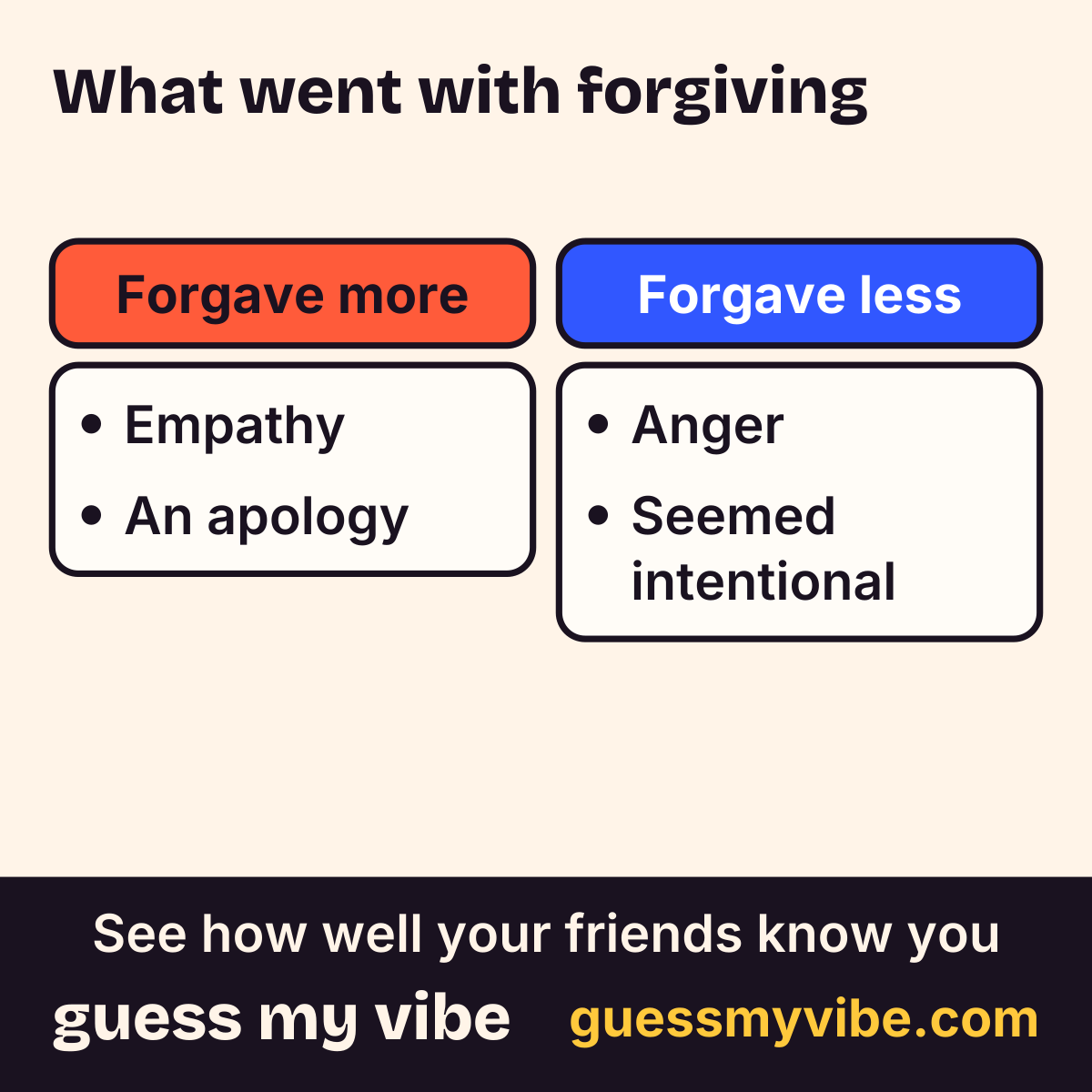
A large meta-analysis by Fehr, Gelfand and Nag pooled 175 studies with 26,006 participants. It looked at forgiveness of a single offender by a single victim, and tested 22 different constructs as correlates. The notable ones were the offender's intent (r = -.49), the victim's state empathy (r = .51), an apology (r = .42), and state anger (r = -.41) [1].
In plain words, those are correlations of roughly .4 to .5 in size. People forgave more when they felt empathy toward the person who hurt them and when they got an apology. They forgave less when they were angry and when the offense seemed intentional. Because these are correlations, the studies can't say which way each arrow runs: forgiving someone may also make you feel more empathy toward them. The review also found that situational factors accounted for more of the differences in forgiveness than the victim's dispositions did, though the differences within each category were considerable [1].
Two findings in that review go against common assumptions. Gender was unrelated to forgiveness (r = .01), and age was barely related (r = .06) [1]. So the idea that one gender is naturally more forgiving doesn't hold up in the pooled data, and neither does a strong claim that people become much more forgiving as they get older.
Cite this figure
Figure: "What went with forgiving." Guess My Vibe (guessmyvibe.com). https://guessmyvibe.com/learn/forgiveness-in-friendship#figure-forgave-more-or-less
Empathy, and the personality trait that stands out
A second meta-analysis, by Riek and Mania, sorted the antecedents of forgiveness by how close they sit to the act of forgiving, from the most distant (personality) through relationship factors and offense-specific factors to the most immediate (social-cognitive factors such as empathy). Every variable they investigated was significantly related to forgiveness. Empathy was a stronger correlate of forgiveness than any other antecedent outside the social-cognitive group, except for trait Agreeableness [2].
Agreeableness is the Big Five trait that describes how warm, cooperative and trusting someone tends to be, and it was the one exception to empathy's lead in the meta-analysis above. Our guide to agreeableness covers the trait itself. The takeaway for friendships is that forgiveness has a trait side: some people may lean toward it more easily, which would be a matter of temperament, not moral effort, though a correlation can't say why. It also suggests that a friend who takes longer to forgive isn't necessarily being difficult. It may be partly how they're wired, combined with the details of what happened. The abstract doesn't give effect sizes for these links, so we describe the pattern without a number.
Curious how your friends would answer?
Free. Answer 10 quick questions about you, then send your link. Friends play in their browser, no app needed.
Start freeForgiving isn't one feeling: revenge, avoidance and goodwill
Researchers who study forgiveness often split the reaction to a hurt into three separate motives: wanting revenge, wanting to avoid the person, and feeling goodwill toward them. McCullough and Hoyt examined how much of each is a stable individual difference, and found that individual differences accounted for 22% to 44% of the variance in all three. Agreeableness consistently went with revenge motivation, while both Neuroticism and Agreeableness went with avoidance and goodwill [3].
This split is useful for friendships because the three motives are measured separately, which fits with how they can come apart in real life: someone might stop wanting payback but still want distance, or feel real goodwill toward a person and still not want to be close. The same study also warns that a single incident is a weak guide to a person's general tendencies: estimating a person's disposition from how they responded to one hurt gives "perilously undependable estimates" [3]. So how a friend reacted to one big argument doesn't tell you how forgiving they are in general, and the same goes for how you reacted.
Forgiving a friend isn't the same as going back to normal
A lot of confusion about forgiveness comes from treating it as the same thing as reconciling. They're different. Forgiveness, as researchers measure it, is about the motives above: less desire for revenge, less urge to avoid, more goodwill. Reconciliation is a decision about the relationship: whether to trust again, spend time together, and treat things as before. Someone can forgive and still decide to keep a distance, and someone can reconcile without having fully forgiven.
The research doesn't say what each friendship should do. But it makes the distinction clear enough to be useful. If you feel pressure to forgive because you think it means you must go back to how things were, separating the two can help: you can work on your own feelings about the hurt without committing to anything about the friendship. And if a friend says they've forgiven you, it doesn't automatically mean the friendship is back to normal, and that may be a reasonable response to what happened.
Replaying the hurt can slow forgiveness down
One more factor deserves a short mention. In three longitudinal studies, within-person increases in rumination about a specific hurt went with reductions in forgiveness of it, a link that appeared to be mediated by anger toward the person who caused the hurt [4]. Separately, a paper on vengefulness (the disposition to seek revenge after an offense) found that vengefulness at the start of an eight-week follow-up was negatively related to change in forgiving over those weeks [5]. That suggests that replaying an argument over and over isn't a harmless way of processing it, and that giving yourself something else to focus on may be part of how forgiveness gets room to happen. This is about the person's own thought pattern, and it isn't a judgment on how serious the hurt was. We cover it in more depth in the article on holding grudges.
What this means for your own friendships
If you want to understand why a friend forgave you quickly, or why you find it hard to forgive, the research suggests a few places to look. Did the hurt feel deliberate? Did you get an apology, and did it feel sincere? Can you see what the other person was dealing with? And is this a friend who tends to take time with everything? None of these is a rule, since these are correlations and every friendship has its own history, but they're more helpful than asking whether you're a forgiving person or not.
Friends also tend to know each other's patterns better than people expect. Guess My Vibe is a free game where a friend guesses how you'd answer questions about yourself, and one fun question to try is how quickly you think you'd forgive. Comparing your answer with your friend's guess is a light-hearted way to learn how they see you, and a way to talk about it before it matters.
Key takeaways
- Across 175 studies and 26,006 participants, forgiveness went with empathy (r = .51), apology (r = .42), less anger (r = -.41) and the offender's intent (r = -.49, so less forgiveness when the offense was more intentional); these are correlations, and situational factors explained more than personality did [1].
- A second meta-analysis found every antecedent it tested was related to forgiveness, and that empathy was a stronger correlate than any other non-social-cognitive factor except trait Agreeableness [2].
- Forgiveness isn't one thing: researchers separate wanting revenge, wanting to avoid the person, and feeling goodwill toward them, and Agreeableness consistently went with revenge motivation [3].
- Gender was not significantly related to forgiveness in the large meta-analysis (r = .01), and age was negligibly related (r = .06) [1].
- This isn't therapy, a diagnosis, or a substitute for professional care.
Questions people ask
Why do some people forgive more easily than others?
Both the situation and the person matter. In a meta-analysis of 175 studies, situational factors such as empathy, apology and the offender's intent explained more of the differences than dispositions did [1], and in a second meta-analysis Agreeableness was the one non-social-cognitive factor that empathy did not outdo as a correlate [2].
Does an apology help someone forgive?
On average, yes. Apology correlated with forgiveness at r = .42 in a large meta-analysis, though a correlation can't prove that an apology causes forgiveness [1].
Are women more forgiving than men?
The pooled data don't show it. In the 175-study meta-analysis, the effect of gender on forgiveness was nonsignificant (r = .01) [1].
Is forgiving a friend the same as staying friends?
No. In this research, forgiveness is about motives such as revenge, avoidance and goodwill [3]. Whether to rebuild trust and stay close is a separate decision about the relationship.
Does thinking about a hurt a lot make it harder to forgive?
It can. In three longitudinal studies, within-person increases in rumination about a hurt went with reductions in forgiveness, a link that appeared to be mediated by anger [4].
See how well your friends know you.
Free. Answer 10 quick questions about you, then send your link. Friends play in their browser, no app needed.
Start freeReferences
- [1] Fehr, R., Gelfand, M. J., & Nag, M. (2010). The road to forgiveness: A meta-analytic synthesis of its situational and dispositional correlates. Psychological Bulletin, 136(5), 894-914. PubMed: 20804242 (opens in a new tab)
- [2] Riek, B. M., & Mania, E. W. (2012). The antecedents and consequences of interpersonal forgiveness: A meta-analytic review. Personal Relationships, 19(2), 304-325. doi.org/10.1111/j.1475-6811.2011.01363.x (opens in a new tab)
- [3] McCullough, M. E., & Hoyt, W. T. (2002). Transgression-related motivational dispositions: Personality substrates of forgiveness and their links to the Big Five. Personality and Social Psychology Bulletin, 28(11), 1556–1573. doi.org/10.1177/014616702237583 (opens in a new tab)
- [4] McCullough, M. E., Bono, G., & Root, L. M. (2007). Rumination, emotion, and forgiveness: Three longitudinal studies. Journal of Personality and Social Psychology, 92(3), 490–505. PubMed: 17352605 (opens in a new tab)
- [5] McCullough, M. E., Bellah, C. G., Kilpatrick, S. D., & Johnson, J. L. (2001). Vengefulness: Relationships with forgiveness, rumination, well-being, and the Big Five. Personality and Social Psychology Bulletin, 27(5), 601–610. doi.org/10.1177/0146167201275008 (opens in a new tab)
How we find and check these sources: how we write. Spotted an error? Report a correction.
Related
- Holding Grudges: The Personality Behind It
- Agreeableness: The Trait Closeness Barely Helps Friends Read
- Conflict Styles: How Personality Shapes How You Fight
- How to Build Trust in a Friendship, According to Research
- Jealousy in Friendship Is Normal: The Research
- Betrayal by a Friend: Why It Hurts, According to Research
- How to Apologize to a Friend: What Research Says Works
Cite this article
- Title
- Forgiveness in Friendship: Why Some People Forgive Faster
- Publisher
- Guess My Vibe
- Updated
- URL
- https://guessmyvibe.com/
learn/ forgiveness-in-friendship
Copy this citation
Guess My Vibe. (2026, October 4). Forgiveness in Friendship: Why Some People Forgive Faster. Guess My Vibe. https://guessmyvibe.com/
To point at one section, add that section's anchor (the # link on its heading) to the URL.