Jealousy in friendship is normal and, in the research, treated as a protective response rather than a flaw. A large study spanning 11 studies and nearly 3,000 people found friendship jealousy is specifically triggered by a third person threatening to replace you, scales with how much the friendship actually means to you, and pushes people toward reinvesting in the friendship rather than just stewing in a bad feeling [1]. It becomes more of a problem when it's frequent, intense, or combined with controlling behavior, not simply because it shows up at all.
Jealousy in friendship is normal, and research treats it as functional
Jealousy gets written about almost entirely as a romantic problem, which leaves a lot of people quietly assuming that feeling jealous over a friend means something is wrong with them specifically. A large research program looking directly at friendship found otherwise. Across 11 studies and nearly 3,000 people, using hypothetical scenarios, real recalled events, and manipulated situations, friendship jealousy turned out to follow a clear, specific pattern rather than being random background anxiety [1]. It wasn't provoked by the general, vague risk that a friendship might someday end. It was provoked specifically by a third person seeming to threaten your particular place in that friendship, which is a much narrower and more pointed trigger than "friendships are fragile" on its own.
What specifically sets it off
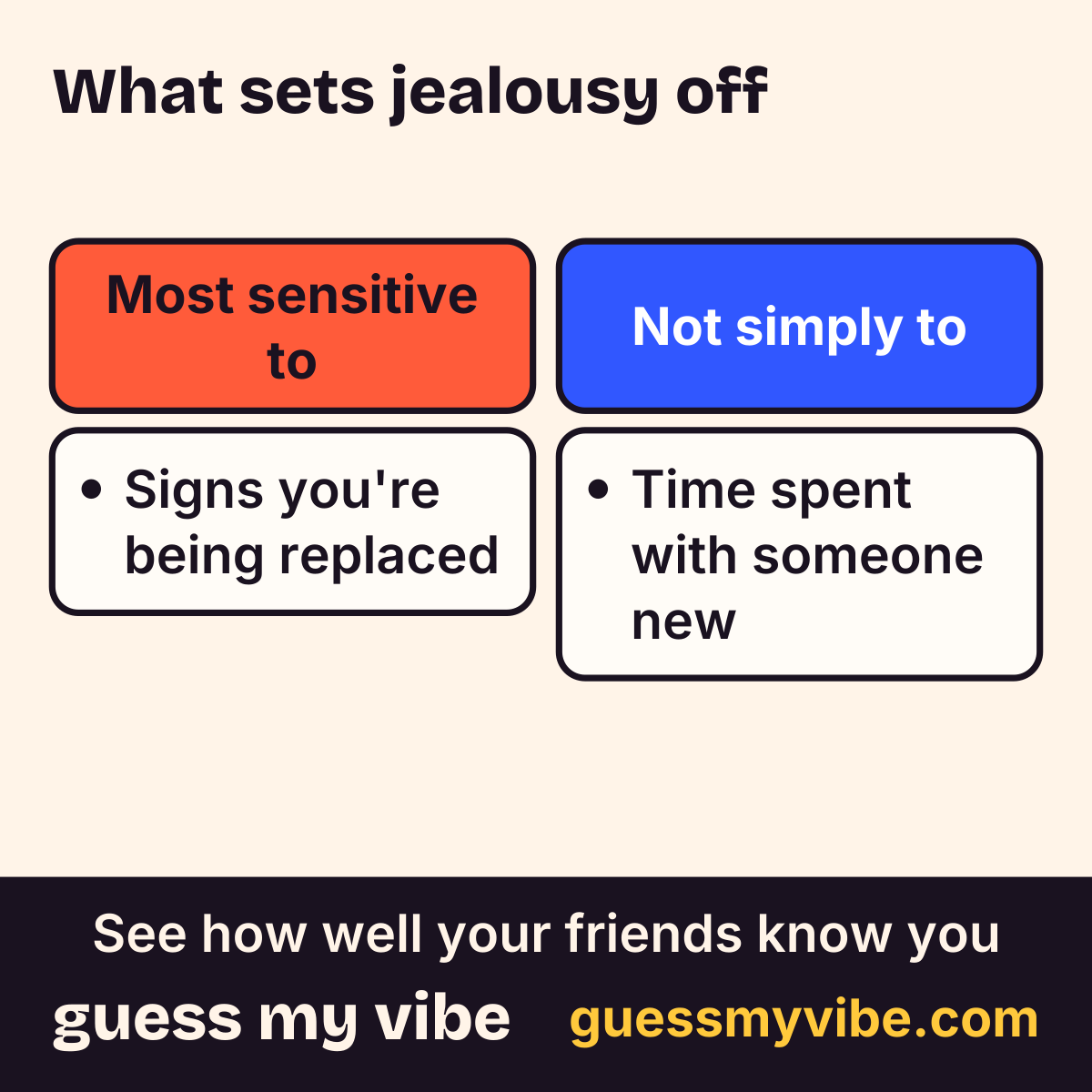
The same research program dug into exactly which cues mattered most, and the answer is more precise than "spending time together." Friendship jealousy was most sensitive to signs that you were being replaced, not simply to how much time your friend and the newcomer were spending together [1]. In other words, it isn't primarily the hours on the calendar that set it off. By that logic, a friend going on a trip with someone new might not spike jealousy the way a comment like "she's basically my best friend now" would, because one is about shared time and the other is a direct signal about your position. The same studies found jealousy scaled with how much the friendship was actually worth to the person feeling it: a more valuable friendship produced a stronger response to a real threat than a less valuable one did, which is the opposite of jealousy being some uncalibrated overreaction. It was tracking something real, proportionally.
Cite this figure
Figure: "What sets jealousy off." Guess My Vibe (guessmyvibe.com). https://guessmyvibe.com/learn/jealousy-in-friendship#figure-what-sets-it-off
What friendship jealousy is actually for
The research frames friendship jealousy as a tool, not just a symptom: it motivated "friend-guarding" behavior, actions aimed specifically at countering the threat and holding on to the friendship [1]. That reframe matters for how the feeling actually gets handled. A feeling with no job to do is something to just push down or wait out. A feeling that's pointing at something real, that a friendship you value is at risk of mattering less to the other person, is information you can act on directly: reach out, name what you're noticing, make more time, rather than treating the discomfort itself as the problem to solve. Why a close friendship is worth protecting this hard in the first place has its own separate evidence behind it: a meta-analysis of 148 studies and over 300,000 people found people with stronger social relationships had 50% higher odds of survival over the study period than people with weaker ones, a health effect comparable to other well-known risk factors [4]. The researchers argue jealousy may be a tool for guarding something that, by that measure, is actually worth guarding.
Curious how your friends would answer?
Free. Answer 10 quick questions about you, then send your link. Friends play in their browser, no app needed.
Start freeWhat this looks like with an actual friend
A friend starts spending every weekend with someone new from work, posting more inside jokes with them than she ever did with you, and you catch yourself checking who liked whose photo a little too often. That specific, uncomfortable feeling isn't really about the new person's time with her; the research above says it's about the signal that you're being quietly repositioned, moved from first-string to an afterthought. The useful next move isn't to compete for her attention or go cold on her, both of which read, accurately, as the surveillance and conflict the developmental research links to worse outcomes. It's closer to what "friend-guarding" actually looks like in the original research: reaching out, naming that you've missed her, making real plans, the direct version of reinvesting in a friendship you don't want to quietly lose.
When jealousy in friendship becomes more than normal
Normal doesn't mean evenly distributed or always harmless at any intensity. Two studies in young adolescents measured friendship jealousy directly and found it wasn't random who felt more of it: girls and adolescents with lower self-worth reported more frequent, more intense friendship jealousy, and a reputation for friendship jealousy was linked to more aggressive behavior and broader difficulties fitting in with peers, while both self- and peer-reported jealousy contributed to loneliness [2]. A follow-up study dug into what made some adolescents more vulnerable than others, and found that holding rigid, unrealistic expectations of what a friendship should provide went with more jealousy and more surveillance-type behavior toward the friend, that a tendency to ruminate over friendship problems also went with more jealousy, and that stronger jealous feelings and behavior were in turn related to more conflict and emotional maladjustment [3]. The useful distinction isn't "jealousy is bad" versus "jealousy is fine." It's that the occasional pang when a friend gets close to someone new is doing the protective job the research above describes, while frequent, intense jealousy combined with rigid expectations or controlling behavior is a different, harder pattern worth taking seriously rather than normalizing away.
One more detail from that adolescent research is worth knowing before assuming you can tell at a glance who's the jealous one in a friend group: self-reported jealousy and what a person's own friends and peers actually perceived in them were only modestly related [2]. People aren't always visibly broadcasting it, and other people aren't always picking up on it accurately either, even when it's genuinely there. That cuts against the instinct to quietly diagnose a friend as "the jealous one" based on a vibe, and argues for the same fix as everywhere else in this research: asking directly tends to beat guessing, in either direction.
What to actually do with it
Given what the research above actually shows, the useful move isn't to suppress the feeling or treat it as proof something's wrong with you for having it. It's to use it as the signal it's built to be: notice specifically what triggered it (usually a replacement cue, not just shared time), check whether the threat is actually real or just a quiet assumption, and if the friendship genuinely matters, put some of that friend-guarding energy into actually reaching out rather than into resentment or surveillance. Most people never get to find out whether a worry like this is accurate, because it stays an unspoken feeling instead of an actual conversation or an actual check-in. Guess My Vibe is built around that same small habit in a lower-stakes form, a friend guessing your real answers to personality questions instead of you both assuming you already know where you stand, which is a useful practice run for the harder version of the same question: ask, instead of just feeling it out alone.
Key takeaways
- Friendship jealousy is triggered specifically by a third party threatening to take your place, not just by the general risk that a friendship could end for any reason [1].
- It scales with the actual value of the friendship: the closer and more important the friend, the more jealousy a real threat provokes, which is the opposite of jealousy being random or irrational [1].
- The research frames it as a tool: friendship jealousy motivates "friend-guarding," actively reinvesting attention and effort in the friendship, not just a painful feeling with nowhere to go [1].
- Jealousy isn't evenly distributed. In adolescents, lower self-worth and rigid, unrealistic expectations of a friendship both went with more frequent and more intense jealousy, and stronger jealousy was linked to more conflict with friends and worse emotional adjustment [2] [3].
- This isn't therapy, a diagnosis, or a substitute for professional care; it's a plain-English summary of what research says about jealousy in friendship.
Questions people ask
Is it normal to feel jealous of your best friend's other friends?
Yes. A large research program (11 studies, nearly 3,000 people) found friendship jealousy follows a clear, specific pattern, triggered by signs you're being replaced, and scales with how much the friendship actually means to you, rather than being random or a personal flaw [1].
What actually triggers friendship jealousy?
Specifically, signs that a friend is putting someone else in your place, more than the sheer amount of time your friend spends with that other person. Research found jealousy was most sensitive to replacement cues, not time-spent cues [1].
Does jealousy mean something is wrong with the friendship?
Not by itself. Research frames friendship jealousy as a protective response that motivates reinvesting in a friendship you value, not a symptom of something broken. It tends to scale proportionally with how much the friendship is actually worth to you [1].
When does friendship jealousy become a problem?
When it's frequent, intense, or tied to rigid expectations and controlling behavior rather than an occasional pang. Research in adolescents linked higher, more persistent jealousy to more conflict, surveillance-type behavior, and worse social adjustment [2] [3].
Why does losing a close friend to someone else feel like such a big deal?
Because close friendships carry real stakes. A meta-analysis of over 300,000 people found people with stronger social relationships had meaningfully better survival odds over time, which is part of why a mechanism for protecting a valued friendship, like jealousy, would exist in the first place [4].
See how well your friends know you.
Free. Answer 10 quick questions about you, then send your link. Friends play in their browser, no app needed.
Start freeReferences
- [1] Krems, J. A., Williams, K. E. G., Aktipis, A., & Kenrick, D. T. (2021). Friendship jealousy: One tool for maintaining friendships in the face of third-party threats?. Journal of Personality and Social Psychology, 120(4), 977–1012. PubMed: 32772531 (opens in a new tab)
- [2] Parker, J. G., Low, C. M., Walker, A. R., & Gamm, B. K. (2005). Friendship jealousy in young adolescents: Individual differences and links to sex, self-esteem, aggression, and social adjustment. Developmental Psychology, 41(1), 235–250. PubMed: 15656752 (opens in a new tab)
- [3] Lavallee, K. L., & Parker, J. G. (2009). The role of inflexible friendship beliefs, rumination, and low self-worth in early adolescents' friendship jealousy and adjustment. Journal of Abnormal Child Psychology, 37(6), 873–885. PubMed: 19337827 (opens in a new tab)
- [4] Holt-Lunstad, J., Smith, T. B., & Layton, J. B. (2010). Social relationships and mortality risk: A meta-analytic review. PLoS Medicine, 7(7), e1000316. PubMed: 20668659 (opens in a new tab)
How we find and check these sources: how we write. Spotted an error? Report a correction.
Related
- Envy vs Jealousy: The Real Difference, With Friend Examples
- Conflict Styles: How Personality Shapes How You Fight
- Honesty in Friendship: Why It Hurts Less Than You Think
- Friendship Psychology: What the Research Actually Says
- Jealousy in Relationships: What Research Says
- Frenemy: What Mixed Feelings About a Friend Do to You
Cite this article
- Title
- Jealousy in Friendship Is Normal: The Research
- Publisher
- Guess My Vibe
- Updated
- URL
- https://guessmyvibe.com/
learn/ jealousy-in-friendship
Copy this citation
Guess My Vibe. (2026, October 3). Jealousy in Friendship Is Normal: The Research. Guess My Vibe. https://guessmyvibe.com/
To point at one section, add that section's anchor (the # link on its heading) to the URL.