A frenemy is a friend you have both positive and negative feelings about, and researchers call that kind of tie an ambivalent relationship. In a lab study of 107 adults, people showed the biggest rise in systolic blood pressure when they talked about a negative event with an ambivalent friend rather than a supportive one [1]. That is a short-term stress signal, not a health verdict.
Want to take it for real? See how a friend really sees you with the best friend test
A frenemy is a friend who is part friend and part something else: someone you enjoy and trust in some ways and feel tense, wary or let down by in others. The word is a popular blend, not a scientific term, so no study measures frenemies by that name. Researchers do study the same thing under a plainer label, ambivalent relationships, meaning ties that carry both positive and negative feelings. That research suggests such friends can take more out of you in the moment than a simply good friend, which is worth knowing, as long as we stay careful about what it does and doesn't show.
Two cautions up front. Nearly all of this research uses short physiological measures such as blood pressure, in small samples, and none of it shows that a particular friend is harming your health. And an ambivalent friend is not the same as a bad friend. Ambivalence just means mixed, and many people have a relationship or two like that.
What a frenemy looks like in research terms
A 2019 theoretical paper lays out the idea. It argues that although the protective influence of social relationships on health is widely documented, not all relationships are positive, and relationships with both positivity and negativity, ambivalence, should be considered separately from relationships that are mostly supportive or mostly aversive. It introduces what the authors call the social ambivalence and disease model as a guide for future work, and points to gaps in the literature [2]. That is a framework, not a test, and it is useful mainly for the point it makes: mixed relationships may behave differently from either clearly good or clearly bad ones.
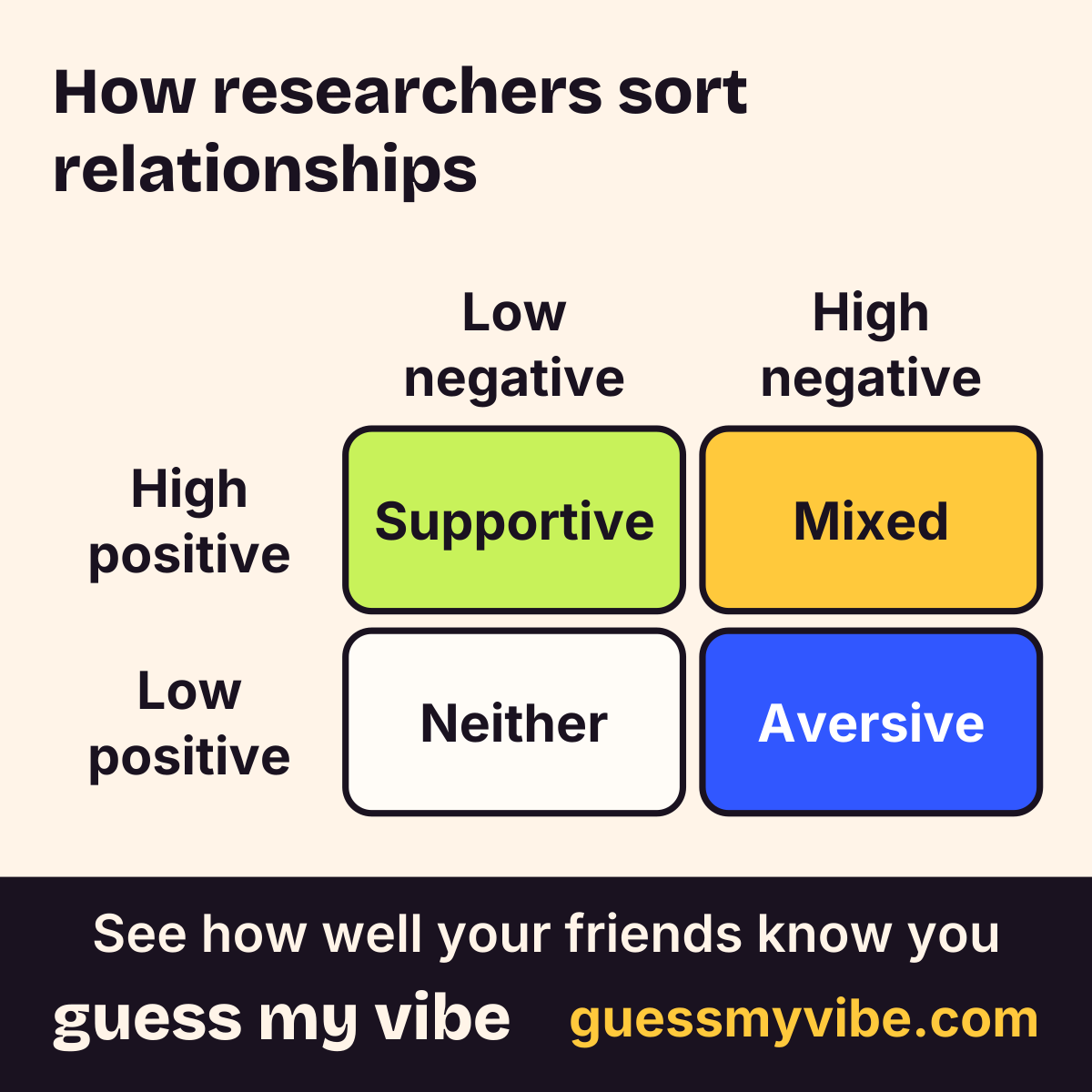
That framing is helpful for another reason. Most people think of friends as either friends or not. The theory treats positive and negative feelings as two separate dials, so one person can score high on both. One study in this line sorted ties into four kinds on those two dials: supportive (mostly positive), aversive (mostly negative), ambivalent (high on both, the mixed kind this article is about) and indifferent (low on both, neither warm nor cold) [4]. Someone you are close to can also be someone who stings, and that combination is exactly what the word frenemy tries to capture.
Cite this figure
Figure: "How researchers sort relationships." Guess My Vibe (guessmyvibe.com). https://guessmyvibe.com/learn/frenemy#figure-types-of-ties
What happens when you talk to an ambivalent friend
In one lab study, 107 healthy adults each brought a same-sex friend, either an ambivalent one or a supportive one, and spoke about positive or negative life events. The biggest systolic blood pressure rise came when participants talked about a negative event with an ambivalent friend rather than a supportive one. People who had brought ambivalent friends also had higher resting heart rates and lower respiratory sinus arrhythmia, a heart-rhythm marker tied to the calming branch of the nervous system. The authors' conclusion is that people may not be able to fully relax around ambivalent friends, and may not benefit from support in times of stress [1].
In plain words, a friend you feel mixed about may be a worse person to take a hard thing to. The support that would normally calm you down seemed to work less well when the friend was ambivalent. These were short measures taken in a lab, though, not long-term health outcomes, and the study can't say whether the body's reaction came from the friend or from the person's own mixed feelings.
Curious how your friends would answer?
Free. Answer 10 quick questions about you, then send your link. Friends play in their browser, no app needed.
Start freeWhat about everyday life?
Another study left the lab. It had 102 healthy adults wear blood pressure monitors for three days, taking a reading five minutes into each social interaction, and had them log who they were with and how they felt about the relationship. Interactions with family members and spouses went with lower ambulatory blood pressure. Interactions with ambivalent network members went with the highest ambulatory systolic blood pressure, an effect that held up independently of the family effect. The psychological variables the researchers measured did not explain the finding [3].
A longer-term marker was looked at in a community sample of 136 adults aged 48 to 77. People with more ambivalent ties in their networks had shorter telomeres, a biological marker linked to general disease risk. The link was independent of how many supportive ties they had, and it was seen primarily in women. Follow-up analyses suggested it came mainly from friendships, parents and social acquaintances [4]. That is an association in one older community sample at a single point in time. It can't show that ambivalent friends shorten anything, and we would not read it that way.
Put together, the pattern is consistent: in small studies using different measures, mixed relationships looked different from supportive ones, and not in a good direction. The pattern is also limited. The samples were small and mostly adults, the measures were physiological markers, and no study followed people to see whether they got sick.
What to do with a frenemy
The research doesn't tell you what to do about a specific friend, and it doesn't say you should cut anyone off. The ideas below are our own reading, offered as options.
- Name it for yourself. Noticing that a friend is both good and hard for you is the first step, and it makes the feeling less confusing. Mixed doesn't mean wrong.
- Pick the right topics. If the lab finding holds, an ambivalent friend may be a poor person to bring a stressful problem to. You can still enjoy them for what they are good at, like fun, shared history or shared interests.
- Spread your support around. Try not to make a mixed relationship your only place to take hard things. Having a few reliably supportive people is the other half of the picture.
- Check what the stress is made of. Sometimes the mixed feeling comes from one specific habit, like teasing, competing or canceling. Naming it kindly to the friend is sometimes enough to change it. Our articles on competitive friends and flaky friends cover two common versions.
- Adjust the dose. You can see a frenemy less often, or in a group, without ending anything. That is a choice about your energy, not a verdict on them.
- Be fair to them, too. Ambivalence runs both ways, and you may be someone else's frenemy in some moods. Everyone mixes good and bad.
What this research can't say
- It can't say that any specific friend is harming you. Averages across small samples don't describe one relationship.
- It can't say whether the stress comes from the friend, from you or from how the two of you interact.
- It doesn't show long-term health effects. The measures are blood pressure, heart rate and a biological marker.
- It hasn't been tested for the younger, online-heavy friendships many people have now.
How Guess My Vibe fits in
Guess My Vibe won't tell you whether a friend is a frenemy. It does give you and a friend a light way to see how each of you sees the other, and a mismatch in how you answer can be a gentle, fun way to start a more honest talk.
Key takeaways
- Frenemy is a popular word, not a research term; the closest studied idea is an ambivalent relationship, one with both positive and negative feelings [2].
- In 107 adults, discussing a negative event with an ambivalent friend produced the greatest systolic blood pressure reactivity, compared with a supportive friend, and the authors say people may not be able to fully relax around ambivalent friends [1].
- In a 3-day study of everyday interactions, ambivalent network members went with the highest ambulatory systolic blood pressure, while family and spouses went with lower readings [3].
- In 136 adults aged 48 to 77, more ambivalent ties went with shorter telomeres, mostly in women and mostly through friendships, parents and acquaintances, but this is a cross-sectional link in an older sample [4].
- This isn't therapy, a diagnosis, or a substitute for professional care.
Questions people ask
What does frenemy mean?
A frenemy is a friend you have both positive and negative feelings about. The word is popular, not scientific; researchers call the same kind of tie an ambivalent relationship, one with both positivity and negativity [2].
Are frenemies bad for you?
The evidence is limited. In a lab study of 107 adults, talking about a negative event with an ambivalent friend produced the greatest systolic blood pressure reactivity [1], and ambivalent ties went with shorter telomeres in a different sample [4]. These are short-term and cross-sectional measures, not proof of long-term harm.
How do I know if a friend is a frenemy?
Research can't give you a checklist, and a label may not help. A common sign is that the same friend leaves you feeling both good and tense, which researchers call ambivalence [2]. Paying attention to how you feel after seeing them tells you more than any label.
Should I cut off a frenemy?
That is your decision, and the research doesn't recommend it. Other options include seeing them less, in groups, or around the things you both enjoy, and not bringing them your hardest problems. The lab finding suggests support from an ambivalent friend may work less well [1].
Can a frenemy become a real friend?
Sometimes, if the specific thing causing the tension can be named and changed, but no study here tested it. A direct, kind conversation about one habit is the most practical first step.
See how well your friends know you.
Free. Answer 10 quick questions about you, then send your link. Friends play in their browser, no app needed.
Start freeReferences
- [1] Holt-Lunstad, J., Uchino, B. N., Smith, T. W., & Hicks, A. (2007). On the importance of relationship quality: The impact of ambivalence in friendships on cardiovascular functioning. Annals of Behavioral Medicine, 33(3), 278-290. PubMed: 17600455 (opens in a new tab)
- [2] Holt-Lunstad, J., & Uchino, B. N. (2019). Social ambivalence and disease (SAD): A theoretical model aimed at understanding the health implications of ambivalent relationships. Perspectives on Psychological Science, 14(6), 941-966. PubMed: 31533019 (opens in a new tab)
- [3] Holt-Lunstad, J., Uchino, B. N., Smith, T. W., Olson-Cerny, C., & Nealey-Moore, J. B. (2003). Social relationships and ambulatory blood pressure: Structural and qualitative predictors of cardiovascular function during everyday social interactions. Health Psychology, 22(4), 388-397. PubMed: 12940395 (opens in a new tab)
- [4] Uchino, B. N., Cawthon, R. M., Smith, T. W., Light, K. C., McKenzie, J., Carlisle, M., Gunn, H., Birmingham, W., & Bowen, K. (2012). Social relationships and health: Is feeling positive, negative, or both (ambivalent) about your social ties related to telomeres?. Health Psychology, 31(6), 789-796. PubMed: 22229928 (opens in a new tab)
How we find and check these sources: how we write. Spotted an error? Report a correction.
Related
Cite this article
- Title
- Frenemy: What Mixed Feelings About a Friend Do to You
- Publisher
- Guess My Vibe
- Updated
- URL
- https://guessmyvibe.com/
learn/ frenemy
Copy this citation
Guess My Vibe. (2026, October 7). Frenemy: What Mixed Feelings About a Friend Do to You. Guess My Vibe. https://guessmyvibe.com/
To point at one section, add that section's anchor (the # link on its heading) to the URL.