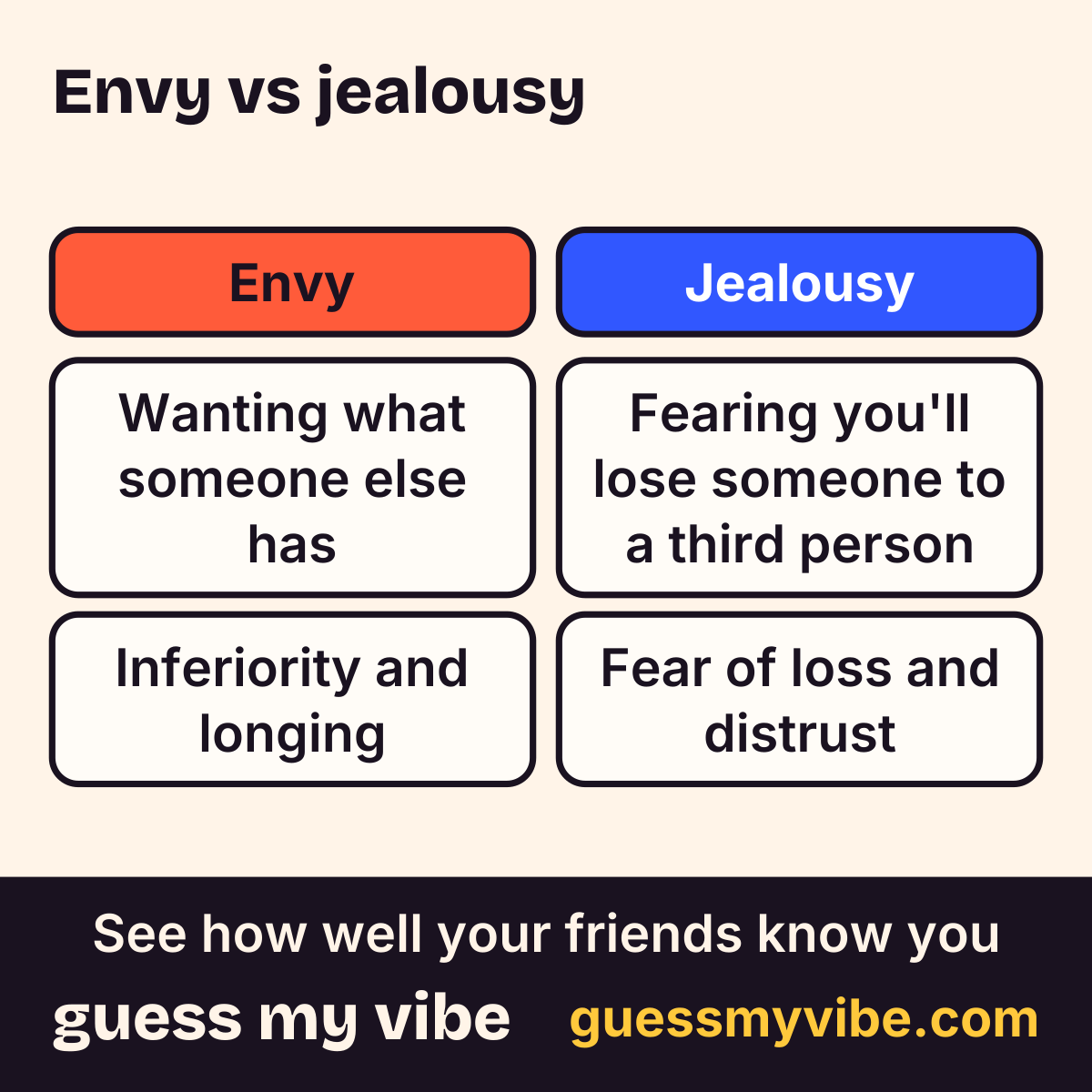
Envy and jealousy are different emotions, not two words for the same feeling. Envy is wanting something someone else has, her new job, her apartment, her confidence. Jealousy is the fear of losing someone to a third person, like watching a friend get closer to someone new and worrying you're being replaced. Research distinguishes the two by their actual emotional ingredients: envy runs on inferiority and longing, jealousy runs on fear of loss and distrust. Envy itself then splits again, into a benign form that pushes you to improve and a malicious form that pushes you to tear the other person down.
Envy vs jealousy: the short version
People use "envy" and "jealousy" as if they're interchangeable, but envy vs jealousy is a real, researched distinction with two different emotional shapes. Envy is about wanting something someone else has: her promotion, his apartment, the easy confidence a friend seems to walk around with. Jealousy is about a third person: the fear that someone you care about is slipping toward someone else, and you're about to be replaced. You can feel envy about a stranger you've never met. Jealousy needs a triangle, you, the person you don't want to lose, and whoever's threatening that.
What the research actually found when it compared the two
Two experiments put this to an actual test instead of relying on how people casually use the words. In one, people recalled a real personal experience of either envy or jealousy; in the other, people read scenarios where the circumstances that trigger each emotion were deliberately varied apart from each other [1]. Both found the same clean split. Envy was characterized by feelings of inferiority, longing, resentment, and often a kind of self-disapproval, not liking that you feel this way about someone else's good fortune. Jealousy was characterized by an entirely different set: fear of loss, distrust, anxiety and anger. These aren't two words for the same bad feeling. They're built from different ingredients, which is part of why they call for different responses: envy is a comment on what you want for yourself, jealousy is a comment on a relationship that feels at risk.
Cite this figure
Figure: "Envy vs jealousy." Guess My Vibe (guessmyvibe.com). https://guessmyvibe.com/learn/envy-vs-jealousy#figure-envy-and-jealousy
Envy itself splits in two: benign vs malicious
Envy isn't even one thing once you look closer. A set of three studies, spanning the Netherlands, the United States and Spain, found envy reliably splits into two distinct experiences [2]. Benign envy comes with a moving-up motivation: seeing a friend's success makes you want to work toward something similar for yourself. Malicious envy comes with a pulling-down motivation instead: the goal shifts from catching up to seeing the other person knocked down a peg. The researchers found this split even in the United States and Spain, where English and Spanish only have one word for envy, using a statistical method that groups people by what they actually describe feeling rather than by which word they picked. The single word hides two very different emotional experiences underneath it.
A follow-up line of research confirms this isn't just a one-off finding. A scale built specifically to separate benign and malicious envy as personality traits, tested across four studies and more than a thousand people, found the two are independent of each other, meaning someone can be high in one without being high in the other, with distinct real-world outcomes [3]. People higher in dispositional benign envy tended toward hope for success, and among marathon runners, that trait was linked to setting higher goals and running faster races. People higher in dispositional malicious envy tended toward fear of failure, and were more likely to give up on a race goal rather than chase it. Benign envy looks like motivation with someone else's success as the spark. Malicious envy looks like motivation draining away.
Curious how your friends would answer?
Free. Answer 10 quick questions about you, then send your link. Friends play in their browser, no app needed.
Start freeFriendship jealousy is its own, researched thing, not just a romantic import
Jealousy gets written about almost entirely as a romantic emotion, but a large research program looking specifically at friendship found it shows up there too, with its own clear pattern. Across 11 studies and nearly 3,000 people, using hypothetical scenarios, real recalled events, and manipulated online situations, friendship jealousy turned out to be specifically triggered by a third party threatening to take a friend's place, not simply by the general risk of a friendship ending [4]. It scaled with how much the friendship was actually worth to the person feeling it, and it was most sensitive to a very particular cue: signs that you're being replaced, even more than to a more obvious cue like how much time your friend and the newcomer were spending together. The researchers frame it as a tool, not just a flaw: friendship jealousy motivated "friend-guarding" behavior aimed at holding onto the friendship, which lines up with an uncomfortable feeling that's doing a specific job rather than just being irrational.
What this looks like with actual friends
A friend gets into the grad program you didn't, and you catch yourself scrolling her acceptance post a little too long, feeling small and a little resentful. That's envy, and the benign-vs-malicious research above says the next move matters: using it as a nudge to go work on your own application next cycle is benign envy; wanting her spot to fall through is malicious envy, and only one of those is linked to anything good happening next. A different friend starts spending every weekend with a new workmate, and you notice yourself checking who's texting her, not because you want the new workmate's life, but because you're worried about your own place in your friend's life. That's jealousy, running on fear of loss rather than longing, and the friendship-jealousy research above says that discomfort is doing a real job: it's what pushes people to actually show up and reinvest in a friendship that's started to feel like it's drifting toward someone else.
Naming the actual feeling, instead of guessing at a friend's
Most people never get to find out whether what's bothering a friend is really envy or really jealousy, because both get flattened into a vague "something's off" and nobody asks. The two call for different responses: envy usually wants acknowledgment and, ideally, a direction to point the energy; jealousy usually wants reassurance about where you actually stand. Guess My Vibe is built around a smaller version of the same honesty gap, a friend guessing your real answers to personality questions instead of assuming they already know how you'd answer, which is the same habit worth borrowing here: ask which one it actually is, instead of guessing.
Key takeaways
- Envy and jealousy are qualitatively different emotions. Envy involves feeling inferior, longing and disapproving of your own reaction; jealousy involves fear of loss, distrust and anger [1].
- Envy isn't one feeling. Benign envy motivates you to move yourself up to match someone else; malicious envy motivates you to pull them down instead, and both show up even in languages with only one word for envy [2].
- These two sides of envy are measurably different traits, not just two moods: a scale measuring them in over a thousand people found benign envy linked to hope for success, and malicious envy linked to fear of failure [3].
- Friendship jealousy is its own, well-documented thing, specifically triggered by a friend getting close to someone new, not simply by the fear of losing the friendship on its own [4].
- This isn't therapy, a diagnosis, or a substitute for professional care; it's a plain-English summary of what emotion research says about envy and jealousy.
Questions people ask
What is the actual difference between envy and jealousy?
Envy is wanting something someone else has; jealousy is fearing you'll lose someone to a third person. Research comparing the two found they're built from different feelings: envy involves inferiority and longing, jealousy involves fear of loss and distrust [1].
Is envy always a bad thing?
Not in its benign form. Research distinguishes benign envy, which motivates you to improve your own position, from malicious envy, which motivates pulling the other person down; only the benign version is linked to positive outcomes like setting higher goals (in marathon runners) [3] [2].
Can you be a jealous person and an envious person differently?
Yes. A scale measuring dispositional benign and malicious envy across more than a thousand people found the two are independent traits, so someone can run high on one without running high on the other [3].
Is it normal to feel jealous of a friend's other friends?
It's common and specifically studied: research on friendship jealousy found it's triggered by a friend seeming to drift toward someone new, scales with how much the friendship means to you, and motivates behavior aimed at guarding the friendship rather than being purely irrational [4].
Is jealousy only a romantic emotion?
No. A large study (11 studies, nearly 3,000 people) found a distinct pattern of friendship jealousy, triggered by a third party threatening to replace a friend [4].
See how well your friends know you.
Free. Answer 10 quick questions about you, then send your link. Friends play in their browser, no app needed.
Start freeReferences
- [1] Parrott, W. G., & Smith, R. H. (1993). Distinguishing the experiences of envy and jealousy. Journal of Personality and Social Psychology, 64(6), 906–920. PubMed: 8326472 (opens in a new tab)
- [2] van de Ven, N., Zeelenberg, M., & Pieters, R. (2009). Leveling up and down: The experiences of benign and malicious envy. Emotion, 9(3), 419–429. PubMed: 19485619 (opens in a new tab)
- [3] Lange, J., & Crusius, J. (2015). Dispositional envy revisited: Unraveling the motivational dynamics of benign and malicious envy. Personality and Social Psychology Bulletin, 41(2), 284–294. PubMed: 25534243 (opens in a new tab)
- [4] Krems, J. A., Williams, K. E. G., Aktipis, A., & Kenrick, D. T. (2021). Friendship jealousy: One tool for maintaining friendships in the face of third-party threats?. Journal of Personality and Social Psychology, 120(4), 977–1012. PubMed: 32772531 (opens in a new tab)
How we find and check these sources: how we write. Spotted an error? Report a correction.
Related
- Conflict Styles: How Personality Shapes How You Fight
- Honesty in Friendship: Why It Hurts Less Than You Think
- Friendship Compatibility: What Actually Makes It Work
- Jealousy in Friendship Is Normal: The Research
- Social Comparison: Why We Measure Ourselves Against Others
- How to Respond to a Friend's Good News (Research-Backed)
Cite this article
- Title
- Envy vs Jealousy: The Real Difference, With Friend Examples
- Publisher
- Guess My Vibe
- Updated
- URL
- https://guessmyvibe.com/
learn/ envy-vs-jealousy
Copy this citation
Guess My Vibe. (2026, October 3). Envy vs Jealousy: The Real Difference, With Friend Examples. Guess My Vibe. https://guessmyvibe.com/
To point at one section, add that section's anchor (the # link on its heading) to the URL.